

Northern Lights in Canada: Live Radar and Forecast
Canada sits higher under the auroral oval than Scandinavia does — Yellowknife is magnetically further north than Tromsø, even though it is seven degrees closer to the equator. This page gives you the live radar, the Kp threshold for each region, the season as the provinces themselves define it, and an honest comparison with Europe.
Northern lights in Canada: what matters
In short: Yellowknife and Churchill are the two most reliable bases — both sit under the auroral oval, so quiet geomagnetic activity is enough. The Yukon needs moderate activity, and southern Alberta and Saskatchewan need a real storm.
Magnetic latitudes below were computed with the AACGM-v2 model for epoch 2026, not copied from decade-old tables.
| Item | What to know |
|---|---|
| Most reliable bases | Yellowknife (Northwest Territories) and Churchill (Manitoba), both around 67–69° magnetic latitude |
| Season | Two official windows in the NWT: mid-August to the end of September, and mid-November to early April |
| Time of night | Usually within an hour or two of midnight; roughly 20:00–03:00 local (NOAA SWPC, Travel Yukon) |
| How many nights | Destination Canada suggests four to five nights in Yellowknife as a weather buffer |
| Weather advantage | Yellowknife is dry continental: roughly 290 mm of precipitation and about 2255 hours of sunshine a year |
| Getting to Churchill | No road. Either fly from Winnipeg, about 2 h 30 min, or take the VIA Rail train, roughly 45 hours scheduled |
- Northern lights in Canada: what matters
- Tonight in Yellowknife: live conditions
- Latest alerts: solar activity and geomagnetic storms
- Where the aurora is most reliable in Canada
- Magnetic latitude, not geographic
- What Kp you actually need
- Season, month by month
- How many nights to book
- Churchill: aurora and polar bears
- Canada or Scandinavia
- Do you see the aurora in Banff and Jasper
- Common mistakes
- Frequently asked questions
- Read also



Hi, I’m Krystian “dziadzia przewodnik” from OndaTravel.pl!
The North is my greatest passion, but the world is far too beautiful to stay in just one climate. On my blog, I combine the raw landscapes of Iceland and Norway with the exotic energy of Thailand or Vietnam, showing you how to travel authentically — with passion and a camera in hand.
What will you find on OndaTravel.pl?
Visual storytelling: As a photographer and filmmaker, I don’t just describe places — I take you there with professional photos and video.
North expert: Ready-to-use road trip plans for Iceland and Norway, smart tips for budget travel, and my original Northern Lights Radar (locations and forecast).
Travel through the lens of cinema: I track down filming locations — from icy scenes in Interstellar to tropical frames from world cinema.
New direction: Exotic destinations: I love contrast, so the blog is featuring more and more practical knowledge about Vietnam and Thailand. I’ll show you how to find your way around Southeast Asia and come back with your best memories.
P.S. follow me here


Tonight in Yellowknife: live conditions
The module below shows current geomagnetic activity and conditions for Yellowknife, the base most Canadian aurora trips are built around. If you are heading for the Yukon or Manitoba, read it as a measure of solar activity and check cloud cover separately for your own spot — in Canada the sky, not the Kp index, is usually what decides the night.
Northern Lights – live radar and parameters
Parameters refresh automatically. The local aurora chance is calculated for your location (GPS or city).
Aurora oval radar – Northern Hemisphere
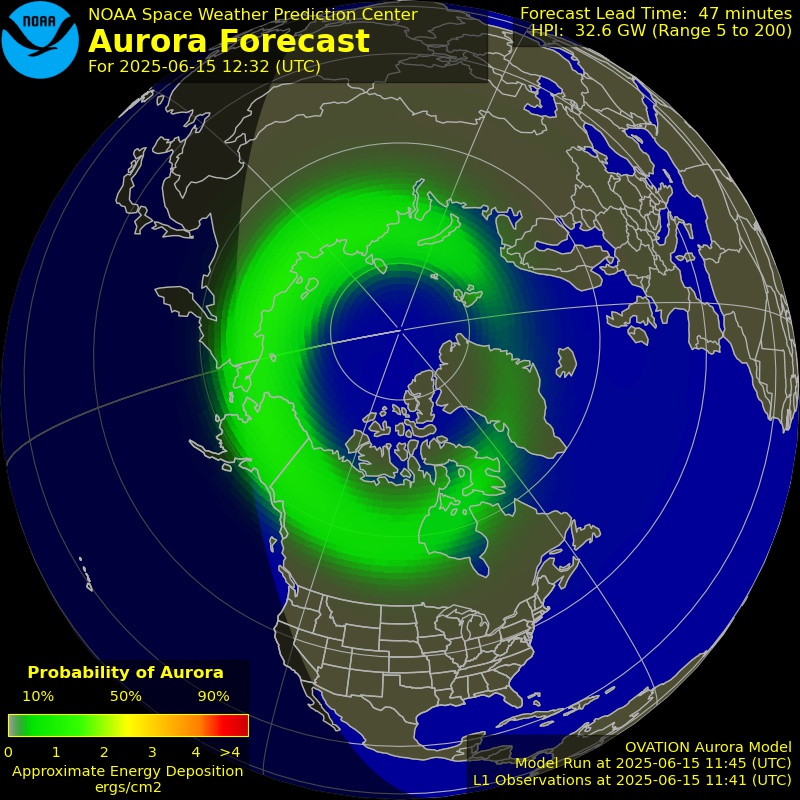
If the animation does not load, a static image will be shown.
Conditions assessment
The indicators consider your location, the local aurora chance and whether it is dark.
Kp (3h)
Kp (1 min)
Bz (GSM)
Bt (IMF)
Speed
Density
Temperature
Latest alerts: solar activity and geomagnetic storms
The monitor below updates automatically from NOAA data: it shows the outlook for the next seven nights and the current aurora alerts. Check it right before you head out — conditions can change within hours.
Sky phenomena
Planning your night-sky observations? These monthly guides highlight the most important astronomical events, meteor showers, Moon phases and the best observation windows. Below you’ll find the two most relevant monthly guides for the current period.

SKY PHENOMENA
Monthly guide
Sky events in September 2026: meteors, equinox and the Moon
The key sky events of the month, meteor activity, the Moon and practical observation windows.
Read the guide
SKY PHENOMENA
Monthly guide
Sky events in October 2026: Draconids, Orionids and Saturn
The key sky events of the month, meteor activity, the Moon and practical observation windows.
Read the guideNorthern Lights
Looking for a longer-term Northern Lights outlook? These monthly guides complement the live radar with seasonal conditions, expected aurora activity and practical viewing tips. Below you’ll find the two most relevant monthly forecasts currently available.
NORTHERN LIGHTS
Monthly forecast
Northern Lights — September 2026
A monthly Northern Lights outlook with live-radar context and practical viewing guidance.
Read the guide
NORTHERN LIGHTS
Monthly forecast
Northern Lights — October 2026
A monthly Northern Lights outlook with live-radar context and practical viewing guidance.
Read the guideWhere the aurora is most reliable in Canada
| Region | Position | Best for | Note |
|---|---|---|---|
| Yellowknife, Northwest Territories | 62.45°N geographic / about 68.5° magnetic | A first trip, maximum predictability | Dry continental climate: about 290 mm of precipitation and 2255 hours of sunshine a year; January averages −24.6 °C |
| Churchill, Manitoba | 58.77°N geographic / about 67.1° magnetic | Aurora combined with subarctic wildlife | No road access; damper than Yellowknife because of Hudson Bay |
| Whitehorse and the Yukon | 60.72°N geographic / about 63.3° magnetic | Trips combined with Alaska and the mountains | Sits south of the quiet oval and needs moderate activity to come under it |
| Alberta and Saskatchewan | about 53°N geographic / 58–60° magnetic | An add-on to a Rockies trip | Tourism Saskatchewan says overhead aurora in the south of the province needs Kp 5 or higher |
| Northern Labrador | about 58–60°N geographic | Expeditions, not short breaks | Newfoundland and Labrador tourism recommends the region, but the logistics are expedition-grade |
Two numbers circulate widely and both deserve context. The Northwest Territories tourism board advertises “up to 240 nights” of active aurora across the territory, and the Churchill Northern Studies Centre reports auroral activity on over 300 nights a year. Both count nights with geomagnetic activity, not nights when the aurora is actually visible — cloud cover and bright summer skies are not subtracted. They also come from two different organisations using different methods, so lining them up as a ranking would be dishonest.
Seven provinces get their own dedicated forecast pages here: Manitoba (Winnipeg) and Saskatchewan (Saskatoon), both south of the classic aurora belt but each with a real, calculable Kp threshold rather than a marketing promise; Quebec (Montreal), British Columbia (Vancouver) and New Brunswick (Fredericton), which all need a notably stronger Kp5-6 storm; Nova Scotia (Halifax), which needs the highest threshold of the seven (Kp6+) because Earth’s offset magnetic pole actually lowers Atlantic Canada’s geomagnetic latitude below the Pacific coast’s; and Newfoundland and Labrador (St. John’s), which has a comparatively easy Kp5 threshold but is officially Canada’s foggiest major city.
Magnetic latitude, not geographic
The auroral oval is centred on the magnetic pole, not the geographic one. That is why a wall map misleads you: Canadian towns that look “low” on it can sit magnetically higher than Arctic Norway. The values below were computed with the AACGM-v2 model for epoch 2026 — worth noting, because the numbers repeated on most travel blogs are a decade old and the poles keep drifting.
| Place | Geographic latitude | Magnetic latitude (AACGM-v2, 2026) |
|---|---|---|
| Yellowknife | 62.45°N | 68.5° |
| Tromsø, Norway | 69.65°N | 67.2° |
| Churchill | 58.77°N | 67.1° |
| Abisko, Sweden | 68.36°N | 65.9° |
| Whitehorse | 60.72°N | 63.3° |
| Jasper, Alberta | 52.87°N | 58.7° |
So Yellowknife really does sit magnetically higher than Tromsø, and Churchill is almost level with it. The advantage of Abisko was never its position in the oval — it is the rain shadow and the clear nights that come with it. Two different arguments, often confused.
What Kp you actually need
NOAA SWPC gives a simple rule of thumb: at Kp 0 the equatorward edge of the oval sits at roughly 66° magnetic latitude and moves about 2° south for every step of Kp, reaching about 48° at Kp 9. Combine that with the table above and you can work out the threshold for your own spot. This is a calculation from the published rule, not a quote from a NOAA table of cities — no such table exists.
- Yellowknife and Churchill — already above the edge at Kp 0–2, so they need no storm at all. During a strong storm the oval slides south and the display can move from overhead to the southern sky.
- Whitehorse and the Yukon — the edge reaches them at about Kp 1.5–2, so Kp 2 and up is the realistic threshold for a good show.
- Edmonton, Calgary, southern Alberta and Saskatchewan — the edge arrives around Kp 3, but low on the northern horizon. Tourism Saskatchewan states Kp 5 and above for overhead aurora in the south of the province.
Kp is a global index averaged over three hours, and the Geophysical Institute in Fairbanks warns that local conditions can differ substantially from it. That is why the local Yellowknife forecast run by Astronomy North avoids Kp altogether and uses a calm–moderate–active scale, with separate probabilities for the evening and the small hours. For storm watching, see our aurora alerts.
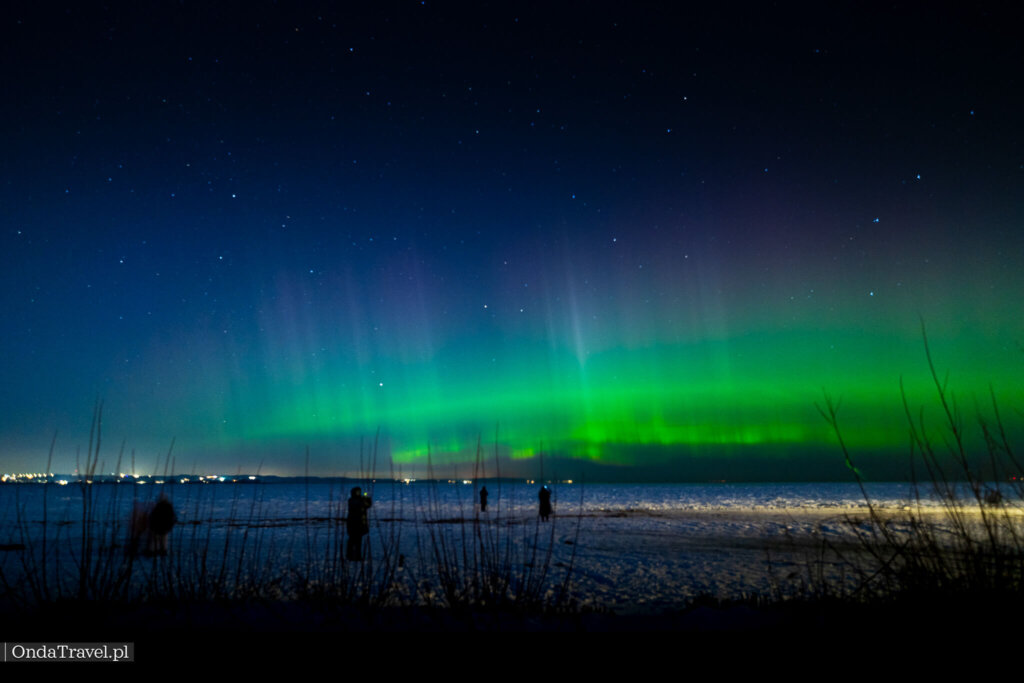
GUIDE
Aurora Alerts
Aurora forecast Poland: alerts, radar, Kp, Bz, solar wind and northern lights chances. Check when to go out, where to look and how to read conditions.
Season, month by month
The Northwest Territories run the season as two separate windows: mid-August to the end of September, and mid-November to early April. The gap between them is not a weaker part of the season — it is outside the season, and local operators generally do not run aurora programmes then. The Yukon counts a wider window, mid-August to mid-April, and Manitoba runs August to April with a peak in January, February and March.
| Period | What to expect |
|---|---|
| Mid-August to late September | Autumn window: mild temperatures, shorter nights, reflections on lakes that have not frozen yet |
| October to mid-November | Outside the NWT season; in Churchill this is peak polar bear time instead |
| Mid-November to January | Longest nights and hardest cold; Yellowknife averages −24.6 °C in January and can hit −40 °C |
| February and March | The best compromise: long dark nights, steadier weather, raised activity around the equinox |
| April | The tail of the season — nights shorten quickly |
| May to July | The aurora is there, but the sky is too bright to see it |
Two things hold all year. Aurora is statistically stronger around the equinoxes, a pattern NOAA confirms, even though there are fewer dark hours then than at midwinter. And the best display usually falls within an hour or two of midnight, with the window widening during strong storms.
How many nights to book
Destination Canada recommends four to five nights in Yellowknife — not because the aurora is rare, but as a weather buffer. The Northwest Territories tourism board goes further and advertises a 98% chance across three consecutive nights in peak season; that is a regional tourism claim with no published methodology, so treat it as marketing rather than measurement.
The logic is simple. Under the oval, geomagnetic activity is close to nightly, so you are buying nights against cloud, not against a quiet sun. Two nights is a bet, three gives you room for one bad evening, four or five turns the trip into a plan. In Alberta or southern Saskatchewan you also need to catch a storm — there, extra nights do not substitute for a high Kp.
Churchill: aurora and polar bears
Churchill is sold as the place where you can have both. You can — but not in the same week, and it is worth knowing that before you book.
- Polar bears — Travel Manitoba lists July to November, peaking in October and November as the bears move back to the edge of the bay.
- Aurora — the Churchill Northern Studies Centre points to August and September plus late January through April; Travel Manitoba narrows the peak to February and March.
- Beluga whales — July and August.
The bear peak therefore falls outside both aurora windows. The only genuine overlap is late September into early October, where the tail of the autumn aurora window meets the start of the bear season. A November trip sold as “bears plus northern lights” is a bear trip with an aurora lottery attached.
Canada or Scandinavia
| Criterion | Canada (Yellowknife, Churchill) | Scandinavia (Tromsø, Abisko, Lapland) |
|---|---|---|
| Position in the oval | Higher: 67–69° magnetic | Lower: 66–67° magnetic |
| Weather | Dry continental interior, fewer fronts | Norwegian coast changeable; Abisko has a rain shadow |
| Cold | Yellowknife averages −24.6 °C in January, −40 °C happens | Usually milder on the Norwegian coast |
| Getting there from Europe | Long haul plus a domestic connection | One connection, arrive the same day |
| What else you get | Subarctic wilderness, Dene and Inuit culture | Fjords, whales, Lapland, glass igloos |
Canada buys you a better position in the oval and a drier sky; you pay in travel time and cold. If you are flying from Europe with only three or four nights, our aurora hub comparing European locations will be more useful. If you have already done Europe and want the aurora overhead rather than on the horizon, Canada earns the trip.
GUIDE
Northern Lights Radar: Live Aurora Forecast by Location
Live aurora radar with Kp thresholds by location, cloud cover and a quick guide to choosing where to watch tonight across the Arctic.
Do you see the aurora in Banff and Jasper
Travel lists routinely put Jasper next to Yellowknife. That is misleading. Jasper National Park covers over 11,000 square kilometres and is the second largest dark-sky preserve in the world, designated in March 2011 — but Parks Canada is careful about the aurora, saying only that on clear, cold nights you might even see it shimmering across the horizon.
The physics explains the caution. Jasper sits at roughly 58.7° magnetic latitude, about seven degrees south of the quiet oval, so the aurora appears low in the north and only during a clear storm. Jasper is an excellent dark-sky destination with its own October festival — but a trip planned purely around the aurora should aim at the Northwest Territories, the Yukon or Manitoba.
Common mistakes
- Confusing geographic and magnetic latitude. Further north is not automatically better — Iqaluit sits inside the oval, often past the band of maximum activity.
- Reading 240 or 300 nights as a guarantee. Those are nights with geomagnetic activity, not nights with a visible aurora.
- Booking two nights. Under the oval the risk is weather, and weather needs a margin.
- Planning aurora in Banff or Jasper. Dark-sky preserves, not aurora destinations.
- Going to Yellowknife in October. Formally outside the season.
- Fearing the full moon. NOAA is explicit: moonlight reduces contrast, not the aurora. A faint quiet arc will wash out; a strong display will not.
- Watching Kp only. In Canada cloud cover decides more nights than geomagnetic activity does.
Frequently asked questions
When is the best time to see the northern lights in Canada?
February and March are the best compromise: long dark nights, steadier weather and raised activity around the equinox. The Northwest Territories run two official windows, mid-August to the end of September and mid-November to early April.
Where is the aurora most reliable in Canada?
Yellowknife and Churchill. Both sit under the auroral oval at roughly 67-69 degrees magnetic latitude, so quiet geomagnetic activity is enough. Yellowknife also has a dry continental climate and fewer cloudy nights.
What Kp do you need in Yellowknife?
Effectively none. Yellowknife is already above the equatorward edge of the oval at Kp 0. During a very strong storm the oval moves south and the display can shift from overhead to the southern sky. Whitehorse needs about Kp 2, and southern Alberta and Saskatchewan need Kp 5 or higher for overhead aurora.
How many nights should you book?
Destination Canada recommends four to five nights in Yellowknife as a weather buffer. Three nights leaves room for one clouded-out evening, two is a bet. Under the oval the risk is cloud cover, not a quiet sun.
How do you get to Churchill?
There is no road to Churchill. You either fly from Winnipeg, about two and a half hours, or take the VIA Rail train from Winnipeg, roughly 45 hours scheduled and often delayed.
Can you see polar bears and the aurora on the same trip?
Only partly. The polar bear peak is October and November, while the best aurora windows are August to September and late January through April. The one genuine overlap is late September into early October.
Is the aurora visible in Banff and Jasper?
Occasionally, and low on the northern horizon. Jasper sits at about 58.7 degrees magnetic latitude, seven degrees south of the quiet oval, so it needs a clear geomagnetic storm. It is a dark-sky preserve rather than an aurora destination.
Does the full moon ruin aurora viewing?
No. NOAA states that moonlight reduces the contrast, not the aurora itself. A faint quiet arc can wash out in bright moonlight, but a strong display stays clearly visible.
Read also
UNDER THE OVAL
The classic Northwest Territories base, magnetically the highest of them all.
Yellowknife Northern Lights Live – Radar and Forecast
Live radar for Yellowknife and what a typical night there looks like.
Read more
AURORA AND WILDLIFE
Manitoba, level with Tromsø magnetically, reachable only by air or rail.
Churchill Northern Lights Live – Radar and Forecast
Live radar for Churchill and how its seasons line up with the bears.
Read more
ACROSS THE BORDER
Interior Alaska: the same oval, a different country and a drier sky.
Fairbanks Northern Lights Live – Radar and Forecast
Live radar for Fairbanks and how it compares with the Canadian north.
Read more
HIGH ARCTIC
Greenland: long dark winters and very little light pollution.
Greenland Northern Lights Live – Radar and Forecast
Live radar and forecast for Greenland, with realistic odds by month.
Read more
LIVE ALERTS
Kp index, solar wind and storm warnings, updated continuously.
Aurora Alerts
Check current activity before you head out tonight.
Read more
GUIDE
Churchill Northern Lights Live – Radar and Forecast
Live aurora radar for Churchill, Manitoba, plus when the northern lights and polar bear seasons actually overlap, where to watch safely, and how many nights to plan.
GUIDE
Yellowknife Northern Lights Live – Radar and Forecast
Live aurora radar for Yellowknife plus the Kp you need, four dark-sky spots including one walkable from downtown, and how many nights to plan.
Hi, I’m Krystian “dziadzia przewodnik” from OndaTravel.pl!
The North is my greatest passion, but the world is far too beautiful to stay in just one climate. On my blog, I combine the raw landscapes of Iceland and Norway with the exotic energy of Thailand or Vietnam, showing you how to travel authentically — with passion and a camera in hand.
What will you find on OndaTravel.pl?
Visual storytelling: As a photographer and filmmaker, I don’t just describe places — I take you there with professional photos and video.
North expert: Ready-to-use road trip plans for Iceland and Norway, smart tips for budget travel, and my original Northern Lights Radar (locations and forecast).
Travel through the lens of cinema: I track down filming locations — from icy scenes in Interstellar to tropical frames from world cinema.
New direction: Exotic destinations: I love contrast, so the blog is featuring more and more practical knowledge about Vietnam and Thailand. I’ll show you how to find your way around Southeast Asia and come back with your best memories.
P.S. follow me here