

Churchill Northern Lights Live – Radar and Forecast
Is the aurora visible in Churchill tonight?
Churchill sits at roughly 58 degrees North on the Hudson Bay coast, inside the auroral oval, with a population under 1,000 and no surrounding urban sprawl. Its defining advantage is the horizon: flat coastal tundra in every direction, so a display is seen in full rather than half-blocked by mountains. Season runs late August to mid-April; February and March are the strongest months. It is also the one aurora destination where you can combine the lights with polar bears.
Table of contents
- Can you see the aurora in Churchill tonight?
- What Kp do you need in Churchill?
- When to go: month-by-month
- Where to watch in Churchill
- Aurora and polar bears together
- How many nights should you plan?
- Cloudy tonight? What to do instead
- Camera settings that work here
- Planning the trip: getting there, staying, packing
- FAQ: Northern Lights in Churchill
- Read also
Northern Lights – live radar and parameters
Parameters refresh automatically. The local aurora chance is calculated for your location (GPS or city).
Aurora oval radar – Northern Hemisphere
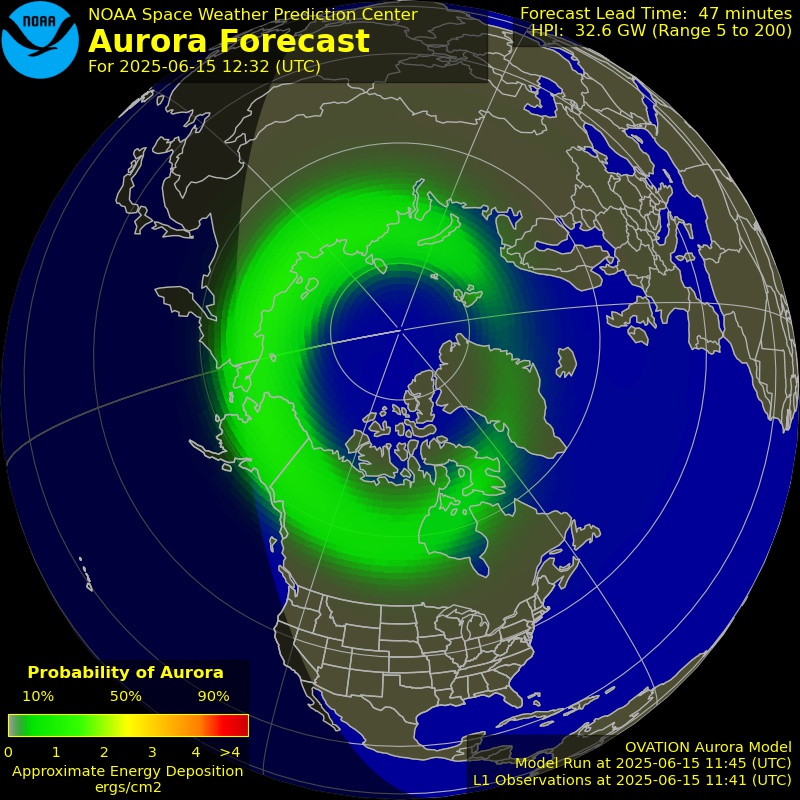
If the animation does not load, a static image will be shown.
Conditions assessment
The indicators consider your location, the local aurora chance and whether it is dark.
Kp (3h)
Kp (1 min)
Bz (GSM)
Bt (IMF)
Speed
Density
Temperature
Latest alerts: solar activity and geomagnetic storms
The monitor below updates automatically from NOAA data: it shows the outlook for the next seven nights and the current aurora alerts. Check it right before you head out — conditions can change within hours.
Sky phenomena
Planning your night-sky observations? These monthly guides highlight the most important astronomical events, meteor showers, Moon phases and the best observation windows. Below you’ll find the two most relevant monthly guides for the current period.

SKY PHENOMENA
Monthly guide
Sky events in September 2026: meteors, equinox and the Moon
The key sky events of the month, meteor activity, the Moon and practical observation windows.
Read the guide
SKY PHENOMENA
Monthly guide
Sky events in October 2026: Draconids, Orionids and Saturn
The key sky events of the month, meteor activity, the Moon and practical observation windows.
Read the guideNorthern Lights
Looking for a longer-term Northern Lights outlook? These monthly guides complement the live radar with seasonal conditions, expected aurora activity and practical viewing tips. Below you’ll find the two most relevant monthly forecasts currently available.

NORTHERN LIGHTS
Monthly forecast
Northern Lights — September 2026
A monthly Northern Lights outlook with live-radar context and practical viewing guidance.
Read the guide
NORTHERN LIGHTS
Monthly forecast
Northern Lights — October 2026
A monthly Northern Lights outlook with live-radar context and practical viewing guidance.
Read the guide
Contents
- Can you see the aurora in Churchill tonight?
- What Kp do you need in Churchill?
- When to go: month-by-month
- Where to watch in Churchill
- Aurora and polar bears together
- How many nights should you plan?
- Cloudy tonight? What to do instead
- Camera settings that work here
- Planning the trip: getting there, staying, packing
- FAQ: Northern Lights in Churchill
- Read also
Can you see the aurora in Churchill tonight?
Cloud cover is the deciding factor. Churchill sits under the oval, so moderate geomagnetic activity is usually enough — what stops a night here is weather, not a low Kp. Check the radar before bed and again if you wake in the night; many lodges run a wake-up call system and will ring your room when the sky opens up. The core window is roughly 22:00 to 02:00.
Turn that into a quick tonight verdict. Unlikely: solid overcast over Churchill — at this latitude weather, not a quiet Kp reading, is what actually stops a night. Possible: broken cloud with clear intervals in the 22:00-02:00 window — worth setting an alarm for, especially if your lodge offers a wake-up call. Good: mostly clear sky in that window — Churchill’s own numbers put a strong show at just Kp 2, so an ordinary night is often all it takes once the sky cooperates. The short version: track the cloud radar, not just the Kp forecast.



Hi, I’m Krystian “dziadzia przewodnik” from OndaTravel.pl!
The North is my greatest passion, but the world is far too beautiful to stay in just one climate. On my blog, I combine the raw landscapes of Iceland and Norway with the exotic energy of Thailand or Vietnam, showing you how to travel authentically — with passion and a camera in hand.
What will you find on OndaTravel.pl?
Visual storytelling: As a photographer and filmmaker, I don’t just describe places — I take you there with professional photos and video.
North expert: Ready-to-use road trip plans for Iceland and Norway, smart tips for budget travel, and my original Northern Lights Radar (locations and forecast).
Travel through the lens of cinema: I track down filming locations — from icy scenes in Interstellar to tropical frames from world cinema.
New direction: Exotic destinations: I love contrast, so the blog is featuring more and more practical knowledge about Vietnam and Thailand. I’ll show you how to find your way around Southeast Asia and come back with your best memories.
P.S. follow me here


What Kp do you need in Churchill?
| Location | Geomagnetic latitude | Kp from town | Kp from the tundra | Kp for a strong show |
|---|---|---|---|---|
| Churchill | ~68° | 0-1 | 0 | 2 |
When to go: month-by-month
| Month | Aurora | What else is happening | Rating |
|---|---|---|---|
| Late Aug-Sep | First dark nights return | Belugas ending, bears arriving | Good |
| October | Increasing | Peak polar bear season begins | Very good |
| November | Good | Peak polar bear season, ice forming | Very good |
| December | Strong, long nights | Bears out on the ice, town quiet | Excellent |
| January | Strong | Deep winter, coldest | Excellent |
| February | Peak | Clear skies, den emergence begins | Best month |
| March | Peak | Milder, Wapusk den season | Best month |
| April | Declining daylight window | Season ending | Fair |
Where to watch in Churchill
- The frozen bay — in deep winter the bay surface becomes the best viewing platform in town, with a completely open horizon in every direction. This is not a self-drive or walk-out spot: access depends on that day’s ice conditions, so you go with a local guide who checks conditions and drives you out, typically a short ride from town rather than a long trip. There’s no fixed parking, because the safe access point shifts through the season. The guide requirement isn’t only about ice — Churchill sits in an active polar bear corridor, and reputable operators carry bear monitors or firearms as standard practice on the bay. Never attempt this one independently, whatever the conditions look like from town.
- Cape Merry — a short drive from town, roughly 5 minutes, overlooking the Churchill River mouth and Hudson Bay. One of the classic viewpoints, and photogenic in daylight too. There’s a marked parking area right at the site, so this one doesn’t need much of a walk once you arrive — but getting there on foot after dark isn’t recommended, since the site sits on open tundra at the edge of town, exactly where bear activity is most common. The horizon opens north over the bay mouth, which is where the aurora and the ice both show up together. Check the local polar bear alert status before heading out, even by car, and stay near the viewing area rather than wandering.
- Just outside town — with fewer than 1,000 residents there is very little light pollution to escape. Walking a few minutes from the main street is often enough for a genuinely dark sky, and no drive or parking is needed for this one. The clearest views open north toward the bay, away from the handful of streetlights along the main road. The practical warning matters more here than in most Arctic towns: Churchill is bear country, and locals genuinely leave vehicles unlocked so people can take shelter if needed. Stick to the lit, built-up part of town after dark, check the current Polar Bear Alert status before heading even a short distance out, and never walk toward the tundra edge alone at night.
- Dedicated viewing domes and lodges — several operators run heated viewing structures on the tundra outside town, which matters when you are waiting for hours at -25°C or colder. Most sit a 10 to 20 minute drive from town and are reached by lodge-arranged shuttle rather than a self-drive or a walk, since they’re built specifically because the surrounding tundra isn’t safe to wander on foot. The dome design usually gives a wide, largely unobstructed horizon in whatever direction the aurora is active, which is the point of the structure. Parking, transport, and bear safety are handled by the operator as part of the package — book ahead, since space fills fast in peak aurora weeks.
Safety note: Churchill is polar bear country. During bear season, and to a lesser extent year-round, walking outside town alone at night is not advisable. This is the one aurora destination on this site where going with a local guide is a safety decision, not just a convenience one.
Aurora and polar bears together
This is Churchill’s unique proposition, and it comes with a genuine trade-off. Peak polar bear season is mid-October to mid-November, when bears gather on the shoreline waiting for the bay to freeze. Peak aurora season is February and March. The two overlap only partially: in late October and November the nights are already long enough for good aurora, but the very best aurora conditions arrive after the bears have moved out onto the ice.
If you want both in one trip, late October to November is the compromise. If the aurora is the priority, come in February or March — and consider that late February and March also coincide with polar bear den emergence in Wapusk National Park, accessible through specialist operators.
How many nights should you plan?
Three to four nights. Churchill is not a place you reach casually — there is no road in, so you arrive by air from Winnipeg or by rail, which makes short trips expensive per night. Since you are committing to the journey anyway, give yourself enough nights to absorb one or two cloudy ones.
Cloudy tonight? What to do instead
Churchill has no road out, so you cannot drive away from weather the way you can in Canada’s interior. Hudson Bay weather also moves fast, which cuts both ways: a solid overcast at 22:00 can break by 01:00. The practical move is to stay reachable rather than chase clear sky, and to let your lodge wake you if the sky opens.
| Where to go instead | Distance | Drive time | Why it can work |
|---|---|---|---|
| Cape Merry | 2 mi / 3 km | ~10 min | River mouth and bay; the classic viewpoint, quick to reach if the sky breaks |
| Frozen bay with a guide | varies | 10-20 min | Fully open horizon on the ice. Never go out alone here |
| Just outside town | under 1 mi | 5 min walk | Fewer than 1,000 residents, so even a short walk gives a dark sky |
| Wait it out indoors | – | – | Most lodges run a wake-up call service; on the Bay this beats driving |
Camera settings that work here
Faint display: ISO 1600-3200, f/2.8 or wider, 8-15 seconds, manual focus at infinity. Strong display: 2-5 seconds. The flat horizon here is a gift for wide compositions — a 14mm to 24mm lens lets you frame the full arc without a mountain cutting it off. Bring more battery capacity than you think you need; deep winter on the Hudson Bay coast combines extreme cold with persistent wind, which drains cells faster than still cold does.
Planning the trip: getting there, staying, packing
Getting there
There is no road to Churchill. You fly from Winnipeg in about two and a half hours, or take the Hudson Bay Railway, which runs roughly two days each way. The flight is the practical choice for a short aurora trip; the train is an experience in itself but eats most of a week. Book early for February and March, when capacity is tight.
Where to stay
The town is small enough that location barely matters for distance, but it matters for service. Several hotels and lodges run a wake-up call when the aurora appears, which is the single most useful amenity here given how fast Hudson Bay weather turns. Purpose-built viewing lodges outside town offer heated domes and guided transfers, at a noticeably higher price.
Costs and booking
Churchill is expensive by Canadian standards because everything arrives by air or rail. Expect to pay more for food and rooms than in Winnipeg, and budget for guided activities rather than self-drive, since there is almost nowhere to drive. Aurora-plus-bear packages in late October and November sell out furthest ahead.
What to pack
Hudson Bay combines deep cold with persistent wind, which is harsher than the same temperature inland. Insulated boots, full layering, a windproof outer shell, face covering and over-mitts. Bring more camera battery capacity than you think you need: wind chill drains cells faster than still cold, and there is nowhere to duck inside on the tundra.
FAQ: Northern Lights in Churchill
Can you see polar bears and the northern lights on the same trip?
Partially. Peak bear season is mid-October to mid-November; peak aurora season is February and March. Late October and November is the compromise window where nights are long enough for good aurora while bears are still on the shoreline.
What is the best month for the aurora in Churchill?
February and March. Cold, clear conditions combine with long nights, and late February into March also coincides with polar bear den emergence in Wapusk National Park.
Is it safe to watch the aurora outside at night in Churchill?
Not alone. Churchill is polar bear country, and during bear season especially, going out at night without a local guide is a genuine safety risk rather than just a convenience question.
How do you get to Churchill?
There is no road. You arrive by air from Winnipeg or by rail. That makes short visits expensive per night, which is why three to four nights is the sensible minimum.
Why is Churchill considered so good for aurora viewing?
Three reasons: it sits inside the auroral oval, its population is under 1,000 so light pollution is minimal, and the flat coastal tundra gives an unobstructed 360-degree horizon with no mountains blocking part of the display.
What Kp index do you need in Churchill?
Low. At roughly 68 degrees geomagnetic latitude, Kp 0 to 1 is often enough for a visible display, and Kp 2 or above typically produces a strong show. Cloud cover matters far more than the Kp number.

About the OndaTravel.pl author
Krystian — „dziadzia przewodnik”
Meet the OndaTravel.pl author: an independent Arctic guide, photographer and filmmaker. See how the guides are made, where the field photos come from, and how to reach out about a guided trip to Iceland, Lofoten or Norway.
Read also
Churchill sits almost level with Tromsø magnetically; the wider picture is in our guide to the northern lights in Canada.
CANADA
Live radar
Yellowknife
Canada’s other aurora capital: further under the oval, drier weather, easier road access.
Check Yellowknife radarALL LOCATIONS
Hub
Aurora Radar: Choose a Location
Compare Kp thresholds across every location we track, from Arctic Europe to North America.
See all locationsPHENOMENON EXPLAINED
Guide
Live Aurora Forecast Explained
Understand what Kp, Bz and cloud cover actually mean before you check any radar.
Read the explainerTOOL
Alerts
Aurora Alerts
Get notified the moment conditions turn favourable, wherever you are.
Open Aurora Alerts