

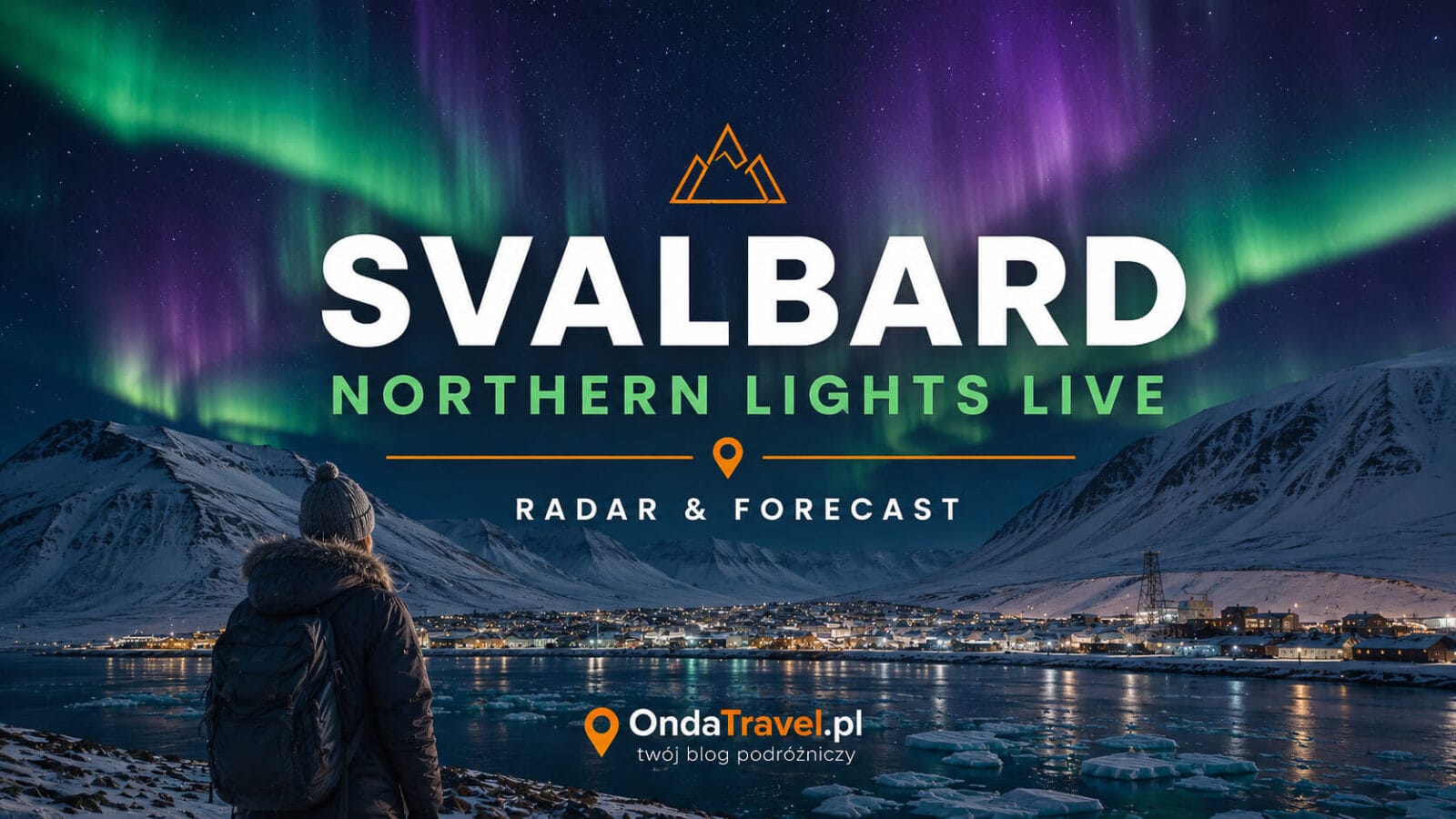
The Northern Lights on Svalbard are possible when you have darkness, clear spells and safe conditions. During the polar night it can be dark even in the middle of the day.
To connect this topic with a wider northern travel plan, see the North section.

NORTH
Svalbard – a quick check before observing
On Svalbard the aurora can be visible very high in the sky, but the decision to go out still starts with the weather and with safety. Check for clear breaks in the cloud, the geomagnetic activity, the terrain conditions and whether going outside the settlement is possible and safe.
North: Iceland, Norway, northern lights and Lofoten
A dedicated OndaTravel section for northern trips: Iceland, Norway, fjords, Lofoten, northern lights, ready-made routes and planning tools.
Use this radar to check current aurora activity and remember that weather and safety in Arctic conditions matter as much as Kp.
Svalbard Northern Lights live: radar, forecast and weather
Live aurora check for Svalbard: current parameters and a quick view before planning tonight.
Northern Lights – live radar and parameters
Parameters refresh automatically. The local aurora chance is calculated for your location (GPS or city).
Aurora oval radar – Northern Hemisphere
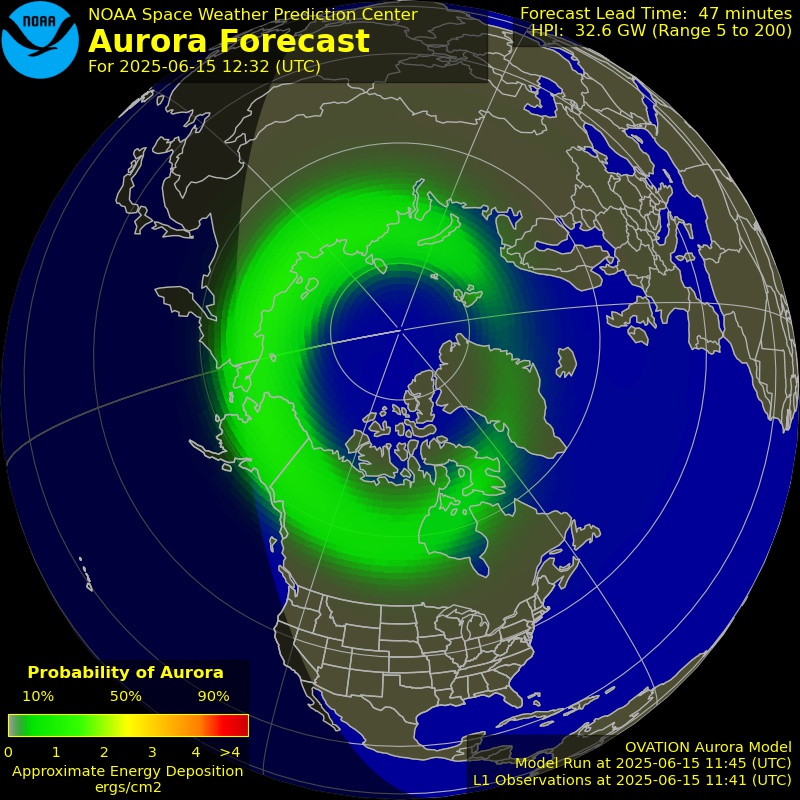
If the animation does not load, a static image will be shown.
Conditions assessment
The indicators consider your location, the local aurora chance and whether it is dark.
Kp (3h)
Kp (1 min)
Bz (GSM)
Bt (IMF)
Speed
Density
Temperature
Latest alerts: solar activity and geomagnetic storms
The monitor below updates automatically from NOAA data: it shows the outlook for the next seven nights and the current aurora alerts. Check it right before you head out — conditions can change within hours.
Sky phenomena
Planning your night-sky observations? These monthly guides highlight the most important astronomical events, meteor showers, Moon phases and the best observation windows. Below you’ll find the two most relevant monthly guides for the current period.
SKY PHENOMENA
Monthly guide
Sky events in October 2026: Draconids, Orionids and Saturn
The key sky events of the month, meteor activity, the Moon and practical observation windows.
Read the guide
SKY PHENOMENA
Monthly guide
Sky events in November 2026: Leonids, Taurids and a supermoon
The key sky events of the month, meteor activity, the Moon and practical observation windows.
Read the guideNorthern Lights
Looking for a longer-term Northern Lights outlook? These monthly guides complement the live radar with seasonal conditions, expected aurora activity and practical viewing tips. Below you’ll find the two most relevant monthly forecasts currently available.
NORTHERN LIGHTS
Monthly forecast
Northern Lights — October 2026
A monthly Northern Lights outlook with live-radar context and practical viewing guidance.
Read the guide
NORTHERN LIGHTS
Monthly forecast
Northern Lights — November 2026
A monthly Northern Lights outlook with live-radar context and practical viewing guidance.
Read the guideQuick check before aurora hunting on Svalbard
- Make sure it is dark enough for observation.
- Check clear spells and wind.
- Respect local safety rules and wildlife restrictions.
- Compare wider Norway conditions if planning alternatives.
What Kp do you need on Svalbard?
Svalbard sits at roughly 75.2 degrees geomagnetic latitude, deep inside the auroral oval almost year-round. Based on NOAA space weather data and Svalbard’s position, even the quietest geomagnetic conditions are often enough here.
| Kp index | What you will likely see |
|---|---|
| Kp 0 | Aurora activity present essentially every clear, dark night |
| Kp 0-1 | Clear, moving displays overhead |
| Kp 2+ | Strong, colourful shows, sometimes visible even during the low-light hours of the polar night |
What makes Svalbard unique in this cluster: during the polar night (roughly mid-November to late January), the sun never rises at all. That means on clear days the aurora can sometimes be visible even around midday, not just after dark – something no other location on this site can offer.
When to go: month-by-month
Svalbard’s aurora season runs from late August to mid-April – one of the longest windows anywhere in the Arctic, because part of it overlaps with total polar darkness.
| Month | Dark hours | Typical cloud cover | Rating |
|---|---|---|---|
| Late August | Nights returning after midnight sun | Variable | Fair |
| September | Growing darkness | Moderate | Good |
| October | Long nights | Often cloudy, Arctic storms begin | Good |
| November | Polar night begins mid-month | Variable | Very good |
| December | Full polar night, 24h darkness | Variable, clear spells common | Best |
| January | Polar night continues to late month | Variable | Best |
| February | Daylight returning, long nights remain | Often clear and cold | Very good |
| March | Nights shortening | Frequently clear | Good |
| Early April | Short dark window before midnight sun | Improving | Fair |
Dark-sky spots near Longyearbyen
Longyearbyen is the only real settlement on Svalbard, and it has almost no light pollution to begin with. Read the safety note below before you plan anything here – it changes how you approach dark-sky viewing more than in any other location on this site.
- Edge of Longyearbyen town – the simplest option. Walk a few minutes away from the main street lighting and the sky is already dark enough for a good view.
- Adventdalen valley – open, flat terrain just outside town with a wide horizon, popular with local tour operators for exactly that reason.
- Bjornoya viewpoint area near the airport – open ground with sea and mountains as a backdrop, easy to reach by car.
- UNIS/university area on the edge of town – slightly elevated, minimal light spill, still an easy walk.
Safety note – this is not optional. Polar bears roam the whole archipelago, including areas just outside Longyearbyen. Local rules require a rifle and the training to use it (or a guide who carries one) if you leave the town boundary, even at night for aurora viewing. Do not walk out into Adventdalen or any unlit area alone without a guide or the proper permit and equipment – this is treated as a serious, non-negotiable safety rule locally, not tourist caution.
How many nights should you plan?
Given how far inside the auroral oval Svalbard sits, 2 to 3 nights is usually enough to see something, which is shorter than most other locations on this site. Weather, not geomagnetic activity, is the main risk here – Svalbard’s coastal Arctic climate brings frequent cloud and wind. If the aurora is the main reason for the trip, plan 4 nights to have a real buffer against a run of cloudy weather.
Cloudy tonight? What to do instead
Svalbard is genuinely isolated – there is no nearby alternative location to drive to like on mainland Norway. If it clouds over, your best move is simply to wait it out and check again later the same night, since Arctic coastal weather here can clear quickly. For a mainland alternative on a future trip, these are the closest live radars in the cluster.
| Location | Distance | How to get there | Check radar |
|---|---|---|---|
| Tromso, Norway | ~900 km | Flight required, not a same-night option | Tromso live radar |
| Abisko, Sweden | ~1000 km | Flight + onward travel required | Abisko live radar |
Camera settings that work here
Start around ISO 1600-3200, f/2.8 or wider if your lens allows it, and a 5-10 second exposure, then adjust based on how bright the display is. Temperatures on Svalbard regularly drop below -15C in winter – keep spare batteries in an inside pocket, as cold drains them fast, and let your camera adjust slowly to temperature changes to avoid condensation on the lens and sensor.
With or without a tour?
Unlike Tromso or Lofoten, this is not really an optional choice on Svalbard. Renting a car is possible but the road network barely extends beyond Longyearbyen, and going beyond the town boundary without a rifle and the training to use it is not allowed for good reason. Most visitors either stay within the well-lit edges of town for a simple, free view, or join a local guide who carries the required equipment and knows current polar bear activity in the area. A guided snowmobile or dog-sled aurora trip is also the way most visitors get further from town lights safely.
How to read the Svalbard aurora forecast
Do not judge the evening by Kp alone. On Svalbard, a lower activity forecast with a clear gap in the clouds can be more useful than a strong forecast hidden behind full cloud cover.
- Darkness: make sure the season and local light conditions allow the aurora to be visible.
- Cloud cover: look for real clear windows rather than relying only on a daily weather icon.
- Bz and solar wind: use them as supporting signals, not as a guarantee.
- Wind, visibility and safety: Arctic conditions decide whether leaving your accommodation is sensible.
The practical green light is a combination of darkness, a genuine break in the clouds and safe local conditions.
FAQ: Northern Lights on Svalbard
When is it easiest to see the Northern Lights on Svalbard?
From late autumn to early spring, especially during the polar night, when darkness can last through the day.
Can you see the aurora during the midnight sun season?
No. If the sky is too bright, the aurora will not be visible even when activity is high.
What matters more: Kp or cloud cover?
Weather usually comes first. Without clear spells, the aurora stays hidden.
What should I be careful about at night on Svalbard?
Weather changes quickly and local safety rules are essential. Use safe places and follow local guidance.

About the OndaTravel.pl author
Krystian — „dziadzia przewodnik”
Meet the OndaTravel.pl author: an independent Arctic guide, photographer and filmmaker. See how the guides are made, where the field photos come from, and how to reach out about a guided trip to Iceland, Lofoten or Norway.
Read also

NORWAY
Live radar
Tromso
Easiest arctic base to reach, no car needed for several viewing spots.
Check Tromso radar
NORWAY
Live radar
Lofoten
Aurora over dramatic mountain and sea scenery, a different composition entirely.
Check Lofoten radarNORWAY
Region guide
Norway
Compare every Norwegian aurora region and pick the one that fits your trip.
See Norway overviewTOOL
Alerts
Aurora Alerts
Get notified the moment conditions turn favourable, wherever you are.
Open Aurora AlertsALL LOCATIONS
Hub
Aurora Radar
Compare Kp thresholds across every location we track, including Iceland.
See all locations



Hi, I’m Krystian “dziadzia przewodnik” from OndaTravel.pl!
The North is my greatest passion, but the world is far too beautiful to stay in just one climate. On my blog, I combine the raw landscapes of Iceland and Norway with the exotic energy of Thailand or Vietnam, showing you how to travel authentically — with passion and a camera in hand.
What will you find on OndaTravel.pl?
Visual storytelling: As a photographer and filmmaker, I don’t just describe places — I take you there with professional photos and video.
North expert: Ready-to-use road trip plans for Iceland and Norway, smart tips for budget travel, and my original Northern Lights Radar (locations and forecast).
Travel through the lens of cinema: I track down filming locations — from icy scenes in Interstellar to tropical frames from world cinema.
New direction: Exotic destinations: I love contrast, so the blog is featuring more and more practical knowledge about Vietnam and Thailand. I’ll show you how to find your way around Southeast Asia and come back with your best memories.
P.S. follow me here

