

Northern Lights in Alaska: Live Radar and Forecast
Alaska is one of the most accessible places on Earth to chase the northern lights from within the United States, with Fairbanks sitting almost directly under the auroral oval.
Northern Lights in Alaska: At a Glance
| Best season | Late August – mid-April |
| Peak months | September, and December – March |
| KP index needed | KP 1-2, sometimes even KP 0 near Fairbanks |
| Nearest airport | Fairbanks International Airport (FAI) |
| Typical stay | 3 nights for a >90% chance (per Explore Fairbanks data) |
| Documentation | US entry rules – different from a Canada trip |
- Get an alert the moment conditions turn favourable
- Why interior Alaska is so reliable for the aurora
- How many nights do I need?
- ESTA and documentation: different from a Canada trip
- Best window inside the season
- Getting around once you land
- Read next: more aurora destinations
Northern Lights – live radar and parameters
Parameters refresh automatically. The local aurora chance is calculated for your location (GPS or city).
Aurora oval radar – Northern Hemisphere
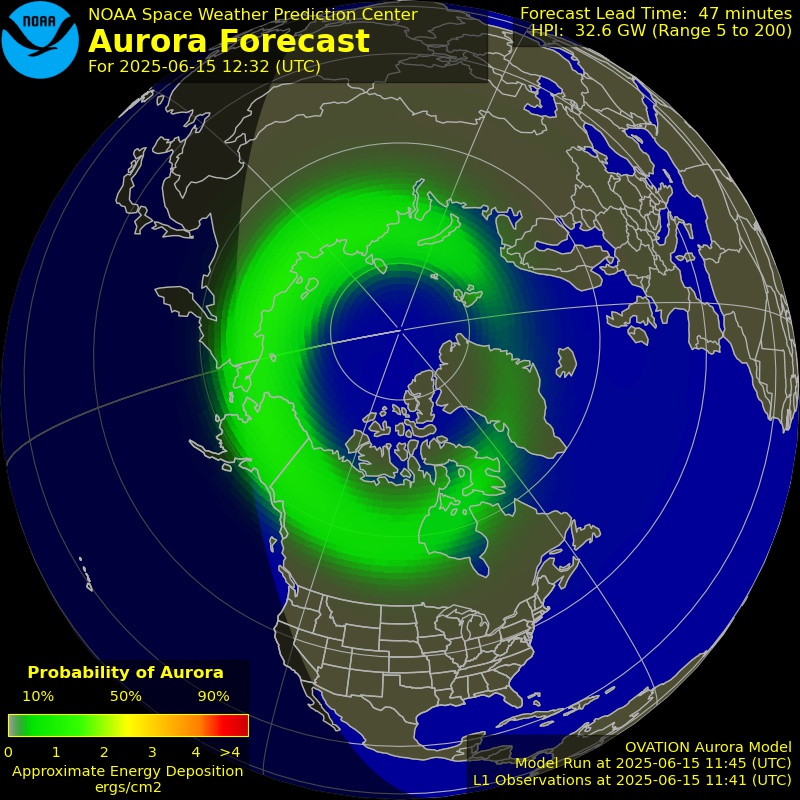
If the animation does not load, a static image will be shown.
Conditions assessment
The indicators consider your location, the local aurora chance and whether it is dark.
Kp (3h)
Kp (1 min)
Bz (GSM)
Bt (IMF)
Speed
Density
Temperature
Get an alert the moment conditions turn favourable
Set a free alert for Fairbanks and interior Alaska and we will notify you when the KP index and cloud cover line up for a realistic viewing window.
Why interior Alaska is so reliable for the aurora
Fairbanks sits at roughly 64.8°N, directly beneath the auroral oval for most of the aurora season, which is why local activity can appear even at a low or moderate KP index. The interior’s continental climate also means colder but clearer nights than Alaska’s coastal cities, giving visitors a genuinely strong statistical chance if they stay long enough. Unlike coastal Anchorage or Juneau, which sit further from the oval’s core and see more maritime cloud cover, the Fairbanks area routinely posts more clear or partly clear nights across the aurora season, which is why nearly every serious aurora operator in the state bases its tours there rather than further south.

GUIDE
Northern Lights in Canada: Live Radar and Forecast
Northern lights in Canada: live radar, Kp thresholds for Yellowknife, Churchill and the Yukon, the season as the provinces define it, and how it compares with Scandinavia.
How many nights do I need?
Explore Fairbanks, the local tourism authority, has published data suggesting visitors staying three nights in the area have over a 90% chance of seeing the aurora under normal seasonal conditions. Shorter stays are still possible, especially around the September and March equinox windows when geomagnetic activity tends to increase, but three nights remains the benchmark most local operators recommend. Travellers on a tighter schedule can improve their odds by picking a viewing spot away from Fairbanks’ own light dome — a short drive out along the Steese or Elliott highways puts you under genuinely dark sky within twenty to thirty minutes.
ESTA and documentation: different from a Canada trip
Alaska is part of the United States, so entry requirements differ from those for a Canadian aurora trip. Visa-waiver-eligible travellers need a valid ESTA authorisation before flying, and standard US customs and entry rules apply on arrival, even though Fairbanks feels geographically closer to Canada’s aurora destinations than to the continental US. If your itinerary also includes a stop in Canada — for example combining Fairbanks with Yellowknife — check both countries’ entry requirements separately, since an ESTA does not cover Canadian entry and vice versa.
For a comparison with our other North American aurora destination, see our guide to the northern lights in Canada.
| Factor | Fairbanks, Alaska (USA) | Yellowknife, Canada |
|---|---|---|
| Entry document | ESTA (visa-waiver) or visa | eTA or visa |
| Typical KP needed | KP 1-2, sometimes KP 0 | KP 1-2 |
| Access | Direct flights to Fairbanks (FAI) | Flights via Edmonton/Calgary |
Best window inside the season
Within the August-to-April season, late August and early September give the earliest dark skies while temperatures are still mild, which suits visitors who want to combine aurora viewing with hiking. December through early March brings the longest, darkest nights and the coldest conditions, often below -20°C, which improves atmospheric clarity but demands proper cold-weather gear. Late March, around the spring equinox, sees a statistical uptick in geomagnetic activity that many aurora chasers specifically target.
Getting around once you land
Most aurora-focused stays outside downtown Fairbanks require a rental car, since the best dark-sky viewpoints are a short drive from the city’s own light pollution. Winter driving conditions can be demanding — expect packed snow and ice on secondary roads — so allow extra time and check road conditions before heading out after dark. Many hotels and lodges in the area also offer wake-up call services or dedicated aurora viewing decks for guests who prefer not to drive at night.
What is the best time of year to see the northern lights in Alaska?
The season runs from late August to mid-April, with September and the December-March stretch generally the strongest.
How many nights do I need in Fairbanks to see the aurora?
Explore Fairbanks data suggests three nights gives visitors over a 90% chance under typical conditions, though shorter stays can still succeed.
Do I need a visa for Alaska?
Alaska is part of the United States. Visa-waiver-eligible travellers need a valid ESTA before flying; others need a standard US visa. This is separate from Canadian entry requirements.
What KP index do I need near Fairbanks?
A KP index of 1 or 2 is usually enough, and activity can sometimes be visible even at KP 0 given Fairbanks’ position under the auroral oval.
How do I get to Fairbanks?
Fairbanks International Airport (FAI) has direct and connecting flights from major US hubs, including seasonal routes aimed at aurora travellers.
Can I combine an Alaska trip with a Canada aurora trip?
Yes, some travellers combine Fairbanks with Yellowknife, but remember the entry documents are separate — an ESTA does not cover Canadian entry, and a Canadian eTA does not cover US entry.