

Rocket Launches Live 2026/27 – Countdown & Streams
Rocket launches — in short
Rockets lift off every few days all year round, but the date announced is almost never final. Whether a launch actually happens is decided by the launch window, the weather at the spaceport and the technical status of the vehicle. Below you will find a countdown to the next launches, the status of each mission and a link to the stream, and further down — an explanation of how to read this data and what is coming in 2026 and 2027.
Table of contents
The main sections of this guide: the live countdown, how to read a launch schedule, where to watch a liftoff, what is visible from Europe, the missions of 2026/27 and the launch sites.

Check out my YouTube channel and travel with me.
Follow the channel for videos, routes and practical travel inspiration.
Follow me here:
What’s up?
Enjoying my content?
Buy me a coffee at buycoffee.to/ondatravel and support the creation of more travel content.
Your support helps me create more practical guides, videos and travel inspiration.

Contents
- LIVE: next rocket launches and countdown
- How to read a launch schedule: T-0, launch window, scrub
- What the launch statuses mean
- Where to watch a rocket launch live
- Can a rocket launch be seen from Europe
- Programmes and missions 2026/27 — what is really coming
- Where rockets launch from: the most important spaceports
- FAQ: rocket launches
- Read also
LIVE: next rocket launches and countdown
SDA Tranche 1 Transport Layer A
(05.10, 08:06 UTC)
NeonSat-2 to 6 & Others
(07.10, 03:23 UTC)
CRS SpX-35
(13.10, 10:33 UTC)
Data: RocketLaunch.Live. Stan na 2 October 2026, 19:00 czasu polskiego. Godziny startów mogą się zmienić.
Loading the launch schedule…
Loading the map of upcoming launches…
How to read a launch schedule: T-0, launch window, scrub
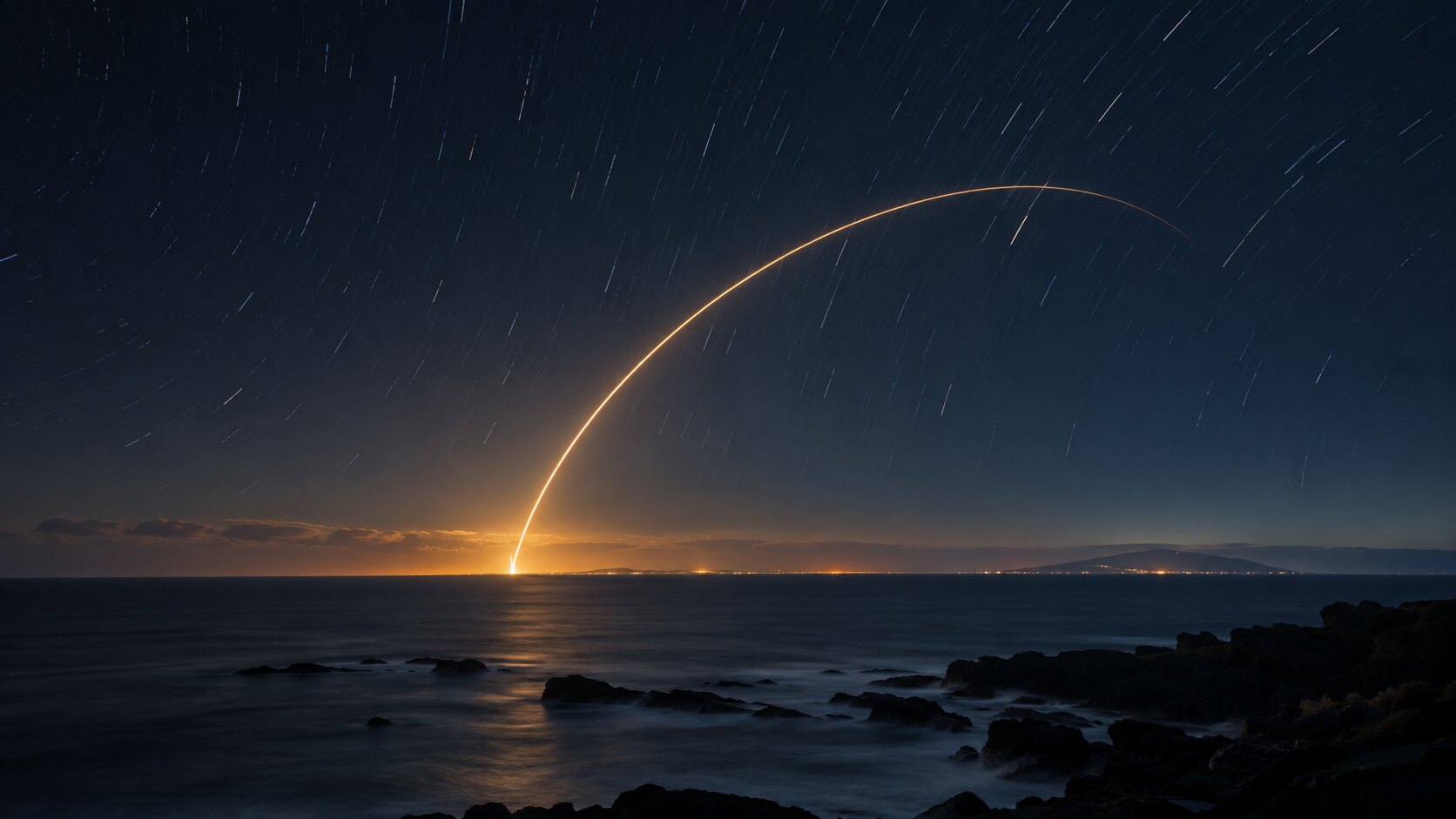
A rocket launch schedule looks like a simple list of dates, but every entry carries several pieces of information that decide whether it is worth setting an alarm.
T-0 is the moment the engines ignite. Everything that happens earlier is described as "T minus": T-4 hours is propellant loading, T-45 minutes is usually the flight director's final decision, T-10 seconds is the ignition sequence.
The launch window is the interval in which a launch is physically possible. For missions heading to the International Space Station it can be instantaneous — literally a few seconds, because the rocket has to hit the plane of the station's orbit. For satellites going to geostationary orbit the window can be several hours long. The shorter the window, the greater the chance that a single thunderstorm cloud pushes the launch back by a full day.
A scrub is a launch called off before ignition: because of weather, a fault or a ship in the drop zone. It is a normal part of spaceflight, not a failure. The next attempt can come as soon as the following day, if the window repeats.
A hold is a pause in the countdown, often planned so the teams have time for checks. An automatic hold a few seconds before T-0 means the computer has detected a parameter outside limits.
The practical conclusion: a launch date is a forecast, not a promise. For missions marked as approximate, realistic slips are counted in weeks, not hours.
What the launch statuses mean
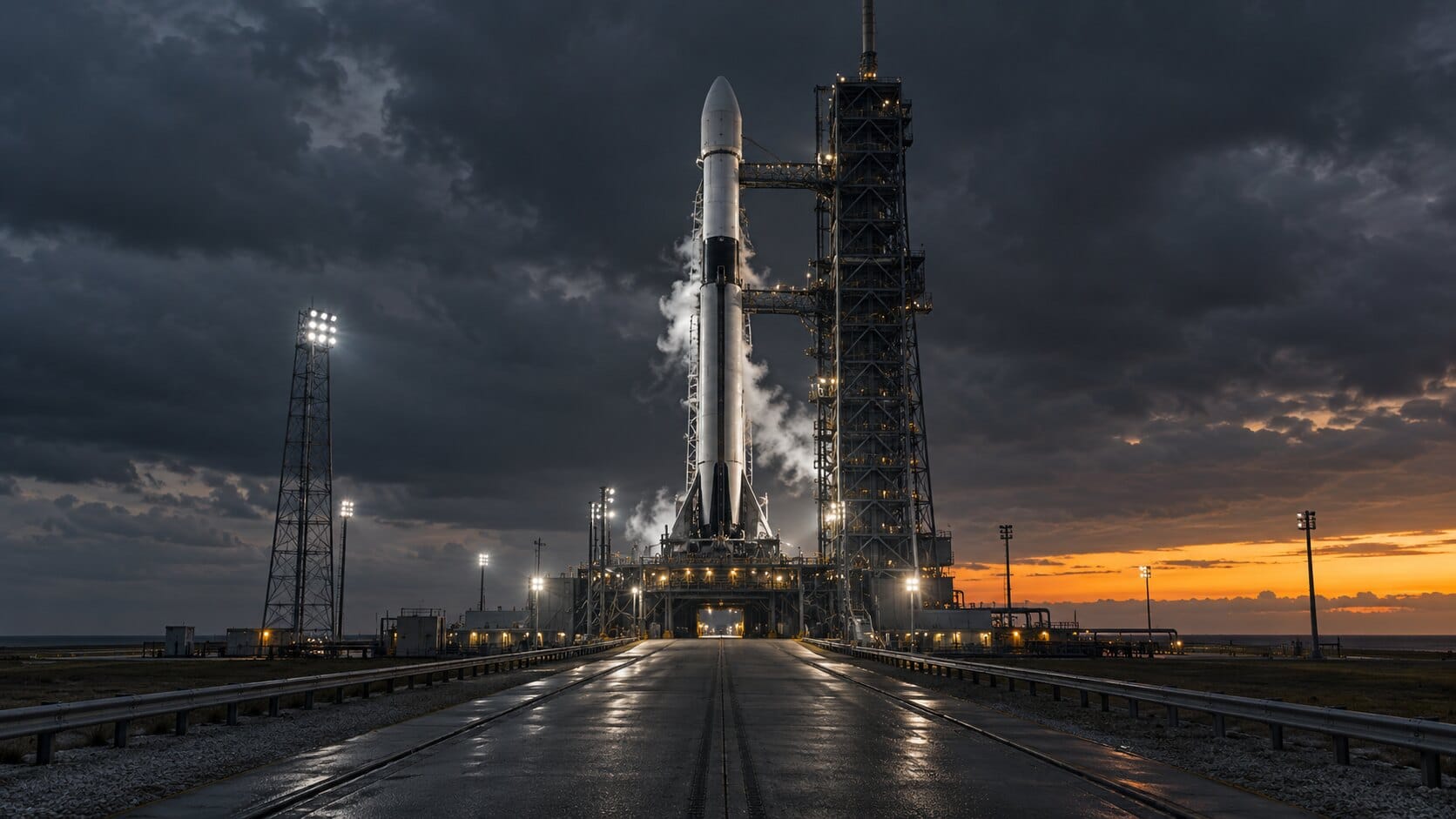
Every launch in the schedule above carries a status label. Here is how to read them:
- Confirmed — the operator has confirmed a specific T-0 time. This is the most reliable category, although a scrub can still happen here.
- Provisionally confirmed — the date is known and likely, but has not yet passed final approval.
- Approximate date — only the month or the quarter is known. The time in the schedule is then a technical value, not a real target.
- Hold — the countdown is stopped; the decision to resume comes within minutes or hours.
- In flight — the rocket has lifted off and the flight is under way.
- Success / failure — the status after the mission has ended.
Where to watch a rocket launch live
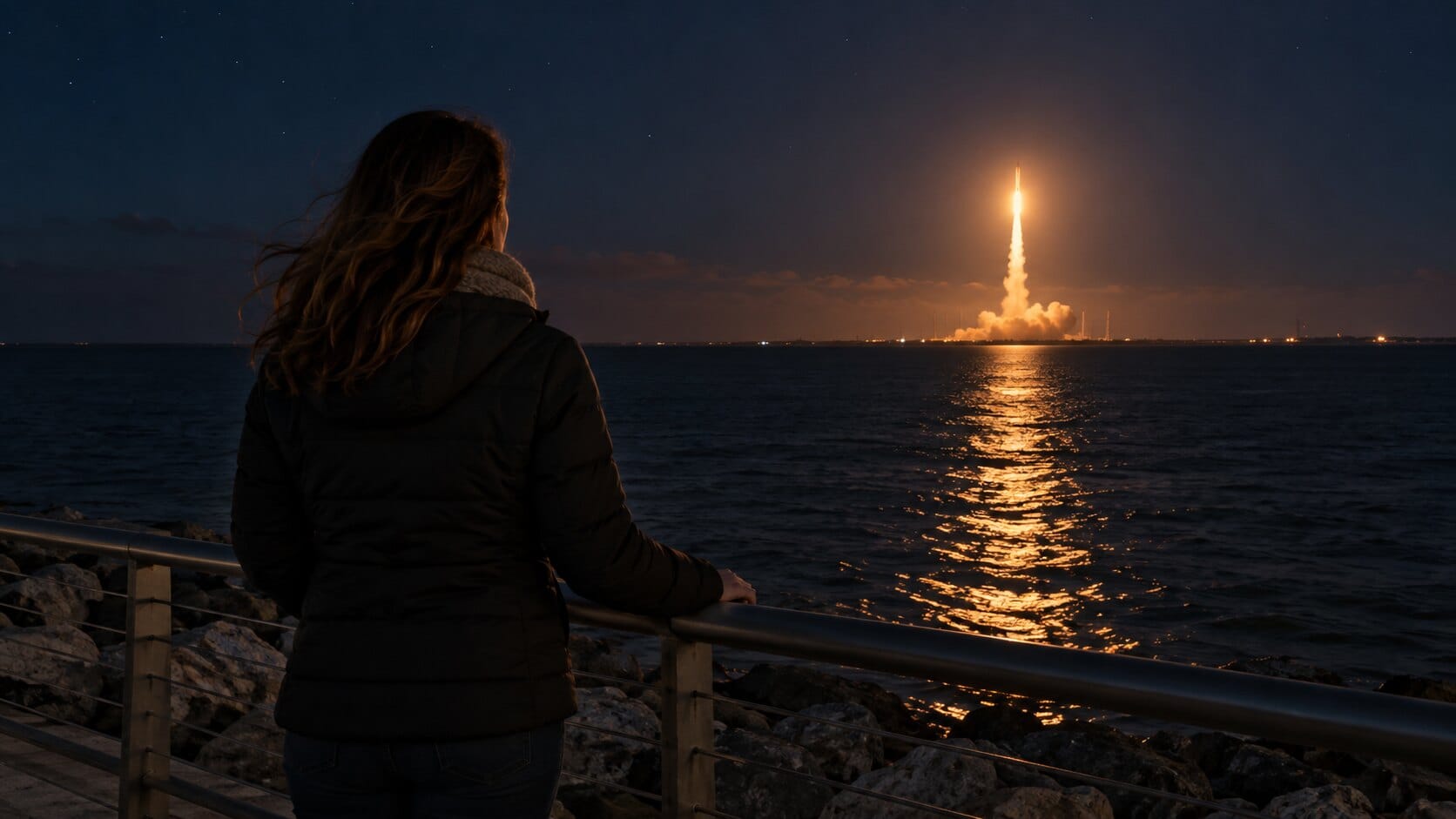
Every launch in the schedule for which the operator has made a stream available carries a "Live stream" link. Beyond that, it is worth knowing the standing sources:
- SpaceX — the stream usually starts 5–15 minutes before T-0 for Falcon 9 and about an hour earlier for crewed missions.
- NASA — for major missions the stream begins several hours before launch and covers propellant loading and crew ingress.
- ESA and Arianespace — streams from Kourou, usually with English commentary as well.
- China's CASC — streams are sometimes announced at the last moment or not at all; some launches are only shown after the fact.
Practical advice: for a launch with a short window, turn the stream on 15 minutes early. For missions with a long window it is better to check in shortly before T-0 itself, because countdowns are often held.
Can a rocket launch be seen from Europe
No. All active orbital spaceports lie thousands of kilometres from the places where most people in Europe live, and a rocket disappears below the horizon within a few minutes. From Europe you will see neither a launch from Cape Canaveral, nor from Baikonur, nor from Kourou.
What can be seen is what stays in orbit. The most recognisable effect is the Starlink "space train" — a string of bright points moving across the sky a few days after launch, before the satellites spread out to their target orbits. It is visible to the naked eye, usually in the first hour after dusk or just before dawn. A Starlink pass tracker will tell you when a pass will be visible over your location.
The second visible effect is a pass of the International Space Station — a very bright point moving steadily and without twinkling. If you are not sure what you are looking at overhead, a guide to lights in the night sky will help.
Programmes and missions 2026/27 — what is really coming
The table below collects the events that matter most. The "date certainty" column is the key one here: confirmed means a date given by the agency, approximate means that only the year or the quarter is known.
| Mission | Who | Planned date | Date certainty |
|---|---|---|---|
| Starship, flight 14 — first attempt at an orbital trajectory | SpaceX | no earlier than 22 September 2026 | likely |
| Crew-13 — ISS crew rotation | NASA and SpaceX | end of September 2026 | likely |
| MMX — sample return from Phobos, with the European Idefix rover | JAXA | no earlier than 19–20 October 2026 | likely |
| BepiColombo — orbit insertion at Mercury | ESA and JAXA | 21 November 2026 | confirmed |
| Hera — arrival at the asteroids Didymos and Dimorphos | ESA | November 2026 | likely |
| Europa Clipper — Earth gravity assist | NASA | 3 December 2026 | confirmed |
| PLATO — telescope searching for Earth-like planets | ESA | January 2027 | likely |
| Artemis III — Orion rendezvous with landers in Earth orbit | NASA | 2027 | approximate |
| Gaganyaan-4 — India's first crewed flight | ISRO | early 2027 | approximate |
| Chang'e-7 — lander, rover and mini-hopper at the Moon's south pole | CNSA | 2027 | approximate |
Three things worth knowing, because older texts online get them wrong.
First, Artemis II has already flown — the mission lifted off on 1 April 2026 and ended with splashdown on 10 April, after nine days of flight. The four-person crew circled the Moon and on the way broke the record for human distance from Earth, set by Apollo 13.
Second, Artemis III in 2027 is not a Moon landing. After the programme was reworked over the turn of winter and spring 2026, the mission is to be a demonstration in Earth orbit: a crewed Orion rendezvousing and docking with the SpaceX and Blue Origin landers. The first human landing has been moved to Artemis IV, planned for 2028.
Third, Chang'e-7 did not launch in August 2026 — the launch was called off a few hours before the window because of a typhoon, and the mission was moved to 2027.
The European thread is also worth noting. In September 2026 a private European rocket reached orbit for the first time launching from continental Europe — from the Norwegian spaceport at Andøya. A Polish contribution in the coming years is the SAWA mission, a satellite monitoring space weather, with Creotech Instruments as prime contractor for ESA; launch is planned for 2029. No further mission for a Polish astronaut has been announced since the IGNIS flight of 2025.
Where rockets launch from: the most important spaceports
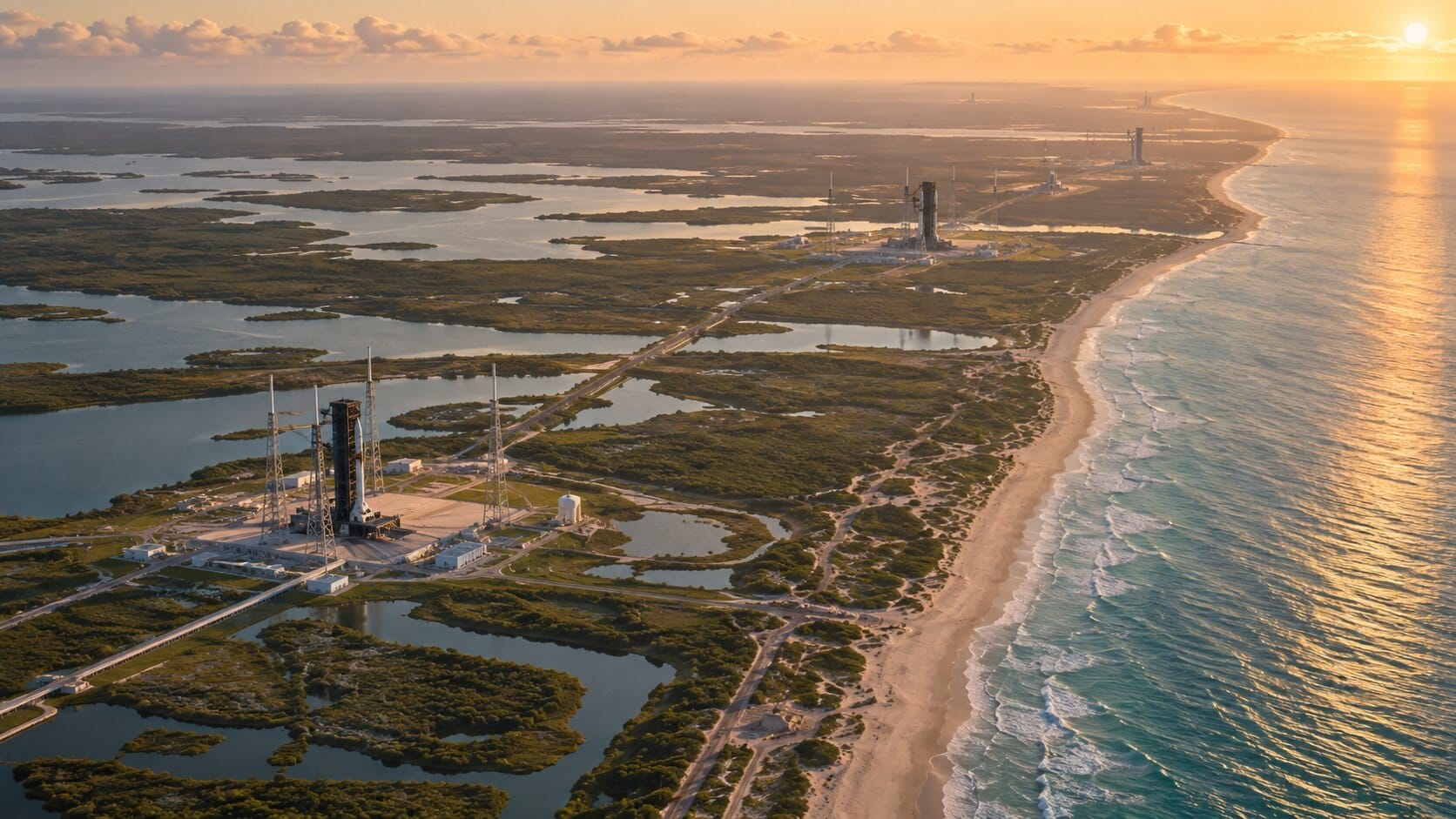
The launch site explains half of the schedule. Spaceports are built close to the equator, because the Earth's rotation gives a rocket free velocity, and so that the first stage falls over water.
| Spaceport | Country | What launches from here | Why there |
|---|---|---|---|
| Cape Canaveral and KSC | USA, Florida | Falcon 9, Falcon Heavy, crewed ISS missions | Close to the equator, launch out over the ocean, the busiest site in the world |
| Vandenberg | USA, California | Polar orbits, Earth observation satellites | Launch south over the Pacific |
| Starbase | USA, Texas | Starship | SpaceX's own facility, test flights over the Gulf of Mexico |
| Kourou | French Guiana | Ariane 6, Vega-C | Europe's spaceport, 5 degrees from the equator |
| Baikonur | Kazakhstan | Soyuz | The oldest active orbital spaceport |
| Wenchang, Jiuquan, Xichang | China | Long March, missions to Tiangong, the lunar programme | Wenchang is closest to the equator, launches out to sea |
| Tanegashima | Japan | H3, the MMX Phobos sample-return mission | An island in the south of the country, launch over the ocean |
| Satish Dhawan | India | PSLV, LVM3, and in time Gaganyaan | East coast, launch over the Bay of Bengal |
| Andøya, Esrange, SaxaVord | Norway, Sweden, Shetland | Small European rockets, polar orbits | The active orbital spaceports closest to continental Europe |
From a European perspective the last group is the most interesting. Andøya recorded its first successful orbital launch in September 2026 and is the only active orbital spaceport you can reach from continental Europe without crossing an ocean. These are the places we will cover in separate guides: how to get there, where to stand and when it is worth planning a trip to watch a launch at all.
FAQ: rocket launches
Read also
If you are interested in one particular day, check rocket launches today — the same list narrowed to the next 48 hours. Planning to see a launch in person? Start with the Cape Canaveral viewing guide. For everything else worth looking up at, see sky phenomena and our live tools. A few days after a launch you can follow the new satellites in the Starlink tracker.

LIVE
Guide
Is there a rocket launch today
Today’s launch times, statuses and stream links — with a live countdown.
Check today’s launches
FLORIDA
Guide
Where to watch launches at Cape Canaveral
Free and paid viewing spots, getting there, weather and common mistakes.
See the viewing spots
HUB
Calendar
Sky phenomena
Meteors, eclipses, full moons and conjunctions — the calendar for the whole year.
Open the calendar
SATELLITES
Tool
Starlink tracker
When the satellite train passes after the latest launch, and at what time.
Check the passes
When is the next rocket launch?
You will find the next launch in the schedule at the top of this page, with a counter counting down to T-0. The list covers every operator: SpaceX, NASA, ESA, China's CASC, India's ISRO and the rest, and it refreshes on every visit.
What time is a rocket launch?
Times are given in the schedule in UTC and, in parallel, in the local time of the launch site. Operators' streams almost always run on UTC, so UTC is the reference to use when you set an alarm.
Can a rocket launch be seen from Europe?
No. The spaceports lie thousands of kilometres away. What can be seen from Europe are satellites already placed in orbit: the most distinctive is the Starlink "space train", a string of bright points visible a few days after launch, and passes of the International Space Station.
Why do rocket launches slip so often?
Because a launch has to hit its launch window and at the same time meet weather and technical conditions. For ISS missions the window can be instantaneous, counted in seconds, so a single thunderstorm cloud or a ship in the drop zone moves the whole mission by a day. A cancellation before ignition is called a scrub and is a normal part of spaceflight.
Where can I watch a rocket launch live?
For every launch where the operator has made a stream available, a "Live stream" link appears in the schedule. SpaceX usually goes live 5–15 minutes before T-0, NASA for major missions even several hours earlier, and ESA and Arianespace broadcast from Kourou.
Has Artemis II already flown?
Yes. Artemis II lifted off on 1 April 2026 and ended with splashdown on 10 April, after nine days of flight around the Moon. Artemis III, planned for 2027, is no longer a landing mission after the programme was reworked: it is a demonstration in Earth orbit. The first human landing is planned for Artemis IV in 2028.
How many rocket launches happen each year?
The pace of orbital launches has been rising for years and is now counted in the hundreds annually, with Starlink missions making up the largest share. For an observer that means a rocket launch happens on average every few dozen hours, not a few times a year.
What is the difference between the launch window and T-0?
T-0 is the specific moment the engines ignite. The launch window is the interval in which a launch is possible at all: from a few seconds for ISS missions to several hours for satellites going to geostationary orbit. The shorter the window, the easier it is for a launch to slip to the next day.
If you care about one specific day, check rocket launches today. And if you want to watch a liftoff in person, start with Cape Canaveral: viewing spots, costs and spare days.

Guide
Sky Phenomena
Everything visible overhead: aurora, meteors, eclipses and noctilucent clouds.

Live tool
Starlink Tracker
Pass times for your location — the satellite train is visible days after a launch.
Tools
Live Tools
Radars, maps and live widgets we use every day.

About the author
Krystian — guide and photographer
Who runs OndaTravel and why these tools exist.

Hi, I'm Krystian “dziadzia przewodnik” from OndaTravel.pl!
The North is my greatest passion, but the world is far too beautiful to stay in just one climate. On my blog, I combine the raw landscapes of Iceland and Norway with the exotic energy of Thailand or Vietnam, showing you how to travel authentically — with passion and a camera in hand.
What will you find on OndaTravel.pl?
Visual storytelling: As a photographer and filmmaker, I don’t just describe places — I take you there with professional photos and video.
North expert: Ready-to-use road trip plans for Iceland and Norway, smart tips for budget travel, and my original Northern Lights Radar (locations and forecast).
Travel through the lens of cinema: I track down filming locations — from icy scenes in Interstellar to tropical frames from world cinema.
New direction: Exotic destinations: I love contrast, so the blog is featuring more and more practical knowledge about Vietnam and Thailand. I’ll show you how to find your way around Southeast Asia and come back with your best memories.
P.S. follow me here