

Where to Watch a Rocket Launch at Cape Canaveral
In brief
Quick Summary
Cape Canaveral is the one place on Earth where a rocket launch is a realistic part of a holiday itinerary. What decides whether you actually see one is the launch calendar, the viewing spot you pick and how many spare days you leave — a launch can slip by hours or by a week.
Table of contents
The main sections of this guide: the live countdown, how to read a launch schedule, where to watch a liftoff, what is visible from Europe, the missions of 2026/27 and the launch sites.
Check out my YouTube channel and travel with me.
Follow the channel for videos, routes and practical travel inspiration.
Follow me here:
What’s up?
Enjoying my content?
Buy me a coffee at buycoffee.to/ondatravel and support the creation of more travel content.
Your support helps me create more practical guides, videos and travel inspiration.

Contents
- Quick Summary
- How Many Launches There Really Are, and What You Might Catch
- Proven Viewing Spots — Compared
- Paid Spots: Inside Kennedy Space Center
- Free Spots: Titusville, the Beaches and Playalinda
- What Is Not Here, and Why
- KSC Tickets and Packages — What They Actually Get You
- When to Go and How Many Buffer Days to Allow
- Getting There, Parking and Getting Out After Launch
- Weather and Scrubs
- Florida Rocket Launches — Frequently Asked Questions
- Read Next
How Many Launches There Really Are, and What You Might Catch
The Eastern Range recorded 94 successful orbital launches in a year, making it the “world leader for the third year in a row.” In practice that means several launches a week. Most often you will see a Falcon 9 from one of three pads: LC-39A at Kennedy Space Center, and SLC-40 and SLC-41 at Cape Canaveral. Starship has not yet launched from Florida — the LC-39A site is still in preparation.
The current schedule is in the launch calendar, with a countdown clock to the next mission.
Loading the map of upcoming launches…
Proven Viewing Spots — Compared
| Spot | Distance to pads | Access | Best for |
|---|---|---|---|
| Main Visitor Complex | LC-39A 7.5 mi (12.1 km) · SLC-40 6.7 mi (10.8 km) · SLC-41 7.1 mi (11.4 km) | Included with daily admission + $15 parking | First visit, families — attractions included |
| Banana Creek | LC-39A 3.9 mi (6.3 km) | Admission + $75 (Premium Launch Transportation) | The closest legal spot for LC-39A launches |
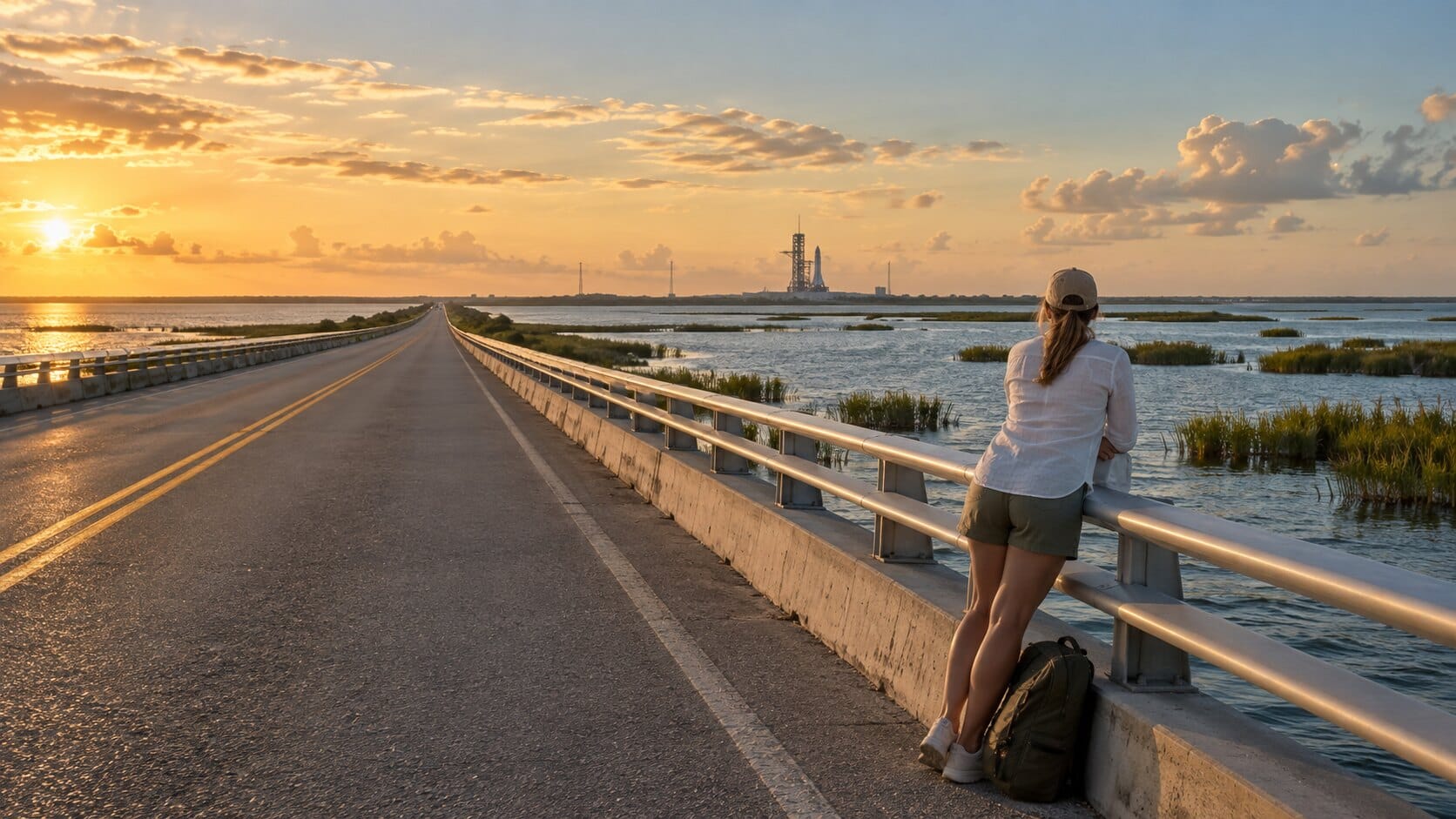
| The Gantry at LC-39 | SLC-41 2.3 mi (3.7 km) · SLC-40 3.4 mi (5.5 km) | Included with admission (KSC bus ride) | SLC-41 and SLC-40 launches — LC-39A is not visible from here |
| Space View Park, Titusville | A dozen-plus miles across the Indian River | City park, no posted admission fee | Budget viewing, audio feed from NASA control |
| Playalinda Beach | The closest view of any beach | $25 per vehicle (7 days), cashless | Beachgoers with a car who know the closure rules |
| Jetty Park, Port Canaveral | View partly blocked by a berm | Pass bought online in advance | Cocoa Beach base, viewing plus beach time |
Paid Spots: Inside Kennedy Space Center
Banana Creek — As Close As You Can Get
This is the area beside the Apollo/Saturn V Center, 3.9 mi (6.3 km) from LC-39A. You get there by bus through the NASA gates, so the Banana Creek Premium Launch Transportation Ticket ($75 on top of admission) has to be bought in advance. For night launches, boarding can happen in the middle of the night — for one crewed mission, buses picked up passengers at 3:15 a.m.
Common mistake: planning anything else that day. Between boarding, waiting on site and the bus ride back, half a day is gone.
The Gantry at LC-39 — Excellent Spot, But Not for Every Mission
A viewing platform included with admission, reached by KSC bus. SLC-41 is 2.3 mi (3.7 km) away, SLC-40 is 3.4 mi (5.5 km). The key detail: "LC-39A and LC-39B are not visible from the Gantry" for security reasons. If you are coming for a Falcon 9 launch from LC-39A, this spot will not work.
Main Visitor Complex — The Simplest Choice
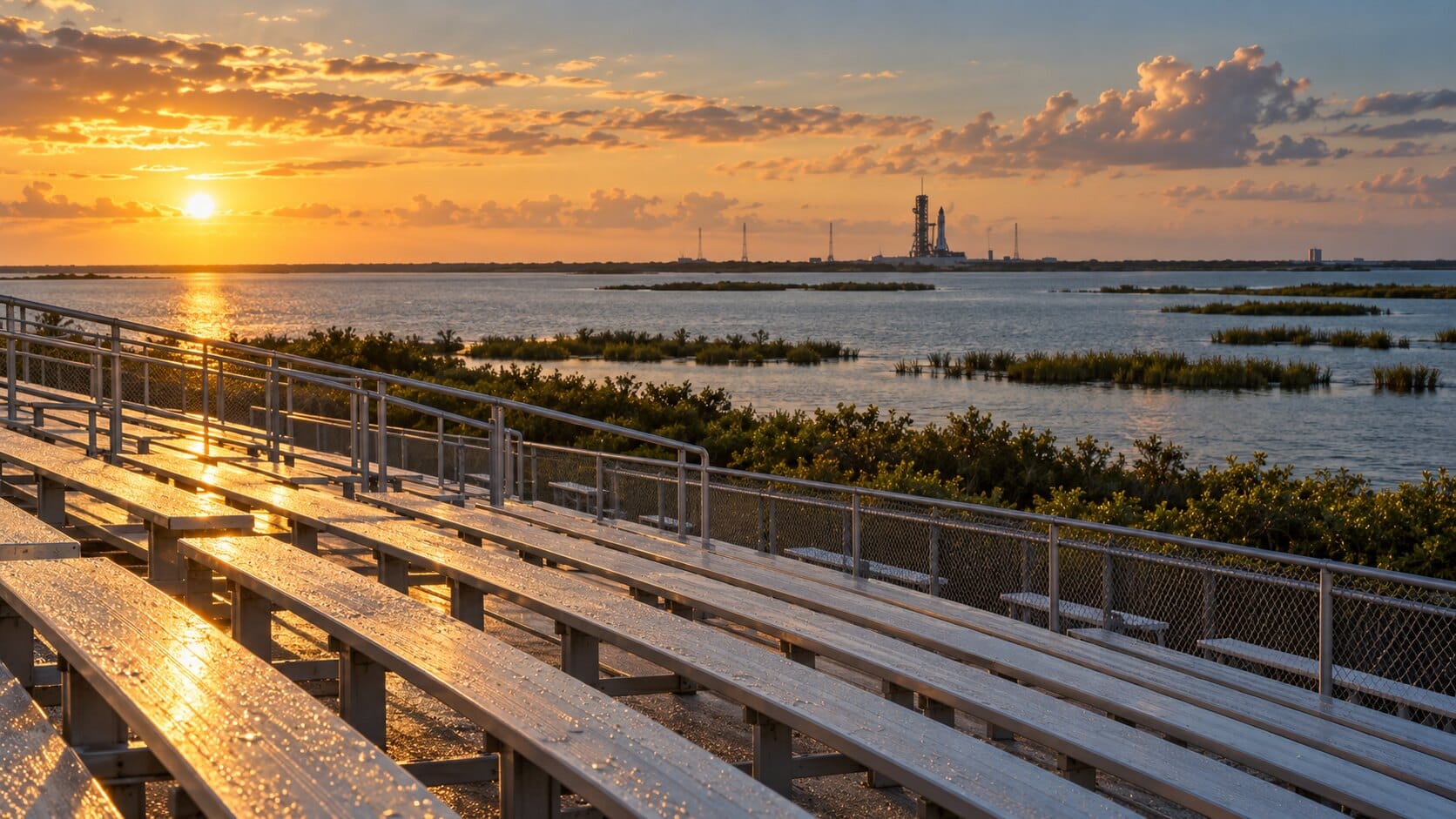
Bleachers and lawn are included with daily admission, seating is first come, first served. The complex usually operates from 9 a.m. to 5 p.m.; parking opens half an hour earlier and costs $15 per car, $5 per motorcycle and $20 per RV. On launch days hours can change, and for the biggest missions only holders of launch packages are admitted.
Common navigation mistake: typing "Kennedy Space Center" into your GPS instead of "Kennedy Space Center Visitor Complex." The first address takes you to a federal gate.
Free Spots: Titusville, the Beaches and Playalinda
Space View Park, Titusville
A city park on the Indian River with an unobstructed view of the pads and a PA system carrying the NASA control-center audio loop. There are restrooms and picnic areas, and the American Space Museum is a few minutes' walk away. The city does not post an admission fee. NASA lists it on its official viewing-site list along with Sand Point Park in Titusville and Alan Shepard Park and Cocoa Beach Pier in Cocoa Beach.
Photo tip: over the water you get the plume reflected in the river — for night launches that is the one shot you cannot get from KSC property.
The A. Max Brewer Bridge and the Parks Around It
The bridge area is popular with photographers for its open perspective over the water. Keep one thing in mind: for major launches, police close the bridge for about an hour after liftoff for pedestrian safety. Details are announced separately for each mission in Titusville's traffic advisories.
Playalinda Beach — The Closest Beach, With Caveats
Playalinda is part of Canaveral National Seashore. Entry costs $25 per vehicle for seven consecutive days, $20 per motorcycle and $15 per person on foot or by bicycle. The park does not accept cash — cards and contactless payments only.
- The launch time has to fall within park hours — 6 a.m. to 8 p.m. in summer, 6 a.m. to 6 p.m. in winter. A pre-dawn launch rules Playalinda out.
- The beach road closes 30 minutes before launch on the stretch from the gate to Parking Lot 1, and reopens only after liftoff or a scrub.
- Parking is allowed only in the designated beach lots — not on the shoulder.
- For missions with heightened security, the park can be closed. During the Artemis II campaign in 2026, Lots 1, 2 and 3 were closed, hours were cut short, and on launch day, April 1, Playalinda was shut.
Common mistake: showing up without water, food and a full tank. The NPS itself warns that "there are no facilities on the beach" — bring a chair, a hat and sunscreen.
Jetty Park, Port Canaveral
Open daily from 7 a.m. to 9 p.m., with a beach and a pier. Entry requires a pass bought online in advance — the gate takes neither cash nor cards. The view of the pads is partly blocked by a berm, so the first phase of flight can be hidden. For the biggest missions, passes can sell out ahead of time.
What Is Not Here, and Why
- Exploration Tower in Port Canaveral — closed since 2022 and, as of 2026, still empty.
- Specific admission prices for Jetty Park and Cocoa Beach parking — the port and the city do not publish current rates on their information pages.
- "A $99 Gantry ticket" — no such product exists. The platform is included with admission.
- A recommendation for a specific parking lot at Playalinda — the NPS does not name a best one.
- A buffer of X days as a rule — no official source gives such a number.
- "Launch viewing" boat trips — no official rules on restricted zones on the water were found.
KSC Tickets and Packages — What They Actually Get You
Kennedy Space Center sells launch viewing in three forms: viewing areas included with daily admission, an add-on bus ride closer to the pad (Launch Transportation Ticket — $75), and premium packages. The priciest package, "Feel the Heat," costs $250 plus tax and includes, among other things, admission on two target launch dates, transport to Banana Creek, a meal and a souvenir.
No ticket guarantees the launch will happen — KSC says so outright in its terms. Bleacher seating is first come, first served.
Scrub policy:
- Scrub before the complex opens — the package rolls to a new date, or you get a refund for unused, unscanned tickets.
- Scrub after opening but at least 3 hours before launch — items such as the meal and souvenir stay valid for the next attempt.
- Scrub less than 3 hours before launch — tickets stay valid for the original date only.
- Bus transport: if it ran on the second attempt, it counts as fully used and is not refundable.
When to Go and How Many Buffer Days to Allow
There is no official "come for X days" recommendation. There is a hard clue in the KSC terms: the package covers "two target launch dates," and the center itself advises flexible travel plans. So a sensible minimum is to plan your stay to cover at least two attempts — in practice three to four days on the Space Coast.
Since there are several launches a week, the second strategy is to flip the order: do not travel "for a specific mission," plan a week in Florida and pick the launch that falls inside that window. The current schedule with mission statuses is published by the Space Coast Office of Tourism, which also has a mobile app with a countdown and a compass.
Getting There, Parking and Getting Out After Launch
Kennedy Space Center is about 50 mi (80 km) from Orlando; you drive east on SR 50 or SR 528, then SR 405. No public transit reaches the Visitor Complex — without a car you are left with a commercial transfer or a rideshare. On-site parking costs $15 per car.
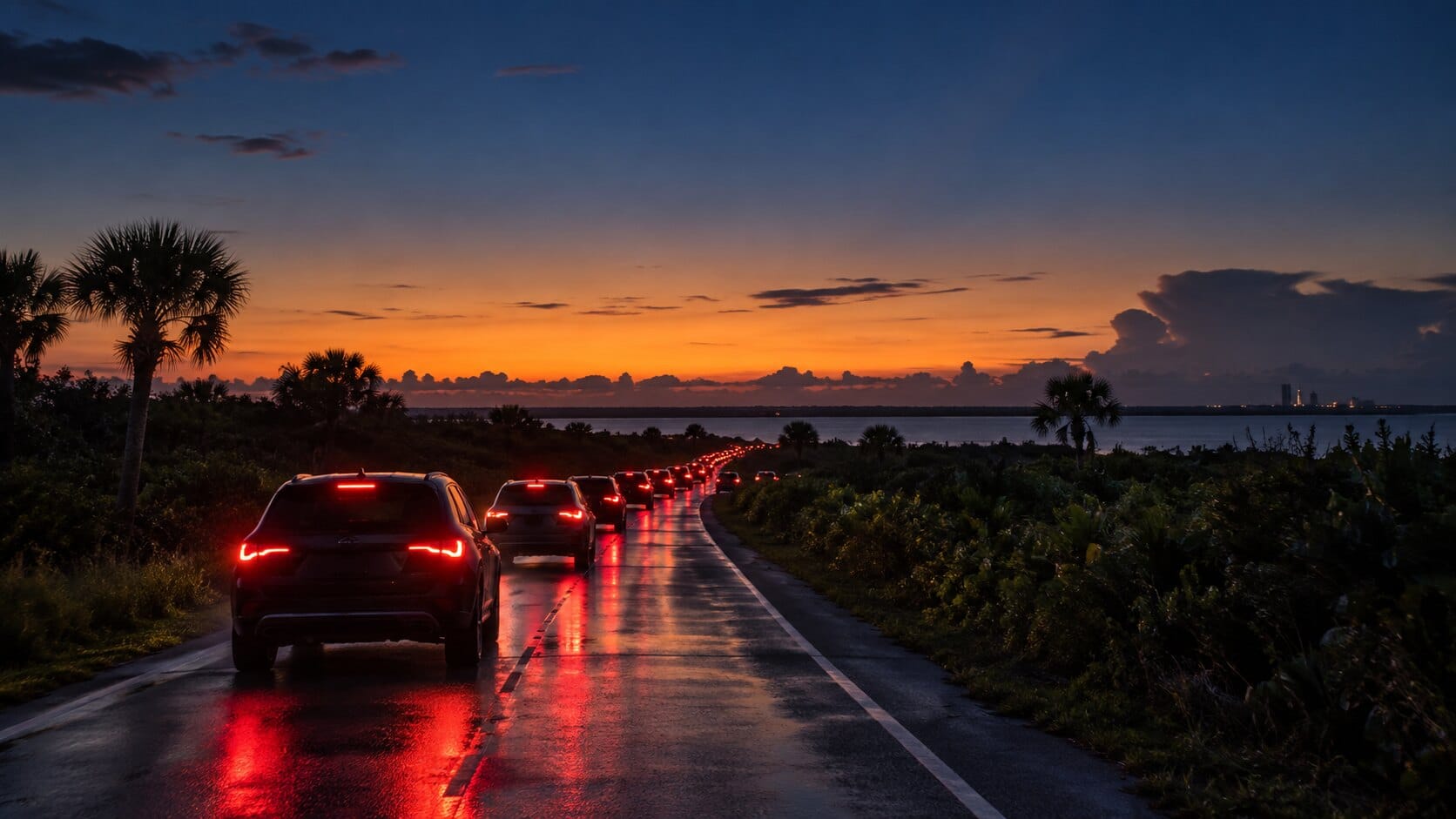
The free spots practically require a car, unless you are staying within walking distance. Watch for one shared rule: "parking on the shoulders of highways and on causeways is prohibited," and traffic is often diverted after a launch.
Common mistake: booking a return flight or an Orlando reservation right after the launch. Getting out of the area can take more than an hour, and the Titusville bridge is sometimes closed.
Weather and Scrubs
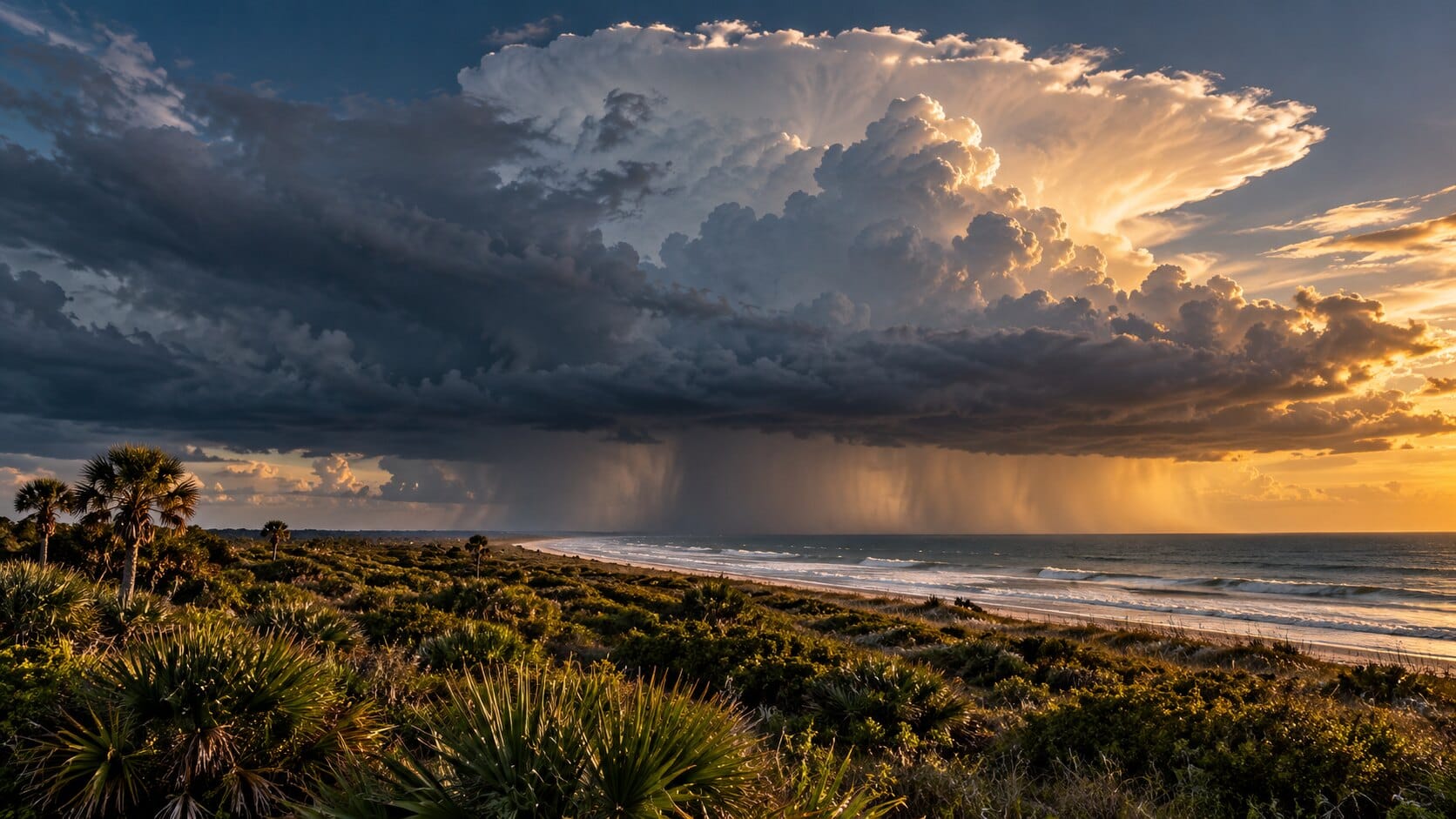
Forecasts for Florida launches are produced by the 45th Weather Squadron, the specialized meteorological unit supporting the Eastern Range. There are fourteen weather criteria, and breaking just one is enough to push a launch. The two that most often decide it:
- no launch for "30 minutes after a lightning strike" within 10 nautical miles,
- no launch with "sustained winds above 30 mph" at the 162-foot level.
Afternoon thunderstorms are the rule in Florida in summer — one reason so many launches happen at night and before dawn. If a mission has a middle-of-the-night window, check the viewing spot's hours first: Playalinda opens at 6 a.m., Jetty Park at 7 a.m., so both are out for a pre-dawn launch.
Florida Rocket Launches — Frequently Asked Questions
Read Next
For the current schedule with launch times, see rocket launches today. The sky phenomena section covers observations you can plan further ahead. And if you notice a string of lights a few days after a launch, check the Starlink tracker or what that light in the sky is — most likely the satellites that mission carried up.
Where is the best place to watch a rocket launch in Florida?
The closest legal spot is Banana Creek — 3.9 mi (6.3 km) from pad LC-39A — but getting in requires a Kennedy Space Center ticket plus an add-on bus transport ticket. Without a ticket, the best conditions are at Space View Park in Titusville: an open view across the Indian River and a PA feed of the control-center audio loop.
How much does it cost to watch a launch from Kennedy Space Center?
The viewing areas at the Visitor Complex are included with daily admission, plus $15 for parking. Transport to Banana Creek is another $75, and the premium "Feel the Heat" package is $250 plus tax. The Gantry at LC-39 platform is included with admission. Prices checked September 24, 2026.
Does a ticket guarantee I will see the launch?
No. Kennedy Space Center states it plainly: "purchasing a launch viewing ticket does not guarantee that the launch will occur." The package covers admission on two target dates, and detailed refund rules apply if the launch scrubs.
How many days should I set aside for a launch trip?
No official source gives a specific number. A sensible minimum follows from the terms: the KSC package covers two launch attempts, so plan a stay long enough to fit both — in practice three to four days.
Can I see a launch without a car?
No public transit reaches the Visitor Complex, so without a car you are left with a commercial transfer from Orlando or a rideshare. If you are staying in Titusville or Cocoa Beach, some of the free spots are within walking distance.
Can you always drive into Playalinda Beach?
No. The beach road is "closed 30 minutes before launch," and the park operates from 6 a.m. to 8 p.m. in summer and to 6 p.m. in winter, so pre-dawn launches are out. For missions with heightened security the park can close entirely — that is what happened during Artemis II in spring 2026.
Can I plan a trip around a Starship launch from Florida?
As of September 2026, no Starship has launched from Florida — the LC-39A site is still in preparation and testing. Plan your trip around a Falcon 9.
How do I check whether a launch will actually happen?
Mission status: Go means a confirmed date, TBC a preliminary one, TBD no set date. The Space Coast Office of Tourism publishes the schedule, and a quick overview is in the rocket launch calendar with local launch times. ---
Before you fix your dates, check the launches happening today and the countdown calendar.

Guide
Sky Phenomena
Everything visible overhead: aurora, meteors, eclipses and noctilucent clouds.
Live tool
Starlink Tracker
Pass times for your location — the satellite train is visible days after a launch.
Tools
Live Tools
Radars, maps and live widgets we use every day.

About the author
Krystian — guide and photographer
Who runs OndaTravel and why these tools exist.

Hi, I'm Krystian “dziadzia przewodnik” from OndaTravel.pl!
The North is my greatest passion, but the world is far too beautiful to stay in just one climate. On my blog, I combine the raw landscapes of Iceland and Norway with the exotic energy of Thailand or Vietnam, showing you how to travel authentically — with passion and a camera in hand.
What will you find on OndaTravel.pl?
Visual storytelling: As a photographer and filmmaker, I don’t just describe places — I take you there with professional photos and video.
North expert: Ready-to-use road trip plans for Iceland and Norway, smart tips for budget travel, and my original Northern Lights Radar (locations and forecast).
Travel through the lens of cinema: I track down filming locations — from icy scenes in Interstellar to tropical frames from world cinema.
New direction: Exotic destinations: I love contrast, so the blog is featuring more and more practical knowledge about Vietnam and Thailand. I’ll show you how to find your way around Southeast Asia and come back with your best memories.
P.S. follow me here