

What Is That Light in the Sky? Identify Starlink, Satellites, Planes and More
QUICK SKY IDENTIFIER
What is that light in the sky?
Start with four clues: how many lights there are, how they move, whether they blink or change color, and how long they remain visible. A smooth white point may be a satellite or the ISS; a regularly blinking object is more likely an aircraft; a line of evenly spaced points often suggests Starlink; and a short bright streak usually points to a meteor.
| What you see | Movement / lights | Typical duration | Likely source |
|---|---|---|---|
| One steady moving point | Smooth path, usually no navigation-light pattern | Several minutes | Satellite or ISS |
| A line or string of white points | Same direction and similar speed | Several minutes | Often a recently deployed Starlink train |
| Red, green or white flashes | May change apparent direction or approach you | Minutes | Aircraft |
| Hovering or abrupt direction changes | Can stop, climb or move sideways | Variable | Drone or another nearby object |
| Fast streak or brilliant flash | Crosses part of the sky very quickly | A fraction of a second to several seconds | Meteor or fireball |
| Very bright point that barely moves | Stays fixed relative to nearby stars | Hours | Planet or bright star |
SKY PHENOMENA
Sky Phenomena 2026
Use the main OndaTravel sky hub to explore meteors, eclipses, the Moon, aurora and practical observing tools.
Contents
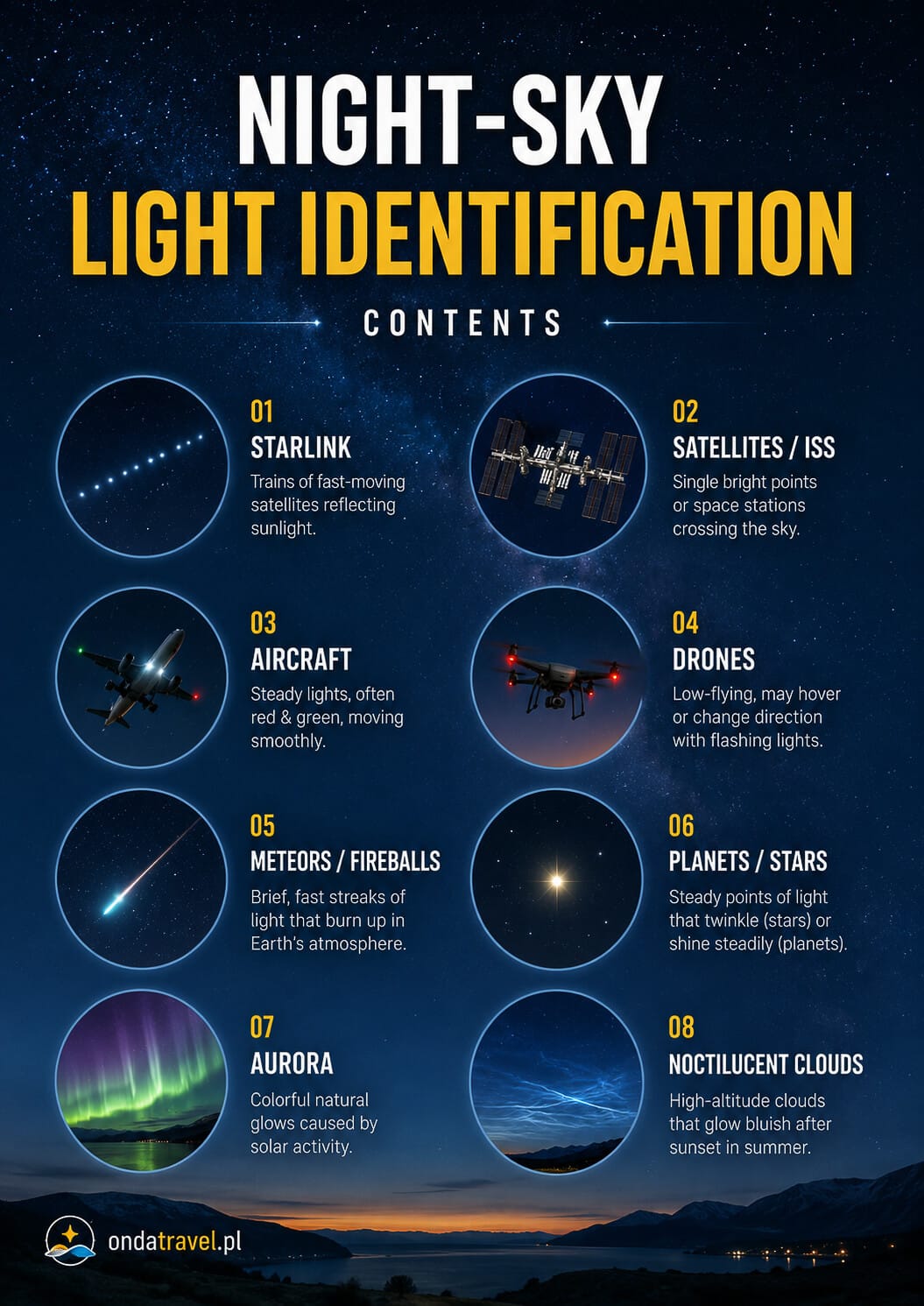
- Identify a light in 30 seconds
- One steady moving light — satellite or ISS?
- A line of lights — is it Starlink?
- Blinking lights — is it an aircraft?
- A hovering or turning light — drone?
- A fast streak — meteor or fireball?
- A bright stationary point — planet or star?
- Glow or luminous clouds — aurora or NLC?
- Rocket plumes, reentry and other lights
- How to check what you actually saw
- Does unidentified mean UFO or UAP?
- Frequently asked questions

Check out my YouTube channel and travel with me.
Follow the channel for videos, routes and practical travel inspiration.
Follow me here:
What’s up?
Enjoying my content?
Buy me a coffee at buycoffee.to/ondatravel and support the creation of more travel content.
Your support helps me create more practical guides, videos and travel inspiration.

How to identify a light in the sky in 30 seconds
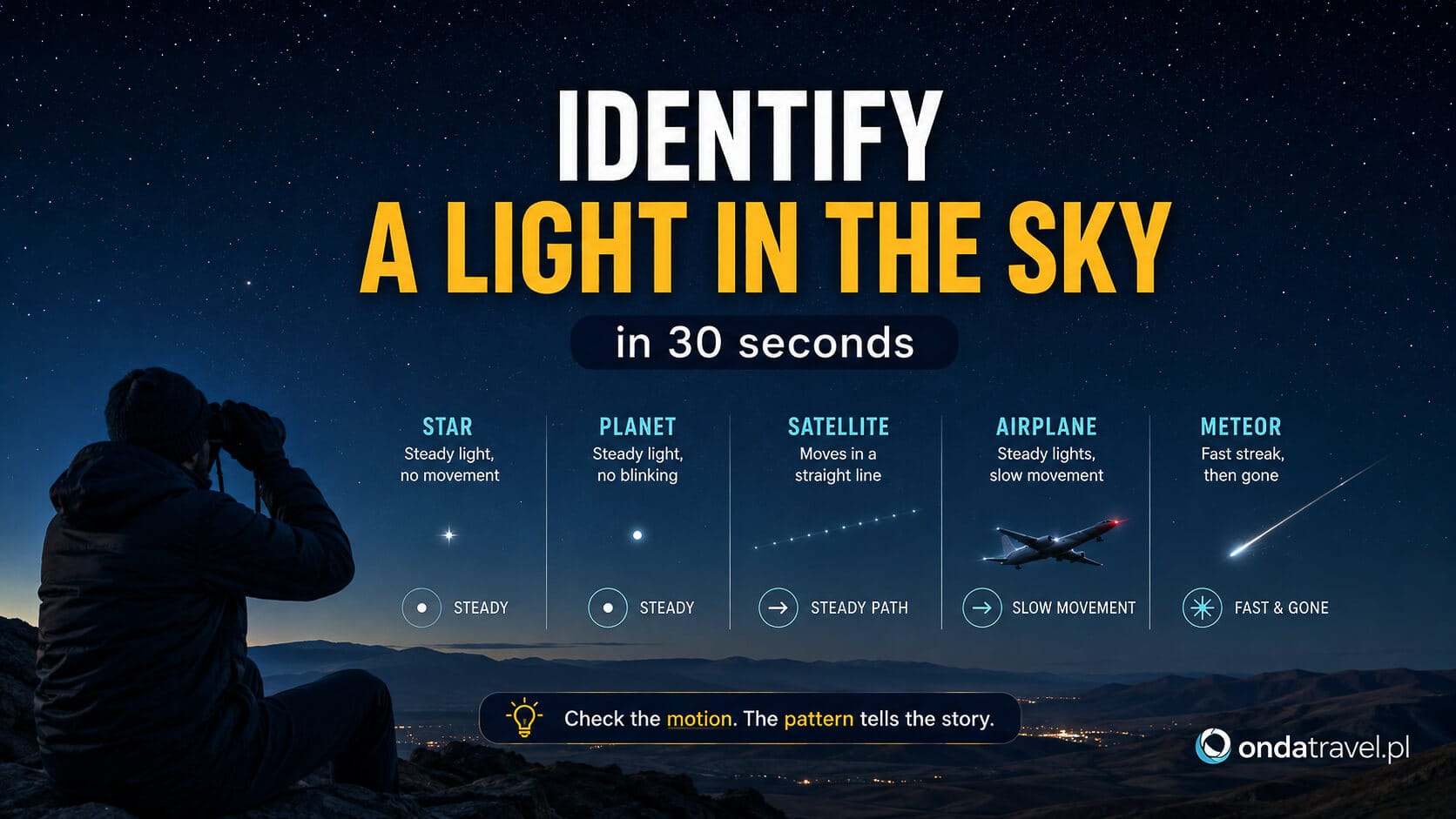
Before guessing the name of an object, describe what you actually see. The most useful clues are number of lights, direction and speed, blinking pattern, color, duration and whether the object can stop or change direction. These clues are usually more reliable than apparent size, because distance is extremely difficult to judge against a dark sky.
- Count the lights: one point, a pair, a cluster or a long line?
- Watch the motion: smooth and constant, drifting, hovering, accelerating or changing direction?
- Watch the light pattern: steady white light, regular flashes, red/green lights or changing brightness?
- Time it: a second, several seconds, a few minutes or almost stationary for hours?
One steady light moving across the sky — satellite or ISS?
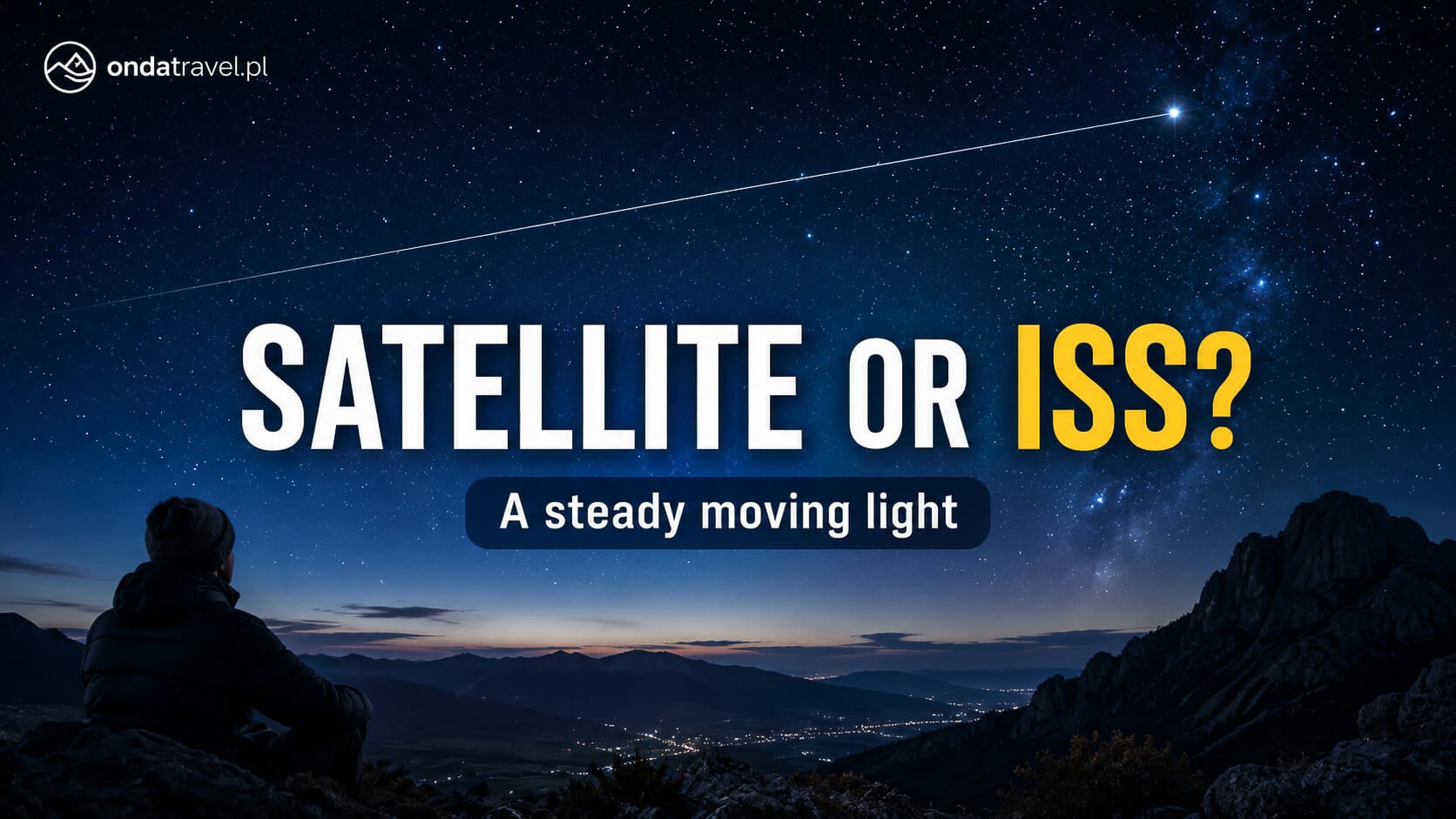
A single white point that moves smoothly across the sky without the familiar navigation-light pattern of an aircraft is often an artificial satellite. The International Space Station can be much brighter than most satellites and may look like an unusually bright star gliding steadily from one side of the sky to the other.
Satellites do not have to stay at exactly the same brightness. Their orientation can change, reflective surfaces can produce brief increases in brightness, and an object may fade quickly when it enters Earth’s shadow. For an ISS candidate, compare the exact time and your location with NASA Spot the Station. For other satellites, a sky-pass service such as Heavens-Above can help.
A line or string of lights — is it Starlink?
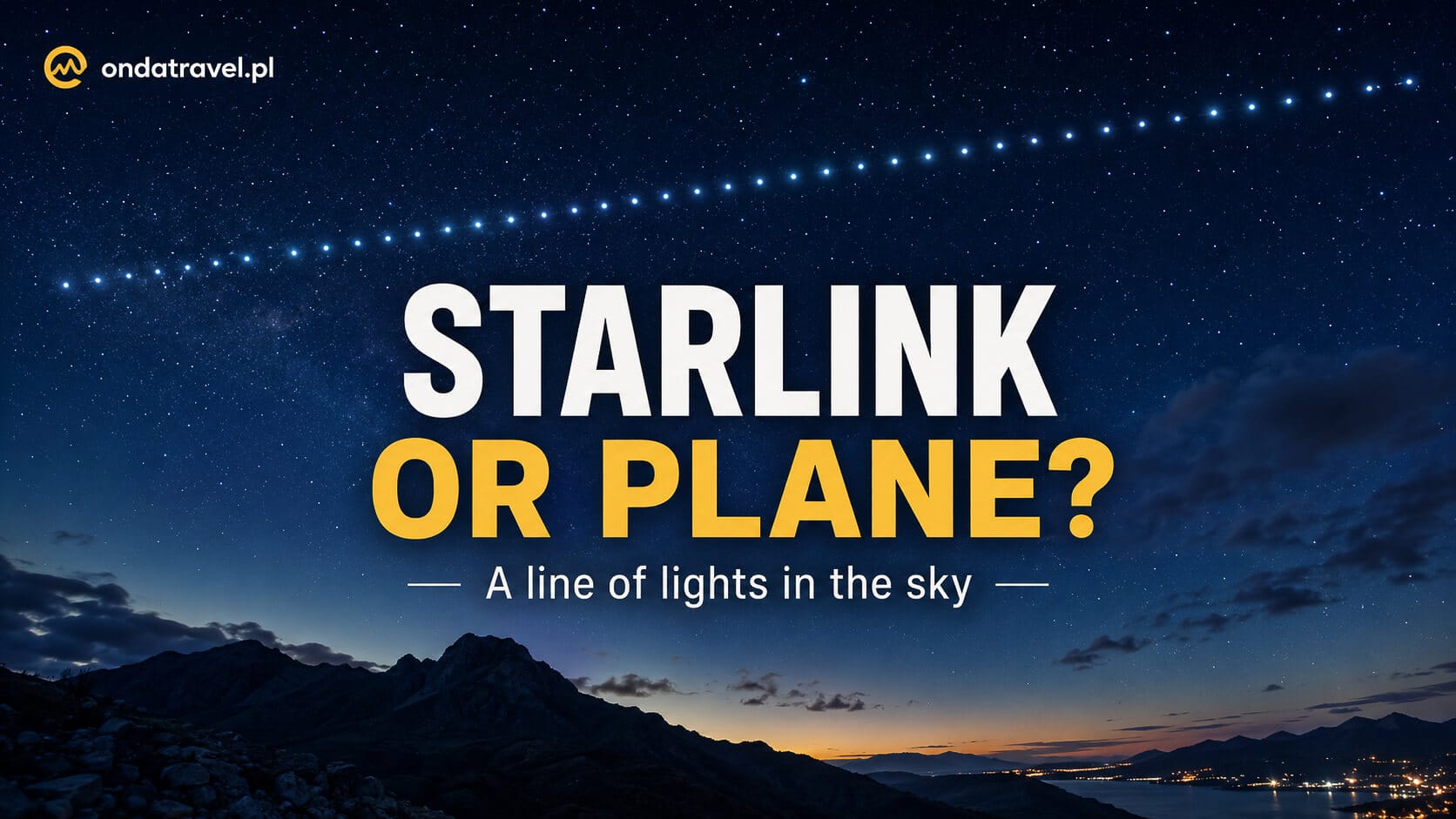
A row of white points moving in the same direction at similar speed is one of the most recognisable forms of a recently deployed Starlink train. Soon after deployment the satellites can appear close together; later they spread out, so operational Starlink satellites do not always look like a dramatic “train”.
Do not identify every line of lights as Starlink automatically. Aircraft approaching the same airport route, drones or nearer illuminated objects can sometimes create confusing patterns. Check whether the points are evenly spaced, whether they blink like aircraft and whether a Starlink pass was actually predicted for your location.

LIVE TRACKER
Starlink Tracker
Check the live map, upcoming passes and visibility when a line of moving lights looks like Starlink.
Blinking red, green or white lights — is it an aircraft?

Aircraft are usually easier to recognise once you notice a repeating light pattern. Navigation and anti-collision lights can produce red, green and bright white flashes, although the exact appearance depends on viewing angle, distance and the aircraft’s configuration.
A plane coming almost directly toward you can look surprisingly stationary for a while before its sideways motion becomes obvious. Sound can help, but do not rely on it: at long distance the sound may arrive late or be difficult to hear. If the time and direction matter, compare the observation with a current flight tracker.
A light that hovers or changes direction — could it be a drone?
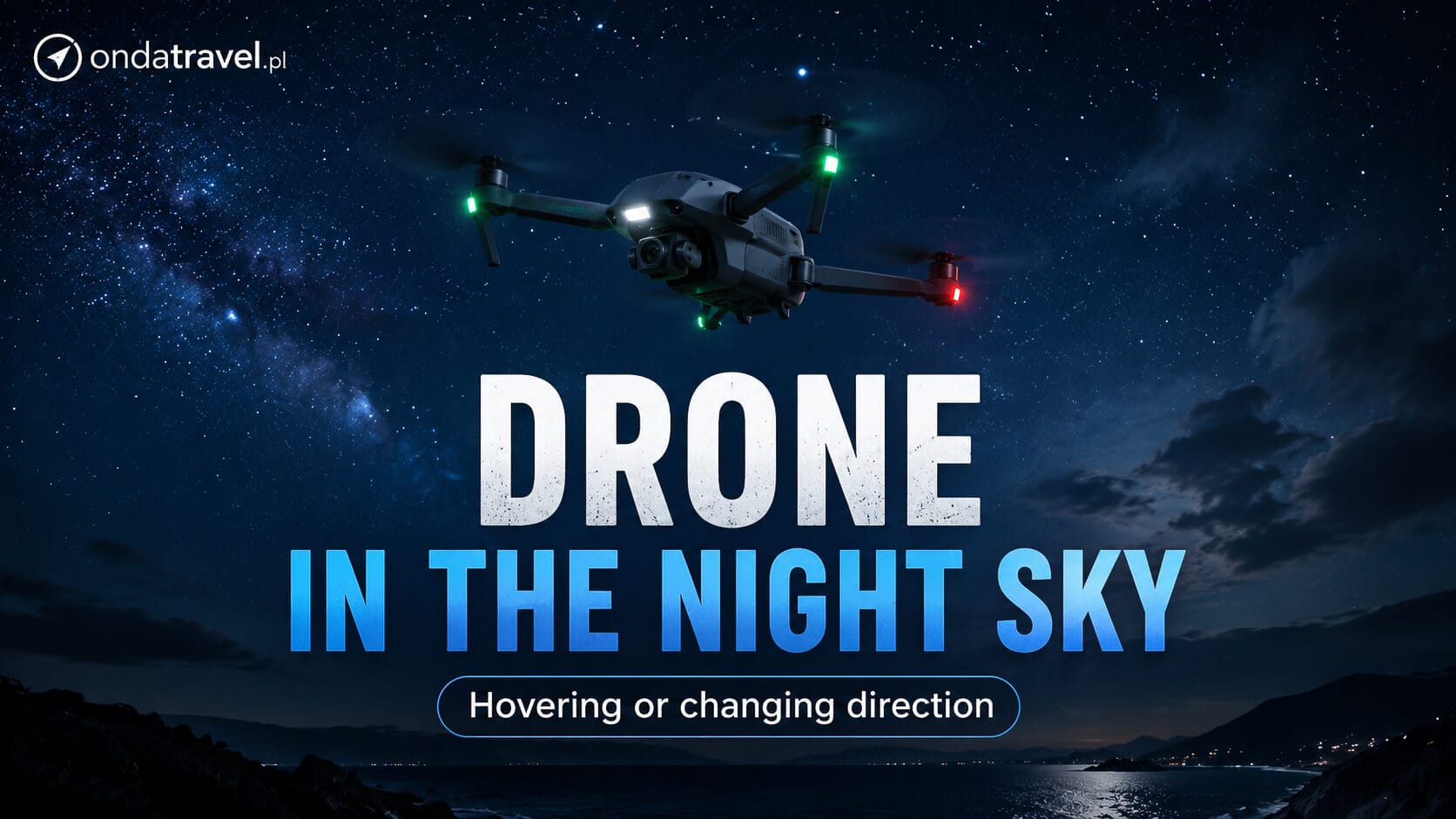
A drone is much closer than a satellite, which means it can behave in ways an orbital object cannot: it may hover, stop, move sideways, climb, descend or reverse direction. Its LEDs may also change color or brightness.
Distance at night is deceptive, so apparent hovering alone is not proof of a drone. An aircraft flying toward you can appear nearly motionless, and a bright star near the horizon can seem to move when thin clouds or camera shake change your reference points.
A fast streak or brilliant flash — meteor or fireball?
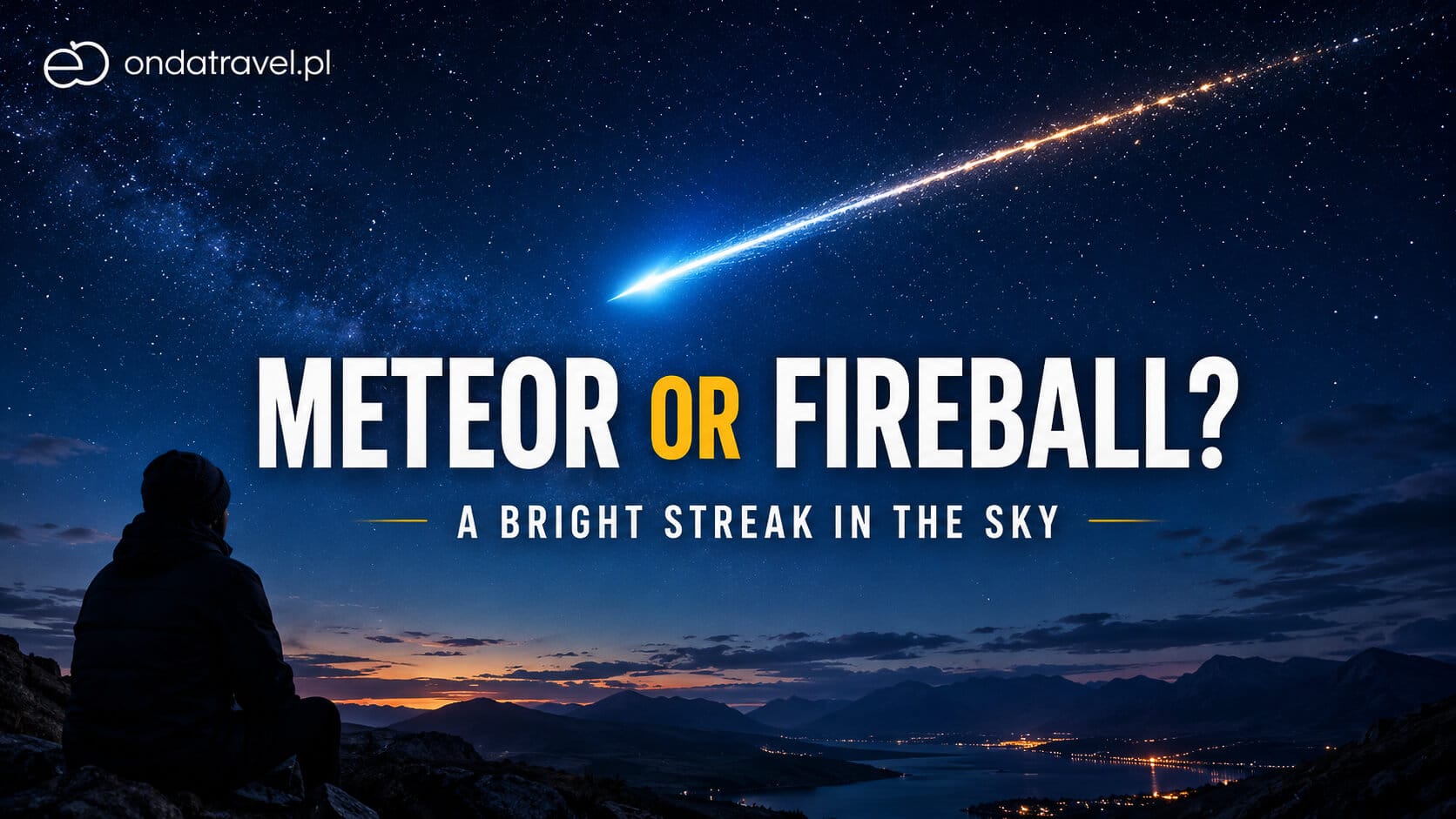
A meteor is fundamentally different from an aircraft or satellite because it is usually very fast. It may appear as a short streak, a bright flash or a longer luminous path lasting several seconds. Exceptionally bright meteors are commonly called fireballs.
A meteor does not have to vanish in a fraction of a second. Bright events can remain visible for several seconds and may leave a short-lived persistent trail. If you saw a bright meteor, compare the date with the current meteor-shower calendar; isolated sporadic meteors can also occur outside major showers.

OBSERVING CALENDAR
Meteor Shower Calendar 2026
Check upcoming meteor showers, peak nights and the best periods for observing shooting stars.
A very bright point that barely moves — planet or star?
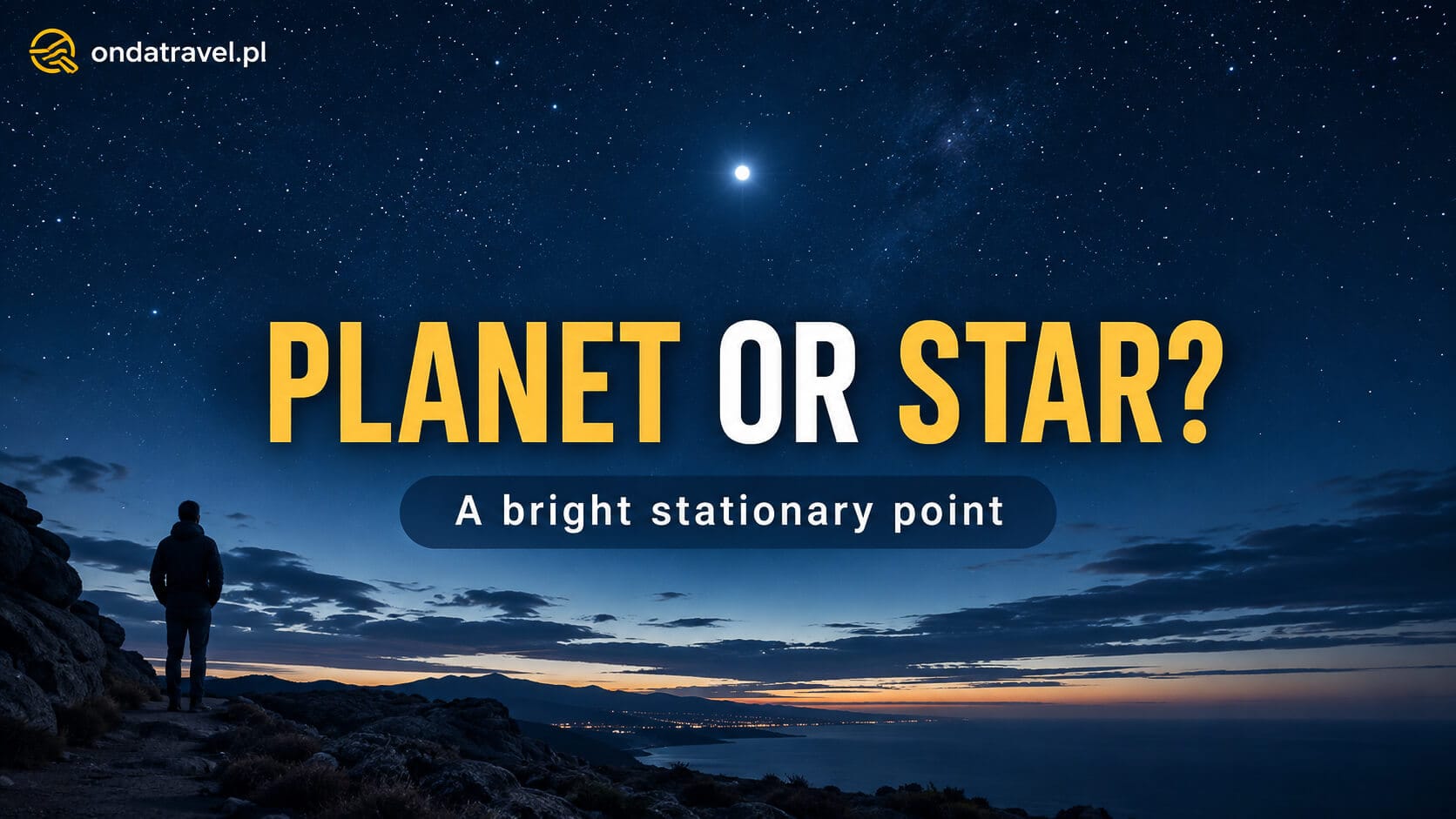
Venus and Jupiter are frequent causes of “what is that incredibly bright star?” questions. A planet does not cross the sky in a few minutes like a satellite. Instead, it remains in a stable position relative to nearby stars during a short observation.
Planets often appear steadier than stars, but the rule is not absolute. Atmospheric turbulence near the horizon can make even a bright planet shimmer, flicker or show changing colors. A current planetarium or sky-map app is the quickest way to confirm a stationary bright object.
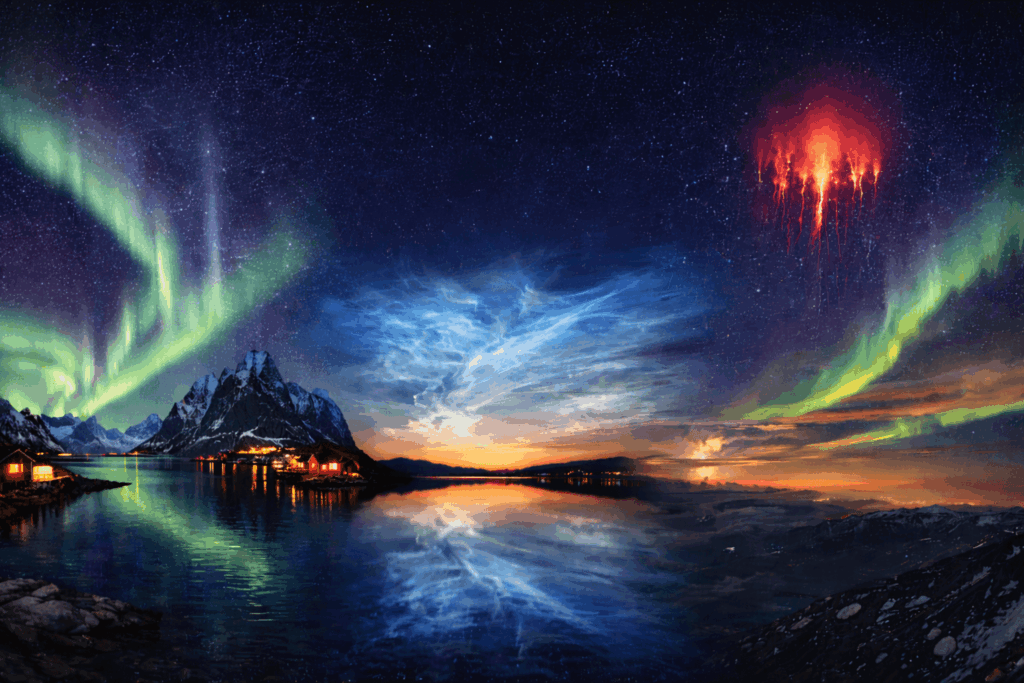
A glow or luminous cloud — aurora, NLC or reflected light?
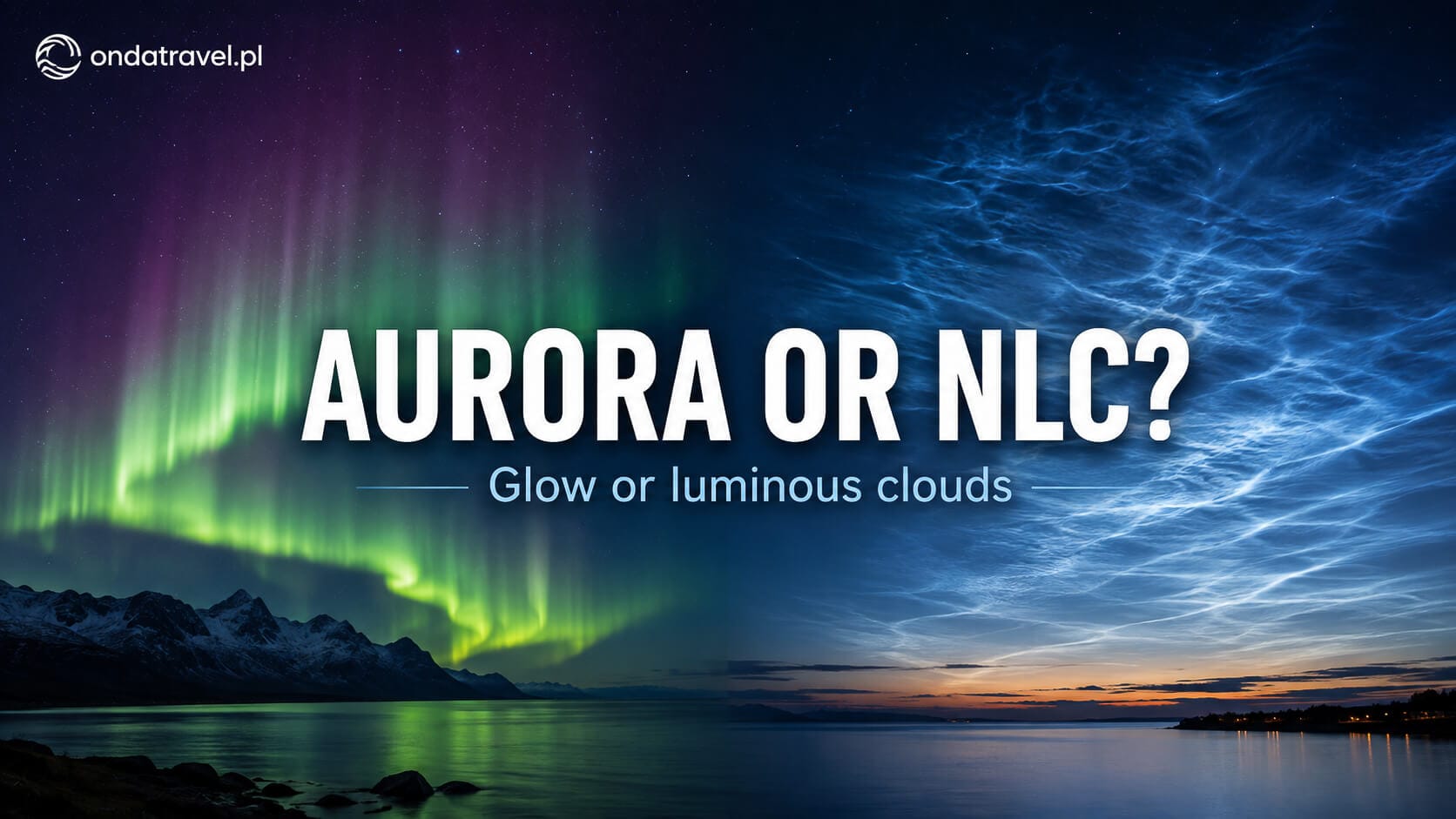
Not every unusual sky sight is a point of light. Aurora can appear as a diffuse glow, arc, band or curtain that changes shape over minutes. A weak aurora may look grey or almost colorless to your eyes while a phone or camera records much stronger green or red.
Noctilucent clouds, or NLC, are different. They form silver-blue ripples and bands very high in the atmosphere, most often around summer twilight at suitable latitudes. They remain sunlit after lower clouds are already dark.
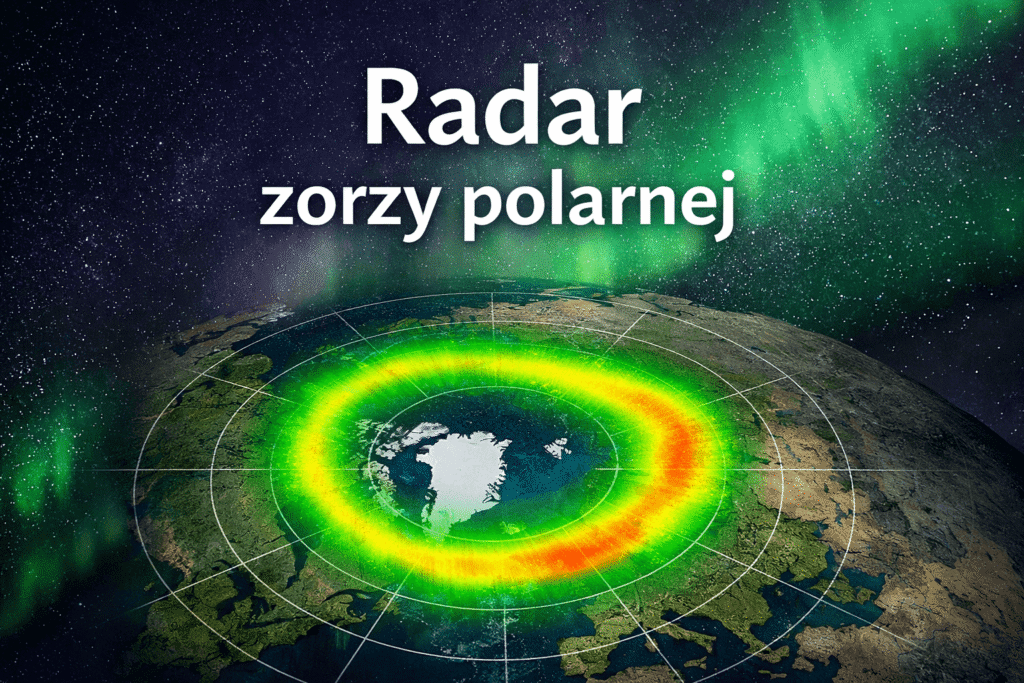
If the glow appears to sit on the underside of ordinary low clouds and repeatedly sweeps along the same route, check for ground-based spotlights or lasers. For aurora conditions use the OndaTravel Northern Lights Radar; for noctilucent clouds use the dedicated NLC Radar.

LIVE SKY TOOL
NLC Radar & Noctilucent Cloud Monitor
Check current NLC monitoring data when silver-blue twilight clouds appear near the horizon.
Rocket plumes, reentry, balloons, lanterns and other unusual lights

Moving patches of light on clouds may come from powerful spotlights or lasers on the ground rather than from an object in the sky. Repeated sweeps along the same path are a strong clue.
A slowly drifting point may be a balloon, lantern or another wind-driven object. Rocket launches can create expanding luminous clouds, fans, spirals or unusual plumes when high-altitude exhaust remains illuminated by the Sun after the ground is dark.
Atmospheric reentries can look different again: a spacecraft or rocket body may produce a long path that fragments into several glowing pieces. For spectacular observations, always check the exact date, local time and viewing direction before deciding what caused the event.
How to find out what you actually saw
The strongest identification combines appearance with data for one exact observation. Before the light disappears, record as much context as possible.
- Exact local time: even a one- or two-minute difference can matter for a satellite or aircraft.
- Location: town or coordinates are more useful than a broad region.
- Direction: note where it appeared and where it moved — north, east, south or west.
- Duration: seconds, minutes or effectively stationary?
- Movement: straight and smooth, drifting, hovering, turning or fragmenting?
- Original photo/video: keep the uncropped file because horizon, stars and metadata can be more useful than the bright point itself.
Aircraft: compare the time and direction with a current flight tracker. ISS: check NASA Spot the Station. Satellites: use a satellite-pass service. Starlink: use the OndaTravel Starlink Tracker. Meteors: compare the date with the meteor shower calendar. For a broader set of radars and maps, open OndaTravel Live Tools.
GUIDE
Live Tools: Aurora, Storms, Earthquakes, Starlink & Night Sky
Live radars, maps and calendars for checking auroras, storms, earthquakes, NLC, cyanobacteria and the night sky.
Does an unidentified light mean UFO or UAP?
No. UFO and the newer term UAP describe something that has not yet been identified from the available information. They do not, by themselves, establish an extraterrestrial origin.
Before using an extraordinary explanation, rule out aircraft, satellites and the ISS, Starlink, planets, meteors, drones, balloons, rocket activity and ground lights reflected from clouds. The key distinction is between unidentified and unexplainable: an observation can remain unidentified simply because the time, location, video quality or other data are insufficient.
A useful example of how quickly the word “UFO” can dominate a story is the Baltic Sea Anomaly. A real sonar observation became associated with much stronger claims than the publicly available evidence could establish. For formal UAP terminology and current official explanations, see the All-domain Anomaly Resolution Office.
PHENOMENA IN THE SKY
Baltic Sea Anomaly: What It Is, Location and Explanation
What is the Baltic Sea Anomaly and where is it? See sonar images, depth, coordinates, Ocean X claims and the most likely geological explanation.
Lights in the sky — frequently asked questions
How can I quickly tell Starlink from an airplane?
A recently deployed Starlink train usually appears as several white points moving in the same direction with similar spacing and no aircraft-style navigation-light pattern. An airplane is a single aircraft and often shows repeating white flashes plus red or green navigation lights, depending on viewing angle.
Can a satellite blink or change brightness?
Yes. Many satellites look like steady white points, but rotation, orientation and reflective surfaces can cause temporary brightening or repeated changes in brightness. Blinking alone is not enough to identify an object.
What is a very bright point that barely moves?
It is often Venus, Jupiter or a bright star. A planet remains almost fixed relative to nearby stars during a short observation instead of crossing a large part of the sky in a few minutes like a satellite.
How long is the ISS visible during a pass?
A visible ISS pass commonly lasts several minutes. The station moves smoothly across the sky and can fade or disappear quickly when it enters Earth’s shadow.
Can a planet twinkle or change color?
Yes. Planets usually appear steadier than stars, but atmospheric turbulence can make a bright planet shimmer or change color, especially when it is low above the horizon.
What is the difference between a meteor, a fireball and a meteorite?
A meteor is the visible light produced as material travels through the atmosphere. A fireball is an exceptionally bright meteor. A meteorite is material that survives the atmospheric passage and reaches the ground.
Why did a moving light suddenly disappear?
A satellite may fade when it enters Earth’s shadow, while a cloud can hide a more distant object. An aircraft can also change apparent brightness as its angle to you changes. The exact time and direction help distinguish these possibilities.
Does every unexplained light count as a UFO or UAP?
An observation may be called unidentified when there is not enough information to identify it, but that does not mean it has an extraterrestrial origin. Many reports can later be matched to aircraft, satellites, Starlink, planets, meteors, drones, balloons or other ordinary sources.
What should I record if I want to identify the light later?
Record the exact time, location, direction, duration, motion and colors. Keep the original photo or video without cropping it because the horizon, stars and file metadata can be more useful than the bright object alone.
Night-sky tools and guides
Once you have narrowed down the type of object or phenomenon, use a specialist tool or guide rather than guessing from appearance alone. These OndaTravel pages help plan and verify night-sky observations.
LIVE TOOLS
Radars, maps and trackers
Live Tools
Open OndaTravel tools for aurora, storms, Starlink, noctilucent clouds and other live conditions.
Open live tools
MOON
Plan darker nights
Moon Phases 2026
Check new moons, full moons and lunar phases before planning meteor, Milky Way or faint-sky observations.
Check Moon phases
ASTROPHOTOGRAPHY
Camera guide
How to Photograph the Night Sky
Camera settings and practical techniques for stars, meteors, the Milky Way, the Moon and aurora.
Open photography guide
NIGHT-SKY PHENOMENON
Seasonal observing guide
Noctilucent Clouds (NLC)
Learn when noctilucent clouds appear, what they look like and how to distinguish them from ordinary clouds.
Open NLC guide


Hi, I’m Krystian “dziadzia przewodnik” from OndaTravel.pl!
The North is my greatest passion, but the world is far too beautiful to stay in just one climate. On my blog, I combine the raw landscapes of Iceland and Norway with the exotic energy of Thailand or Vietnam, showing you how to travel authentically — with passion and a camera in hand.
What will you find on OndaTravel.pl?
Visual storytelling: As a photographer and filmmaker, I don’t just describe places — I take you there with professional photos and video.
North expert: Ready-to-use road trip plans for Iceland and Norway, smart tips for budget travel, and my original Northern Lights Radar (locations and forecast).
Travel through the lens of cinema: I track down filming locations — from icy scenes in Interstellar to tropical frames from world cinema.
New direction: Exotic destinations: I love contrast, so the blog is featuring more and more practical knowledge about Vietnam and Thailand. I’ll show you how to find your way around Southeast Asia and come back with your best memories.
P.S. follow me here

