

Strong G3 Geomagnetic Storm (Kp 7), 10–11 October 2026: CME Hits Earth – Northern Lights in the UK?
Strong G3 geomagnetic storm (Kp 7) reached on 10 October — will you see the Northern Lights in the UK tonight?
Strong G3 geomagnetic storm (Kp 7) reached on 10 October 2026 — twice, at 17:58 UTC (18:58 BST) and again at 19:27 UTC (20:27 BST). A CME shock hit Earth’s magnetic field at 15:16 UTC (16:16 BST). For the rest of the night of 10/11 October NOAA forecasts Kp 5.67 (G2) for 00:00–03:00 UTC (01:00–04:00 BST) on 11 October, then a weakening storm. The sky is dark (New Moon on 10 October) — but you need clear skies and a southward Bz. Check the live data below.
Data status: NOAA SWPC (alerts up to 10 Oct 2026, 21:45 UTC; observed Kp and Kp forecast updated around 22:30 UTC) and NASA CCMC DONKI.
The Sun has had an unusually restless week. Active region 4549 has fired off a series of flares — including an M6.7 and an M6.4 — and several coronal mass ejections (CMEs). On Saturday afternoon, 10 October, the first of them hit Earth, and by the evening the geomagnetic storm had reached G3 (strong, Kp 7) — twice. This page collects only verified NOAA SWPC and NASA bulletins, gives every time in both UTC and BST, and tells you plainly where and when to look for the Northern Lights in the UK this night, 10–11 October. The news feed and live data box below update automatically.

Check out my YouTube channel and travel with me.
Follow the channel for videos, routes and practical travel inspiration.
Follow me here:
What’s up?
Enjoying my content?
Buy me a coffee at buycoffee.to/ondatravel and support the creation of more travel content.
Your support helps me create more practical guides, videos and travel inspiration.

Geomagnetic storm live — latest updates
AURORA NEWS · NOAA SWPC
What is happening on the Sun and around Earth right now
The latest NOAA SWPC bulletins — geomagnetic storms, flares and CMEs. Editorial entries are added by hand; new NOAA bulletins appear here automatically every 5 minutes (times in UTC).
- 10 Oct, 19:27 UTCKp 7 again: G3 strong storm confirmed for 18–21 UTCSTORM
At 19:27 UTC (20:27 BST) NOAA SWPC issued a second Kp 7 (G3) alert, this time for the 18:00–21:00 UTC window. Observed Kp for that period: 6.67. Kp 7 meets the thresholds in this article for most of the UK.
- 10 Oct, 17:58 UTCG3 strong storm reached: Kp 7STORM
At 17:58 UTC (18:58 BST) NOAA SWPC confirmed Kp 7, a G3 (strong) geomagnetic storm, for the 15:00–18:00 UTC window (observed Kp 7.00). At G3 the aurora can reach around 50° geomagnetic latitude.
- 10 Oct, 17:42 UTCNOAA warning: Kp 7 or greater (G3) expectedWARNING
At 17:42 UTC (18:42 BST) NOAA SWPC issued a warning for Kp 7 or greater (G3), valid until 23:59 UTC on 10 October (00:59 BST on 11 October).
- 10 Oct, 17:17 UTCG2 storm reached: Kp 6STORM
At 17:17 UTC (18:17 BST) NOAA SWPC confirmed Kp 6, a G2 (moderate) geomagnetic storm — the level warned of earlier in the afternoon.
- 10 Oct, 15:35 UTCG1 geomagnetic storm under way — NOAA warns of G2STORM
At 15:35 UTC (16:35 BST) NOAA SWPC confirmed Kp 5, a G1 storm. Earlier it issued a warning for Kp 6 (G2) valid until 23:59 UTC (00:59 BST). That is good news for Scotland and Northern Ireland tonight, but only if Bz turns southward.
- 10 Oct, 15:16 UTCImpact: the CME shock has hit Earth’s magnetic fieldIMPACT
Magnetometers recorded a sudden impulse of 56 nT (Niemegk station, Germany) at 15:16 UTC (16:16 BST) — the moment the cloud of solar plasma struck Earth’s magnetosphere.
- 10 Oct, 15:10 UTCAnother strong flare: M6.4 from the same region, 4549FLARE
Peak at 15:10 UTC, location N08W50, with short R2 radio blackouts on the sunlit side of Earth. It came with a Type II radio burst (about 929 km/s), a likely sign of a new CME — coronagraph analysis is still pending.
- 10 Oct, 14:43 UTCSolar wind jumps from about 380 to 600 km/sIMPACT
The SOLAR-1 (SWFO-L1) spacecraft at the L1 point detected an interplanetary shock: plasma density rose to around 119 particles per cm³ and the total field Bt reached about 46 nT — values typical of strong storms. Preliminary data.
- 9 Oct, 16:36 UTCNOAA: G2 storm watch for 11 OctoberWATCH
A G2 (moderate) watch for 11 October and G1 for 9–10 October, linked to several CMEs launched between 6 and 8 October.
- 8 Oct, 16:44 UTCM6.7 flare launches an Earth-directed CMECME
Coronagraph imagery showed a mass ejection from region 4549, with a shock of about 720 km/s according to preliminary SWPC analysis. NASA’s WSA-ENLIL model put its arrival on 11 October, roughly 09:00–21:00 UTC (10:00–22:00 BST).
- 8 Oct, 15:48 UTCStrongest flare of the week: M6.7 (R2)FLARE
Region 4549 (N12W20) produced an M6.7 flare peaking at 15:48 UTC. Its magnetically complex beta-gamma-delta layout favours powerful eruptions.
- 6 Oct, 06:23 UTCFull halo CME after an M1.4 flareCME
The ejection appeared as a full halo around the Sun — a sign the cloud was heading our way. Speed about 570 km/s (NASA DONKI). This cloud, together with two more, is linked to the impact on 10 October.
Quick view from the OndaTravel aurora monitor (Kp over the last 24 hours, forecast peak and active NOAA alerts):
live update
Geomagnetic activity - live
Kp now
3.7
3-day forecast
5.00
Active watch
G1+
Want a heads-up before the aurora starts? Sign up for OndaTravel aurora alerts — we only send them when there is a realistic chance of a sighting.
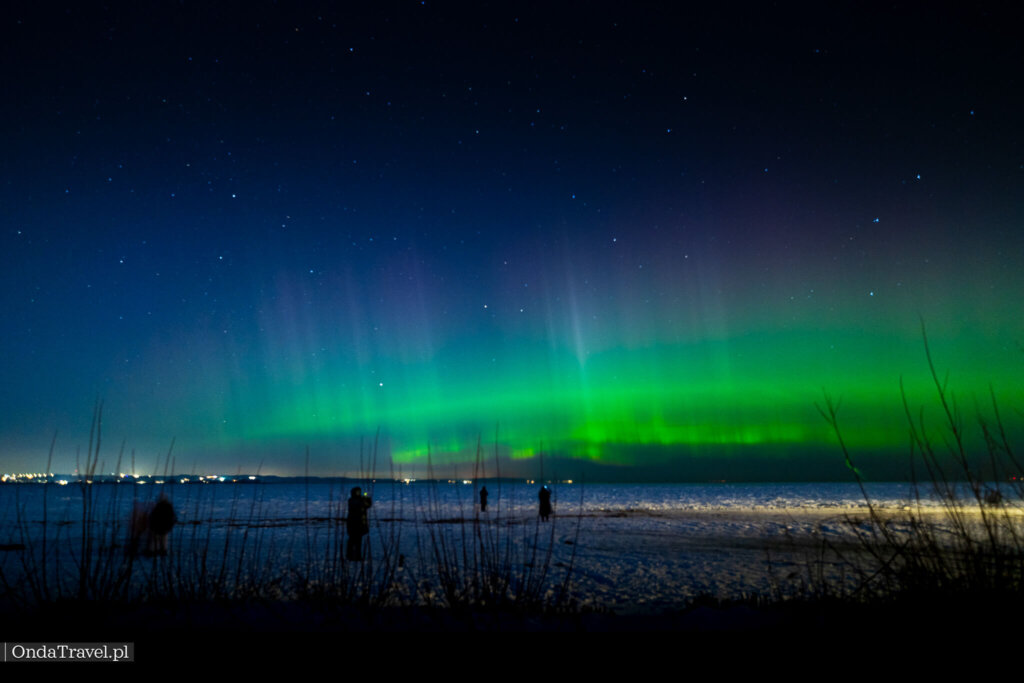
AURORA ALERTS
Aurora Alerts — get notified when chances rise
Alerts when NOAA raises the storm level and conditions start to look promising.
Will the Northern Lights be visible in the UK tonight, 10–11 October?
In short: yes, there is a real chance this night, 10–11 October — but no guarantee. At G3 (Kp 7), reached on 10 October, the aurora is possible across Scotland, Northern Ireland and northern England, and often further south on camera: Kp 7 meets the thresholds below for most of the UK. NOAA expects the storm to ease to G2 (Kp 5.67) for 00:00–03:00 UTC (01:00–04:00 BST) on 11 October and then weaken further. Whether the aurora reaches the UK depends on the direction of the magnetic field inside the cloud (Bz). When Bz is negative (southward) for more than about half an hour, energy pours into the magnetosphere and the auroral oval expands south. When Bz is positive, even a very strong cloud largely passes us by. Straight after the impact, Bz swung between about −16 and +34 nT — typical of the leading edge of a CME. Follow it in the live box above or on our Northern Lights UK live radar and forecast.
| Area | Kp needed | Chance at G3 (Kp 7) / at the forecast G2 (Kp 5.67) |
|---|---|---|
| Shetland, Orkney, northern Scotland | ≥ 5 | good at Kp 7 — possibly visible to the naked eye; still good at Kp 5–6 |
| Central Scotland, Northern Ireland | ≥ 6 | good at Kp 7; realistic at Kp 6 — best from the coast or dark countryside, low in the north |
| Northern England, North Wales | ≥ 6–7 | realistic at Kp 7, often on camera; low at Kp 5–6 |
| Midlands, southern England | ≥ 7–8 | possible on camera at Kp 7–8; low at the forecast Kp 5–6 |
When to look? For the rest of the night of 10/11 October: astronomical darkness lasts until roughly 05:10 BST on 11 October (it varies with latitude). The NOAA warning for Kp 7 or greater ran until 23:59 UTC on 10 October (00:59 BST on 11 October); the updated forecast gives Kp 5.67 (G2) for 01:00–04:00 BST and 4.67 (G1) for 04:00–07:00 BST. New Moon fell on 10 October (15:50 UTC), so there is no moonlight to wash out the sky.
Where to stand? Away from street lights, with an open view to the north: a beach, a loch or lake shore, a hilltop or open fields. Check the Met Office cloud forecast first — under full cloud cover no storm will help.

LIVE RADAR
Northern Lights in the UK — live radar and forecast
Auroral oval, Kp, Bz and cloud cover in one place. Check it before you head out.
What happened on the Sun: M6.7 and M6.4 flares and a series of CMEs
The source of all this is active region 4549 — a large sunspot group with a complex magnetic layout (beta-gamma-delta) that spent the week crossing the centre of the Sun’s disc, directly facing Earth. Below are the key events, each with its source and status.
| Time (UTC) | Event | Source | Status |
|---|---|---|---|
| 6 Oct, 06:10 | M1.4 flare and full halo CME, about 570 km/s | NASA DONKI | confirmed |
| 6 Oct, 08:05 | M1.8 flare and another CME, about 420 km/s | NASA DONKI | confirmed |
| 7 Oct, 13:17 | C7.9 flare and a slower CME, about 310 km/s | NASA DONKI | confirmed |
| 8 Oct, 15:48 | M6.7 flare (R2), CME with a shock of about 720 km/s | NOAA SWPC, DONKI | preliminary analysis |
| 10 Oct, 14:33–14:43 | Interplanetary shock in the solar wind (L1) | NOAA SWPC, DONKI | confirmed |
| 10 Oct, 15:10 | M6.4 flare (R2), Type II radio burst about 929 km/s | NOAA SWPC | CME unconfirmed |
| 10 Oct, 15:16 | Geomagnetic sudden impulse, 56 nT | NOAA SWPC | confirmed |
| 10 Oct, 15:35 | Kp 5 — G1 storm | NOAA SWPC | confirmed |
| 10 Oct, 17:17 | Kp 6 — G2 storm | NOAA SWPC | confirmed |
| 10 Oct, 17:58 | Kp 7 — G3 storm (15–18 UTC) | NOAA SWPC | confirmed |
| 10 Oct, 19:27 | Kp 7 — G3 again (18–21 UTC) | NOAA SWPC | confirmed |
NASA links the 10 October shock to the three clouds launched on 6 and 7 October; its models had expected further CMEs (including the one from the M6.7 flare) to arrive on Sunday, 11 October. NOAA’s updated Kp forecast (around 22:30 UTC on 10 October) no longer shows a storm on 12 October. To compare this storm with the truly big events, see our guide to the biggest aurora storms in UK history.

HISTORY
The biggest aurora storms ever seen over the UK
When the Northern Lights reached southern England — and what Kp it took.
NOAA forecast for 11–12 October 2026 (updated)
NOAA SWPC updated its Kp forecast around 22:30 UTC on 10 October. The storm has already been stronger than the earlier forecast: observed Kp reached 7.00 for 15:00–18:00 UTC and 6.67 for 18:00–21:00 UTC on 10 October, well above the earlier forecast of 4.67 for that evening. Updated forecast (BST = UTC + 1 hour):
| Date | Window (UTC / BST) | Kp forecast | Scale |
|---|---|---|---|
| 11 Oct, night | 00:00–03:00 UTC (01:00–04:00 BST) | 5.67 | G2 |
| 11 Oct, before dawn | 03:00–06:00 UTC (04:00–07:00 BST) | 4.67 | G1 |
| 11 Oct, rest of the day and evening | 06:00–24:00 UTC (07:00–01:00 BST) | 3.67–4.00 | no storm |
| 12 Oct | whole day | max 4.33 | no storm |
The storm was driven by the arrival of several CMEs. NOAA gives a 55% chance of M-class flares (R1–R2) until 12 October, mainly from region 4549; its 3-day forecast issued at 12:30 UTC on 10 October also gave 10% for stronger flares (R3+) and 10% for an S1 radiation storm. This table is a forecast, not a promise — new bulletins appear automatically in the news feed at the top of this page.
Want to understand how NOAA builds these forecasts and why the timing can be out by several hours? We explain it in our guide to the aurora forecast tonight — how to read the live data.
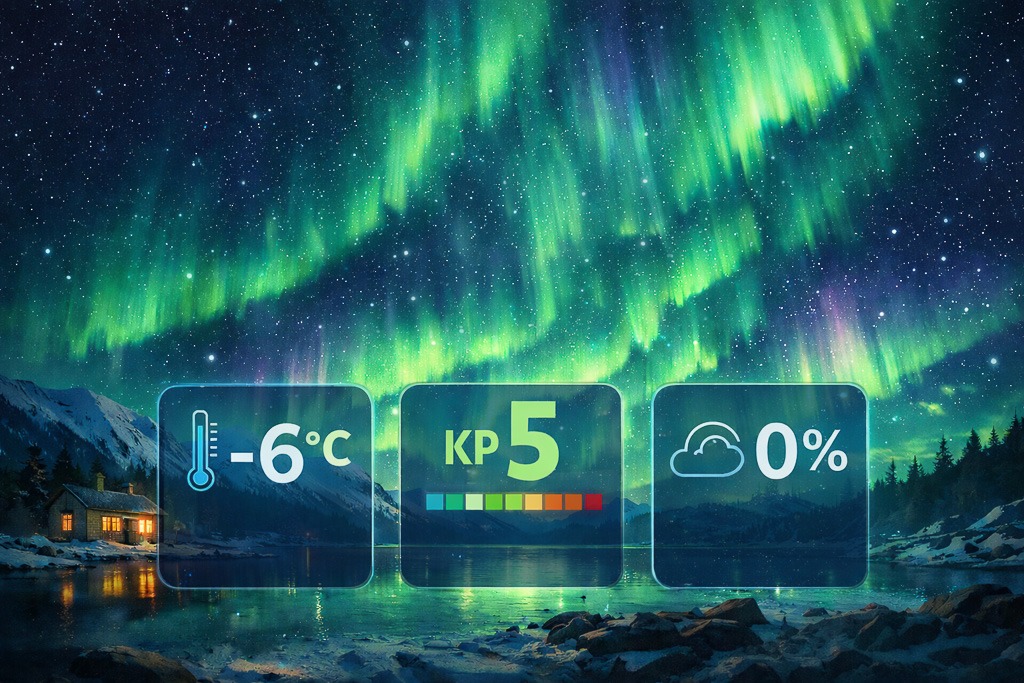
GUIDE
How to read an aurora forecast: Kp, Bz, Bt and solar wind
What the NOAA numbers mean and how to turn them into a decision: go out or stay in.
Kp, Bz, Bt and solar wind speed — what the live numbers mean
| Parameter | What it tells you | Good sign for the UK |
|---|---|---|
| Kp | Global level of disturbance in Earth’s magnetic field, scale 0–9 | 5+ for Scotland, 6–7+ for northern England |
| Bz | Direction of the magnetic field in the solar wind | negative, e.g. −10 nT, holding for 30+ minutes |
| Bt | Total strength of that field — how much “fuel” the cloud carries | 20 nT or more |
| Solar wind speed | How fast the plasma hits the magnetosphere | above 500 km/s |
Kp is calculated with a delay of a few hours, so Bz gives the earliest hint of aurora: a spacecraft at L1 sees the cloud roughly 30–60 minutes before it reaches Earth. That is why aurora watchers check Bz and Bt first and Kp second. Colour on phone photos often shows up before you can see anything with the naked eye, because the camera collects light for several seconds. If you see a bright dot or a string of lights moving across the sky, that is not the aurora: find out how to identify Starlink, satellites and other lights in the sky.
NOT JUST AURORA
What is that light in the sky?
Starlink, satellites, planes, flares — how to tell them apart from the aurora in seconds.
How to watch and photograph the aurora tonight — checklist
- Clouds come first. Check the Met Office cloud forecast for the next few hours and look for gaps towards the north.
- A dark spot with a view north. Ideally 20–30 km from a large town or city; coasts and big lochs or lakes give the lowest horizon.
- Give your eyes 15–20 minutes. Switch off bright screens and use a red light — your eyes need time to adapt to the dark.
- Phone: night mode and a tripod. Exposure of 3–10 seconds, focus at infinity, flash off. Further south in the UK the aurora usually looks like a pink-green glow low on the horizon in photos.
- Camera: 15–20 mm, f/2.8, ISO 1600–3200, 5–15 seconds. Shorten the exposure when the display moves quickly.
- Be patient. Activity comes in waves (substorms) lasting 20–40 minutes. One quiet spell does not mean the night is lost.
Stay safe: never stop on a motorway hard shoulder or a busy road verge to look up, dress warmly (October nights in Scotland and on exposed coasts can drop to a few degrees), and tell someone where you are going if you head somewhere remote.
Is the geomagnetic storm dangerous? Radio, GPS and health
On NOAA’s official scale, a G3 (strong) storm — the level reached on 10 October — can require voltage corrections in power grids and cause problems with satellite navigation and high-frequency (HF) radio. It is also the level at which the aurora can be seen down to around 50° geomagnetic latitude. M5+ flares (R2) cause short HF radio blackouts lasting tens of minutes on the sunlit side of Earth.
For most people in the UK, nothing changes in daily life: mobile phones, the internet and sat-nav in the car work normally. Effects may be noticed by radio amateurs, pilots on polar routes and users of high-precision GPS (for example in farming or surveying). There is no credible evidence that storms like this harm human health at ground level — the atmosphere and Earth’s magnetic field protect us from the radiation.
What next: the storm weakens on 11 October, region 4549 stays active
Region 4549 is now moving towards the western edge of the Sun’s disc. Eruptions from that part of the Sun hit Earth head-on less often, but they can still deliver a glancing blow. Over the coming days, three things matter most:
- The storm is weakening after 00:00 UTC on 11 October — NOAA forecasts G2 (Kp 5.67) for 00:00–03:00 UTC, G1 (4.67) for 03:00–06:00 UTC, then Kp 3.67–4.00 for the rest of 11 October. For 12 October no storm is forecast now (max Kp 4.33); the earlier G2 forecast for the morning of 12 October has been dropped.
- Region 4549 — NOAA gives a 55% chance of M-class flares until 12 October.
- The M6.4 flare of 10 October — a CME from it is still unconfirmed. If coronagraphs confirm an Earth-directed cloud, the forecast could change.
- The weather — even the best geomagnetic forecast is useless under total cloud cover.
We will keep adding new bulletins at the top of this page. For the bigger picture, our October 2026 guide has a daily activity log, and the best windows for the coming weeks are in our Northern Lights UK forecast for November 2026.
NEXT MONTH
Northern Lights in the UK — November 2026
Best nights, Kp thresholds and the outlook for the next month of the season.
Read next
Pick your next step depending on what you need: live data, background or trip planning.
Aurora over the UK is a bonus; above the Arctic Circle it is routine. Check live conditions for Norway, Finland, Iceland and more.

GUIDE
Northern Lights Radar by location
Live auroral oval and conditions for over a dozen destinations.
Where auroras come from, why they glow green or red and what a CME has to do with it — explained simply.

NORTHERN LIGHTS
How the Northern Lights form
Solar wind, magnetosphere, colours and Kp in plain language.
The full month at a glance: Kp thresholds for the UK, best nights and a daily NOAA activity log.
AURORA ALERTS
Northern Lights in the UK — October 2026
Forecast, radar and daily geomagnetic log for the month.
All our live tools in one place: radars, maps and forecasts.
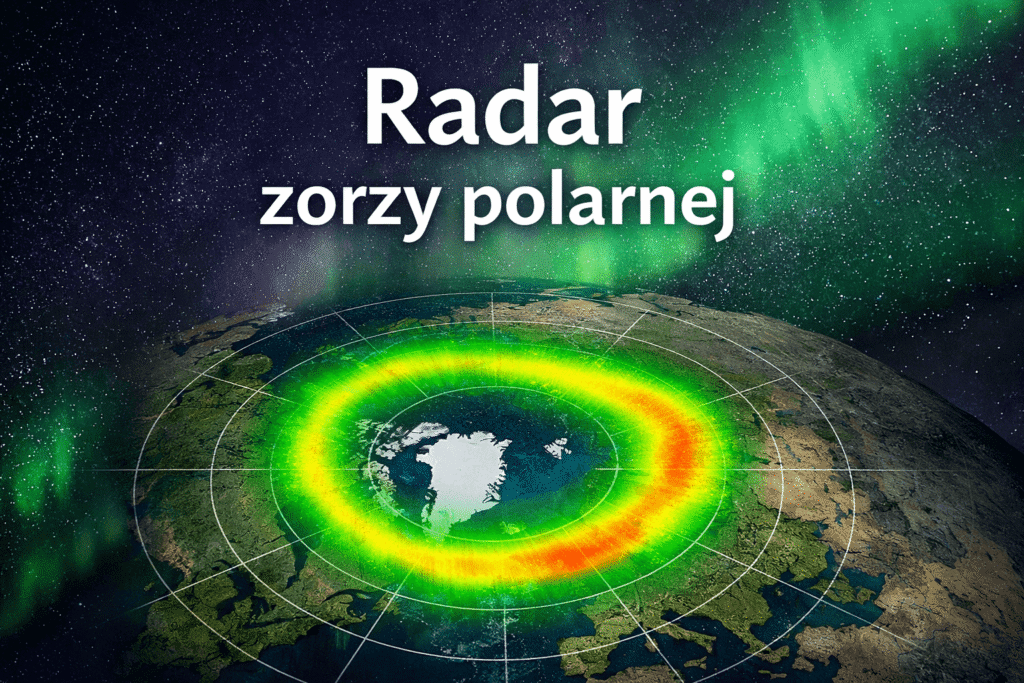
GUIDE
OndaTravel live tools
Radars, maps and forecasts — context, not official warnings.
FAQ
Will I see the Northern Lights in the UK tonight?
There is a real chance on the night of 10–11 October 2026. A strong G3 geomagnetic storm (Kp 7) was reached on 10 October, at 17:58 UTC and again at 19:27 UTC. At Kp 7 the aurora is possible across Scotland, Northern Ireland and northern England, and often further south on camera. NOAA forecasts Kp 5.67 (G2) for 01:00–04:00 BST on 11 October, then weakening. You need clear skies and a southward Bz.
What time is best to see the aurora tonight?
On the night of 10–11 October, the best remaining window is 01:00–04:00 BST (00:00–03:00 UTC) on 11 October, when NOAA forecasts Kp 5.67 (G2); after that the storm weakens, and darkness ends around 05:10 BST. The aurora usually brightens in waves of 20–40 minutes.
What is a CME and did it hit Earth?
A coronal mass ejection (CME) is a cloud of plasma and magnetic field thrown out by the Sun, usually after a flare. Yes: a CME shock reached Earth on 10 October 2026, with a sudden impulse recorded at 15:16 UTC. It drove the storm to G3 (Kp 7) the same evening.
What Kp do I need to see the aurora in Scotland or England?
Roughly Kp 5 for Shetland, Orkney and northern Scotland, Kp 6 for central Scotland and Northern Ireland, Kp 6–7 for northern England and North Wales, and Kp 7–8 for the Midlands and southern England. In weaker storms the aurora may only show up on camera.
Will the Northern Lights be visible on the night of 11–12 October?
Less likely. NOAA’s updated forecast gives Kp 3.67–4.00 for the rest of 11 October and a maximum of 4.33 on 12 October — no storm, and below the Kp 5 needed for northern Scotland. Forecasts can change, for example if a CME from the M6.4 flare is confirmed, so check the live data before going out.
Is the geomagnetic storm dangerous?
There is no credible evidence that geomagnetic storms harm people at ground level. A G3 storm like the one on 10 October can cause power-grid voltage corrections and problems with satellite navigation and HF radio, but phones, the internet and car sat-nav normally keep working.
How do I photograph the Northern Lights on my phone?
Switch on night mode, rest the phone on a tripod or a steady surface, set an exposure of 3–10 seconds and point it north. A phone often shows the aurora more clearly than your eyes can.
Sources and limits of this article
- NOAA SWPC — alerts, warnings and watches (K-index, sudden impulse, flares), 3-day forecast (10 Oct 2026, 12:30 UTC), forecast discussion, observed planetary Kp and Kp forecast (updated around 22:30 UTC, 10 Oct 2026).
- NOAA SWPC — real-time solar wind (SOLAR-1/SWFO-L1) and explanation of the G, R and S scales.
- NASA CCMC — DONKI: catalogue of CMEs, flares and interplanetary shocks (WSA-ENLIL models).
- Sunset, darkness and New Moon times — approximate astronomical calculations for the UK; actual times vary with latitude.
This article does not replace official bulletins. Figures from the first hours of a storm are preliminary and may change; NOAA forecasts are probabilities, not guarantees.





Sorry, the comment form is closed at this time.