


Northern Lights in the UK: When Were the Biggest Aurora Storms in History?
Search for “biggest northern lights storm in UK history” and you’ll find plenty of listicles with confident dates going back decades — most of them impossible to verify. This page takes a stricter approach: it covers the one extreme aurora storm with solid, checkable UK-specific evidence — the G5 storm of 10–11 May 2024 — and is honest about what the historical record before that can and can’t confirm.
Quick answer (30 seconds)
The UK’s only fully confirmed extreme aurora storm is the G5 event of 10–11 May 2024 — the strongest since October 2003, with the aurora reported right across the country, from Shetland down to Cornwall. Older storms (such as the famous 1859 Carrington Event) are well documented globally, but detailed UK-specific sighting records for them aren’t verified here.
| Question | Quick answer |
|---|---|
| What was the biggest confirmed UK aurora storm? | The G5 (extreme) geomagnetic storm of 10–11 May 2024, peak Kp 9 |
| How rare is a storm like that? | Very — it was the first G5-class storm since October 2003, roughly a once-in-twenty-years event |
| How far south was it seen? | Aurora was documented across Scotland, northern England, and central and southern England, including Cornwall |
Northern Lights – live radar and parameters
Parameters refresh automatically. The local aurora chance is calculated for your location (GPS or city).
Aurora oval radar – Northern Hemisphere
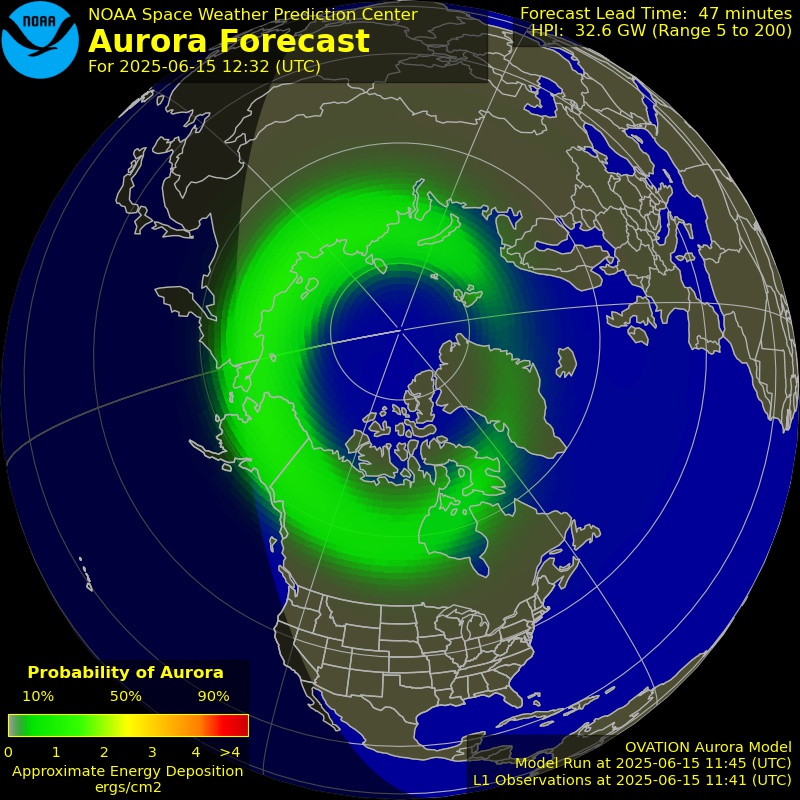
If the animation does not load, a static image will be shown.
Conditions assessment
The indicators consider your location, the local aurora chance and whether it is dark.
Kp (3h)
Kp (1 min)
Bz (GSM)
Bt (IMF)
Speed
Density
Temperature
Contents
The confirmed benchmark: the G5 storm of 10–11 May 2024
A sudden storm commencement was recorded at 17:08 UT on 10 May 2024, as a series of coronal mass ejections from an unusually active sunspot region reached Earth. Geomagnetic activity climbed fast: the Kp index — a 0-to-9 scale published by NOAA’s Space Weather Prediction Center — hit 9, the maximum possible reading, classifying the event as a G5 “Extreme” geomagnetic storm. Elevated activity continued for more than 30 hours, through the night of 10–11 May and into 12 May.
What makes this the safe reference point for “biggest UK aurora storm” isn’t just the Kp number — it’s that the event is independently documented from several directions at once: NOAA’s own storm classification, peer-reviewed analysis of UK magnetometer data, and AuroraWatch UK‘s own alert log, which shows a red alert (“aurora likely”) issued at 15:57 UTC on 11 May 2024. British Geological Survey instruments — which feed AuroraWatch UK’s alerts — recorded some of the largest magnetic field deviations of the modern instrument era, with the strongest disturbance at the Lerwick observatory in Shetland.
- Storm onset: 17:08 UT, 10 May 2024
- Peak Kp index: 9 (G5, “Extreme” — the top of NOAA’s 5-level storm scale)
- Duration of elevated activity: over 30 hours, into 12 May 2024
- Classification context: the first G5-class storm since the Halloween storms of October 2003 — roughly a 20-year gap
- UK alert: AuroraWatch UK red alert issued 15:57 UTC, 11 May 2024
How far south the aurora reached — and why
A G5 storm pushes the auroral oval — the ring-shaped zone of active aurora that normally sits close to the poles — much further from its usual position. Published analysis of the May 2024 event found the aurora reached below 54°N, a latitude that runs roughly through northern England, with monitoring cameras picking up the auroral display across a band stretching from around 54.7°N down to 50.8°N — from northern England to the UK’s southern coast. That range covers virtually the whole country.
On the ground, that translated into widely reported sightings well outside the usual Scotland-only territory. Scotland and northern England saw the aurora clearly and widely; local reporting from Cornwall confirms the display was seen and photographed there too, on one of the very few nights when the far south-west has a realistic chance. Reports from around London on the same night exist, though they’re less formally documented than the Cornwall sightings — consistent with London sitting close to, but within, the <54°N band the research identifies.
This is the practical reason the May 2024 storm anchors this page rather than a vaguer “the aurora is sometimes seen from southern England”: it’s the one event where the claim “visible from the whole UK, including the far south” is backed by both institutional alert data and independent local reporting, not just a single anecdote.
How storms are classified: the G-scale and the Kp index
NOAA’s Space Weather Prediction Center rates geomagnetic storms on a five-step scale, G1 (minor) to G5 (extreme), roughly matched to Kp index values of 5 through 9. Most winters bring several G1–G2 storms; a G5 is a genuinely different order of event — it’s the category large enough to push the aurora as far south as it went in May 2024, and the category historically associated with effects on satellites, radio communication and power infrastructure, not just a better sky show.
For the full breakdown of what Kp value you need to see the aurora from your specific part of the UK on an ordinary night — not just during a record-breaking G5 — see the regional threshold table on our Northern Lights in the UK — Live Radar and Forecast hub, along with the current live Kp status.

GUIDE
Northern Lights in the UK — Live Radar and Forecast
Live UK aurora status and tonight's Kp index, plus Kp thresholds by region, official alert sources, and where to look.
Older storms: what we can and can’t confirm
May 2024 wasn’t the first extreme geomagnetic storm — it’s simply the first one with the kind of instrumented, cross-checkable UK evidence this page requires before stating a claim as fact. Two much older storms are worth naming for context, with the caveat spelled out clearly:
- The Carrington Event, September 1859: the largest geomagnetic storm on modern scientific record, named after English astronomer Richard Carrington, who observed the triggering solar flare from Redhill, Surrey. It’s a fixture of NOAA’s own list of historically significant solar events. What we have not independently verified for this page is a detailed, place-by-place account of exactly where the aurora itself was witnessed across the UK that night — treat any specific UK sighting claims for 1859 as needing separate archival verification, not as confirmed fact here.
- The storm of March 1989: globally famous for triggering the Hydro-Québec power grid collapse in Canada and widely documented internationally. As with 1859, this page does not have a verified, UK-specific sighting record to cite — it’s mentioned only as recognised historical context for how extreme geomagnetic storms can get, not as a confirmed UK aurora event.
The honest reason a confident “top 10 biggest UK aurora storms” list is hard to produce responsibly is that continuous, UK-specific instrumented monitoring — the BGS magnetometer network, AuroraWatch UK’s alert log — is a relatively recent thing, and detailed contemporaneous eyewitness records from earlier centuries are scattered and hard to verify at a UK-regional level. We’d rather list one storm we can back up properly than ten we can’t.
Could a storm like this happen again?
Yes — geomagnetic storm strength tracks, loosely, the roughly 11-year solar activity cycle, and G5-class events remain possible for as long as the Sun is active, which is to say always, to some degree. What history tells us is about frequency, not a fixed schedule: one confirmed G5 in about two decades (2003 to 2024) is a useful sense of scale, not a countdown to the next one. No forecasting model can currently predict a storm of this size more than a few days in advance, and often only hours.
That’s precisely why a live status check matters more than a history page: this page tells you what has happened, but only the live Kp index and an active alert from AuroraWatch UK or the Met Office space weather forecast can tell you whether tonight is heading that way.
Where to look next time
A repeat G5 is the only realistic scenario for aurora reaching Cornwall or the London area again — worth watching for, but not worth planning a trip around. For anyone wanting realistic, repeatable odds rather than a once-in-twenty-years event, Scotland remains the dependable target: it needs a far lower Kp than the rest of the UK, on ordinary storm nights as well as extreme ones.
Our dedicated Cairngorms Northern Lights guide covers one of the most reliable inland viewing areas in Scotland, with dark-sky spots, practical access notes and its own live radar tuned to local coordinates — a better everyday bet than waiting for the next May 2024.
GUIDE
Scotland Northern Lights Live – Cairngorms Radar and Forecast
Live aurora radar for the Cairngorms plus the Kp you actually need at Scottish latitude, official Dark Sky Park spots, and why your phone sees more than your eyes.
FAQ: aurora storm history in the UK
What was the biggest aurora storm ever recorded in the UK?
The best-documented, most reliably confirmed event is the G5 (“Extreme”) geomagnetic storm of 10–11 May 2024, when the Kp index reached its maximum value of 9. It was the first G5-class storm since October 2003, and aurora was reported right across the UK, including Cornwall in the far south-west.
Was the aurora really seen from London and Cornwall?
Peer-reviewed analysis of the May 2024 storm found the aurora reached below 54°N, a band covering virtually the whole UK. Cornwall sightings are confirmed by local press reporting from the night of 10–11 May 2024; reports from around London exist too, though they are less formally documented than the Cornwall coverage.
What about older storms, like the 1859 Carrington Event?
The Carrington Event of September 1859 is the largest geomagnetic storm on modern scientific record and a well-known historical benchmark globally — English astronomer Richard Carrington observed the triggering flare from Surrey. However, a detailed, verified account of exactly where in the UK the aurora was witnessed that night isn’t established in our research, so we don’t present it as a confirmed UK sighting record the way we do for May 2024.
Could a storm this big happen again?
Yes, in principle — storm strength loosely follows the roughly 11-year solar cycle, and extreme storms remain possible at any point. History suggests they’re rare (one G5 in about two decades), but no model can predict one more than a few days ahead. Check the live Kp status and AuroraWatch UK for real-time conditions rather than relying on historical odds.
Read also
Northern Lights in the UK — Live Radar and Forecast — the year-round hub: current Kp status, regional thresholds, and how to read tonight’s alert.
Cairngorms Northern Lights Live — Radar and Forecast — the UK’s most reliable realistic viewing area, with its own live radar and dark-sky spots.

About the OndaTravel.pl author
Krystian — „dziadzia przewodnik”
Meet the OndaTravel.pl author: an independent Arctic guide, photographer and filmmaker. See how the guides are made, where the field photos come from, and how to reach out about a guided trip to Iceland, Lofoten or Norway.





Sorry, the comment form is closed at this time.