


Northern Lights in the UK in July 2027: Why Chances Are Very Low
Short answer first: if you’re planning a trip to see the northern lights from the UK, July is the one month to avoid. It isn’t about the Kp index or how active the sun is — it’s about daylight. In the far north of Scotland, the sky in July never gets properly dark. This guide explains why, what that means even during a very strong storm, and where to look instead if you want a realistic chance this year.
Quick answer (60 seconds)
July is the weakest month of the year for northern lights in the UK — not because storms are rarer, but because the far north of Scotland barely gets dark at all around midsummer. Even a very strong geomagnetic storm is unlikely to be visible against a sky that never turns properly black. If you want a realistic chance this year, aim for September or October instead.
| Question | Quick answer |
|---|---|
| Can I see the northern lights in the UK in July? | Very unlikely. Even in Shetland or the Highlands, the sky stays in twilight all night around the summer solstice — there usually isn’t enough darkness for the aurora to be visible |
| Does a stronger storm change that? | Only a little. A rare, extreme storm might register on a camera on the very darkest nights late in the month, but this isn’t something to plan a trip around |
| When should I actually go instead? | September and October, once darkness properly returns — see the links below |

Live radar: is it worth checking anyway?
Yes — it costs nothing to look, and on the rare night the geomagnetic index spikes hard late in the month, it’s still the fastest way to know. But go in with the right expectations: this page explains below why the odds are so low in July specifically, regardless of what the radar shows. For official UK-specific alert levels alongside it, AuroraWatch UK (Lancaster University) runs a free alert service, and the Met Office space weather forecast covers the same activity nationally.
Northern Lights – live radar and parameters
Parameters refresh automatically. The local aurora chance is calculated for your location (GPS or city).
Aurora oval radar – Northern Hemisphere
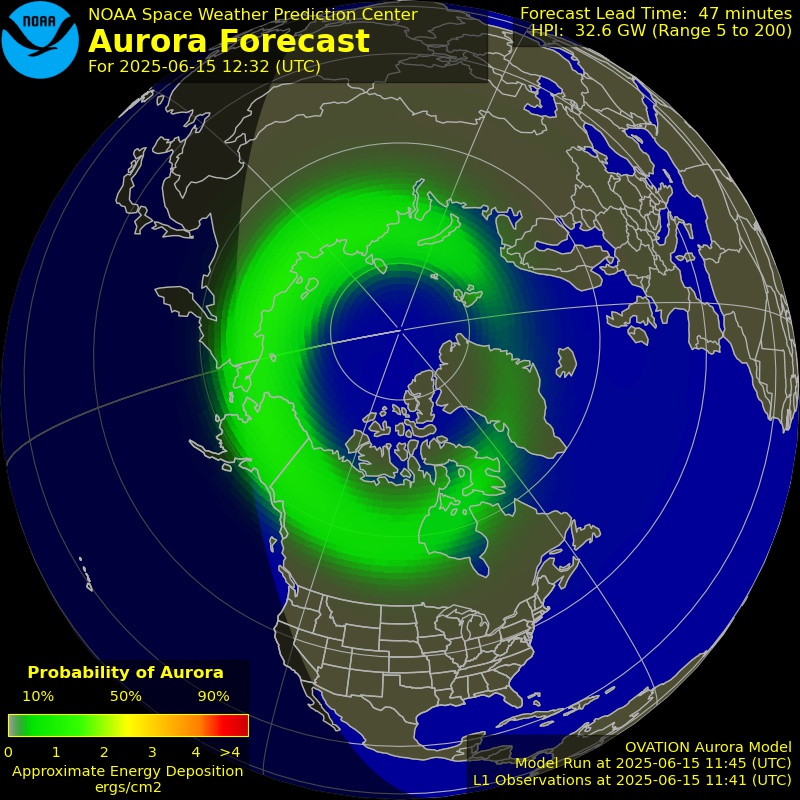
If the animation does not load, a static image will be shown.
Conditions assessment
The indicators consider your location, the local aurora chance and whether it is dark.
Kp (3h)
Kp (1 min)
Bz (GSM)
Bt (IMF)
Speed
Density
Temperature
Why July is the hardest month: the “simmer dim”
Every other month on this site is really a question of geomagnetic activity: is there a storm, and is it strong enough to reach your part of the UK? July is different, because a second condition quietly takes over — darkness — and in the far north of Scotland, July mostly fails it.
Around the summer solstice (roughly 21 June), the sun barely dips below the horizon at high latitudes. In Shetland, this shows up as a phenomenon locally known as the “simmer dim” — a twilight glow along the northern horizon that lingers right through the night instead of fading to true darkness. Roughly speaking, from around Aberdeenshire and the central Highlands northwards (very approximately north of ~56°N), the sky in the weeks either side of the solstice doesn’t reach the kind of dark, black-sky conditions the aurora needs to stand out — it stays in some degree of twilight from sunset to sunrise. By July the nights have started drawing back in slightly compared with the solstice itself, but not by enough to change the picture in the far north.
This is worth stressing: it’s a geometry problem, not a solar-activity problem. It has nothing to do with the Kp index, solar wind speed, or how active the sun currently is — it happens identically every single year regardless of solar activity, purely because of the tilt of the Earth’s axis and how far north you are. That’s what makes July structurally different from, say, a quiet month during an equinox — no amount of watching the radar changes the amount of darkness on offer.
What even a strong storm would look like this month
It’s fair to ask: what about a truly extreme storm — the kind that made headlines? The G5 storm of 10–11 May 2024 reached as far south as Cornwall and London, a reminder that when a storm is genuinely extreme, distance within the UK stops being the main obstacle. But that storm happened in May, when the whole country still gets proper night-time darkness. An equally extreme storm landing in July runs into a different problem: in the far north, there may simply not be enough darkness for it to be visible to the naked eye, no matter how strong the geomagnetic activity is. Further south — England, Wales, southern Scotland — the sky does get properly dark even in July, but those regions need a much stronger storm to see anything at all in any month (see the table below), and July offers no seasonal boost to make that more likely.
The realistic best case in July is narrow: on the darkest available nights near the end of the month, ideally with no moon and clear skies, a very strong storm might register faintly on a long-exposure camera pointed north, even if there’s little or nothing to see with the naked eye. That’s a genuine possibility, but it’s not something to plan travel around — the odds are simply stacked against you this month in a way they aren’t in autumn.
Where in the UK, if you’re determined to try
For reference, here are the same rough Kp thresholds used across this site’s UK guides. Treat them with extra caution this month: in the far north, hitting the Kp number doesn’t help if there isn’t enough darkness for it to matter, and further south the thresholds themselves are already demanding.
| Region | Kp for a chance near the horizon | Kp for a clear, obvious display |
|---|---|---|
| Shetland and the far north Highlands (Caithness, Sutherland) | 2–3 | 5 |
| Cairngorms and Aberdeenshire | 3–4 | 6 |
| Edinburgh, Glasgow, Newcastle, Northumberland | 4–5 | 7 |
| Manchester, Yorkshire, the Midlands | 5–6 | 8 |
| North Wales (Snowdonia) | 5–6 | 8 |
| London, southern England, south Wales | 6–7 | 9 (in practice, only during a G5-class storm) |
If you still want to check, our Cairngorms northern lights guide covers one of the most realistic viewing areas in the country for the rest of the year, with dark-sky spots and its own live radar — useful to bookmark for when the nights draw back in.
GUIDE
Scotland Northern Lights Live – Cairngorms Radar and Forecast
Live aurora radar for the Cairngorms plus the Kp you actually need at Scottish latitude, official Dark Sky Park spots, and why your phone sees more than your eyes.
Note: these thresholds are an orientative guide, not a precise forecast for a specific location — actual visibility depends on your exact geomagnetic latitude (not the same as geographic latitude), local horizon and cloud cover. The British Geological Survey’s coordinate calculator converts a geographic location to geomagnetic latitude.
Common mistakes when chasing the aurora in the UK in July
- Applying the same Kp thresholds as other months: the numbers above assume a properly dark sky. In July, especially in the far north, that assumption often doesn’t hold, whatever the Kp reading says.
- Booking a trip specifically for July “just in case”: save the trip for September or October, when darkness has returned and your odds are genuinely far better for the same amount of effort and cost.
- Confusing the aurora with noctilucent clouds: in the weeks around the summer solstice, the UK — and Scotland in particular — sometimes sees noctilucent clouds: thin, high-altitude clouds that glow an electric blue-white against the twilight sky after sunset. They’re a genuine and separate phenomenon from the aurora, but the two are easy to mix up at a glance if you’re hoping to see the northern lights.
- Only checking a daily forecast, not the live index: if you do check on a very dark, clear late-July night, use the live radar above rather than a general daily outlook — geomagnetic activity changes on a timescale of hours.
- Giving up on the UK entirely: July is a genuine seasonal dead zone here, not a sign that the UK is a poor destination overall — the same regions have realistic chances again from around late August onward, building toward the best months in September and October.
FAQ: northern lights in the UK in July
Can I see the northern lights in the UK in July?
It’s very unlikely. Even in Shetland or the Scottish Highlands, the sky stays in twilight all night around the summer solstice, so there usually isn’t enough darkness for the aurora to be visible, regardless of geomagnetic activity.
What is the “simmer dim” and why does it matter for the aurora?
It’s a local Shetland term for the lingering twilight glow that replaces true night around midsummer at high UK latitudes. The aurora needs a dark sky to be visible against, so when the sky itself never gets properly dark, the display can go unseen even during a real storm.
Would an extremely strong storm change anything in July?
A little, but not much. Even a storm as strong as the G5 event of 10-11 May 2024, which reached Cornwall and London, would struggle to be seen with the naked eye from far-north Scotland in July, simply because the sky isn’t dark enough. A camera might catch a faint trace on the darkest nights late in the month, but this isn’t a realistic basis for planning a trip.
Where in the UK would still be the best bet in July, hypothetically?
The same regions as any other month — Shetland, the far north Highlands, then the Cairngorms and Aberdeenshire — but with darkness as the limiting factor rather than storm strength. Further south it does get dark, but a much stronger storm is needed regardless of season.
What’s the difference between the aurora and noctilucent clouds?
Noctilucent clouds are thin, high-altitude clouds that glow blue-white against the twilight sky around the summer solstice — a real and separate phenomenon, sometimes mistaken for the aurora by people hoping to see the northern lights in summer.
When should I actually plan a UK aurora trip instead of July?
September and October, once proper darkness returns to the UK, give far better realistic odds. March is also a strong month, tied to the spring equinox. See the links below for month-by-month detail.
Read also
AURORA ALERTS
OndaTravel guide
Northern Lights in the UK in September 2026: When Are the Best Chances?
September is one of the two strongest months of the year for northern lights chances in the UK — the other being March. Two things line up at once: proper darkness…
Open
AURORA ALERTS
OndaTravel guide
Northern Lights in the UK in October 2026: When Are the Best Chances?
October is a transitional month for the northern lights in the UK, and that’s actually its strength. It doesn’t have the equinox boost that makes September the…
Open
AURORA ALERTS
OndaTravel guide
Northern Lights in the UK in March 2027: When Are the Best Chances?
March is one of the two strongest months of the year for northern lights chances in the UK — the other being September. That’s not a coincidence of the calendar: the…
Open
GUIDE
OndaTravel guide
Northern Lights in the UK — Live Radar and Forecast
Northern Lights in the UK are never guaranteed on any single night — they depend on live geomagnetic activity, cloud cover and how far north you are. This page pulls…
Open
About the OndaTravel.pl author
Krystian – photographer, filmmaker and guide
Meet the OndaTravel.pl author: an independent Arctic guide, photographer and filmmaker. See how the guides are made, where the field photos come from, and how to reach out about a guided trip to Iceland, Lofoten or Norway.





Sorry, the comment form is closed at this time.