

Scotland Northern Lights Live – Cairngorms Radar and Forecast
The Cairngorms sit at around 59.5 degrees geomagnetic latitude, well south of the auroral oval, so this is a mid-latitude destination: you need Kp 3 for something on the northern horizon and Kp 6 for a display that fills the sky. What Scotland offers instead is genuinely dark sky — Tomintoul and Glenlivet hold Gold Tier International Dark Sky Park status and are the most northerly Dark Sky Park in the world. Season is mid-October to mid-March, best hours 22:00 to 02:00.
| Minimum Kp | Kp 3 for a glow on the horizon, Kp 4 for a clear display, Kp 6+ for colour overhead |
| Best months | October and March (equinox) |
| Where to go | Tomintoul and Glenlivet (Gold Tier International Dark Sky Park) |
Table of contents
- Can you see the aurora in the Cairngorms tonight?
- What Kp do you need in Scotland?
- Best dark-sky spots in the Cairngorms
- Why your phone sees more than your eyes
- When to go
- How many nights should you plan?
- Cloudy tonight? Where to go instead
- Camera settings that work here
- Planning the trip: getting there, staying, packing
- FAQ: Northern Lights in Scotland
- Read also
Northern Lights – live radar and parameters
Parameters refresh automatically. The local aurora chance is calculated for your location (GPS or city).
Aurora oval radar – Northern Hemisphere
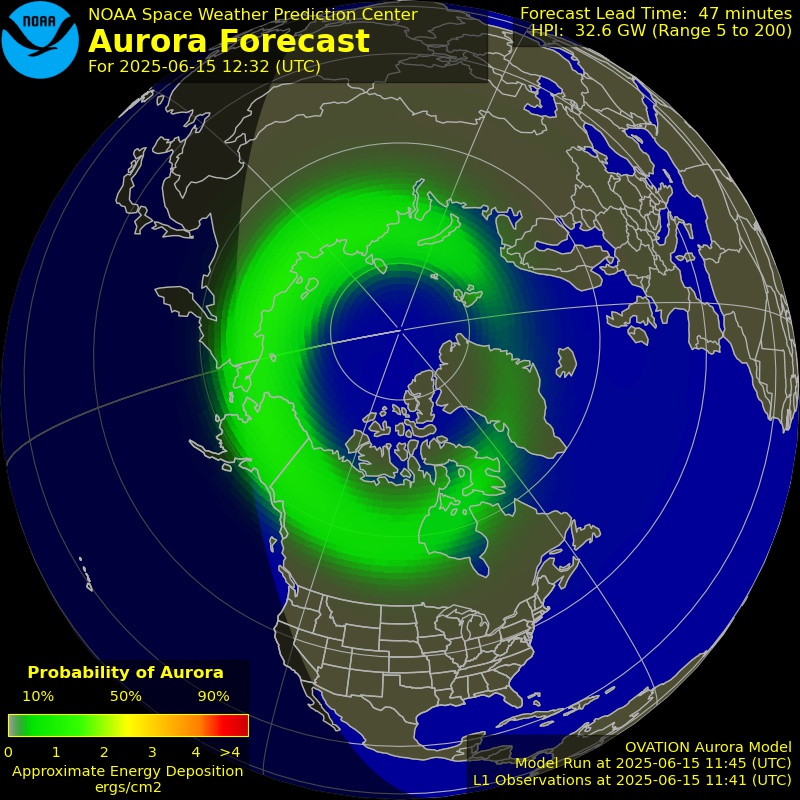
If the animation does not load, a static image will be shown.
Conditions assessment
The indicators consider your location, the local aurora chance and whether it is dark.
Kp (3h)
Kp (1 min)
Bz (GSM)
Bt (IMF)
Speed
Density
Temperature
Latest alerts: solar activity and geomagnetic storms
The monitor below updates automatically from NOAA data: it shows the outlook for the next seven nights and the current aurora alerts. Check it right before you head out — conditions can change within hours.
Sky phenomena
Planning your night-sky observations? These monthly guides highlight the most important astronomical events, meteor showers, Moon phases and the best observation windows. Below you’ll find the two most relevant monthly guides for the current period.
SKY PHENOMENA
Monthly guide
Sky events in October 2026: Draconids, Orionids and Saturn
The key sky events of the month, meteor activity, the Moon and practical observation windows.
Read the guide
SKY PHENOMENA
Monthly guide
Sky events in November 2026: Leonids, Taurids and a supermoon
The key sky events of the month, meteor activity, the Moon and practical observation windows.
Read the guideNorthern Lights
Looking for a longer-term Northern Lights outlook? These monthly guides complement the live radar with seasonal conditions, expected aurora activity and practical viewing tips. Below you’ll find the two most relevant monthly forecasts currently available.
NORTHERN LIGHTS
Monthly forecast
Northern Lights — October 2026
A monthly Northern Lights outlook with live-radar context and practical viewing guidance.
Read the guide
NORTHERN LIGHTS
Monthly forecast
Northern Lights — November 2026
A monthly Northern Lights outlook with live-radar context and practical viewing guidance.
Read the guide
Contents
- Can you see the aurora in the Cairngorms tonight?
- What Kp do you need in Scotland?
- Best dark-sky spots in the Cairngorms
- Why your phone sees more than your eyes
- When to go
- How many nights should you plan?
- Cloudy tonight? Where to go instead
- Camera settings that work here
- Planning the trip: getting there, staying, packing
- FAQ: Northern Lights in Scotland
- Read also
Can you see the aurora in the Cairngorms tonight?
Here the order of checks is different from the Arctic. Kp comes first, because below Kp 3 there is usually nothing to see this far south no matter how clear the sky. Then cloud cover, then the Moon — at mid-latitudes the aurora is often faint enough that a bright Moon washes it out entirely, which matters far less at 69 degrees north. Aim for a new or crescent Moon, a clear northern horizon, and the 22:00 to 02:00 window.



Hi, I’m Krystian “dziadzia przewodnik” from OndaTravel.pl!
The North is my greatest passion, but the world is far too beautiful to stay in just one climate. On my blog, I combine the raw landscapes of Iceland and Norway with the exotic energy of Thailand or Vietnam, showing you how to travel authentically — with passion and a camera in hand.
What will you find on OndaTravel.pl?
Visual storytelling: As a photographer and filmmaker, I don’t just describe places — I take you there with professional photos and video.
North expert: Ready-to-use road trip plans for Iceland and Norway, smart tips for budget travel, and my original Northern Lights Radar (locations and forecast).
Travel through the lens of cinema: I track down filming locations — from icy scenes in Interstellar to tropical frames from world cinema.
New direction: Exotic destinations: I love contrast, so the blog is featuring more and more practical knowledge about Vietnam and Thailand. I’ll show you how to find your way around Southeast Asia and come back with your best memories.
P.S. follow me here


What Kp do you need in Scotland?
| Location | Geomagnetic latitude | Kp for a glow on the horizon | Kp for a clear display | Kp for overhead colour |
|---|---|---|---|---|
| Cairngorms | ~59.5° | 3 | 4 | 6 |
| Shetland (for comparison) | ~62° | 2 | 3 | 5 |
This is why Shetland and Caithness sometimes get a display while the Cairngorms stay dark on the same night. The trade-off runs the other way too: the west coast and islands often carry heavier cloud, while the eastern Highlands, Moray and the Cairngorm foothills tend to have clearer skies.
Best dark-sky spots in the Cairngorms
- Tomintoul Field of Hope — an official Dark Sky Discovery Site with car parking and interpretation panels. One of the easiest places to start, and the surrounding hills naturally shield the area from light pollution.
- Blairfindy Moor — another designated Discovery Site on the Glenlivet Estate, with parking and open vantage points to the north.
- The Carrachs — the third of the Tomintoul and Glenlivet Discovery Sites, exposed and open, good for wide compositions.
- Cairngorm Mountain car park — higher ground with a north-facing outlook, useful when low cloud sits in the glens below.
- Glen Tanar Visitor Centre — an official Dark-Sky Discovery Site on the eastern side of the park.
The general rule in Scotland: get high, get a clear view north, and get away from town lighting. Inverness makes a practical base — Dava Moor, the Moray Firth beaches and Tomintoul are all reachable as short drives.
Why your phone sees more than your eyes
This is the single most common disappointment for first-time aurora hunters in Scotland, and it is worth understanding before you drive out at midnight. At mid-latitudes the aurora is usually faint. Human colour vision effectively shuts down in low light, so a display that a camera records as vivid green often reads to the naked eye as a pale grey or whitish arc, sometimes barely distinguishable from cloud.
A phone on night mode, or a camera on a 10-second exposure, accumulates light your eye cannot. That is not cheating and the aurora is not fake — your camera is simply a better low-light detector than you are. Practical use: if you are unsure whether that grey band on the northern horizon is aurora or cloud, take a 5 to 10 second exposure. If it comes back green, it is aurora. Give your eyes 15 to 20 minutes to dark-adapt too, and avoid looking at a bright phone screen in between, which resets that adaptation instantly.
When to go
| Month | Darkness | Notes | Rating |
|---|---|---|---|
| October | Improving | Equinox-season activity, milder weather | Very good |
| November | Long nights | Cloudier on average | Good |
| December | Longest nights | Wettest, most overcast period | Fair |
| January | Long nights | Cold, clearer spells between fronts | Good |
| February | Good | Often the clearest winter month | Very good |
| March | Shortening | Equinox activity peak, season ends mid-month | Very good |
The pattern to notice: the darkest months are not the best months here. October and March combine adequate darkness with the equinox-linked rise in geomagnetic activity and better odds of a clear night, while December offers the longest nights but the worst Atlantic weather.
How many nights should you plan?
Be honest with yourself about the odds. In the Arctic, three nights gets you a very high probability. In Scotland the limiting factor is not darkness but geomagnetic activity reaching Kp 4 or above while your sky happens to be clear, and that combination does not arrive on demand. Treat the aurora as a bonus on a trip you would enjoy anyway — winter walking, distilleries, wildlife — rather than the sole reason for travelling. If you do come specifically for it, a week gives you a realistic chance; two nights is close to a lottery ticket.
Cloudy tonight? Where to go instead
In Scotland the weather usually decides the night, and the split is geographic: the west coast and islands catch the Atlantic fronts while the eastern Highlands, Moray and the Cairngorm foothills stay clearer. If cloud sits in the glens, going up is often more effective than going far.
| Where to go instead | Distance | Drive time | Why it can work |
|---|---|---|---|
| Cairngorm Mountain car park | 12 mi / 19 km | ~25 min | High ground that frequently sits above valley cloud and fog |
| Moray Firth coast | 25-35 mi / 40-56 km | 45-60 min | Often clear when the mountains are not; open northern horizon over water |
| Glen Tanar | 35 mi / 56 km | ~1 h | Dark-Sky Discovery Site on the eastern, drier side of the park |
| Dava Moor | 18 mi / 29 km | ~30 min | Open moorland between Grantown and Forres, easy from Inverness |
Camera settings that work here
Because displays here are usually faint, lean toward longer exposures than you would in the Arctic: ISO 1600-3200, f/2.8 or wider, 10-20 seconds, manual focus at infinity. A tripod is not optional. On a phone, use night mode and prop it against something solid. Frame with something in the foreground — a ruin, a treeline, a loch — because a faint arc over an empty horizon rarely makes a compelling picture on its own. Scottish winter cold is mild compared with Canada, but damp and wind chill are real; a lens cloth for condensation matters more here than spare batteries.
Planning the trip: getting there, staying, packing
Getting there
Inverness Airport is the natural gateway, with connections through London, Amsterdam and several UK regional airports, and it sits about 40 minutes from the Cairngorms. Aberdeen and Edinburgh both work too, at two to three hours by road. The Caledonian Sleeper from London to Inverness is a genuine option and lands you close to the dark-sky sites without a domestic flight.
Where to base yourself
Aviemore is the practical hub: accommodation, food, and 25 minutes from the Cairngorm Mountain car park. Grantown-on-Spey and Tomintoul put you nearer the Dark Sky Park sites, with fewer services. Inverness gives you the widest choice of places to stay and lets you switch between the mountains and the Moray coast depending on where the sky is clearing.
Without a car
Harder here than in the Arctic. Public transport does not run late enough to get you to a dark site and back at 01:00, and the sites themselves have no shelter. If you are not driving, look at guided night-sky tours from Aviemore or Inverness, or choose accommodation that is already outside a town with a clear northern outlook.
What to pack
Scottish winter cold is mild compared with Canada, but it is wet and windy, which is its own problem. Waterproof outer layers matter more than heavy insulation, and a lens cloth for condensation matters more than spare batteries. A head torch with a red mode preserves your dark adaptation, and a tripod is not optional at these latitudes because exposures run long.
FAQ: Northern Lights in Scotland
What Kp index do you need to see the aurora in the Cairngorms?
Kp 3 for a glow on the northern horizon, Kp 4 for a clearly visible display, and Kp 6 or above for colour overhead. The Cairngorms sit at about 59.5 degrees geomagnetic latitude, south of the auroral oval.
Why did the aurora look grey to me but green in photos?
Human colour vision shuts down in low light. At Scottish latitudes the aurora is usually faint enough that your eye sees a pale grey arc while a 10-second camera exposure records vivid green. The camera is not lying; it is simply a better low-light detector.
What is the best month for the aurora in Scotland?
October and March. Both combine sufficient darkness with the equinox-related rise in geomagnetic activity and better odds of clear skies than midwinter. December has the longest nights but the heaviest cloud.
Where exactly should I go in the Cairngorms?
The Tomintoul and Glenlivet Dark Sky Park has three official Discovery Sites with parking: Tomintoul Field of Hope, Blairfindy Moor and The Carrachs. Cairngorm Mountain car park and Glen Tanar are good alternatives, especially when low cloud sits in the glens.
Is Shetland better than the Cairngorms for the aurora?
For geomagnetic latitude, yes: Shetland sits closer to the oval and needs a lower Kp. But the Cairngorms often have clearer skies than the far north and west, and Tomintoul holds Gold Tier Dark Sky Park status, so the two trade advantages.
How many nights should I plan in Scotland?
More than in the Arctic. Here you need both clear sky and Kp 4 or above at the same time, which is not a reliable combination. Plan a week if the aurora is the main goal, or treat it as a bonus on a trip you would enjoy regardless.

About the OndaTravel.pl author
Krystian — „dziadzia przewodnik”
Meet the OndaTravel.pl author: an independent Arctic guide, photographer and filmmaker. See how the guides are made, where the field photos come from, and how to reach out about a guided trip to Iceland, Lofoten or Norway.
Read also
NORWAY
Live radar
Tromso
Want the display overhead instead of on the horizon? This is the nearest place where Kp 0 is enough.
Check Tromso radarALL LOCATIONS
Hub
Aurora Radar: Choose a Location
Compare Kp thresholds across every location we track, from Arctic Europe to North America.
See all locationsPHENOMENON EXPLAINED
Guide
Live Aurora Forecast Explained
Understand what Kp, Bz and cloud cover actually mean before you check any radar.
Read the explainerTOOL
Alerts
Aurora Alerts
Essential at this latitude: get notified when Kp actually rises high enough to matter.
Open Aurora Alerts