
Aurora Forecast Tonight: Live Northern Lights Map

How to read an aurora forecast correctly
This page explains how to interpret an aurora forecast and live space-weather data. What matters is not a single value, but the combined picture of Kp, Bz, Bt, solar wind speed, cloud cover and the conditions at your specific location.
Table of contents
Live aurora map and radar: what to check first?
If you first need to pick a country or location, go to the aurora radar hub. This page focuses on interpretation: the auroral oval, Kp, Bz, Bt, the solar wind and how they combine with cloud cover. You will find the other maps and tools in the OndaTravel live tools hub.
For observing from Poland, the shortest route is the Poland aurora radar. This guide, on the other hand, explains how to read live data and why one good parameter is not enough for a forecast.
Aurora forecast in brief
To judge your chances of seeing the aurora, do not look at a single number. What matters is the combination of geomagnetic activity, the Bz direction, the solar wind speed, the cloud cover, a dark sky and the observer’s location.
Current guide for this month:
Latest guides
What to watch in the sky in July and August 2026?
See two current observing calendars: summer noctilucent clouds, the Moon, the Milky Way, meteor showers, the Perseids and the August eclipses.
For a quick explanation of how to read radar signals without basing your decision on a single number, see also the guide how an aurora radar works (in Polish).
In short (60 seconds):
- Sky phenomena: the main section page (aurora, NLC, sprites, STEVE).
- Noctilucent clouds (NLC): when they are visible and how to tell them apart from the aurora.
- Clouds first (locally): without clear spells even a high Kp can be “invisible”.
- Then the parameters: look at Kp/Bz and the trend (rising or falling).
- Finally the location: drive away from lights, pick a safe place to stop and give your eyes a moment to adapt.
- Want a forecast for a specific country or region? Open the Northern Lights Radar – locations.
Want a location-based forecast? Open the Northern Lights Radar – locations. Planning an aurora trip? Start with the map: Norway or Iceland.
If you are planning Iceland as part of a longer northern route, see also the North section, where I have gathered Iceland, Norway, Lofoten, the fjords and northern lights guides.

NORTH
North: Iceland, Norway, northern lights and Lofoten
A dedicated OndaTravel section for northern trips: Iceland, Norway, fjords, Lofoten, northern lights, ready-made routes and planning tools.
The Northern Lights are one of the most extraordinary phenomena you can see in the night sky, full of colour, movement and the “magic” of nature. If you want to see the aurora in person, this page gives you the current forecast, activity maps and tools that help you quickly judge your chances. It is also worth learning the basics (Kp/Bz) and knowing how to tell the aurora apart from other effects in photos; see: The aurora and other phenomena in the night sky.
Want to quickly tell the aurora apart from other phenomena (e.g. noctilucent clouds, sprites, airglow or STEVE)? See also the main section page: Sky phenomena and the separate guide: Noctilucent clouds (NLC).
So you do not miss a “window”, below you will find the aurora activity forecast for today and tomorrow (updated in real time). You can also follow live maps and tools that help you plan night-time observations, both in Norway and in Poland.
Parameters refresh automatically. The local aurora chance is calculated for your location (GPS or city). If the animation does not load, a static image will be shown.
The indicators consider your location, the local aurora chance and whether it is dark. Aurora Score (Warsaw, beta): -/100Northern Lights – live radar and parameters
Aurora oval radar – Northern Hemisphere
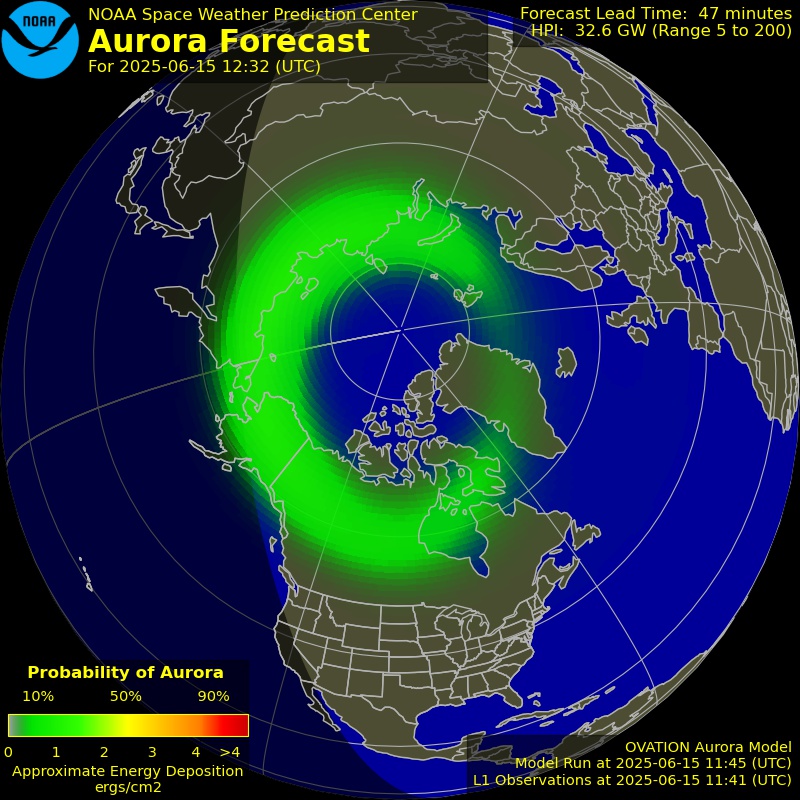
Conditions assessment
Kp (3h)
Kp (1 min)
Bz (GSM)
Bt (IMF)
Speed
Density
Temperature
What time should you check the aurora forecast?
It is worth checking the aurora forecast several times after dark, because conditions can change within 10–20 minutes. The trend matters most: is Kp rising, is Bz staying southward, is the solar wind speed elevated, and are clear spells appearing over your observing spot?
In Poland, observing makes most sense from the evening until late at night, but there is no single fixed hour. During a strong pulse the aurora can appear suddenly and last only briefly. If you want to make a quick decision for Poland, check the Poland aurora radar.
NEXT AURORA WINDOW: NIGHT OF 30/31 OCTOBER
NOAA warns of a minor G1 storm on the night of Friday to Saturday, 30/31 October, after a quiet week
After the G3 storm (Kp 7) of 10 October, a minor G1 storm (Kp 5) followed on the Orionid night of 21/22 October, and Kp 4 on the evening of 23 October. Since 24 October it has been quiet (Kp ≤ 3). On 28 October NOAA issued a G1 storm watch for 31 October: a fast solar wind stream from a coronal hole that returns roughly every 27 days. The 3-day forecast of 29 October: Kp rises from Friday evening, 30 October (about 4.3 before midnight), peaking at Kp 5 (G1) on the night of 30/31 October at about 1:00–7:00 Polish time, with Kp still around 4 on Saturday evening. The 27-day outlook (26 October): then Kp 4 on 1 November and Kp 4 on 9 November. In Poland the chances are mainly in the north of the country, low over the northern horizon, most often only on camera. The Moon (about 70% illuminated) shines for most of the night, so look for a spot with a dark, open northern horizon. The storm timing has low confidence, so check the live radar before heading out.

GUIDE
Go to the live radar
Map, current Kp and Bz, plus cloud cover – all in one place.
Live weather: cloud cover and clear spells
This is the most important “here and now” filter: even a high Kp will not help if your location is under complete cloud cover. Check the live cloud layer and compare it with the location radars.
Related guides and explanations
If you want to understand the aurora itself better, tell it apart from other phenomena, or find out why the weeks around the equinoxes matter so much to observers, start with these three guides.

Beginner guide
What is the aurora and how do you recognise it in practice?
Start with a simple explanation: where the aurora comes from, what it looks like to the naked eye and in photos, and what to look for when you try to confirm a sighting.

Comparisons and identification
The aurora and other night-sky phenomena: how to tell them apart in photos
This guide helps you tell the aurora apart from noctilucent clouds, sprites, STEVE, airglow and other effects that are very often confused with one another.
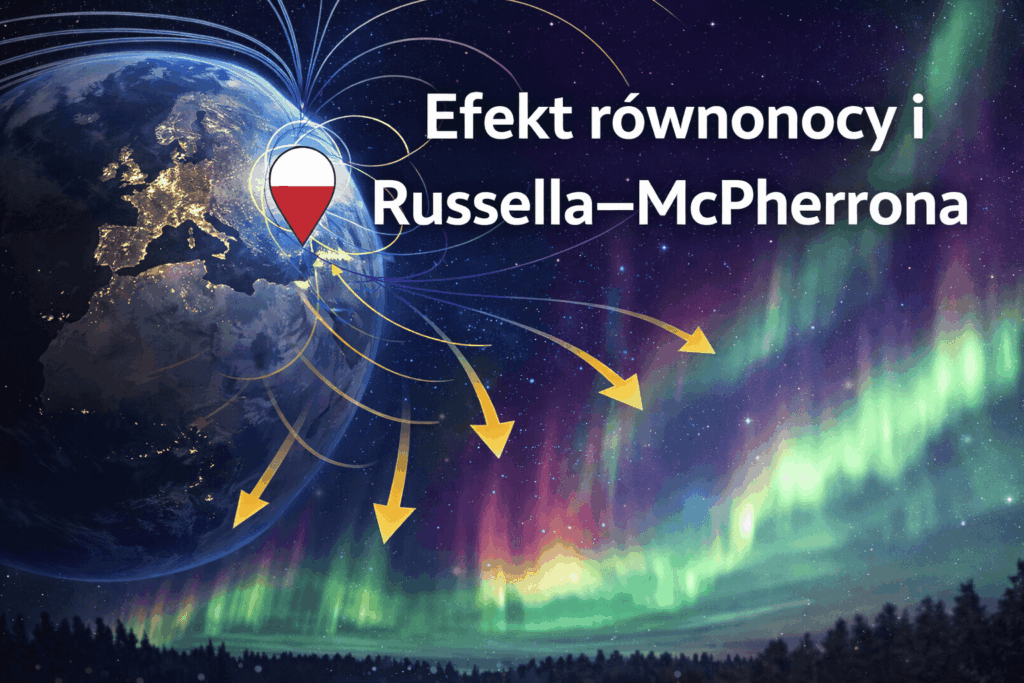
Why then?
The equinox and Russell–McPherron effect: why are March and September so important for the aurora?
Read why geomagnetic activity often increases near the equinoxes and how Percy Groves and the famous “eight sides” motif of the Great Pyramid connect to this topic.
Aurora with the naked eye or on a phone photo? Why they differ
Short answer: a weak or moderate aurora is usually easier to see on a phone photo than with the naked eye. The camera collects light for several to a dozen or so seconds, while the human eye distinguishes colours poorly in the dark. That is why what you see as a grey or whitish glow, your phone may show as a vivid green. Only during a strong storm (Kp 6 or more) does the aurora often look colourful to the naked eye as well.
| Aurora strength | Naked eye | On a phone photo |
|---|---|---|
| Weak (Kp 2–3) | Usually invisible, or a grey streak low over the horizon | Faint green, sometimes visible only after zooming in |
| Moderate (Kp 4–5) | Whitish or greyish-green glow | Clear green, sometimes a pink tint at the top |
| Strong (Kp 6+) | Clear green, sometimes red and pink | Intense, saturated colours across the whole structure |
How to photograph the aurora with a phone
Turn on night or manual mode. Set ISO 1600–3200, an exposure time of 5–15 seconds and the widest available lens. Rest the phone on something stable or use a tripod – with exposures this long, even a slight hand tremor will blur the shot.
How to tell the aurora from an ordinary cloud or city glow
- A cloud hides the stars – the aurora does not. If you can see stars through a grey streak, it is probably the aurora, not a cloud.
- City glow (light pollution) is orange-yellow and stationary. The aurora is usually whitish or greenish and often drifts slowly.
- The most reliable test: take a long-exposure photo with your phone. The aurora will come out green or pink. A cloud will stay grey, city glow – orange.
Aurora forecast: how to read live data
An aurora forecast is not just about checking one number. If you are asking “will there be an aurora tonight?” or searching for northern lights tonight, you need to combine several layers: the Kp index, the Bz magnetic field direction, the Bt field strength, the solar wind, cloud cover, a dark sky and a clear view of the northern horizon.
The quickest overview of current conditions is in the Northern Lights Radar tool, and the latest observing notices are in the aurora alerts section. This guide explains how to read an aurora radar and which parameters matter most, especially if you are interested in an aurora forecast for Poland.
Kp index and the aurora: important, but not enough
The Kp index is a popular measure of geomagnetic activity. Put simply, the higher the Kp, the greater the chance that the auroral oval will shift further south. Poland usually needs a stronger geomagnetic episode, but Kp alone is not enough to decide whether to head out.
The problem is that Kp is an averaged, lagging indicator. It can show that conditions were good, but it will not always tell you what is happening right now over the northern horizon. That is why, alongside Kp, you should check Bz, Bt, solar wind speed and density.
Aurora reach over Poland: which Kp is needed where?
The higher the Kp index, the further south the auroral oval moves, so it determines which part of Poland has any chance of a sighting at all. These are rough thresholds: the exact reach also depends on Bz, the time of night and local conditions, but they give a good starting point for planning.
| Region of Poland | Approximate Kp threshold | Notes |
|---|---|---|
| Coast and north (Pomerania, Warmia and Masuria) | Kp ≥ 5 | Usually the first to see activity; a good starting point |
| Central Poland (Warsaw, Greater Poland, Łódź region) | Kp ≥ 6 | A clearer geomagnetic episode is needed |
| Southern Poland (Silesia, Lesser Poland, Subcarpathia) | Kp ≥ 7–8 | Only during stronger geomagnetic storms (G2/G3+) |
Approximate thresholds based on the NOAA auroral oval model; check the real-time reach in the Poland aurora radar.
Bz and the aurora: why is the field direction so important?
The link between Bz and the aurora is one of the most important relationships in forecasting. When Bz points south, meaning it takes negative values, the Earth’s magnetic field connects more easily with the field carried by the solar wind. That is when the chance of stronger auroral activity increases.
Bt shows the overall strength of the magnetic field in the solar wind. A strong Bt and a long-lasting negative Bz are far more interesting than a high Kp on its own. If Bz dips below zero only briefly, the effect may be weak. If it stays negative for longer, it is worth following alerts and all-sky cameras.
Solar wind and the aurora: speed, density and CMEs
Solar wind and the aurora are another pair of concepts that have to be read together. What counts is the solar wind speed, its density and whether a CME, or coronal mass ejection, is reaching the Earth. A strong CME can trigger a geomagnetic storm, but the exact effect depends on the field direction and when the stream arrives.
In NOAA and SWPC bulletins, geomagnetic storms are often described on the G1, G2, G3 and higher scale. For observers in Poland, the most interesting episodes are those that can push the auroral oval far enough south. The term aurora oval, or auroral oval, helps explain why the aurora is sometimes visible over Scandinavia and sometimes also appears over Poland.
Northern lights live: what to check before you go out
If you are interested in the northern lights live, check three things before leaving home: space weather, the local weather and your observing spot. Even very good geomagnetic activity will not help if the northern horizon is blocked by clouds, fog, forest, buildings or city glow.
- Sky: check the cloud cover, especially low and mid-level clouds; IMGW forecasts (the Polish national weather service) and local cloud maps can help.
- Location: pick a spot with an open northern horizon and the darkest sky possible.
- Light: avoid street lamps, car parks, city centres and places where light glow drowns out faint auroral light.
- Photos: prepare a tripod and a camera, or a phone in night mode; you will find the settings in the guide how to photograph the night sky.
How to tell a real chance from a false alarm
False alarms happen most often when one parameter looks good but the others do not cooperate. A high Kp without a good Bz may produce a weak display. A negative Bz without sufficient speed and density is not always enough either. A good aurora forecast should combine several data points rather than rely on a single number.
Also keep seasonality in mind. Around the equinoxes, the chances of a stronger magnetospheric response tend to be higher, so when planning observations it is worth reading the guide to the equinox effect and the Russell–McPherron effect. If the sky is quiet, you can use the night for other events from the astronomical events calendar.
Quick answer: will there be an aurora tonight?
In short: whether there will be an aurora tonight depends on several conditions being met at the same time. Look for an elevated Kp, a steadily negative Bz, a strong Bt, a faster solar wind, a possible G1, G2 or G3 geomagnetic storm, plus clear spells and a dark spot with a view to the north. If these elements come together, it is worth following the aurora alerts and getting ready to observe.
How to use an aurora forecast in practice, step by step
It is safest to treat an aurora forecast as a process rather than a one-off reading. First check whether there is any activity on the space side at all: a rising Kp, a negative Bz, a stronger Bt, a faster solar wind or a geomagnetic storm notice. Only then move on to local conditions: cloud cover, air transparency and a spot with a view to the north. In Poland even a strong forecast may come to nothing if you are standing in a city centre or the northern horizon is blocked by forest, buildings or low clouds.
A good routine looks like this: first you check the aurora radar and alerts, then you assess the weather (including the storm and precipitation radar), and finally you decide whether it is worth heading out. If Bz is steadily negative, the solar wind is speeding up and the northern sky has clear spells, get your camera, tripod and warm clothes ready. If one of the elements is missing, keep following the situation, because the aurora can be dynamic and conditions can change within half an hour or so.
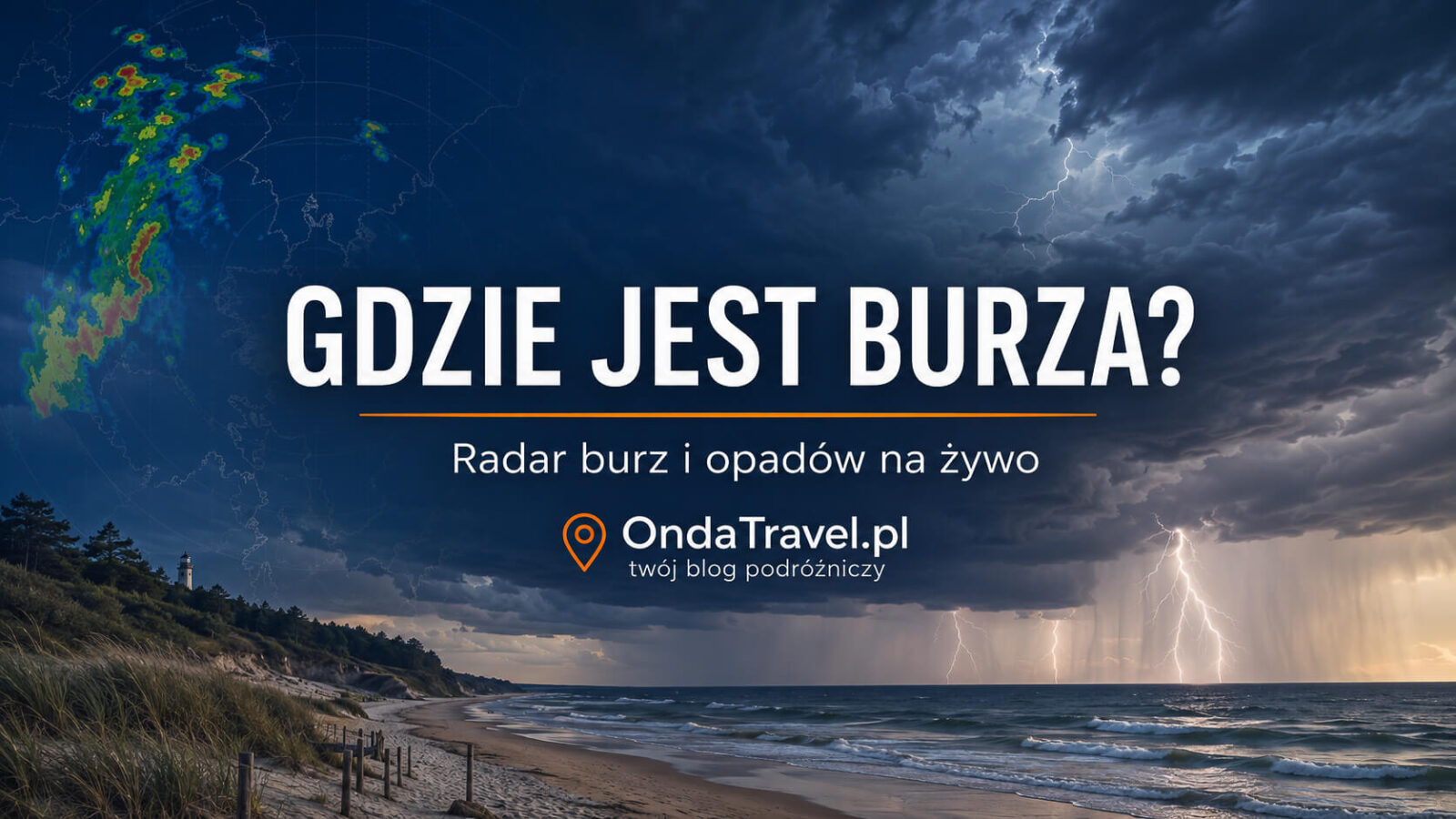
LIVE TOOL
Storm and precipitation radar
Check active storm cells and hazards that the aurora radar does not show.
It is also worth logging your own observations. Note the time, place, Kp, Bz, cloud cover and whether the aurora was visible to the naked eye or only on camera. After a few such attempts you will understand more easily which parameters really work at your location and when an aurora alert is strong enough for you to leave the house.
Geomagnetic storm, 10–12 October 2026: after a series of CMEs and M6.7 and M6.4 flares, a shock wave struck the Earth. Follow the geomagnetic storm live and the aurora chances in Poland, with NOAA bulletins added automatically.
GEOMAGNETIC STORM LIVE
A CME has hit the Earth: will there be an aurora in Poland?
Live NOAA bulletins, Kp, Bz, the forecast for 10–12 October and where to look.
FAQ: aurora forecast
Will there be an aurora in Poland tonight?
Check the Kp index, Bz, Bt, the solar wind, aurora alerts, cloud cover and the view of the northern horizon together. Only the combination of these data gives a realistic assessment of your chances.
What does Bz mean in an aurora forecast?
Bz describes the direction of the magnetic field carried by the solar wind. A long-lasting negative Bz usually increases the chance of auroral activity.
Is the Kp index alone enough for an aurora forecast?
No. Kp is important, but it has to be read together with Bz, Bt, solar wind speed, density and the local weather.
Where is the best place to watch the aurora?
Choose a dark spot with an open northern horizon, far from street lamps and city glow. With a weaker aurora, local conditions matter as much as the geomagnetic activity itself.
What do G1, G2 and G3 mean?
These are geomagnetic storm levels. The higher the level, the greater the chance that the auroral oval will shift further south, but visibility still depends on the weather and the location.
Is the aurora dangerous?
No. The aurora is a light phenomenon in the upper atmosphere and in itself poses no threat to the observer. The strong geomagnetic storms that cause it can, however, affect power grids, satellites and radio communication; that is a risk to infrastructure, not to the person looking at the sky.
Does the aurora make sounds?
Very rarely, and only during exceptionally strong activity, observers report faint crackling or hissing. The phenomenon is not fully explained by science and should not be expected during a typical sighting in Poland; the vast majority of aurora displays are completely silent.
Read more / next steps
Below you will find quick links to local radars, alerts and pages that help you plan observations in Poland, Norway and Iceland.
Northern Lights Radar – locations: choose a location and check the conditions.
Aurora alerts: the latest notices and observing windows.
Poland: aurora radar for today: a quick start for observing in Poland.
Norway: live aurora radar + Norway map.
Iceland: live aurora radar + Iceland map.


Hi, I’m Krystian “dziadzia przewodnik” from OndaTravel.pl!
The North is my greatest passion, but the world is far too beautiful to stay in just one climate. On my blog, I combine the raw landscapes of Iceland and Norway with the exotic energy of Thailand or Vietnam, showing you how to travel authentically — with passion and a camera in hand.
What will you find on OndaTravel.pl?
Visual storytelling: As a photographer and filmmaker, I don’t just describe places — I take you there with professional photos and video.
North expert: Ready-to-use road trip plans for Iceland and Norway, smart tips for budget travel, and my original Northern Lights Radar (locations and forecast).
Travel through the lens of cinema: I track down filming locations — from icy scenes in Interstellar to tropical frames from world cinema.
New direction: Exotic destinations: I love contrast, so the blog is featuring more and more practical knowledge about Vietnam and Thailand. I’ll show you how to find your way around Southeast Asia and come back with your best memories.
P.S. follow me here

Aurora calendar
Northern lights in Poland in September 2026 – alerts and observing windows
September is the start of the aurora season: the equinox boosts geomagnetic activity (the Russell–McPherron effect). Check the Kp thresholds for your region, the observing windows and practical tips for this month.
March 2026
Northern lights in Poland in March 2026 – alerts and observing windows
March is one of the best months for the aurora in Poland – the spring equinox effect boosts geomagnetic activity. Check the Kp thresholds and observing windows.

April 2026
Northern lights in Poland in April 2026 – alerts and observing windows
April closes the active part of the aurora season – strong geomagnetic storms are still possible after the equinox. Check the Kp thresholds and this month's alert history.
July 2026
Northern lights in Poland in July 2026 – alerts and observing windows
July is off-season, but strong X-class flares can surprise. An updated guide: alerts, parameters and practical takeaways for anyone checking for the aurora in Poland.
Author
Krystian „dziadzia przewodnik”The North is my greatest passion, but the world is too beautiful to stay in one climate. On my blog I combine the raw nature of Iceland and Norway with the exotic energy of Thailand and Vietnam, showing you how to travel authentically, with passion and a camera in hand.