

Northern Lights in the USA: Live Radar and Forecast
In the United States the aurora question splits in two. Interior Alaska sits directly under the auroral oval and needs no storm at all; the Lower 48 sees the lights only when a storm pushes the oval far enough south. This page covers both: live radar, the official Alaskan season, how many nights the local institutions actually recommend, and what has to happen for the aurora to reach Michigan or Minnesota.
Northern lights in the USA: what matters
In short: Fairbanks is the base, not Anchorage — the coast carries far more cloud than the interior. The Alaskan season has official dates, 21 August to 21 April. Everywhere south of Alaska is storm-dependent and needs an alert, not a calendar.
The table below collects what actually decides the trip.
| Item | What to know |
|---|---|
| Main base | Fairbanks (64.84°N) — Travel Alaska states the city sits directly under the auroral oval |
| Season | 21 August to 21 April, the dates used by both Explore Fairbanks and the Geophysical Institute at UAF |
| Time of night | Most watching happens between 22:00 and 03:00 local time |
| How many nights | Three minimum: Explore Fairbanks puts the chance above 90% for active watchers, the Geophysical Institute says highly likely though never certain |
| Why not summer | Fairbanks gets 21 hours 49 minutes of daylight at the summer solstice — the sky never darkens enough |
| The Lower 48 | Michigan, Minnesota and the northern tier need a geomagnetic storm; the aurora then sits low on the northern horizon |
- Northern lights in the USA: what matters
- Tonight in Fairbanks: live conditions
- Latest alerts: solar activity and geomagnetic storms
- Where to go: Alaska and the Lower 48
- Why Fairbanks and not Anchorage
- The Lower 48: what has to happen
- Season: 21 August to 21 April
- How many nights to book
- The Dalton Highway and the Arctic Circle
- Common mistakes
- Frequently asked questions
- Read also



Hi, I’m Krystian “dziadzia przewodnik” from OndaTravel.pl!
The North is my greatest passion, but the world is far too beautiful to stay in just one climate. On my blog, I combine the raw landscapes of Iceland and Norway with the exotic energy of Thailand or Vietnam, showing you how to travel authentically — with passion and a camera in hand.
What will you find on OndaTravel.pl?
Visual storytelling: As a photographer and filmmaker, I don’t just describe places — I take you there with professional photos and video.
North expert: Ready-to-use road trip plans for Iceland and Norway, smart tips for budget travel, and my original Northern Lights Radar (locations and forecast).
Travel through the lens of cinema: I track down filming locations — from icy scenes in Interstellar to tropical frames from world cinema.
New direction: Exotic destinations: I love contrast, so the blog is featuring more and more practical knowledge about Vietnam and Thailand. I’ll show you how to find your way around Southeast Asia and come back with your best memories.
P.S. follow me here


Tonight in Fairbanks: live conditions
The module below shows current geomagnetic activity and conditions for Fairbanks. If you are watching from the Lower 48, read the Kp value first: everything south of Alaska depends on how far the oval has been pushed tonight, and cloud cover decides the rest.
Northern Lights – live radar and parameters
Parameters refresh automatically. The local aurora chance is calculated for your location (GPS or city).
Aurora oval radar – Northern Hemisphere
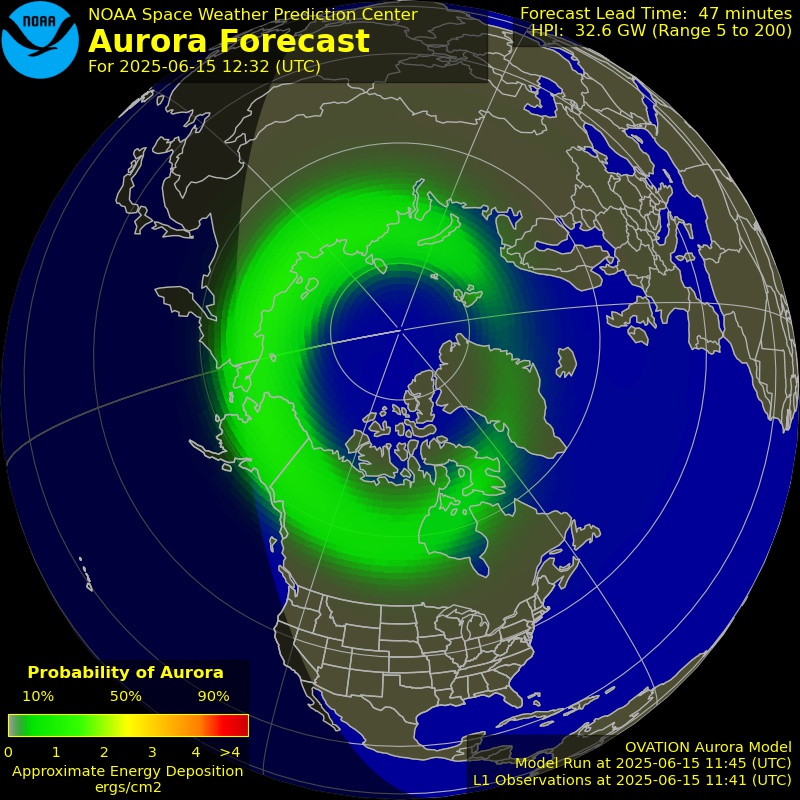
If the animation does not load, a static image will be shown.
Conditions assessment
The indicators consider your location, the local aurora chance and whether it is dark.
Kp (3h)
Kp (1 min)
Bz (GSM)
Bt (IMF)
Speed
Density
Temperature
Latest alerts: solar activity and geomagnetic storms
The monitor below updates automatically from NOAA data: it shows the outlook for the next seven nights and the current aurora alerts. Check it right before you head out — conditions can change within hours.
Sky phenomena
Planning your night-sky observations? These monthly guides highlight the most important astronomical events, meteor showers, Moon phases and the best observation windows. Below you’ll find the two most relevant monthly guides for the current period.
SKY PHENOMENA
Monthly guide
Sky events in September 2026: meteors, equinox and the Moon
The key sky events of the month, meteor activity, the Moon and practical observation windows.
Read the guide
SKY PHENOMENA
Monthly guide
Sky events in October 2026: Draconids, Orionids and Saturn
The key sky events of the month, meteor activity, the Moon and practical observation windows.
Read the guideNorthern Lights
Looking for a longer-term Northern Lights outlook? These monthly guides complement the live radar with seasonal conditions, expected aurora activity and practical viewing tips. Below you’ll find the two most relevant monthly forecasts currently available.
NORTHERN LIGHTS
Monthly forecast
Northern Lights — September 2026
A monthly Northern Lights outlook with live-radar context and practical viewing guidance.
Read the guide
NORTHERN LIGHTS
Monthly forecast
Northern Lights — October 2026
A monthly Northern Lights outlook with live-radar context and practical viewing guidance.
Read the guideWhere to go: Alaska and the Lower 48
| Place | Latitude | Best for | Practical note |
|---|---|---|---|
| Fairbanks, Alaska | 64.84°N | A first trip; the widest choice of lodging and tours | Travel Alaska: directly under the auroral oval; low precipitation means many clear nights in season |
| Coldfoot and Wiseman | 67.25°N and 67.43°N | A trip built around the aurora alone | About 250 miles north of Fairbanks, roughly six hours’ drive; tiny settlements with minimal services |
| Denali, based in Healy | About 120 miles south of Fairbanks | Aurora with mountains in the frame | In winter the park road is open to private vehicles for the first three miles only |
| Anchorage | 61.22°N | A stopover, not an aurora base | Travel Alaska says coastal cloud makes viewing less common than in the interior |
| Utqiagvik (Barrow) | 71.29°N | A committed expedition | No road connects it to the rest of Alaska; February averages around −24 °C |
| Michigan and Minnesota | About 47–48°N | Storm chasing close to home | Needs a real geomagnetic storm; the display sits low on the northern horizon |
Why Fairbanks and not Anchorage
The Geophysical Institute at the University of Alaska Fairbanks describes the auroral oval as a thin band sitting, under quiet conditions, at roughly 67 to 68 degrees geomagnetic latitude, widening as activity rises. Fairbanks sits under that band. Anchorage is further from it and catches cloud off the coast as well. The difference is not whether the aurora appears at all — it is how many of your four nights end with a display.
One number is worth quoting precisely, because it circulates in distorted form. Explore Fairbanks, the city’s official tourism organisation, says the aurora is visible in Fairbanks on average four nights out of five — when the sky is clear and dark enough. That is not the same as “200 nights a year”: the weather and darkness condition is part of the sentence, not a footnote.

GUIDE
Fairbanks Northern Lights Live – Radar and Forecast
Live aurora radar for Fairbanks, Alaska, plus the Kp you actually need, four dark-sky spots with winter driving notes, and how many nights to plan.
The Lower 48: what has to happen
NOAA SWPC publishes the rule you need. At Kp 0 the equatorward edge of the auroral oval sits at roughly 66 degrees magnetic latitude, and it moves about two degrees south for each step of Kp, reaching roughly 48 degrees magnetic at Kp 9. The northern tier of the Lower 48 therefore comes into play only during genuine storms — and when it does, the aurora is low in the north rather than overhead.
- Watch the alerts, not the calendar. In the Lower 48 there is no season to book against; there is a storm to react to within hours.
- Find an unobstructed northern horizon. This matters far more here than in Alaska, where the display is overhead.
- Get away from town lights. A faint arc low in the north is the first thing light pollution erases.
- Trust the camera before your eyes. A long exposure will show colour that the naked eye reads as a grey glow.

GUIDE
Michigan and Minnesota Northern Lights Live – Radar and Forecast
Live aurora radar for the Upper Great Lakes with the Kp you need at each latitude, from the Keweenaw to Detroit, plus certified dark-sky spots and the best months.
Further east, Ohio only sees the aurora during the most extreme storms (Kp8+), but its Lake Erie shoreline gives one of the best open-horizon vantage points in the region when that happens.
Indiana needs an even more extreme storm than Ohio (roughly Kp9, the top of the scale) due to its slightly lower geomagnetic latitude, but its designated dark-sky parks give the state a real shot when one occurs.
Iowa needs roughly the same Kp8 storm as Ohio, and its flat, open farmland makes finding a clear northern horizon easy once a strong storm is underway.
Nebraska sits in the same Kp8 bracket as Ohio and Iowa. Its flat Sandhills region, home to the Nebraska Star Party near Valentine, offers some of the darkest skies in the state once a strong storm is underway.
Illinois shares Nebraska and Ohio’s Kp8 bracket but faces an extra obstacle: Chicago is one of the cloudiest major U.S. cities in winter, and the state’s only certified dark-sky site sits about 110 miles south of the city near Penfield.
Season: 21 August to 21 April
Alaska is one of the few destinations where the aurora season has official dates: 21 August to 21 April, used by Explore Fairbanks and by the Geophysical Institute alike. The limits have nothing to do with solar activity, which runs all year, and everything to do with darkness. Fairbanks gets 21 hours 49 minutes of daylight at the summer solstice and under four hours at the winter one.
| Period | What to expect |
|---|---|
| 21 August to September | Season opens: nights dark enough, temperatures mild, but the viewing window is short |
| October and November | Nights lengthen quickly, cold deepens, tour season gets going |
| December and January | Longest nights and hardest cold; January in Fairbanks averages about −27 °C overnight |
| February and March | The months most people choose: still long nights, less brutal cold than January |
| April to the 21st | The tail end — darkness shrinks week by week |
| May to August | The aurora is there, but the sky is too bright to see it |
An honest note on the equinox effect: the Geophysical Institute quotes Syun-ichi Akasofu to the effect that aurora is least common near the solstices, while adding that the reason is not properly understood. If you read that the University of Alaska has confirmed a specific physical mechanism behind the equinox pattern, that is an over-reading.
How many nights to book
This is the one destination where three independent official sources agree on the number of nights but differ in tone — and the difference between a tourism board and a research institute is instructive.
- Explore Fairbanks — visitors who stay a minimum of three nights and are actively out during the late evening raise their chance to more than 90 percent.
- Travel Alaska — repeats the 90 percent figure for three nights and recommends four to five nights as the optimum.
- Geophysical Institute, UAF — if the weather is clear and you stay at least three nights, seeing the aurora is highly likely, though never certain. No percentage given.
The practical conclusion matches Canada: under the oval you are not buying nights of aurora, you are buying a buffer against cloud. On a trip that already costs you a long flight and a domestic connection, cutting the stay to two nights is the most expensive saving available.
The Dalton Highway and the Arctic Circle
The Dalton Highway runs 414 miles from Livengood, 84 miles north of Fairbanks, to Deadhorse on the Arctic coast. It crosses the Arctic Circle and climbs deep under the oval, which is why it ends up in so many itineraries. Before it ends up in yours, read what the Bureau of Land Management says about it.
- The road is narrow, rough, steep and mostly gravel, with dust, slick mud and sudden potholes.
- Cell service is extremely limited — effectively Coldfoot and scattered points along the route.
- There are no medical facilities and no grocery stores along the way.
- North of Coldfoot you may meet snow and ice in any month of the year.
- In winter the road and private services stay open and tour operators run aurora trips, but the Arctic Interagency Visitor Center in Coldfoot is closed from September to May.
Driving times from Fairbanks, per the BLM: Yukon River about three hours, the Arctic Circle four to five, Coldfoot about six, Atigun Pass about eight, Deadhorse thirteen or more. Add an hour or two on any leg for stops, construction and weather.
The point most trip plans miss: most rental companies prohibit taking their vehicles onto the Dalton Highway. A small number of Fairbanks operators do allow it and equip their vehicles for the route, but terms have to be confirmed with the operator directly — the lists circulating online are years out of date. A guided trip is the safer winter option either way, and current road conditions are published by the state road service.
Common mistakes
- Basing in Anchorage. Convenient to reach, costly in cloud cover.
- Believing the “200 nights a year” line. The official wording is four nights out of five, and only when the sky is clear and dark enough.
- Two nights in Fairbanks. Every local institution says three minimum.
- Taking a rental car up the Dalton. Most rental agreements forbid it, which also voids your cover.
- Planning a summer trip. Between May and August the nights are too bright.
- Chasing the Lower 48 by calendar. There is no season there — only storm alerts.
- Underestimating battery drain. At −25 °C camera and phone batteries lose capacity within the hour.
Frequently asked questions
Where is the best place to see the northern lights in the USA?
Fairbanks, Alaska. Travel Alaska states the city sits directly under the auroral oval, and its low precipitation gives many clear nights during the season. Coldfoot and Wiseman, further north on the Dalton Highway, are darker still.
When is aurora season in Alaska?
From 21 August to 21 April. Those dates are used by both Explore Fairbanks and the Geophysical Institute at the University of Alaska Fairbanks. The limits come from darkness, not from solar activity, which continues all year.
How many nights do you need in Fairbanks?
Three at a minimum. Explore Fairbanks puts the chance above 90 percent for visitors who stay three nights and actively watch, Travel Alaska recommends four to five nights, and the Geophysical Institute says only that it is highly likely though never certain.
Can you see the northern lights in the Lower 48?
Yes, during geomagnetic storms. NOAA gives the rule: the equatorward edge of the oval sits near 66 degrees magnetic latitude at Kp 0 and moves about two degrees south per step of Kp. States such as Michigan and Minnesota come into play during real storms, with the display low on the northern horizon.
Fairbanks or Anchorage for the aurora?
Fairbanks. It sits under the oval and has low precipitation, while Travel Alaska notes that coastal cloud makes viewing in Anchorage less common than in the interior.
Can you see the aurora in Alaska in summer?
No. The activity continues, but the sky stays too bright. Fairbanks has 21 hours 49 minutes of daylight at the summer solstice.
Can you drive the Dalton Highway in a rental car?
Usually not. Most rental companies prohibit their vehicles on the Dalton Highway. A small number of Fairbanks operators allow it and equip vehicles for the route, but you have to confirm terms directly with them. In winter a guided trip is the safer option.
What time of night is best?
Most watching happens between 22:00 and 03:00 local time, and NOAA notes that the best displays usually fall within an hour or two of midnight. Strong storms widen that window.
Read also

THE MAIN BASE
Interior Alaska, directly under the oval and dry in winter.
Fairbanks Northern Lights Live – Radar and Forecast
Live radar for Fairbanks and what a typical night there looks like.
Read more
STORM CHASING
The northern tier of the Lower 48, aurora only during real storms.
Michigan and Minnesota Northern Lights Live – Radar and Forecast
Live radar for Michigan and Minnesota, and the Kp you need to bother going out.
Read more
ACROSS THE BORDER
Canada: the same oval, a different set of logistics.
Yellowknife Northern Lights Live – Radar and Forecast
Live radar for Yellowknife, magnetically the highest base of them all.
Read more
HIGH ARCTIC
Greenland: long dark winters and almost no light pollution.
Greenland Northern Lights Live – Radar and Forecast
Live radar and forecast for Greenland, with realistic odds by month.
Read more
LIVE ALERTS
Kp index, solar wind and storm warnings, updated continuously.
Aurora Alerts
Check current activity before you head out tonight.
Read more
GUIDE
Northern Lights in Canada: Live Radar and Forecast
Northern lights in Canada: live radar, Kp thresholds for Yellowknife, Churchill and the Yukon, the season as the provinces define it, and how it compares with Scandinavia.
Hi, I’m Krystian “dziadzia przewodnik” from OndaTravel.pl!
The North is my greatest passion, but the world is far too beautiful to stay in just one climate. On my blog, I combine the raw landscapes of Iceland and Norway with the exotic energy of Thailand or Vietnam, showing you how to travel authentically — with passion and a camera in hand.
What will you find on OndaTravel.pl?
Visual storytelling: As a photographer and filmmaker, I don’t just describe places — I take you there with professional photos and video.
North expert: Ready-to-use road trip plans for Iceland and Norway, smart tips for budget travel, and my original Northern Lights Radar (locations and forecast).
Travel through the lens of cinema: I track down filming locations — from icy scenes in Interstellar to tropical frames from world cinema.
New direction: Exotic destinations: I love contrast, so the blog is featuring more and more practical knowledge about Vietnam and Thailand. I’ll show you how to find your way around Southeast Asia and come back with your best memories.
P.S. follow me here