

Michigan and Minnesota Northern Lights Live – Radar and Forecast
The Upper Great Lakes are the most accessible aurora region in the United States outside Alaska, but they are firmly mid-latitude: the tip of the Keweenaw Peninsula sits at about 47.5°N and needs Kp 4 to 5 for a display, while Detroit or Minneapolis need Kp 8 or above. Season is September to March, with the equinox months statistically the most active. What the region offers is a genuinely dark northern horizon over Lake Superior and three certified Dark Sky Parks.
| Minimum Kp | Kp 4-5 at the tip of the Keweenaw Peninsula, Kp 5-6 near Mackinaw City |
| Best months | September, October and March (equinox) |
| Where to go | Keweenaw Peninsula – Copper Harbor and Brockway Mountain Drive |
Table of contents
- What Kp do you need here?
- Best dark-sky spots
- Why it looks grey to your eyes
- When to go
- How to actually catch one
- Cloudy tonight? Where to go instead
- Camera settings that work here
- Planning the trip: getting there, staying, packing
- FAQ: Northern Lights in Michigan and Minnesota
- Read also
Northern Lights – live radar and parameters
Parameters refresh automatically. The local aurora chance is calculated for your location (GPS or city).
Aurora oval radar – Northern Hemisphere
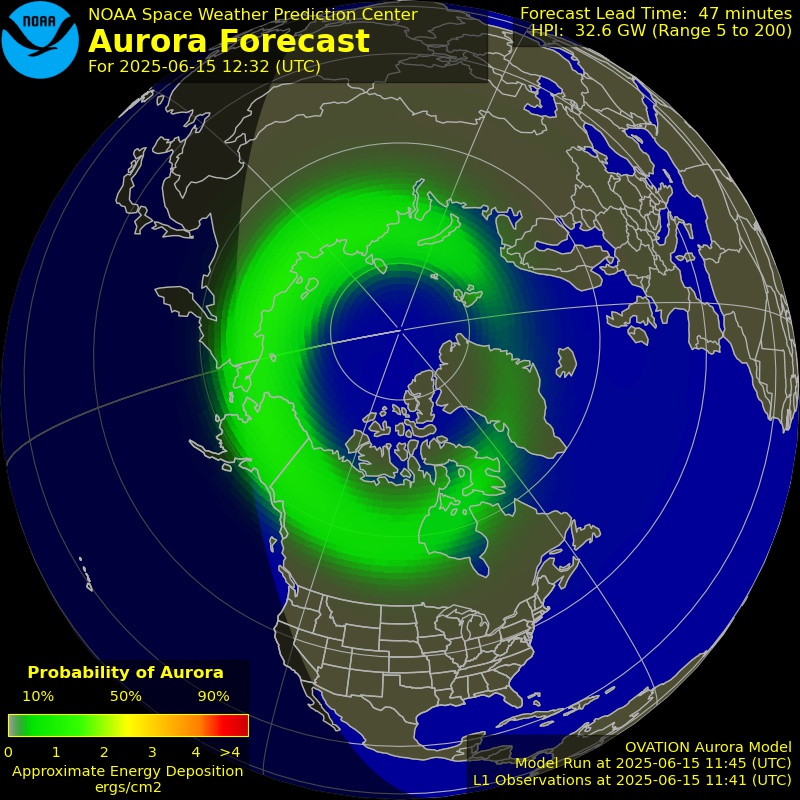
If the animation does not load, a static image will be shown.
Conditions assessment
The indicators consider your location, the local aurora chance and whether it is dark.
Kp (3h)
Kp (1 min)
Bz (GSM)
Bt (IMF)
Speed
Density
Temperature
Turn the numbers above into a quick tonight verdict. Unlikely: heavy cloud cover, or a Kp reading below the threshold for your specific location in the table below — the Upper Peninsula, northern Minnesota and the Detroit/Minneapolis metro area all need different numbers. Possible: Kp at or just above your local threshold with real breaks in the cloud — worth a look toward Lake Superior after 10 PM. Good: Kp clearly above your local “strong show” threshold with mostly clear sky — plan around it if you can. Because the Kp threshold varies so much across this region, check your specific spot in the table before judging tonight’s odds by a single number.
Latest alerts: solar activity and geomagnetic storms
The monitor below updates automatically from NOAA data: it shows the outlook for the next seven nights and the current aurora alerts. Check it right before you head out — conditions can change within hours.
Sky phenomena
Planning your night-sky observations? These monthly guides highlight the most important astronomical events, meteor showers, Moon phases and the best observation windows. Below you’ll find the two most relevant monthly guides for the current period.
SKY PHENOMENA
Monthly guide
Sky events in September 2026: meteors, equinox and the Moon
The key sky events of the month, meteor activity, the Moon and practical observation windows.
Read the guide
SKY PHENOMENA
Monthly guide
Sky events in October 2026: Draconids, Orionids and Saturn
The key sky events of the month, meteor activity, the Moon and practical observation windows.
Read the guideNorthern Lights
Looking for a longer-term Northern Lights outlook? These monthly guides complement the live radar with seasonal conditions, expected aurora activity and practical viewing tips. Below you’ll find the two most relevant monthly forecasts currently available.
NORTHERN LIGHTS
Monthly forecast
Northern Lights — September 2026
A monthly Northern Lights outlook with live-radar context and practical viewing guidance.
Read the guide
NORTHERN LIGHTS
Monthly forecast
Northern Lights — October 2026
A monthly Northern Lights outlook with live-radar context and practical viewing guidance.
Read the guide
What Kp do you need here?
This is the single most useful table on the page, because the difference between the north and south of this region is enormous — far bigger than most visitors assume.
| Location | Latitude | Kp for a visible display | Kp for a strong show |
|---|---|---|---|
| Keweenaw tip (Copper Harbor) | ~47.5°N | 4-5 | 6 |
| Northern Minnesota (Ely, Boundary Waters) | ~47.9°N | 4-5 | 6 |
| Headlands (Mackinaw City) | ~45.8°N | 5-6 | 7 |
| Northern Lower Michigan | ~45°N | 6 | 7 |
| Detroit / Minneapolis metro | ~42-45°N | 8 | 9 |
Two practical consequences. First, driving north matters more here than almost anywhere — the four hours from Detroit to the Keweenaw is the difference between needing a once-a-decade storm and needing a fairly ordinary one. Second, urban light domes wash out everything below roughly Kp 8, so being in a dark location is not optional at this latitude.



Hi, I’m Krystian “dziadzia przewodnik” from OndaTravel.pl!
The North is my greatest passion, but the world is far too beautiful to stay in just one climate. On my blog, I combine the raw landscapes of Iceland and Norway with the exotic energy of Thailand or Vietnam, showing you how to travel authentically — with passion and a camera in hand.
What will you find on OndaTravel.pl?
Visual storytelling: As a photographer and filmmaker, I don’t just describe places — I take you there with professional photos and video.
North expert: Ready-to-use road trip plans for Iceland and Norway, smart tips for budget travel, and my original Northern Lights Radar (locations and forecast).
Travel through the lens of cinema: I track down filming locations — from icy scenes in Interstellar to tropical frames from world cinema.
New direction: Exotic destinations: I love contrast, so the blog is featuring more and more practical knowledge about Vietnam and Thailand. I’ll show you how to find your way around Southeast Asia and come back with your best memories.
P.S. follow me here


Best dark-sky spots
- Keweenaw Dark Sky Park (Copper Harbor) — certified by DarkSky International, headquartered at Keweenaw Mountain Lodge, open to the public 19:00 to 07:00. Surrounded by Lake Superior on three sides, and about as far north as Michigan goes. The gold standard for the region.
- Brockway Mountain Drive — elevated road near Copper Harbor with a wide, open northern outlook over the lake. Popular with local aurora chasers for good reason.
- Headlands International Dark Sky Park — near Mackinaw City, the most accessible certified dark-sky site in the Lower Peninsula, with dedicated viewing areas and an unobstructed water horizon.
- Boundary Waters area, northern Minnesota — around Ely, at a similar latitude to the Keweenaw tip, with very low light pollution and lake horizons.
- Roadside parks along the Keweenaw — many are open all night for stargazing (though not for camping), and several face directly north.
- Marquette area, Michigan — the Upper Peninsula’s largest city, with Presque Isle Park giving a Lake Superior-facing horizon inside city limits, and better dark sky a short drive out along the shoreline. A practical middle ground between the Keweenaw’s certified darkness and a base with real services.
- Cook County / Grand Marais, Minnesota — the North Shore of Lake Superior northeast of Duluth, distinct from the Boundary Waters entry point at Ely. Grand Marais and the shoreline along Highway 61 give an open lake horizon facing north-northeast, a different practical option from the inland Boundary Waters approach.
The Lake Superior shoreline has a structural advantage: open water to the north means no town, no highway and no light dome in exactly the direction you need to look.
Why it looks grey to your eyes
Local aurora groups say this constantly, and it is worth repeating: in Michigan and Minnesota the northern lights often appear to the naked eye as a whitish or grey band low in the north, not as the vivid green you see in photographs. That is not a weak display or a failed night — it is how human vision works. Colour perception shuts down in low light, while a camera sensor accumulates light over a 10-second exposure and records the green clearly.
The practical trick: if you are not sure whether a pale band on the horizon is aurora or thin cloud, photograph it. A 5 to 10 second exposure settles the question immediately. Also give your eyes 15 to 20 minutes to dark-adapt and stay off your phone screen in between.
When to go
| Month | Notes | Rating |
|---|---|---|
| September | Equinox activity peak, mild nights, lake still open | Best |
| October | Equinox effect continues, aurora chasing season begins in earnest | Best |
| November | Long nights, increasing cloud | Good |
| December-January | Longest nights but the cloudiest, snowiest period | Fair |
| February | Cold, clearer spells return | Good |
| March | Equinox activity peak again, still long nights | Best |
Unlike the Arctic, midwinter is not the prime window here. September, October and March combine the equinox-linked rise in geomagnetic storms — which is what you actually need at this latitude — with better odds of a clear sky than the December to January lake-effect cloud season.
How to actually catch one
Mid-latitude aurora hunting is a different discipline from Arctic aurora hunting. In Tromso you book a week and go outside every night. Here you cannot plan the display in advance — storms strong enough to reach 45 to 47 degrees north arrive with a day or two of warning at most. The realistic approach is to be ready rather than scheduled:
- Set up alerts so you know when Kp is forecast to rise, rather than checking manually.
- Know your dark spot in advance and how long it takes to drive there at night.
- Check cloud cover before you commit — a Kp 8 storm under overcast is a Kp 0 experience.
- Plan around the new Moon where you can; faint mid-latitude displays are easily washed out.
- Go out even for a moderate forecast if you are already in the Keweenaw or northern Minnesota — at Kp 4 to 5 you are in range there.
Cloudy tonight? Where to go instead
Lake-effect cloud is the main obstacle in the Upper Great Lakes, and it is very local: it forms downwind of open water and can sit over one shoreline while another is clear. Because you need a storm at this latitude anyway, it is worth driving further than you would in the Arctic when one arrives.
| Where to go instead | Distance | Drive time | Why it can work |
|---|---|---|---|
| Brockway Mountain Drive | 2 mi / 3 km from Copper Harbor | ~10 min | Elevated, open north over Lake Superior; above low lake cloud |
| Keweenaw Dark Sky Park | at Copper Harbor | on site | Certified park, open 19:00-07:00, sheltered from town glow |
| Inland from the shoreline | 10-25 mi / 16-40 km | 20-40 min | Moving away from open water often escapes lake-effect cloud entirely |
| Boundary Waters, Minnesota | different state | varies | Same latitude as the Keweenaw, separate weather system |
Camera settings that work here
Because displays here are usually low on the horizon and faint, use longer exposures than you would in the Arctic: ISO 1600-3200, f/2.8 or wider, 10-20 seconds, manual focus at infinity, tripod essential. Compose with the lake, a lighthouse or a treeline in the frame — a faint band over empty water rarely carries a photograph on its own. Phone night mode works surprisingly well from a stable surface. During a genuine Kp 8 storm, remember to look straight up as well as north; at that strength the aurora is not confined to the horizon.
Planning the trip: getting there, staying, packing
Getting there
For the Keweenaw, the nearest airport is Houghton County Memorial (CMX), served through Chicago, with Copper Harbor about 45 minutes further north. Many visitors instead drive: Chicago is roughly eight hours, Detroit around nine, Minneapolis about six. For northern Minnesota, Duluth is the practical gateway, with Ely a two-hour drive beyond it.
Where to base yourself
Copper Harbor puts you at the northern tip with the Dark Sky Park on your doorstep, but it is small and many businesses close for winter, so check opening dates before booking. Houghton and Hancock have more year-round accommodation and food, at the cost of a 45-minute drive each way. In Minnesota, Ely and the Gunflint Trail lodges play the same role.
Because you cannot book a storm
This is the planning problem specific to mid-latitudes. Kp 4 or higher arrives with a day or two of notice, which is shorter than most people book accommodation. Two approaches work: base a longer trip here for other reasons and treat aurora as a bonus, or keep a flexible booking and a bag ready so you can drive north when the forecast turns. Chasing from Detroit or Chicago on short notice is a genuine strategy locals use.
What to pack
Upper Michigan winters are cold and snowy, and lake-effect snow can close roads with little warning. Winter tyres or all-wheel drive, a snow brush, and enough fuel to avoid hunting for an open station at midnight. For the sky itself: tripod, a wide lens, and patience for 10 to 20 second exposures, because displays at this latitude sit low and faint.
FAQ: Northern Lights in Michigan and Minnesota
What Kp index do you need to see the aurora in Michigan?
It depends heavily on where you stand. The tip of the Keweenaw Peninsula needs Kp 4 to 5; Headlands near Mackinaw City needs Kp 5 to 6; Detroit and other metro areas need Kp 8 or above. Driving north lowers the threshold dramatically.
Where is the best place to see the northern lights in Michigan?
The Keweenaw Peninsula, especially Copper Harbor and Brockway Mountain Drive, is the regional gold standard. It is the furthest north you can get in Michigan and holds DarkSky International certification. Headlands near Mackinaw City is the best accessible option further south.
What is the best month for the aurora in the Upper Great Lakes?
September, October and March. Unlike the Arctic, midwinter is not the best window here: the equinox months bring the geomagnetic storms you need at this latitude, and December to January brings the heaviest lake-effect cloud.
Why did the aurora look grey rather than green?
Human colour vision shuts down in low light. At Michigan and Minnesota latitudes the display is often faint enough that your eye reads a whitish or grey band while a 10-second camera exposure records clear green. Photographing it is also the fastest way to tell aurora from thin cloud.
Can you see the northern lights from Detroit or Minneapolis?
Only during major storms, roughly Kp 8 or above, and even then urban light domes wash out most of the display. When such a storm is forecast, driving north and finding a dark location transforms the experience.
How far in advance can you plan an aurora trip here?
You cannot, really. Storms strong enough to reach these latitudes give a day or two of warning at most. The workable approach is to set up alerts, know your dark spot and drive time in advance, and be ready to go at short notice.

About the OndaTravel.pl author
Krystian — „dziadzia przewodnik”
Meet the OndaTravel.pl author: an independent Arctic guide, photographer and filmmaker. See how the guides are made, where the field photos come from, and how to reach out about a guided trip to Iceland, Lofoten or Norway.
Read also
Michigan and Minnesota only work during storms; for the Alaskan side of the same question see our guide to the northern lights in the USA.
TOOL
Alerts
Aurora Alerts
Essential at this latitude: storms reaching Michigan arrive with a day or two of warning at most.
Open Aurora AlertsALL LOCATIONS
Hub
Aurora Radar: Choose a Location
Compare Kp thresholds across every location we track, from Arctic Europe to North America.
See all locations
NORWAY
Live radar
Tromso
Tired of waiting for a Kp 6 storm? Inside the oval, Kp 0 is enough and the aurora is overhead.
Check Tromso radarPHENOMENON EXPLAINED
Guide
Live Aurora Forecast Explained
Understand what Kp, Bz and cloud cover actually mean before you check any radar.
Read the explainer