

The Perseids are the most famous summer meteor shower. Every year in August, thousands of people head out after dusk to see what is commonly called the night of shooting stars. The problem is that the most important information often gets lost in a single phrase: “Look at the sky on 12 August.” In practice, the right night, time, sky darkness, radiant altitude, Moon phase, weather and observing site all matter.
This guide covers the whole topic: when the Perseids occur, which night is best, what time to go out, where to look, whether they are visible from the city, how many meteors can be seen, how to choose a location, and how to take a photo. You will find information for 2026 as well as principles that will be useful in every subsequent observing season.
If you want to compare the Perseids with other showers, check the meteor shower calendar. If you are interested in the entire month of observation, also go to the guide sky phenomena in August 2026.
Before the August Perseid peak, also see the Delta Aquariids 2026 guide, which peaks at the end of July.
Main guide
Sky phenomena 2026: calendar, meteors, eclipses and auroras
Enter the main guide to sky phenomena and quickly navigate to meteors, eclipses, Moon phases, NLC, and the aurora borealis.
OBSERVATION PLAN
Meteor calendar and the August sky
These two guides help compare the Perseids with other showers and check what else is worth observing in the sky in August 2026.

METEOR SHOWERS
Observation calendar
Meteor shower calendar 2026
Major showers, peak dates and best nights for shooting stars.
Check the meteor calendar
AUGUST 2026
Observation plan
Sky phenomena in August 2026
Perseids, eclipses, the Milky Way and the best nights of the entire month.
See August 2026Key information for someone who simply wants to know when to go out, where to look, and how not to miss the best part of the night.
The best time to observe meteors is the night of the shower’s peak, but only when the sky is dark, cloudless, and as far from city lights as possible. Always check the Moon phase too — a bright full Moon can weaken even an active shower.
Table of contents

Check out my YouTube channel and travel with me.
Follow the channel for videos, routes and practical travel inspiration.
Follow me here:
What’s up?
Enjoying my content?
Buy me a coffee at buycoffee.to/ondatravel and support the creation of more travel content.
Your support helps me create more practical guides, videos and travel inspiration.

Perseids 2026 – key information
The most important night for the Perseids in 2026 is the night of 12/13 August. However, the shower is active much longer: from 17 July to 24 August. This means that individual Perseids can also be seen before and after the main peak, and a clear night close to the peak may be a better choice than a cloudy night on the peak itself.
The formal peak is predicted for 13 August between 02:00 and 04:00 UT, i.e. around 04:00–06:00 UTC (convert to your local time). However, it should not be treated like an eclipse starting at a precise second. The Perseids have a broad peak, and their number changes gradually. For most observers, it makes sense to head out in the late evening of 12 August and keep observing for as long as conditions allow.
| When is the night of the Perseids? | 12/13 August 2026 |
|---|---|
| When is the formal peak? | 13 August, around 04:00–06:00 CEST |
| When to start? | No later than around 22:00–23:00, and best to stay until dawn |
| Will the Moon interfere? | No. The new moon falls on 12 August and conditions are exceptionally favourable |
| Is it worth observing the night before? | Yes, especially if the forecast for the peak night is poor |
| Does the night of 13/14 August make sense? | Yes, activity does not suddenly disappear after the peak |
The year 2026 is particularly interesting because the new moon falls on 12 August. The exact local clock time depends on your location. The sky during the main part of the night will not be brightened by a bright Moon, so even fainter meteors have a greater chance of being visible. This is a big difference compared to years when the peak falls close to a full moon.
Models of the dust stream also indicate a possible encounter of Earth with a very old trail of material and a weak filament near the main peak. This is scientifically interesting, but is not a guarantee of an outburst. It is not worth promising hundreds of meteors or adding different ZHR values together. The best strategy is simpler: observe for as long as possible through the night of 12/13 August and, if the weather permits, also on adjacent nights.
The simplest answer: in 2026, head to a dark-sky site on the evening of 12 August, give your eyes time to adapt to the darkness, and stay at least until late at night. Expect the greatest activity towards dawn, but don’t wait solely for one “magic” hour.
It is worth knowing that 12 August 2026 is also the day of a total solar eclipse. This is a separate phenomenon and the path of totality is limited to specific regions, but astronomically it is an exceptional day. A full overview of other events can be found in the astronomical events calendar. More dates and types of phenomena can also be found in the guide solar and lunar eclipses 2026.
OBSERVATION PLAN
Perseids and exceptional phenomena on the same day
On the day preceding the main Perseid night, a total solar eclipse also occurs. These guides organise the entire astronomical context.

12 AUGUST 2026
Great summer phenomenon
Total solar eclipse 12 August 2026
Path of totality, Europe, Iceland, Spain and a practical observation plan.
See the 2026 eclipse
ECLIPSES
Sun and Moon
Solar and lunar eclipses 2026
Dates, visibility locations and the most important observation rules.
Check eclipses
CALENDAR
Observation plan
Astronomical events calendar 2026
The most important dates, phenomena and best observation windows of the year.
Open calendar
When are the Perseids?
The Perseids do not last just one night. The Earth crosses a vast stream of particles left in orbit by comet 109P/Swift–Tuttle over many weeks. That is why the shower’s activity begins already in the second half of July, gradually increases, reaches a peak in mid-August, and then declines.
For most people, the period from a few nights before the peak to a few nights after is of practical significance. It is then easier to see more meteors in a reasonable amount of time. However, this does not mean that seeing a Perseid on 1 August or 20 August is impossible. The chance and rate of events are simply usually smaller than near the peak.
Why do the Perseids appear at a similar time every year?
The Earth returns to nearly the same part of its orbit around the Sun every year. In mid-August it crosses the region where particles associated with the orbit of comet Swift–Tuttle are located. That is why the Perseid calendar is predictable, although the exact peak time and actual activity may vary between years.
The exact peak date, Moon phase and observing conditions change every year. However, the principles remain the same: a dark location, wide field of view, patience and avoiding a bright screen.
Which night is best for the Perseids?
The term “Perseid night” usually means the night encompassing the shower’s peak. If the formal peak falls in the early morning of 13 August, we are talking about the night of 12/13 August. This is important, because the notation of the date “13 August” alone can be misleading and some people only go out in the evening of 13 August, i.e. already after the main peak.
In 2026, the first choice is the night of 12/13 August. The night of 11/12 August is a very good alternative if the forecast for the main night predicts clouds. The night of 13/14 August also makes sense: activity does not drop to zero after a few minutes, and past years have occasionally seen secondary increases in activity after the main peak. However, one should not assume that such an additional increase will occur in a specific year.
| 11/12 August | Choose this night when skies are clear and the forecast for 12/13 August looks poor. It is still very close to the peak. |
|---|---|
| 12/13 August | First choice in 2026. The formal peak falls in the early morning. |
| 13/14 August | A good option after the peak, if the previous night was spoiled by clouds or you could not observe. |
A clear night close to the peak is better than the “ideal date” under a completely overcast sky. With meteors, weather beats the calendar.
What time is best to watch the Perseids?
Most people want one specific hour, but with the Perseids the interval is more important. It is worth starting to observe in the late evening, and the greatest number of meteors is usually expected after midnight and towards dawn. As the night progresses, the shower’s radiant – the point from which meteors appear to originate – rises higher above the horizon. More of the meteoroid stream then becomes visible from your location.
Is it worth looking before midnight?
Yes. Before midnight the number of meteors may be smaller, but you can catch spectacular, long trails crossing a large part of the sky. Such meteors enter the atmosphere at a shallow angle and are sometimes called “earthgrazers”. They are not guaranteed, but evening observation can be very spectacular.
Why is it usually better after midnight?
After midnight, your location on Earth rotates increasingly into the direction of Earth’s orbital motion. At the same time, the Perseid radiant rises higher. In practice, this increases the number of particles whose glowing trails we can see. That is why anyone hoping to count meteors should plan a longer session in the second half of the night.
In 2026, the formal peak around 04:00–06:00 CEST falls favourably for Europe, although the end of this interval already coincides with increasing dawn. This does not mean you need to set the alarm only for 04:00. It is much better to observe continuously for several hours than to go out for ten minutes at the “exact” time.
What if I miss the peak night of the Perseids?
Do not give up. The Perseids are a broad shower, active for many weeks. The peak night is the best statistical indicator, not the only moment when meteors exist. If the sky is cloudy on 12/13 August, check the night before and the night after.
When choosing between two nights, apply a simple order: cloud cover, sky darkness, Moon, distance from the peak. A cloudless sky two days from the peak can provide a better experience than total cloud cover at the moment of the theoretical peak.
- First check the clouds. If the entire peak night is forecast to be overcast, choose an adjacent night.
- Compare the Moon. In some years, an earlier or later night can provide a darker window.
- Choose a longer observation. An hour under a good sky is better than ten minutes on the ideal date.
- Do not wait for the next night if the weather is great today. In August, the forecast can change quickly.
Where to look for the Perseids?
The Perseid radiant is located in the region of the constellation Perseus. This is where the shower’s name comes from. However, this does not mean that you need to stare exactly at Perseus all night. Meteors can appear across a very large part of the sky.
The best strategy is to choose a dark, wide section of the sky and look about 40–60 degrees away from the radiant. The further from the radiant a meteor appears, the longer its trail may seem. Directly near the radiant, trails are often shorter because we are looking almost along the direction of motion.
From which direction are the Perseids?
For observers in the Northern Hemisphere, Perseus is located in the north-eastern part of the sky in the evening and rises during the night. However, the practical answer is: you do not need to look north-east all the time. Lie down so that you can see as much sky as possible, and keep the radiant to the side of your field of view.
How to find the constellation Perseus?
You can use a sky map on your phone before starting the actual observation. Find Perseus, memorise its position, and then put the phone away or activate the red screen mode. Constantly looking at a bright screen worsens the eye’s adaptation to darkness.
Not every meteor visible in August is a Perseid. Other showers and sporadic meteors are also active during this period. If you trace the meteor’s path backwards and it leads towards the Perseid radiant, it probably belonged to this shower.

Where to watch the Perseids?
The best location does not have to appear on a “top 10 viewing spots” list. It should meet four conditions: be as dark as possible, have a wide view of the sky, be safe and legally accessible, and allow you to stay for at least an hour without constant car movement and lights.
- Avoid direct lamps. Even a single streetlight in the field of view can ruin eye adaptation.
- Choose open spaces. A meadow, clearing, lakeshore or high viewpoint are better than a narrow forest.
- Check the horizon and the direction of the city glow. If you can, position the brightest part of the sky behind you.
- Check access before night. Do not enter private property, a forest road with a ban, or a closed car park.
- Think about the return. Night-time observing can leave you tired; do not plan a long drive without rest.
How far do you need to go outside the city?
There is no single distance in kilometres. What matters is the size of the city, the direction of travel, the terrain, and local light sources. Sometimes 20–30 km from a small town gives very good conditions, while 50 km from a large agglomeration still remains under a bright glow. Look at the actual sky, not just the mileage counter.
Where to watch the Perseids without a car?
If you cannot travel far, look for the largest dark area accessible on foot or by public transport: the edge of a park, a beach, an embankment, an open recreational area, or a place where a building or trees block direct lamps. The most important thing is to remove bright light sources from the field of view.
Is a popular observation spot always the best?
No. On the peak night, popular spots can be full of cars, torches and phones. A darker, quieter location a few kilometres further can provide better conditions. Before you go to a trendy place, check parking, the possibility of night access, and whether the area is closed after dusk.

Are the Perseids visible from the city?
Yes, the brightest Perseids can also be seen from the city. However, you have to accept that many fainter meteors will disappear in the bright sky background. This does not mean that observing from a balcony, park or the outskirts of the city is pointless – especially during an active night you can catch very bright meteors and fireballs.
In the city, the biggest difference is made by blocking direct light. Stand so that a streetlight is hidden behind a building, wall or tree. Do not look towards the illuminated city centre. Choose a wide section of the sky above a darker horizon and give your eyes at least 20–30 minutes.
| Large city centre | Mainly the brightest meteors; make sure to block lamps and advertisements. |
|---|---|
| Park or city outskirts | Clearly better, if the sky is wide and there are no lamps in the field of view. |
| Small town | Good conditions after moving away from local streetlights. |
| Dark location outside the city | The greatest chance for fainter meteors and longer continuous observations. |
Do not compare your result with a photograph composed of several dozen exposures. A photo showing many meteors at once is often a composite of the entire night, and the human eye sees each meteor separately.
How many Perseids can you really see in an hour?
The most frequently repeated number is a ZHR of 100. It does not mean that every person will see exactly one hundred meteors per hour. ZHR is a normalised indicator used to compare shower activity under ideal conditions: with a very dark sky, radiant at the zenith, and unlimited field of view. Actual observation almost always takes place under less ideal conditions.
The result is influenced by: sky brightness, radiant height, clouds, the Moon, horizon obstructions, observing time, phone breaks, and how wide a section of the sky you can see. Two people in different locations on the same night can report very different numbers, and both can be right.
Why do I see only a few meteors when a hundred were predicted?
- You are looking from a bright city and fainter meteors are lost in the background.
- The radiant is still low because you are observing too early.
- Thin clouds let stars through but suppress fainter meteors.
- You check your phone every few minutes and your eyes do not achieve full adaptation.
- You are observing for too short a time. The shower does not work like a steady rain every few seconds.
- In a given year or at a given hour, the actual activity is lower than the popular catalogue value.
In 2026 it is worth maintaining particular realism. Official studies indicate that the background activity may be lower than the often-quoted ZHR 100, although at the same time there are interesting modelled encounters with older material. The best approach is to observe for a long time and not turn the sky into a race for a specific number.
Instead of asking “will I see 100?”, it is better to ask: “do I have a dark sky, a wide field of view, and at least an hour without a phone?” These are three things you can actually control.

Does the Moon interfere with watching the Perseids?
A bright Moon does not stop the shower, but it brightens the sky background. The brightest meteors may still be visible, while some of the fainter ones disappear. That is why the Moon phase can decide whether a night will be average or excellent. The current phase and new moon and full moon dates can be found in the Moon phases guide.
FULL GUIDE
Moon phases 2026
Check the new moon, full moon and quarters to choose the darkest nights for the Perseids and other meteors.
When the Moon is bright, position yourself so that it is behind you or hidden by a building, trees or a hill. Do not look in its direction. Sometimes it is also better to observe before moonrise or after moonset.
The Moon during the Perseids 2026
In 2026 the situation is almost ideal: the new moon falls on 12 August in the evening. On the main peak night there will be no bright lunar disc competing with the meteors. This is one of the main reasons why it is worth reserving more than just a dozen or so minutes for observation.
How to check the weather before observing the Perseids?
The biggest enemy of observation is clouds, not the lack of a telescope. It is not enough to glance at a “cloudless” icon. Check the course of cloud cover throughout the night and pay attention separately to low, medium and high clouds. A thin layer of high clouds can leave the brightest stars visible while simultaneously cutting out most of the fainter meteors.
- Total cloud cover: shows what part of the sky will be obscured.
- High clouds: can be deceptive, because the sky looks “almost fine” but the contrast is weaker.
- Fog and humidity: can limit visibility and deposit dew on the lens.
- Precipitation and storms: are a reason to move the observation or change location.
- Clear spells: with changeable weather, the timing of their arrival matters, not the average icon for the whole night.
If storms or precipitation are developing in the region, the live storm and precipitation radar is also helpful. Treat it as a supplement, however: the precipitation radar does not replace the astronomical cloud cover forecast.

FULL GUIDE
Where is the storm? Live storm and rain radar
Check where it is raining and where storms are developing before you choose a night observation spot.
Is it worth going with partial cloud cover?
Yes, if longer clear spells are forecast and you have a flexible plan. No, if the entire night is forecast to be covered by a thick layer of clouds without real windows. With moving clouds, choose a location with a wide sky – even when half the sky is covered, the other half can provide good observations.
How to prepare for the Perseids in 10 minutes?
The best observations are surprisingly simple. You don’t need a telescope, but it is worth preparing so that you don’t end after twenty minutes because of cold, mosquitoes or an uncomfortable position.
- Check clouds and precipitation a few hours before departure.
- Choose a legal, safe location with a wide view of the sky.
- Take a deckchair, sleeping mat or thick blanket. Looking with your head tilted back quickly tires the neck.
- Dress warmer than the temperature suggests. Without movement, the body cools down faster.
- Take mosquito repellent and something to drink.
- Set your phone to minimum brightness and use red light.
- Give your eyes 20–30 minutes without a bright screen.
- Stay at least 60–90 minutes. Meteors appear irregularly.
How long do eyes need to adapt to the dark?
You will notice some improvement after a few minutes, but fuller adaptation usually takes about 20–30 minutes. Every glance at a bright screen or car headlights can partially reverse this process. That is why it is best to prepare the map, route and camera settings before starting the actual observation.
What to take for the night of shooting stars?
- a deckchair, sleeping mat or blanket with insulation from the ground,
- a warm sweatshirt and an extra layer, even after a warm day,
- a thermos or water,
- mosquito repellent,
- a small red torch,
- a powerbank if you use a phone or camera,
- a lens dew shield or astrophotography heater if you plan a long session.

Do you need a telescope or binoculars for the Perseids?
No. Meteors appear randomly across a large part of the sky, and a telescope and binoculars show a very small section. The best “equipment” for observing the shower is your eyes and a wide field of view. You can take optics to view other objects during breaks, but they will not help in hunting for randomly appearing Perseids.
What are the Perseids and where do they come from?
The Perseids are a meteor shower, i.e. a phenomenon that occurs when Earth passes through a stream of tiny particles located on the orbit of comet 109P/Swift–Tuttle. When such particles enter the atmosphere at enormous speed, they heat and ionise the surrounding air. We then see a brief luminous trail – a meteor.
The colloquial name “shooting star” is beautiful, but astronomically a star is not falling anywhere. The phenomenon occurs in Earth’s atmosphere, usually tens of kilometres above the surface. Most particles are the size of grains of sand or small pebbles, and yet thanks to their speed they create a bright flash.
Meteor, meteoroid and meteorite – how do they differ?
- A meteoroid is a small object moving through space.
- A meteor is the luminous phenomenon visible when a meteoroid enters the atmosphere.
- A meteorite is a fragment that survived the flight and reached Earth’s surface.
Therefore the correct term is meteor shower, not “meteorite shower”. The latter variant is very popular in everyday language but suggests fragments falling to the ground, which we do not see during ordinary Perseid observation.
What do the Perseids have in common with comet Swift–Tuttle?
Comet 109P/Swift–Tuttle, during successive orbits around the Sun, leaves dust and fine material on its orbit. Earth crosses this vast stream every year. This does not mean that the comet itself is then next to our planet. We see old particles distributed along its orbit.
The comet’s orbital period is about 130 years. Individual bands of material can have different ages and densities, which is why the shower’s activity is not identical every year. The gravity of planets, especially Jupiter, can change the position of parts of the stream over time.
Why are they called the Perseids?
If we trace the meteor paths backwards, they appear to emerge from one area in the constellation Perseus. This point is called the radiant. It is a perspective effect similar to railway tracks converging in the distance. Meteors do not start from the constellation Perseus and have no physical connection with those stars.
Why are they called “Tears of Saint Lawrence”?
The Perseid peak falls close to the feast of St Lawrence celebrated on 10 August. In European tradition, the bright trails in the August sky therefore came to be called his tears. This is a cultural name, not an astronomical one, but it still appears in descriptions of the shower.

How to distinguish a Perseid from a satellite, aircraft and Starlink?
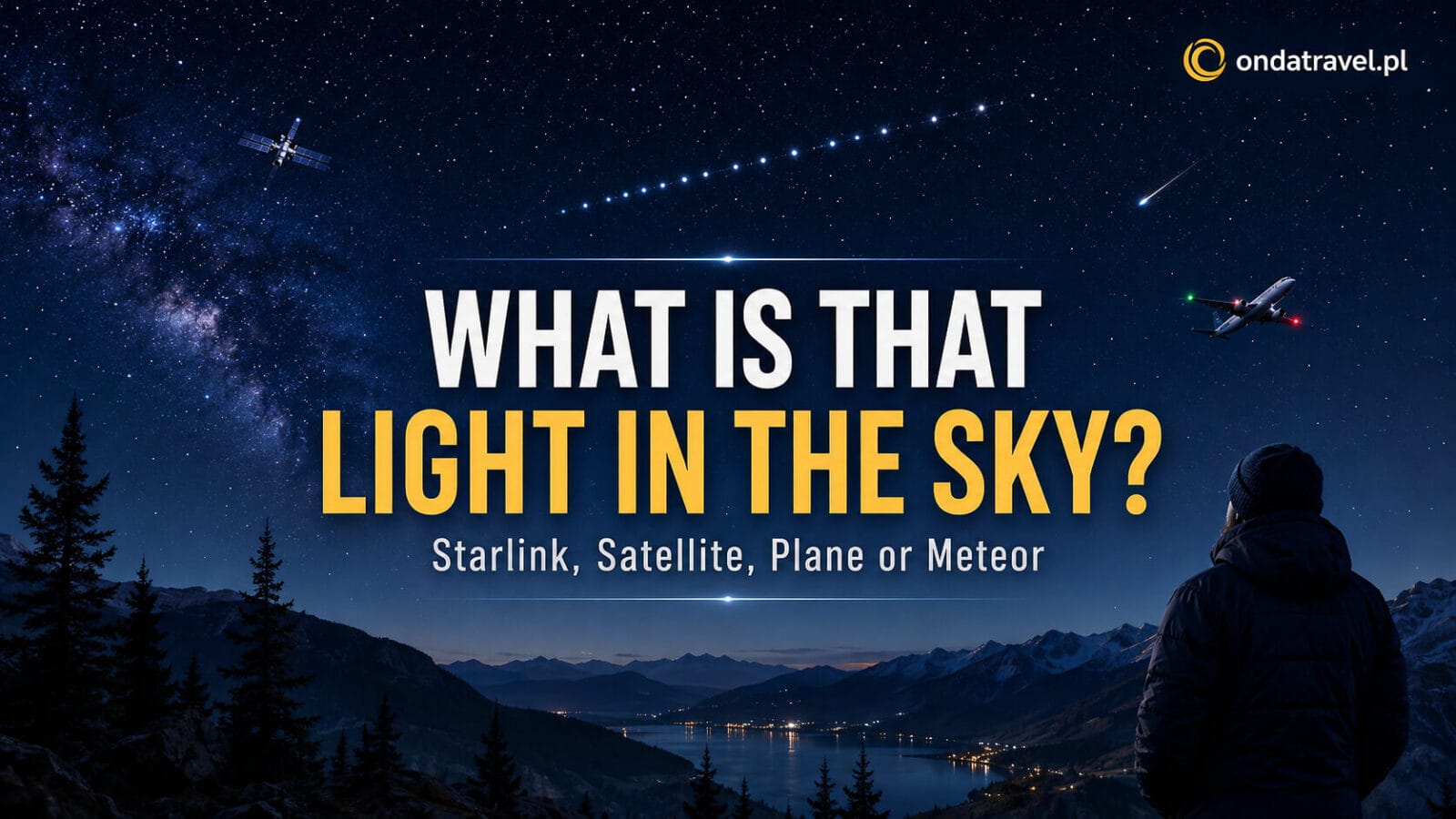
Beginner observers often see far more satellites and aircraft in the first hour than meteors. The most important difference is time. A meteor is usually very fast: it flashes and disappears in a fraction of a second or within a few seconds. A satellite moves slowly and evenly over many minutes. If what you saw does not match any of these patterns, our guide can help you identify a light in the sky and compare Starlink, satellites, aircraft and other common possibilities.
GUIDE
What Is That Light in the Sky? Identify Starlink, Satellites, Planes and More
Identify a strange light in the night sky by its movement, blinking, color and duration. Compare Starlink, satellites, ISS, planes, drones, meteors and more.
| Meteor | Very fast trail, usually a fraction of a second to a few seconds. |
|---|---|
| Satellite | Slow, steady point of light moving for several minutes. |
| Aircraft | Flashing lights, often several colours, long visibility time and possible sound. |
| Starlink | A series of points moving in a similar direction, especially after a recent launch. |
What do the Perseids look like?
The Perseids are fast and often bright. They can leave short-lived trails, and the brightest phenomena – fireballs – can be spectacular even under a poorer sky. Sometimes after a very bright meteor, a delicate glowing trail remains, persisting longer than the flash itself.
Can the Perseids have colours?
Yes. The eye can notice white, yellow, green or other hues, especially with bright meteors. The colour depends on the particle’s composition, speed, temperature and the glow of ionised gases in the atmosphere. A camera can record colours more clearly than eyesight.
Is every meteor in August a Perseid?
No. Other showers are also active in August and sporadic meteors always occur. The simplest test is to imagine extending the meteor’s path backwards. If it points to the vicinity of the radiant in Perseus, the phenomenon probably belonged to the Perseids.
How to photograph the Perseids with a camera?
Photographing meteors is a numbers game. It is impossible to predict exactly where the next meteor will appear, so the best method is a wide frame and a series of many exposures. Full basics of settings can be found in the guide how to photograph the night sky and stars.
FULL GUIDE
How to photograph the night sky and meteors?
Camera settings, tripod, focus and a practical plan for photographing meteors, the Moon and the Milky Way.
- Tripod: essential for long exposures.
- Wide-angle lens: increases the section of sky covered in the frame.
- Wide aperture: it is usually worth starting with the widest possible lens opening.
- Manual focus: set on a bright star and do not change afterwards.
- RAW: gives greater freedom in post-processing.
- Continuous sequence: an intervalometer allows you to keep shooting for a long time without touching the camera.
What camera settings should you start with?
There is no single setting that works for every camera and sky. As a starting point, use a wide-angle lens, an exposure time short enough that stars do not turn into obvious streaks, an ISO high enough for your sensor, and a wide aperture. Take a test photo, zoom in on the stars and check the histogram.
Under a very dark sky, a longer exposure records more stars but also brightens the background. In the city, you often need to shorten the time or lower the ISO. The most important thing is taking many frames – a meteor may appear in one photo out of several dozen.
Which direction to point the camera?
Do not aim the lens exactly at the radiant. Near the radiant, trails are shorter. Set the camera about 40–60 degrees away from Perseus and choose a frame with plenty of sky and an interesting foreground. With a wide lens, composition and dark sky are more important than finding one “ideal” direction.
Can you photograph the Perseids with a phone?
Yes, but the result depends on the phone and luck. The brightest meteors can be recorded, especially by models with a manual or astrophotography mode. The phone must be stationary. Holding it in your hand practically eliminates the chance of a sharp night photo.
- Place the phone on a tripod or stable holder.
- Choose the widest sensible frame with plenty of sky.
- Use Pro mode, long exposure or night mode if the device allows it.
- Turn off the flash.
- Take many photos instead of one.
- Do not expect the phone to capture every meteor seen with the eyes.

Practical observing plan for the Perseids 2026
The plan below assumes the main night of 12/13 August 2026. The exact time of dusk differs between the north and south of the country, so treat the times as a practical plan rather than a minute-by-minute timetable.
| 18:00–20:00 | Check the latest cloud, precipitation and travel forecast. The new moon falls in the evening. |
|---|---|
| 20:00–22:00 | Arrive at the location in daylight or with remaining light. Set up your deckchair and camera. |
| 22:00–23:00 | Put away the bright phone, begin eye adaptation and observation. |
| 23:00–02:00 | Look broadly at the sky. The radiant rises higher and higher. |
| 02:00–04:00 | One of the best observation windows. Do not take frequent breaks. |
| 04:00–06:00 | Formal peak predicted for this interval; the end may be limited by dawn. |
Backup plan if the night of 12/13 August is cloudy
Check the night of 11/12 August and 13/14 August. If one of them has a long, clear window, choose it instead of waiting under full cloud cover. In 2026, the absence of a bright Moon also favours observations on adjacent nights.
How to watch the Perseids with children?
You don’t have to wait until dawn. Choose late evening, a dark and safe location, and plan 60–90 minutes. Children usually find it easier to watch from a reclining chair with a blanket than to stand and look up. It is worth explaining beforehand that meteors do not appear at regular intervals and sometimes you have to wait.
Safety during night observation
- Do not stop your car on the roadside without a designated parking spot.
- Do not enter closed viewpoints and private property at night.
- Check whether hunting or night forestry work is taking place in the area.
- Take warm clothing and a supply of water.
- Do not observe alone in a place you do not know if you do not feel safe.
- After a whole night, rest before a long drive.
Most common mistakes when watching the Perseids
- Going out for only ten minutes. Meteors appear irregularly and a short attempt often ends in disappointment.
- Looking only at Perseus. The longest trails are often seen further from the radiant.
- Constantly checking your phone. A bright screen worsens the visibility of faint meteors.
- Believing the promise of “100 meteors per hour”. ZHR is not a counter for one person.
- Choosing a trendy spot without checking parking and lights. A crowd can spoil the darkness more than a distant city.
- Ignoring thin clouds. Faint meteors disappear even if the brightest stars are still visible.
- Lack of a warm layer. An August night after an hour without movement can be chilly.
- Using a telescope to search for meteors. The field of view is too narrow.
- Arriving exactly at the moment of the peak. You lose time on travel and eye adaptation.
- Giving up after the peak. The shower does not switch off at one hour and you can still see meteors.
The best observing setup is usually the simplest: a good location, a comfortable position, darkness, patience and a wide field of view. That is precisely why the Perseids are such a good first meteor shower for people who have never before consciously observed the night sky.
For more observing guides, continue with Sky phenomena or explore after-dark travel in noctourism.
OBSERVATION PLAN
Sky phenomena and after-dark travel
After the Perseids, you can go further: to the entire sky observation section or to travel planned around darkness, stars and night phenomena.
SECTION
Main observation page
Sky phenomena 2026
Meteors, Moon, eclipses, auroras, NLC and planning tools.
Return to section
NOCTOURISM
After-dark travel
Noctourism: night sky and travel
Trips planned around meteors, aurora, the Milky Way and dark skies.
See noctourism
Frequently asked questions about the Perseids
When are the Perseids?
The Perseids are usually active from the second half of July to the second half of August. The greatest activity falls in mid-August.
When is the Perseid night in 2026?
The most important night is 12/13 August 2026. The formal peak falls in the early morning of 13 August.
What time is best to watch the Perseids?
It is worth starting late in the evening and observing after midnight until dawn. In 2026 the formal peak falls around 04:00–06:00 UTC (convert to your local time).
Do you have to wait exactly until the peak?
No. The Perseids have a broad peak and are visible for many hours and on adjacent nights. A longer observation is better than a short attempt at one specific hour.
Are the Perseids visible the night before the peak?
Yes. The night before the peak can be very good, especially when the forecast for the main night is worse.
Are the Perseids visible the night after the peak?
Yes. Activity does not suddenly disappear after the peak. The night after the peak still makes sense if the previous night was spoiled by clouds.
What if I miss the Perseid night?
Check the sky on subsequent nights. The shower remains active until the second half of August, although the number of meteors gradually decreases.
Are the Perseids visible today?
It depends on the date. The shower is active from mid-July to late August, and your best chance comes near the mid-August peak.
Where to look for the Perseids?
Look broadly at the darkest part of the sky. You do not need to stare directly at the constellation Perseus.
Which part of the sky should you look at for the Perseids?
The radiant is located in the region of Perseus in the north-eastern sky, but in practice it is best to look 40–60 degrees away from the radiant and keep a wide field of view.
Do you need to find the constellation Perseus?
No. Knowing the radiant’s position helps identify the shower, but for viewing itself a wide, dark sky is enough.
Are the Perseids visible across the whole sky?
Yes. Meteors can appear across a large part of the sky. Their paths traced backwards point to the vicinity of the radiant in Perseus.
Where is the best place to watch the Perseids?
The best places are dark, legally accessible spots with a wide view of the sky and no direct lamps. It does not have to be a well-known viewpoint.
Are the Perseids visible from the city?
Yes, especially the brightest meteors and fireballs. You will see fewer faint meteors from the city than under dark skies.
How far do you need to go outside the city?
There is no single number of kilometres. What matters is the direction relative to the glow, the size of the city and local lighting. Sometimes a short trip gives a big improvement.
How many Perseids can be seen per hour?
The actual number depends on darkness, clouds, radiant height, the Moon and observation time. A ZHR of 100 does not automatically mean a hundred meteors for one person.
What does ZHR 100 mean?
It is a normalised indicator of shower activity for ideal conditions. It is not a direct forecast of the number of meteors visible from a specific location.
Why do I see only a few meteors?
The most common causes are a bright sky, low radiant, clouds, short observation time and loss of eye adaptation due to a phone or lamps.
Does the Moon interfere with watching the Perseids?
A bright Moon brightens the sky and hides fainter meteors. In 2026 the peak falls during a new moon, so conditions are exceptionally good.
Are the Perseids visible with partial cloud cover?
Yes, if there are longer clear spells. A wide field of view allows observing a clear section of sky between clouds.
How long do you need to look at the sky?
Aim for at least an hour; 90 minutes or longer is better. The shower does not produce meteors at regular intervals.
How long do eyes take to adapt to the dark?
Your vision starts improving quickly, but fuller adaptation takes about 20–30 minutes without a bright screen or direct lamps.
Do you need a telescope to watch the Perseids?
No. A telescope has too narrow a field of view. The Perseids are best viewed with the naked eye.
Is it worth taking binoculars?
Not for searching for meteors. Binoculars can be useful for viewing other objects during breaks, but the shower itself is observed without them.
How to photograph the Perseids?
Use a tripod, wide lens, manual focus and a series of many exposures. The most important thing is photographing a large section of the sky for a long time.
Can you photograph the Perseids with a phone?
Yes, especially the brightest meteors, but the phone must be stationary. It is best to use Pro mode, night mode or astrophotography mode and take many photos.
Which direction to point the camera?
Usually better 40–60 degrees from the radiant than exactly at Perseus. This way the trails can be longer in the frame.
Are the Perseids shooting stars?
That is a colloquial name. Stars do not fall. We see a luminous phenomenon created when a particle enters Earth’s atmosphere.
How does a meteor differ from a meteorite?
A meteor is a luminous phenomenon in the atmosphere. A meteorite is a fragment that survived the flight and reached Earth’s surface.
Where do the Perseids come from?
From particles left in orbit by comet 109P/Swift–Tuttle. Earth crosses this stream every year.
How fast do the Perseids travel?
Perseid particles enter the atmosphere at a speed of about 59 km/s, which is why the meteors look very fast.
Can the Perseids fall to Earth?
Typical shower particles are small and burn up or disintegrate high in the atmosphere. The Perseids pose no threat to observers.
Why are they called the Perseids?
Their radiant lies in the region of the constellation Perseus. Meteor paths traced backwards apparently converge in that area.
What are the Tears of Saint Lawrence?
This is a traditional name for the Perseids associated with the timing of their August peak, falling close to the feast of St Lawrence.
Is every meteor visible in August a Perseid?
No. Other showers and sporadic meteors are active at the same time. A Perseid is identified by tracing its path backwards toward the vicinity of the radiant.
Are the September Perseids the same shower?
No. The September epsilon Perseids are a separate, weaker shower. The name is similar because their radiant also lies near Perseus.
Are the Perseids visible from the southern hemisphere?
Conditions are much worse than at mid-northern latitudes because the radiant is low or below the horizon. From most of the southern hemisphere the shower is poorly visible.
Are high northern latitudes good for the Perseids?
Not necessarily. In summer at latitudes above about 60 degrees north, bright twilight and a short night can significantly limit observation.


Hi, I’m Krystian “dziadzia przewodnik” from OndaTravel.pl!
The North is my greatest passion, but the world is far too beautiful to stay in just one climate. On my blog, I combine the raw landscapes of Iceland and Norway with the exotic energy of Thailand or Vietnam, showing you how to travel authentically — with passion and a camera in hand.
What will you find on OndaTravel.pl?
Visual storytelling: As a photographer and filmmaker, I don’t just describe places — I take you there with professional photos and video.
North expert: Ready-to-use road trip plans for Iceland and Norway, smart tips for budget travel, and my original Northern Lights Radar (locations and forecast).
Travel through the lens of cinema: I track down filming locations — from icy scenes in Interstellar to tropical frames from world cinema.
New direction: Exotic destinations: I love contrast, so the blog is featuring more and more practical knowledge about Vietnam and Thailand. I’ll show you how to find your way around Southeast Asia and come back with your best memories.
P.S. follow me here


The most important thing at the end: do not wait for a single second of the peak. Choose the darkest possible location, check the clouds, lie down comfortably and look broadly at the sky for at least an hour. In 2026, the absence of moonlight gives the night of 12/13 August exceptionally good observing conditions.