
Total Solar Eclipse on August 12, 2026
On August 12, 2026, one of the most important astronomical events of this decade in Europe will take place — a total solar eclipse. In Poland you will only see a partial eclipse, but within the path of totality — especially in Spain, Iceland, and a small part of Portugal — it will be possible to witness the fully covered solar disk, the solar corona, and the dramatic darkening of the sky. If you want to plan your observation well, the key questions are: when will the total solar eclipse of 2026 happen, where can you see the solar eclipse on August 12, 2026, what time will it begin, will it be visible in Poland, and is Spain or Iceland the better choice?
To connect this topic with a wider northern travel plan, see the North section.

NORTH
North: Iceland, Norway, northern lights and Lofoten
A dedicated OndaTravel section for northern trips: Iceland, Norway, fjords, Lofoten, northern lights, ready-made routes and planning tools.
For broader route planning, start with Iceland: routes, regions and practical guides.
If you are also looking for broader context, see the Eclipses 2026 page, the full 2026 astronomical events calendar, and the entire Sky Phenomena section. This article focuses only on the event of August 12, 2026 and is meant to help you plan a specific observation session or trip.

Eclipse Guide
Eclipses 2026 — when do they occur and what will be visible from Poland?
Check all solar and lunar eclipses in 2026, the key dates, visibility, and practical viewing tips.
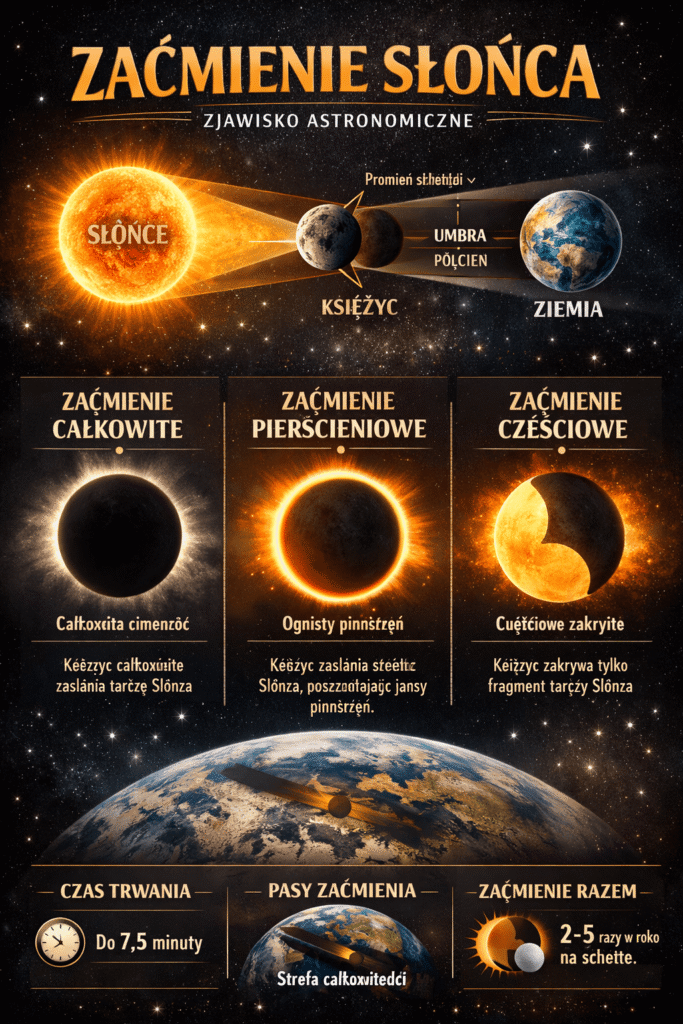
Solar eclipse 2026 — in short
The total solar eclipse of 12 August 2026 is a phenomenon that requires planning the location, the weather and observation safety in advance. The most important thing is to find a spot on the path of the eclipse and prepare eye protection.
Table of contents
When will the solar eclipse on August 12, 2026 take place?
Will the 2026 solar eclipse be visible in Poland?
Where can you see the total solar eclipse of 2026?
Solar eclipse map for 2026 and the path of totality
Spain or Iceland — which is better for observing it?
What time will the 2026 solar eclipse happen? Selected locations
How to watch a solar eclipse safely?
How to photograph the 2026 solar eclipse?

Check out my YouTube channel and travel with me.
Follow the channel for videos, routes and practical travel inspiration.
Follow me here:
What’s up?
Enjoying my content?
Buy me a coffee at buycoffee.to/ondatravel and support the creation of more travel content.
Your support helps me create more practical guides, videos and travel inspiration.

When will the solar eclipse on August 12, 2026 take place?
The total solar eclipse will take place on Wednesday, August 12, 2026. It will be one of the biggest astronomical events in Europe, because for many observers it will be the first major chance in years to see a full total phase without traveling to another continent.
What matters most, however, is that simply searching for “solar eclipse 2026” is not enough. For an observer, three things matter most: whether you are inside the path of totality, whether you have a clear western or west-northwestern horizon, and whether the weather will allow you to see the phenomenon. Only when all three align do you have a real chance of experiencing the full effect.
Will the 2026 solar eclipse be visible in Poland?
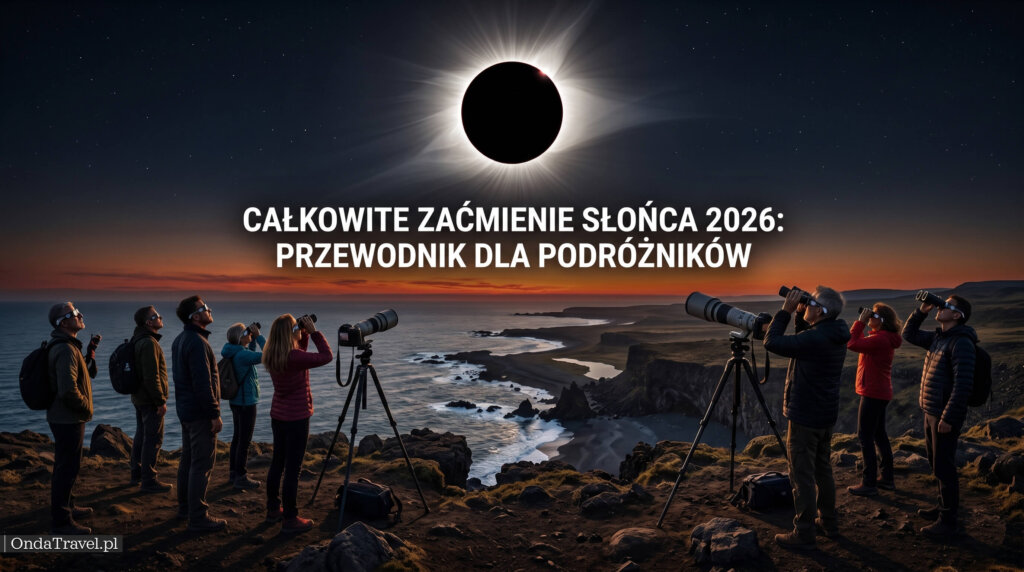
Yes, but not as a total eclipse. In Poland, on August 12, 2026, a partial eclipse will be visible. That is an important difference, because even a very deep partial eclipse does not create the same effect as standing inside the path of totality. You will not see the solar corona, the sudden drop into darkness, or the full “switching off” of the solar disk.
For observers in Poland, this will still be a great event to follow, but if you want the full experience, you need to plan a trip. Roughly speaking, in Poland the partial phase will last in the evening, from about 19:10 to 20:39 CEST, though the exact timing depends on location. In practice, that means even if you stay in the country, it is worth checking local visibility and a low western horizon in advance.
If you want to compare it with other major sky events of the year, also check the 2026 astronomical events calendar. August is not only about the eclipse, but also a very strong month for night-sky observers.

2026 Calendar
2026 astronomical events calendar — the most important dates
See the full 2026 astronomical events calendar and check what else is worth planning alongside the August solar eclipse.


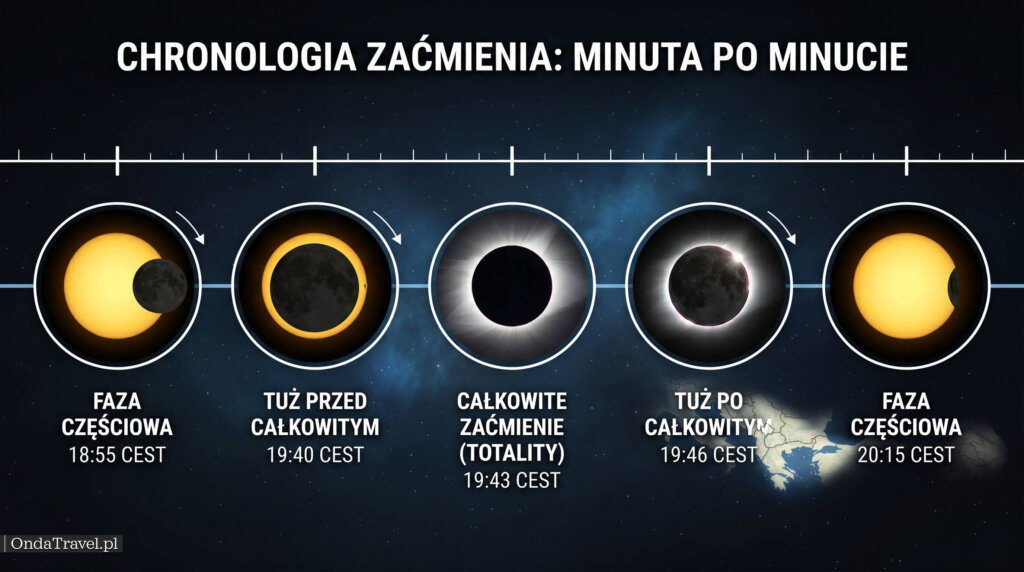
Where can you see the total solar eclipse of 2026?
On August 12, 2026, the path of totality will cross several very different regions. The most attention goes to Iceland and Spain, but the Moon’s shadow will also pass over Greenland, part of Russia, and a small section of Portugal. For most people traveling from Poland, however, the real choice comes down to two scenarios: Iceland for the scenery or Spain for a better chance of good weather and easier logistics.

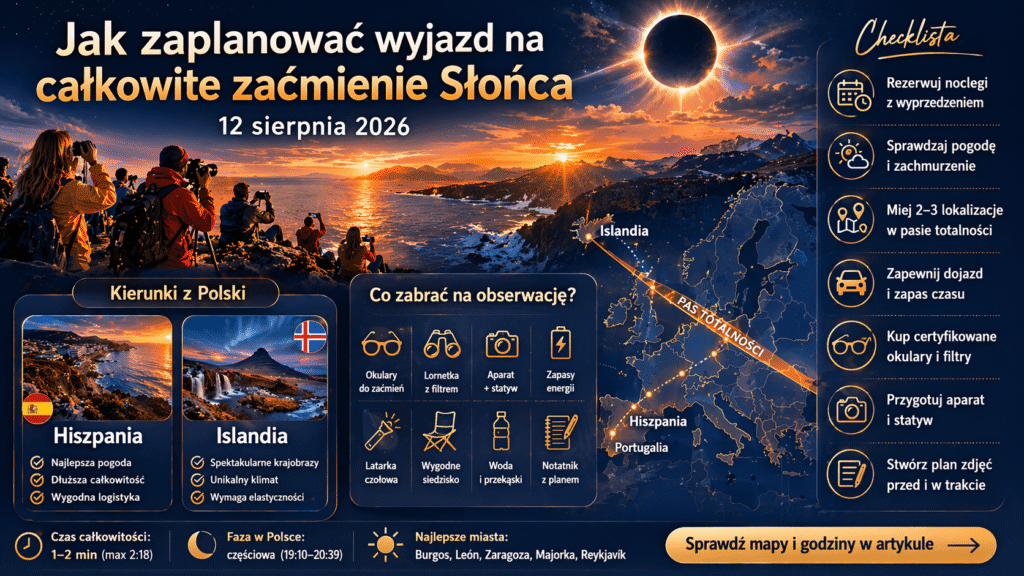
Solar eclipse map for August 12, 2026 and the path of totality
If you want to check where to see the 2026 solar eclipse, what time the 2026 solar eclipse will happen, and how the path of totality runs in detail, start with the official maps. They are the best place to compare Spain, Iceland, and locations closer to the western horizon.
- Interactive 2026 solar eclipse map with timing and path details – the best starting point for checking the time and visibility for a specific location.
- NASA: map of the central line and the boundaries of the path of totality – very useful if you want to place yourself precisely inside the totality zone.
- NSO: map of the shadow path across Iceland, the Atlantic, and Spain – a quick overview of the full eclipse route on August 12, 2026.
- Spain: official IGN map and eclipse route description – especially useful if you are considering León, Burgos, Bilbao, Zaragoza, or the Balearic Islands.
In practice, this section answers the most common Google searches: 2026 solar eclipse map, 2026 path of totality, 2026 solar eclipse Spain, and 2026 solar eclipse Iceland. Before you travel, check not only the path itself, but also the Sun’s altitude above the horizon and how easy it is to reach the observation point.
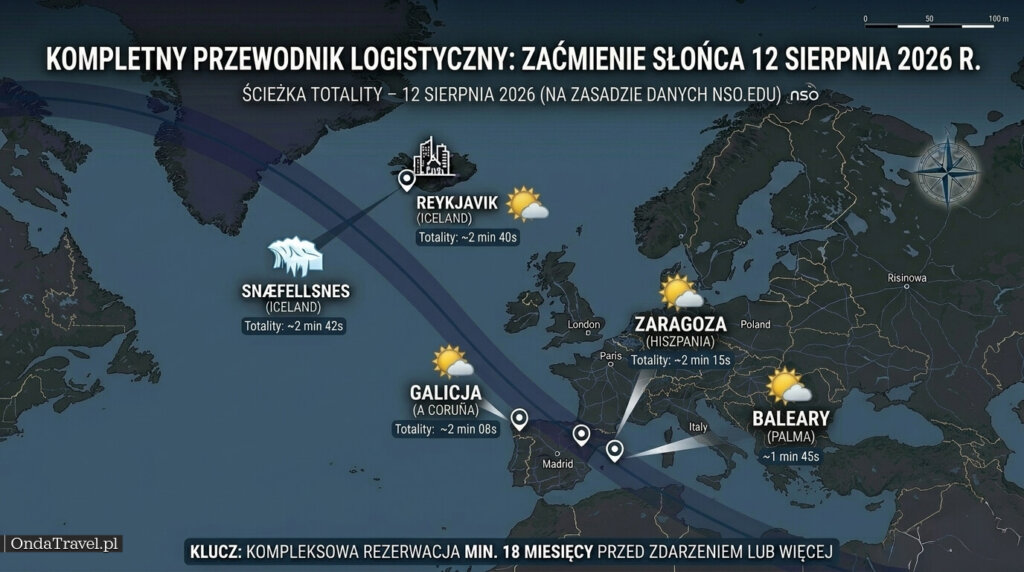
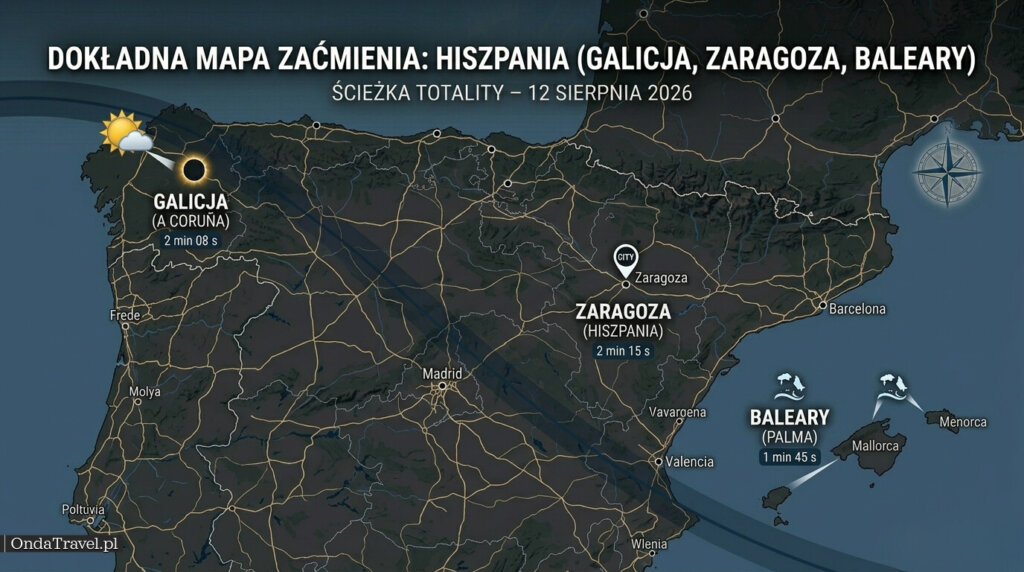
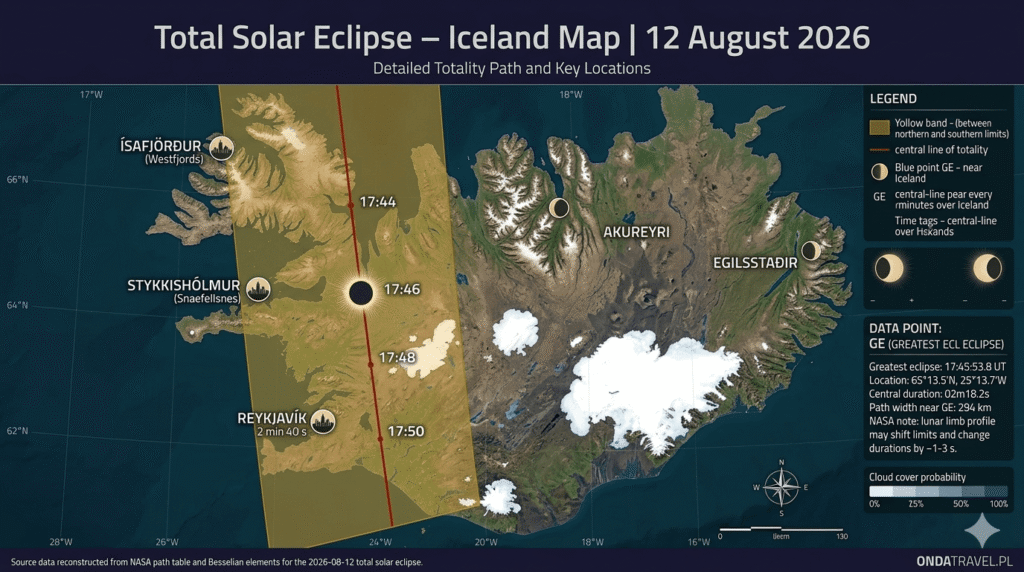
Viewing location maps — quick links
If you are planning a road trip or want to compare several spots, below you will find quick maps for the places most often chosen for the 2026 total solar eclipse in Spain and Iceland.
- Burgos – viewing location map
- León – viewing location map
- Zaragoza – viewing location map
- Palma de Mallorca – viewing location map
- Reykjavík — viewing location map
- Hellissandur and Snæfellsnes — viewing location map
- Reykjanes Peninsula — viewing location map
2026 solar eclipse in Spain — the best places
- Burgos and surrounding areas – a very strong balance between totality duration, access, and the chance of better weather.
- León and Castile and León – one of the most frequently recommended areas for people who want to combine good logistics with a high chance of clear skies.
- Soria and the central part of northern Spain – a strong option for observers focused on precise chasing of the path of totality.
- Zaragoza and Aragón – an interesting option for people who want to catch the event very low over the horizon.
- Mallorca – visually spectacular, but very demanding because of the extremely low position of the Sun above the horizon.
2026 solar eclipse in Iceland — the best places
If you are planning to observe the eclipse in this country, also see my guide to Iceland and the separate articles about the regions that most often appear in eclipse-trip planning: Snæfellsnes and Hellissandur, Reykjavík, and the Reykjanes Peninsula.

Snæfellsnes and Hellissandur
Snæfellsnes and Hellissandur — where to observe the eclipse in western Iceland
Go to the guide to the Snæfellsnes Peninsula and Hellissandur if you want to combine eclipse observation with one of the strongest scenic routes in Iceland.

Reykjavík
Reykjavík — a practical base for the 2026 solar eclipse in Iceland
See the Reykjavík guide if you are planning easier logistics, accommodation in the capital, and quick weather-based decisions just before the event.
Reykjanes
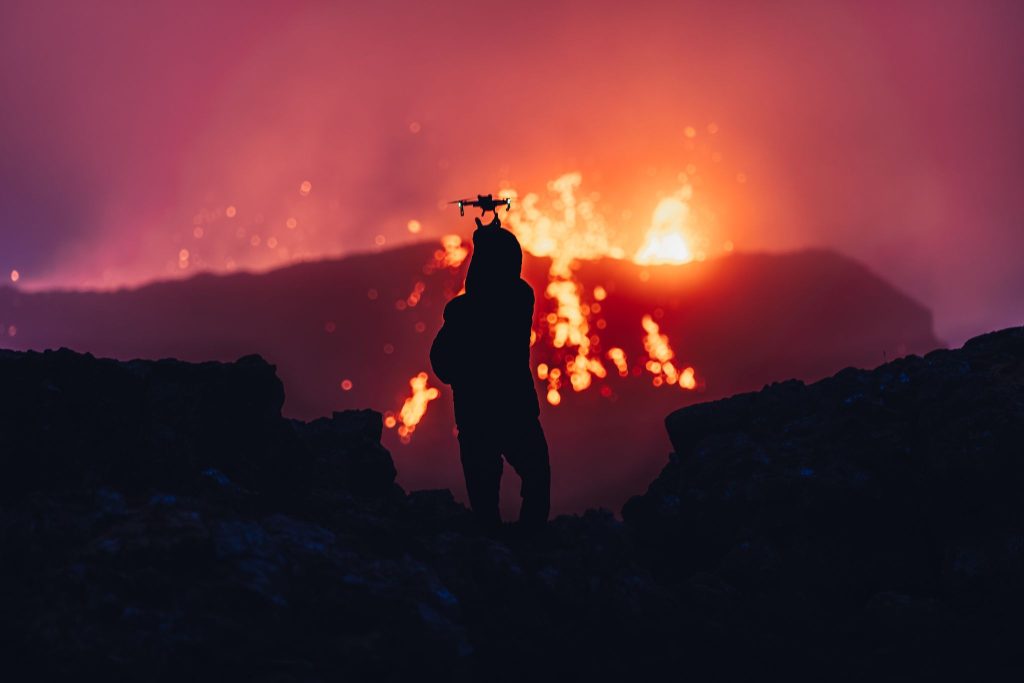
Reykjanes Peninsula — a flexible option for observation and access from the airport
Go to the Reykjanes guide if you want to combine eclipse observation with stark lava landscapes and strong mobility by car.
If you want a broader guide to eclipses themselves and to safe observing, also return to the Eclipses 2026 page. This article goes one step further and focuses on a single event and practical planning.
Spain or Iceland — which is better for observing it?
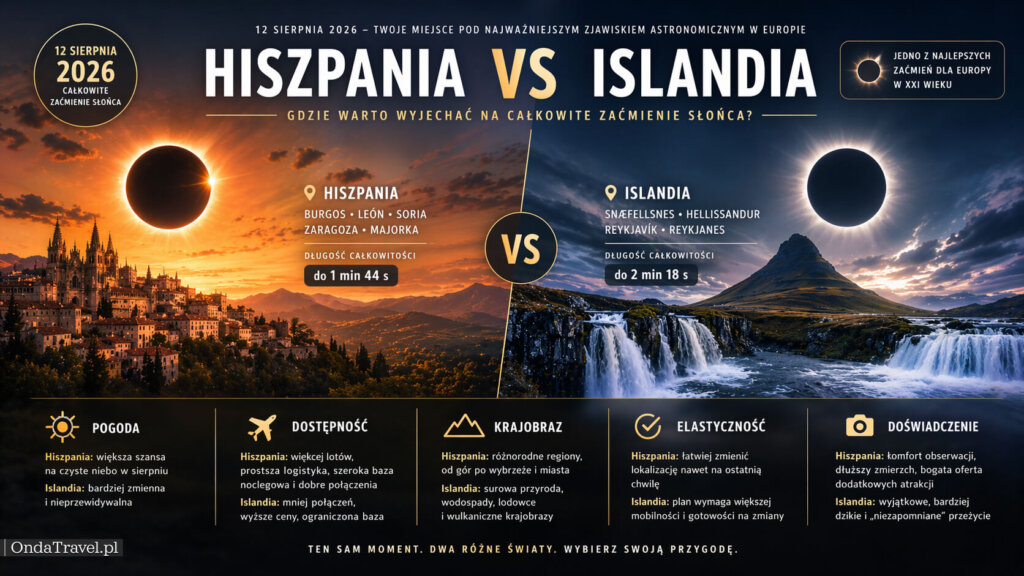
From a practical point of view, Spain is the better choice for most observers. The main reason is the statistically better weather along the final section of the path of totality. Spain also has simpler logistics: more flights, more accommodation, more roads, and greater flexibility to change location even the day before.
Iceland, on the other hand, is the option for people who want to combine the eclipse with one of the most photogenic landscapes in Europe. The downside is the greater instability of the weather. In practice, that means an Iceland plan should assume mobility, several backup locations, and a willingness to make decisions almost at the last moment.
The simplest way to sum it up is this:
- Spain – better weather, easier access, and a higher chance of a smooth trip.
- Iceland – stronger visual atmosphere and more dramatic scenery, but also a higher risk of clouds and more pressure to stay flexible.
- Mallorca – a beautiful option for sunset-like light and photos, but technically more difficult because of the very low Sun.
For most readers traveling from Poland, the best choice will therefore be northern Spain or central areas within the path of totality, while Iceland remains the more dream-like and adventurous option.
What time will the 2026 solar eclipse happen? Selected locations
The exact minute depends on the location, but the quick reference below shows well what practical planning looks like. In general, the farther west you go and the closer you are to the centerline of the path of totality, the better the duration of totality. When planning photos and logistics, the altitude of the Sun above the horizon matters as well.
| Location | Eclipse begins | Totality begins | Totality duration | Notes |
|---|---|---|---|---|
| Poland | around 19:10 CEST | — | no totality | Only a partial eclipse is visible |
| Burgos | 19:33 CEST | 20:28 CEST | 1 min 44 s | Strong logistical and viewing option |
| León | 19:32 CEST | 20:29 CEST | 1 min 44 s | Very popular option in Spain |
| Zaragoza | 19:34 CEST | 20:29 CEST | 1 min 25 s | Very low above the horizon |
| Palma de Mallorca | 19:38 CEST | 20:31 CEST | 1 min 36 s | Spectacular sunset, but trickier geometry |
| Reykjavík | 16:47 GMT | 17:48 GMT | 1 min 01 s | Easier than western Iceland, but shorter |
In practice, it is worth planning not just a “city,” but a specific spot with a clear view of the western or west-northwestern horizon. Especially in Spain and Mallorca, the low position of the Sun may decide whether you see the whole event or only part of it.
How to watch a solar eclipse safely?
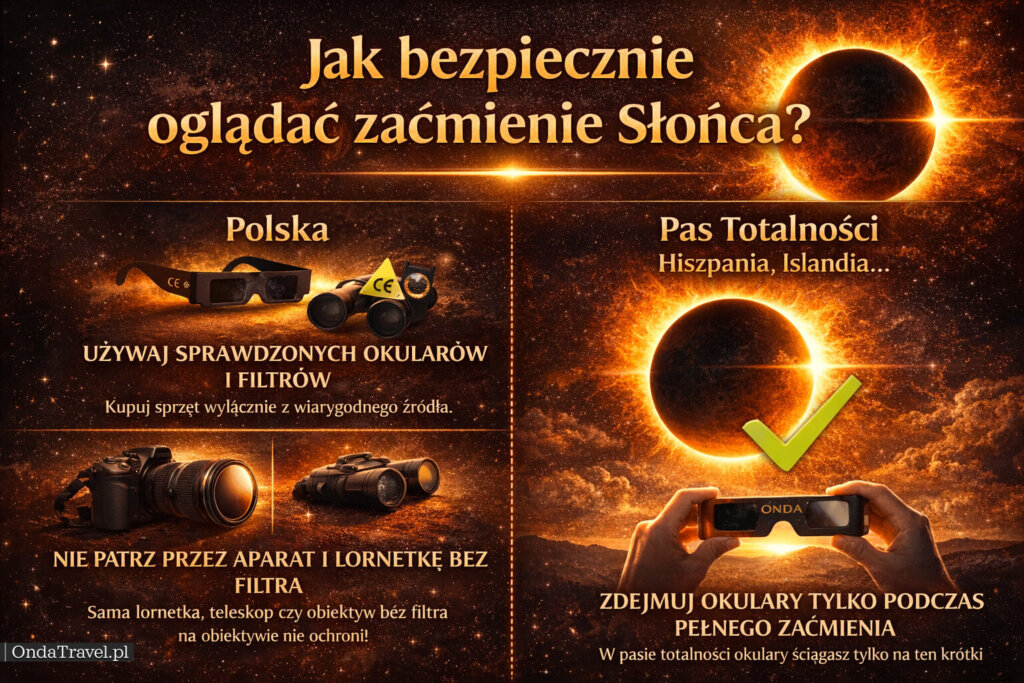
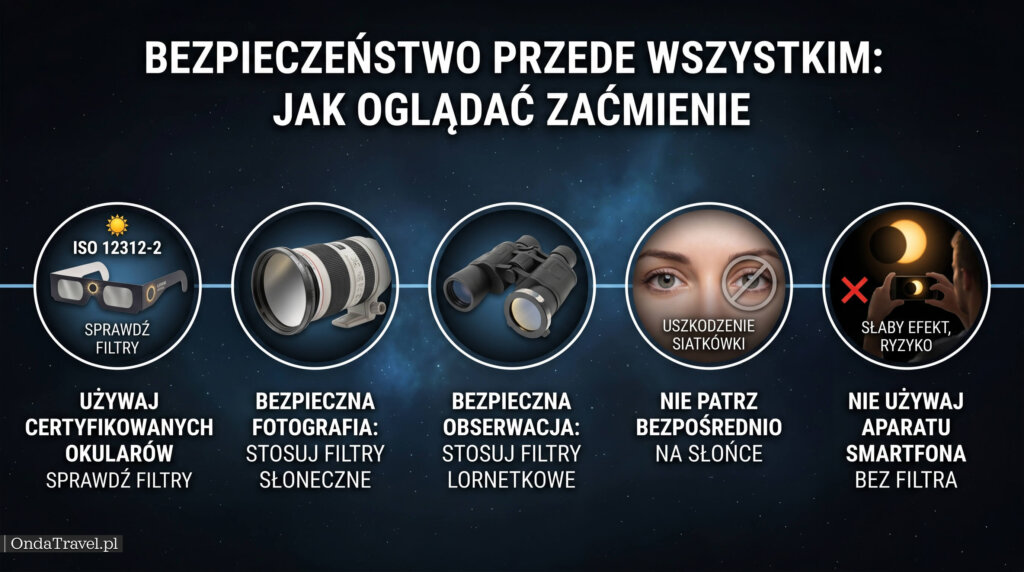
This is one of the most important parts of the entire plan. Never look directly at the Sun with the naked eye during the partial phase, and never use ordinary sunglasses. For observation, use only certified solar filters and eclipse glasses. This also applies to binoculars, telescopes, and cameras – a camera or telephoto lens alone does not protect your eyes or your equipment.
- buy eclipse glasses and filters only from a reliable source,
- do not use ordinary sunglasses, smoked glass, or homemade “tricks,”
- do not look through a camera, telescope, or binoculars without the proper front-mounted filter,
- inside the path of totality, you remove eclipse glasses only for the very short moment of full totality.
If you are staying in Poland, the rule is even simpler: because there will be no totality here, you do not remove eclipse glasses at all. This is still a partial eclipse and eye protection is required the entire time.


How to photograph the 2026 solar eclipse?
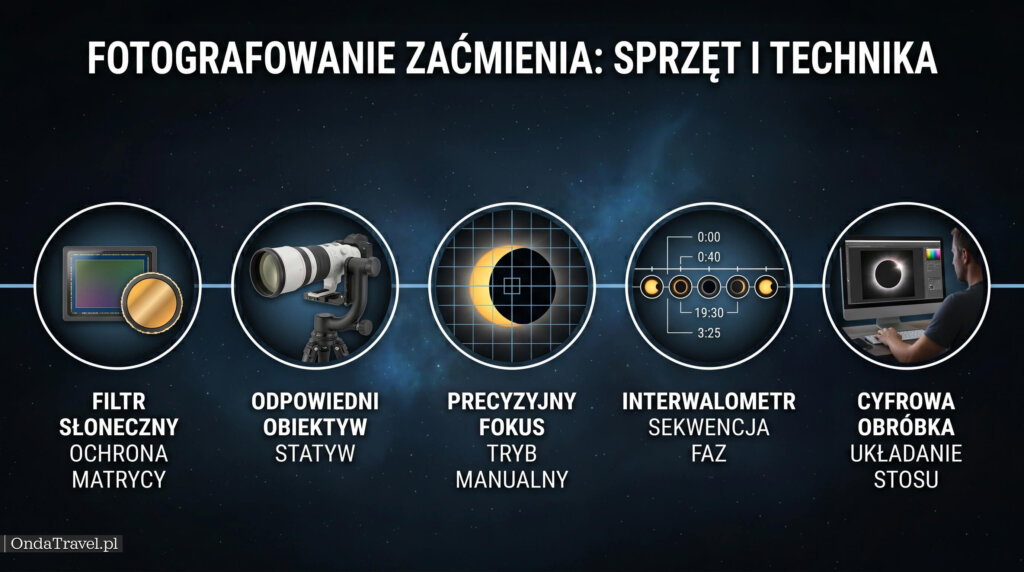
A solar eclipse is the kind of event that is very easy to ruin with an overly complicated photography plan. The best strategy for most people is simple: observation first, photos second. If this is your first trip into the path of totality, do not try to do everything at once.
- a wide frame – great if you want to show the landscape, the crowd, the low Sun, and the atmosphere of the place,
- a telephoto lens or a small refractor – better if you want the solar disk, the corona, and fine detail,
- a tripod and remote shutter release – very helpful for reducing chaos during the most important seconds,
- a shot plan – it is worth deciding in advance what you will photograph before, during, and after totality.
If you want to refine your technique for photographing the night sky and astronomical subjects, also check the guide how to photograph the night sky and stars. It is a good starting point before moving into more advanced eclipse astrophotography.
Astrophotography
How to photograph the night sky, the Moon, meteors, and the Milky Way
Go to the guide on camera settings, frame planning, and the basics of astrophotography that are also useful before an eclipse trip.
How to plan a trip for the eclipse?
The biggest mistake with this kind of event is a plan that is too tight. For a total solar eclipse, you should assume that accommodation will be expensive, roads may become congested, and the final decision about the observation spot may be made very late – even the day before the event.
- book early – especially in Spain and Iceland,
- have a plan B – ideally 2–3 locations within driving range,
- check clouds and transparency – the weather matters more than a “nice-sounding place name,”
- arrive early – do not count on getting there at the last minute,
- stay longer after the event – leaving immediately after totality may result in hours of traffic jams.
If you are treating August 2026 more broadly, connect your preparation with other OndaTravel pages as well: the meteor shower calendar, the astronomical events calendar, and the Sky Phenomena section. This helps combine the eclipse, the Perseids, and other major moments of the year into one plan.
The same day also leads into the key meteor night. The dedicated Perseids 2026 guide gives the peak hours and a practical observing plan after the eclipse.

GUIDE
Perseids 2026: When and Where to Watch the Meteor Shower
Perseids 2026: best night, peak time, where to look, Moon conditions and practical viewing and photography advice for your location.
FAQ: 2026 solar eclipse
When will the total solar eclipse of 2026 happen?
The total solar eclipse will take place on August 12, 2026. It is the most important eclipse for observers in Europe in this cycle.
Will the 2026 solar eclipse be visible in Poland?
Yes, but only as a partial eclipse. To see the full total phase, you need to travel to the path of totality.
Where is the best place to watch the total solar eclipse of 2026?
For most people from Poland, Spain will be the best choice — especially Burgos, León, Soria, or other locations in the northern and central part of the path of totality. Iceland is riskier in terms of weather, but visually spectacular.
Spain or Iceland — which is better for the trip?
If your priority is a better chance of clear weather and easier logistics, Spain is the better choice. If you care more about exceptional scenery and accept higher weather risk, Iceland remains a strong option.
What eclipse glasses should you buy for a solar eclipse?
Use only glasses and filters designed specifically for observing the Sun. Ordinary sunglasses are not suitable for viewing a solar eclipse.
Can you remove eclipse glasses in Poland during the eclipse?
No. In Poland there will be no totality on August 12, 2026, so proper eye protection is required throughout the entire observation.
Read also / continue
If you want to expand your observation plan beyond the eclipse itself, also visit these related OndaTravel guides and calendars:
Sky Phenomena
Sky Phenomena 2026 — go to the main observation section
Enter the main OndaTravel section if you want calendars, guides, and tools for future sky observations gathered in one place.

Moon Phases 2026
Moon Phases 2026 — calendar of full moons, new moons, and the best moments
See the Moon phases calendar if you want to expand your observation plan with full moons, new moons, and the most important lunar moments in 2026.

Meteor Showers 2026
Meteor Shower Calendar 2026 — showers, peaks, and the best nights
Go to the meteor shower calendar if you want to plan the Perseids and other strongest observation nights of the year after the eclipse as well.

Hi, I’m Krystian “dziadzia przewodnik” from OndaTravel.pl!
The North is my greatest passion, but the world is far too beautiful to stay in just one climate. On my blog, I combine the raw landscapes of Iceland and Norway with the exotic energy of Thailand or Vietnam, showing you how to travel authentically — with passion and a camera in hand.
What will you find on OndaTravel.pl?
Visual storytelling: As a photographer and filmmaker, I don’t just describe places — I take you there with professional photos and video.
North expert: Ready-to-use road trip plans for Iceland and Norway, smart tips for budget travel, and my original Northern Lights Radar (locations and forecast).
Travel through the lens of cinema: I track down filming locations — from icy scenes in Interstellar to tropical frames from world cinema.
New direction: Exotic destinations: I love contrast, so the blog is featuring more and more practical knowledge about Vietnam and Thailand. I’ll show you how to find your way around Southeast Asia and come back with your best memories.
P.S. follow me here
Author
Krystian „dziadzia przewodnik”The North is my greatest passion, but the world is too beautiful to stay in one climate. On my blog I combine the raw nature of Iceland and Norway with the exotic energy of Thailand and Vietnam, showing you how to travel authentically, with passion and a camera in hand.