

Fairbanks Northern Lights Live – Radar and Forecast
Is the aurora visible in Fairbanks tonight?
Fairbanks sits directly beneath the aurora oval, so you only need Kp 1 for a display near town and Kp 3 for a strong show. Season runs late August to late April, peak darkness is November to February, and the interior location means far fewer cloudy nights than coastal Alaska. Spend three nights actively watching and your odds of seeing the aurora top 90 percent.
Table of contents
- Can you see the aurora in Fairbanks tonight?
- What Kp do you need in Fairbanks?
- When to go: month-by-month
- Best dark-sky spots near Fairbanks
- How many nights should you plan?
- Cloudy tonight? What to do instead
- Camera settings that work here
- With or without a tour?
- Planning the trip: getting there, staying, packing
- FAQ: Northern Lights in Fairbanks
- Read also
Northern Lights – live radar and parameters
Parameters refresh automatically. The local aurora chance is calculated for your location (GPS or city).
Aurora oval radar – Northern Hemisphere
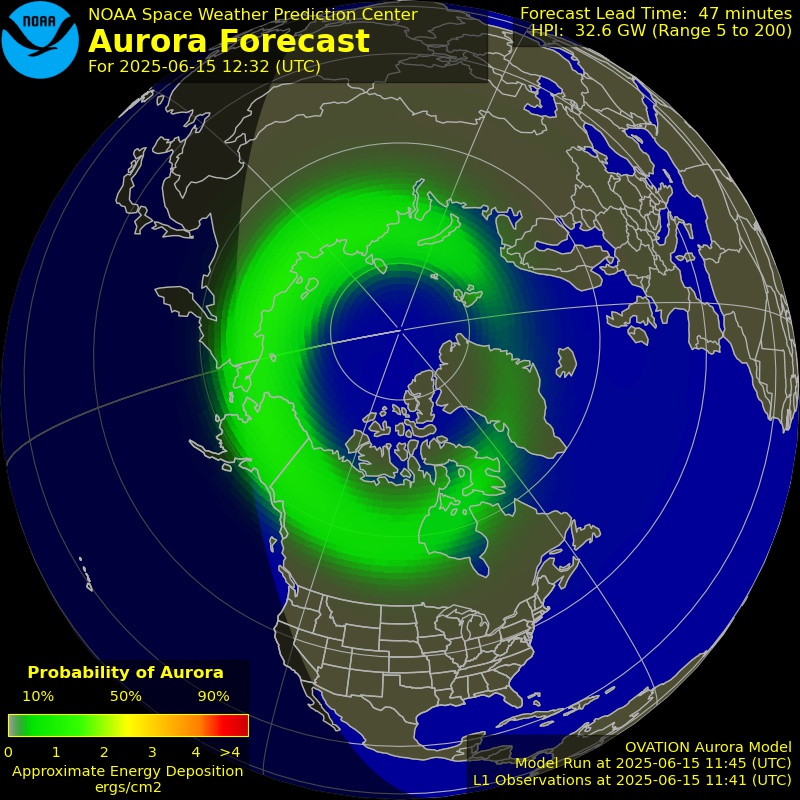
If the animation does not load, a static image will be shown.
Conditions assessment
The indicators consider your location, the local aurora chance and whether it is dark.
Kp (3h)
Kp (1 min)
Bz (GSM)
Bt (IMF)
Speed
Density
Temperature
Latest alerts: solar activity and geomagnetic storms
The monitor below updates automatically from NOAA data: it shows the outlook for the next seven nights and the current aurora alerts. Check it right before you head out — conditions can change within hours.
Sky phenomena
Planning your night-sky observations? These monthly guides highlight the most important astronomical events, meteor showers, Moon phases and the best observation windows. Below you’ll find the two most relevant monthly guides for the current period.

SKY PHENOMENA
Monthly guide
Sky events in September 2026: meteors, equinox and the Moon
The key sky events of the month, meteor activity, the Moon and practical observation windows.
Read the guide
SKY PHENOMENA
Monthly guide
Sky events in October 2026: Draconids, Orionids and Saturn
The key sky events of the month, meteor activity, the Moon and practical observation windows.
Read the guideNorthern Lights
Looking for a longer-term Northern Lights outlook? These monthly guides complement the live radar with seasonal conditions, expected aurora activity and practical viewing tips. Below you’ll find the two most relevant monthly forecasts currently available.
NORTHERN LIGHTS
Monthly forecast
Northern Lights — September 2026
A monthly Northern Lights outlook with live-radar context and practical viewing guidance.
Read the guide
NORTHERN LIGHTS
Monthly forecast
Northern Lights — October 2026
A monthly Northern Lights outlook with live-radar context and practical viewing guidance.
Read the guide
Contents
- Can you see the aurora in Fairbanks tonight?
- What Kp do you need in Fairbanks?
- When to go: month-by-month
- Best dark-sky spots near Fairbanks
- How many nights should you plan?
- Cloudy tonight? What to do instead
- Camera settings that work here
- With or without a tour?
- Planning the trip: getting there, staying, packing
- FAQ: Northern Lights in Fairbanks
- Read also
Can you see the aurora in Fairbanks tonight?
Read the widget in three steps. First, check cloud cover for Fairbanks and the areas around Murphy Dome or Chena Hot Springs — clear sky matters more than a high Kp number. Second, check the Kp trend: rising is better than falling, and a sudden jump often means a substorm is starting. Third, check the hour: 9 PM to 3 AM gives you the best odds, with the deepest darkness around local midnight.
Turn those three checks into a quick tonight verdict. Unlikely: Kp under 1 and the sky over Fairbanks is mostly overcast — wait for a clearer night. Possible: Kp 1-2 with real breaks in the cloud, especially from a dark spot outside downtown — worth a look between 9 PM and 3 AM. Good: Kp 3 or higher with mostly clear sky — by Fairbanks’ own low threshold, that’s already a strong-show night worth planning around. Because the local Kp threshold is so low, cloud cover and the clock decide most nights here, not the Kp number itself.



Hi, I’m Krystian “dziadzia przewodnik” from OndaTravel.pl!
The North is my greatest passion, but the world is far too beautiful to stay in just one climate. On my blog, I combine the raw landscapes of Iceland and Norway with the exotic energy of Thailand or Vietnam, showing you how to travel authentically — with passion and a camera in hand.
What will you find on OndaTravel.pl?
Visual storytelling: As a photographer and filmmaker, I don’t just describe places — I take you there with professional photos and video.
North expert: Ready-to-use road trip plans for Iceland and Norway, smart tips for budget travel, and my original Northern Lights Radar (locations and forecast).
Travel through the lens of cinema: I track down filming locations — from icy scenes in Interstellar to tropical frames from world cinema.
New direction: Exotic destinations: I love contrast, so the blog is featuring more and more practical knowledge about Vietnam and Thailand. I’ll show you how to find your way around Southeast Asia and come back with your best memories.
P.S. follow me here


What Kp do you need in Fairbanks?
Based on NOAA space weather data and Fairbanks’ distance from the aurora oval, here is the threshold that actually matters for your evening.
| Location | Geomagnetic latitude | Kp from downtown | Kp from a dark spot | Kp for a strong show |
|---|---|---|---|---|
| Fairbanks area | 65.6° | 0-1 | 1 | 3 |
When to go: month-by-month
Fairbanks’ official aurora season runs from August 21 to April 21. Inside that window, conditions vary more than most visitors expect.
| Month | Dark hours | Typical cloud cover | Rating |
|---|---|---|---|
| September | ~10h | Moderate, clearing later in month | Good |
| October | ~13h | Improving | Very good |
| November | ~17h | Low | Excellent |
| December | ~19-20h (peak) | Low | Excellent, but extreme cold |
| January | ~18h | Low | Excellent, coldest month |
| February | ~14h | Low | Excellent |
| March | ~11h | Clearest month of the year | Excellent, milder |
| April | ~7h (season ends Apr 21) | Rising | Fair, last chance |
Best dark-sky spots near Fairbanks
- Murphy Dome — roughly 25 miles (40 km) northwest of downtown, elevation around 900 m on a former military radar site. The broad, open summit gives 360-degree views above the valley haze. Needs all-wheel or 4-wheel drive in winter — the access road climbs steadily and gets icy, so budget 45 minutes to an hour each way rather than judging it by distance alone. Not reachable without a vehicle; there’s no walking approach in winter darkness and cold. Parking is an informal pull-off near the summit, unmarked and unlit, with room for only a handful of cars. Check road conditions before heading up in a standard rental car, and turn back if the road looks glazed rather than pushing on, especially in a two-wheel-drive rental without winter tires.
- Chena Hot Springs Resort — about 60 miles (100 km) east, roughly 1 hour by car and not reachable any other way in winter. The only spot on this list where you can watch from a hot spring; also home to the Aurora Ice Museum. The pool faces a fairly open northern sky, though tree cover softens the horizon in places compared to the summit spots. Popular, so parking and pool space fill up on active nights — book a day pass or room ahead rather than showing up and hoping, especially on weekends in peak season.
- Cleary Summit — around 20 miles (32 km) north on the Steese Highway, elevation about 730 m, roughly 30-35 minutes’ drive from downtown. A well-known local gathering point on active nights, with an open pullout and unobstructed northern horizon. Not walkable in winter — this is highway driving, not a hike. The pullout is informal and fills fast when the aurora is strong, so arrive early on forecast-good nights. The Steese Highway sees moose on the road after dark and can ice over on the climb, so keep speeds down and stay alert for eyeshine at the roadside.
- Chena Lakes Recreation Area — about 15 miles (24 km) southeast, roughly 25 minutes by car and an easy option if you do not want to drive far. Not walkable from town in winter. The open water, or ice in winter, can add reflections to your photos, with a horizon that opens broadly to the north over the lake. Designated pullouts reduce light from passing traffic and give somewhere legal and safe to stop. One practical note: some recreation-area access roads and gates close or go unplowed overnight in deep winter, so confirm the entrance you plan to use is actually open before you drive all the way out.
Downtown Fairbanks itself works surprisingly often — the city is small enough that light pollution is moderate, not severe — but any of the four spots above will show you a noticeably darker, more colorful sky.
How many nights should you plan?
Plan for at least 3 nights. Local tourism data puts the odds of seeing the aurora at over 90 percent for visitors who spend three nights actively watching in the late evening — one of the highest success rates of any aurora destination, thanks to Fairbanks’ position directly under the oval and its comparatively dry, clear interior climate. A single night is still worth trying, but treat it as a bonus, not a guarantee.
Cloudy tonight? What to do instead
Interior Alaska’s weather can flip within an hour, so a cloudy start to the evening does not mean a cloudy night. Check the radar again around 11 PM before giving up. If it stays overcast in town, driving even 20-30 minutes toward Cleary Summit or Murphy Dome often puts you above low valley cloud and fog that never clears from downtown. If the whole region is socked in, that is a genuinely lost night — Fairbanks does not have a nearby alternative microclimate the way coastal regions sometimes do, so the honest move is to try again on your next scheduled night.
| Where to go instead | Distance | Drive time | Why it can work |
|---|---|---|---|
| Chena Hot Springs | 60 mi / 100 km | ~1 h | Soak while you watch; own microclimate east of town |
| Cleary Summit | 20 mi / 32 km | ~30 min | Higher ground, often above valley fog |
| Murphy Dome | 25 mi / 40 km | ~40 min | 900 m summit, 360-degree horizon |
Camera settings that work here
Faint display: ISO 1600-3200, f/2.8 or wider, 8-15 seconds, manual focus at infinity. Strong, fast-moving display: drop to 2-5 seconds to keep the curtain shape instead of a green blur. Fairbanks winters mean serious cold — temperatures regularly fall below -20°F (-29°C). Batteries drain in minutes, not hours, so carry two or three spares in an inside pocket, keep your camera in a bag between shots rather than exposed the whole time, and give your lens 20-30 minutes to acclimatise indoors before shooting to avoid condensation fogging the glass.
With or without a tour?
Self-drive works well if you are comfortable driving on packed snow and ice in extreme cold, and it is the cheapest option once you have a rental car. A guided tour is worth it if you do not want to drive at -20°F, want a heated shelter between sightings, or want a local guide chasing clear sky on your behalf rather than guessing yourself. Many lodges near Chena Hot Springs and Fairbanks itself also offer wake-up-call service: they watch the sky for you overnight and call your room if the aurora appears, which removes the need to stay awake or drive at all.
Planning the trip: getting there, staying, packing
Getting there
Fairbanks International (FAI) has year-round connections through Seattle, Anchorage and Minneapolis, and sits about 15 minutes from downtown. The Alaska Railroad runs from Anchorage in roughly 12 hours, scenic but slow in winter. Most visitors rent a car at the airport; ask for winter tyres and check whether the rental allows unpaved roads, because several of the best viewing spots are on them.
Where to base yourself
Downtown puts you near restaurants and tour pickups, and the aurora is visible from town on active nights. Chena Hot Springs, an hour east, trades convenience for darker sky, a hot spring to watch from, and lodges that phone your room when the aurora appears. Staying out of town costs you flexibility if cloud settles on your side of the valley.
Without a car
Workable, but narrower. Operators run heated shuttles from downtown hotels and some lodges include transfers. What you give up is reacting to the radar yourself and driving toward a clear panel at short notice, which in interior Alaska is often the difference between a display and a lost night.
What to pack
December and January regularly run below -20°F (-29°C). Insulated boots rated for extreme cold, layered base and mid layers, a windproof shell, face covering, and two pairs of gloves: thin liners to work a camera plus heavy mitts over them. Spare batteries go in an inside pocket; hand warmers earn their weight if you stand still for an hour.
FAQ: Northern Lights in Fairbanks
What is the best month to see the northern lights in Fairbanks?
March offers the clearest skies of the year alongside still-long nights. December and January have the darkest, longest nights but the coldest temperatures. November and February are a good middle ground.
Do you need a car to see the aurora in Fairbanks?
No. The aurora is visible from downtown Fairbanks on active nights, and several tour operators offer pickup. A car (or a booked tour) helps if you want the darker skies at Murphy Dome or Cleary Summit.
How cold does it get in Fairbanks in winter?
Regularly below -20°F (-29°C) in December and January, occasionally colder. Pack for genuine Arctic conditions: layered clothing, insulated boots rated for extreme cold, and a face covering.
Can you see the aurora from Chena Hot Springs?
Yes. Chena Hot Springs is one of the most popular viewing spots near Fairbanks, partly because you can watch the sky while soaking in the hot spring itself.
Is Fairbanks better than other parts of Alaska for the aurora?
For consistency, yes. Fairbanks sits directly under the aurora oval with a dry interior climate that produces more clear nights than Alaska’s coastal regions, which see more cloud cover off the Pacific.
What Kp index do I need in Fairbanks?
Kp 1 is usually enough for a visible display from a dark spot near Fairbanks, and Kp 0-1 can still show something from town on a very clear night. Kp 3 or higher typically means a strong, colorful show.

About the OndaTravel.pl author
Krystian — „dziadzia przewodnik”
Meet the OndaTravel.pl author: an independent Arctic guide, photographer and filmmaker. See how the guides are made, where the field photos come from, and how to reach out about a guided trip to Iceland, Lofoten or Norway.
Read also
Fairbanks is the strongest base in the country — the full picture, including the Lower 48, is in our guide to the northern lights in the USA.
ALL LOCATIONS
Hub
Aurora Radar: Choose a Location
Compare Kp thresholds across every location we track, from Arctic Europe to North America.
See all locationsPHENOMENON EXPLAINED
Guide
Live Aurora Forecast Explained
Understand what Kp, Bz and cloud cover actually mean before you check any radar.
Read the explainer
NORWAY
Live radar
Tromso
A different arctic base: easiest access, no car needed for several viewing spots.
Check Tromso radarTOOL
Alerts
Aurora Alerts
Get notified the moment conditions turn favourable, wherever you are.
Open Aurora Alerts