

Yellowknife Northern Lights Live – Radar and Forecast
Is the aurora visible in Yellowknife tonight?
Yellowknife sits at 69.1 degrees geomagnetic latitude, directly under the auroral oval, so Kp 0 to 1 is enough for a display overhead. Season runs late August to April, and the real advantage here is weather: average cloud cover during aurora season is around 35 percent, well below coastal Norway or Iceland. Plan three or more nights and your odds are excellent.
Table of contents
- Can you see the aurora in Yellowknife tonight?
- What Kp do you need in Yellowknife?
- When to go: month-by-month
- Best dark-sky spots near Yellowknife
- How many nights should you plan?
- Cloudy tonight? Where to go instead
- Camera settings that work here
- With or without a tour?
- Planning the trip: getting there, staying, packing
- FAQ: Northern Lights in Yellowknife
- Read also
Northern Lights – live radar and parameters
Parameters refresh automatically. The local aurora chance is calculated for your location (GPS or city).
Aurora oval radar – Northern Hemisphere
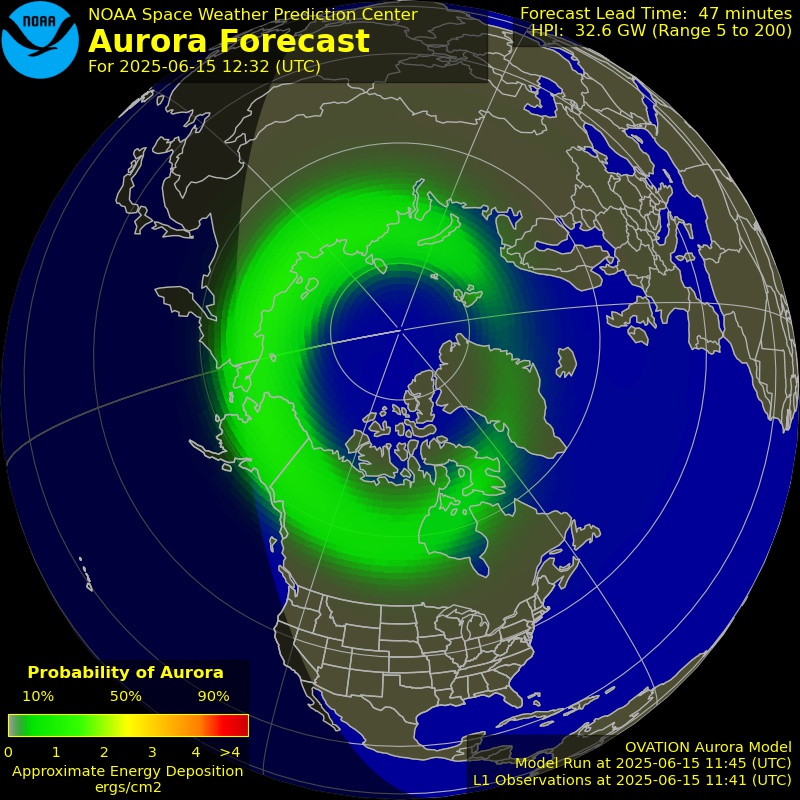
If the animation does not load, a static image will be shown.
Conditions assessment
The indicators consider your location, the local aurora chance and whether it is dark.
Kp (3h)
Kp (1 min)
Bz (GSM)
Bt (IMF)
Speed
Density
Temperature
Latest alerts: solar activity and geomagnetic storms
The monitor below updates automatically from NOAA data: it shows the outlook for the next seven nights and the current aurora alerts. Check it right before you head out — conditions can change within hours.
Sky phenomena
Planning your night-sky observations? These monthly guides highlight the most important astronomical events, meteor showers, Moon phases and the best observation windows. Below you’ll find the two most relevant monthly guides for the current period.

SKY PHENOMENA
Monthly guide
Sky events in September 2026: meteors, equinox and the Moon
The key sky events of the month, meteor activity, the Moon and practical observation windows.
Read the guide
SKY PHENOMENA
Monthly guide
Sky events in October 2026: Draconids, Orionids and Saturn
The key sky events of the month, meteor activity, the Moon and practical observation windows.
Read the guideNorthern Lights
Looking for a longer-term Northern Lights outlook? These monthly guides complement the live radar with seasonal conditions, expected aurora activity and practical viewing tips. Below you’ll find the two most relevant monthly forecasts currently available.
NORTHERN LIGHTS
Monthly forecast
Northern Lights — September 2026
A monthly Northern Lights outlook with live-radar context and practical viewing guidance.
Read the guide
NORTHERN LIGHTS
Monthly forecast
Northern Lights — October 2026
A monthly Northern Lights outlook with live-radar context and practical viewing guidance.
Read the guide
Contents
- Can you see the aurora in Yellowknife tonight?
- What Kp do you need in Yellowknife?
- When to go: month-by-month
- Best dark-sky spots near Yellowknife
- How many nights should you plan?
- Cloudy tonight? Where to go instead
- Camera settings that work here
- With or without a tour?
- Planning the trip: getting there, staying, packing
- FAQ: Northern Lights in Yellowknife
- Read also
Can you see the aurora in Yellowknife tonight?
Check cloud cover first — inside the auroral oval, clear sky matters far more than the Kp number. Then check the hour: 22:00 to 02:00 is the core window. Kp is a weaker signal here than further south, because at this latitude the aurora is often overhead during ordinary activity rather than sitting low on the northern horizon.
Turn that into a quick tonight verdict. Unlikely: heavy overcast over Yellowknife, whatever the Kp reading — cloud is the real gatekeeper this far north. Possible: partly cloudy skies with some clear breaks between 22:00 and 02:00; even a quiet, low-Kp night can produce a visible glow here. Good: mostly clear sky in that same window — at Yellowknife’s geomagnetic latitude, Kp 2 already counts as a strong show, so a merely average night is often enough once the clouds cooperate. The short version: watch the sky, not the Kp number.



Hi, I’m Krystian “dziadzia przewodnik” from OndaTravel.pl!
The North is my greatest passion, but the world is far too beautiful to stay in just one climate. On my blog, I combine the raw landscapes of Iceland and Norway with the exotic energy of Thailand or Vietnam, showing you how to travel authentically — with passion and a camera in hand.
What will you find on OndaTravel.pl?
Visual storytelling: As a photographer and filmmaker, I don’t just describe places — I take you there with professional photos and video.
North expert: Ready-to-use road trip plans for Iceland and Norway, smart tips for budget travel, and my original Northern Lights Radar (locations and forecast).
Travel through the lens of cinema: I track down filming locations — from icy scenes in Interstellar to tropical frames from world cinema.
New direction: Exotic destinations: I love contrast, so the blog is featuring more and more practical knowledge about Vietnam and Thailand. I’ll show you how to find your way around Southeast Asia and come back with your best memories.
P.S. follow me here


What Kp do you need in Yellowknife?
| Location | Geomagnetic latitude | Kp from downtown | Kp from a dark spot | Kp for a strong show |
|---|---|---|---|---|
| Yellowknife | 69.1° | 0 | 0 | 2 |
When to go: month-by-month
| Month | Dark hours | Conditions | Rating |
|---|---|---|---|
| September | ~10h | Mild, open water reflections | Very good |
| October | ~13h | Cooling, clear spells increase | Excellent |
| November | ~16h | Cold, dry, clear | Excellent |
| December | ~18h (peak) | Very cold, longest nights | Excellent |
| January | ~17h | Coldest month, ice roads open | Excellent |
| February | ~14h | Cold, very clear, ice road season | Excellent |
| March | ~11h | Milder, equinox activity | Excellent |
| April | ~8h | Season winding down | Fair |
Best dark-sky spots near Yellowknife
- Frame Lake — in the middle of downtown, a 5-15 minute walk from most hotels depending where you’re staying. The one spot on this list that needs no car and no winter drive at all. Once the lake freezes solid, usually by December, you can walk out onto the ice for a near-unobstructed horizon facing north across the water. The catch: streetlights along the shore path wash out faint aurora, so keep walking until the glow from downtown windows is behind you. No parking to worry about, but check for posted ice-thickness notices before walking out early or late in the season, and stay on the cleared walking routes rather than cutting across untested ice.
- Ingraham Trail (Highway 4) — the main aurora corridor east of town, with marked pullouts along a chain of lakes. In winter, driving time from downtown runs roughly 20 minutes to the Yellowknife River Day Use Area, about 30 minutes to Madeline Lake, and around 30 minutes (30 km) to Prelude Lake Territorial Park. There’s no way to reach any of these without a vehicle — no transit runs the highway, and it’s too far and too cold to walk after dark. The pullouts open north and northeast across the lakes, well clear of city glow, with Prelude Lake giving the widest unobstructed sweep. Never park on the shoulder — plow crews clear narrow in winter and roadside cars get buried or clipped; use the designated pullout lots only. Cell coverage thins out past Madeline Lake, so let someone know your plan before heading out. Bring a thermos, too — there’s no shelter at any of these pullouts, and clear nights here often mean temperatures well below -30C, exactly when the aurora tends to be strongest.
- Dettah Ice Road — open roughly January to March once the ice is certified thick enough, crossing the frozen bay 5 to 10 minutes from Old Town by car. It’s a working winter road for Dettah residents rather than a walking route, so plan on driving, even though a taxi can drop you at the access point. Out on the flat ice the sky opens a full 360 degrees, with no treeline or building blocking any direction — the widest horizon in the cluster — plus mirror-like reflections in the refrozen cracks. Pull well off the plowed travel lane into one of the marked side areas; this is an active community road, not a viewing pullout. Check the daily ice road condition report before driving and never drive over unplowed sections or visible cracks.
- Vee Lake — around 18 miles (29 km) northeast of downtown, roughly 25-30 minutes by car via the Ingraham Trail and Vee Lake Road, quieter than the main pullouts and popular with photographers wanting water or ice in the foreground. There’s no winter foot or transit access, so a vehicle is required. The lake’s open bay faces northeast, giving a clean sightline with a low, distant treeline rather than pure open sky, which suits compositions built around a horizon anchor. Parking is a small, often unplowed pull-in near the boat launch, so a vehicle with decent winter clearance helps after fresh snow; some visitors leave the car near the highway and walk the last short stretch in on foot instead. This spot sees far less passing traffic than the Ingraham pullouts, so if you get stuck there’s less chance of quick help — go with a second vehicle or tell someone your expected return time.
The aurora is regularly visible from inside Yellowknife itself — the city is small and the oval sits overhead — but driving 20 to 30 minutes out makes faint structure far more visible.
How many nights should you plan?
Three nights minimum, four if the trip is built around the aurora. Yellowknife has one of the highest success rates in North America, but that reputation comes from the combination of oval position and dry inland weather across multiple nights — not from any single night being a sure thing. What decides the outcome is usually how many nights you stay and whether you are willing to drive away from cloud, not which month you picked.
Cloudy tonight? Where to go instead
Yellowknife sits in a dry inland basin, so a fully overcast night is less common here than on any Arctic coast. When it does happen, the cloud usually sits in bands rather than a solid lid, and driving 20 to 40 minutes along the Ingraham Trail is often enough to find a gap. Check the radar for the direction the clear panel is moving, then pick the stop that matches it.
| Where to go instead | Distance | Drive time | Why it can work |
|---|---|---|---|
| Ingraham Trail pullouts | 12-19 mi / 20-30 km | 20-35 min | Chain of lakes with marked parking; easiest place to leapfrog a cloud band |
| Dettah Ice Road | 3 mi / 5 km | 5-10 min | January to March only. Flat ice, open sky in every direction, mirror reflections |
| Vee Lake | 18 mi / 29 km | ~30 min | Quieter than the Ingraham stops, with water or ice in the foreground |
| Prelude Lake | 19 mi / 30 km | ~35 min | Territorial park at the far end of the trail; often clear when town is not |
Camera settings that work here
Faint display: ISO 1600-3200, f/2.8 or wider, 8-15 seconds, manual focus at infinity. Strong overhead display: drop to 2-5 seconds, because at this latitude the aurora often moves fast enough to blur into a green smear at longer exposures. January and February regularly run below -30°C, so carry spare batteries inside your jacket, and let gear warm up slowly in a bag when you come indoors to avoid condensation.
With or without a tour?
Yellowknife is unusually friendly to going without a tour: Frame Lake is walkable, and a rental car opens the whole Ingraham Trail. The catch is winter driving in deep cold on icy road with heavy truck traffic, and no cell service at the far end of the trail. Guided options range from simple transport to viewing camps with heated cabins and teepees, which are worth considering if waiting outside at -30°C for hours sounds unrealistic.
Planning the trip: getting there, staying, packing
Getting there
Yellowknife Airport (YZF) connects through Calgary, Edmonton and Vancouver and sits five minutes from downtown. There is a road in, the Yellowknife Highway from Alberta, but it is a two-day drive most visitors skip. Renting at the airport is straightforward and worth it, because the Ingraham Trail is where the best stops are.
Where to base yourself
Downtown and Old Town both work. Old Town sits nearer the bay and the Dettah ice road and has more character; downtown has more hotels and restaurants. Frame Lake is walkable from most of the centre, which makes Yellowknife unusually forgiving if you end up without a car. Several operators also run heated teepee camps outside town.
Without a car
Genuinely viable here, unlike most Arctic bases. Frame Lake is a short walk from most hotels and, once frozen, gives an open northern horizon in the middle of the city. For the Ingraham Trail stops you will want a rental or a tour, but skipping both does not end your trip.
What to pack
January and February regularly fall below -30°C, and the cold is dry, which makes it deceptive: you notice it late. Insulated boots, layered clothing, face covering, liner gloves under over-mitts. If you plan to stand on the ice road or a frozen lake, add a layer beyond what feels sufficient, because there is no shelter and no windbreak out there.
FAQ: Northern Lights in Yellowknife
What Kp index do you need in Yellowknife?
Effectively none. At 69.1 degrees geomagnetic latitude the aurora can appear overhead during ordinary activity, so Kp 0 to 1 is often enough. Kp matters far less here than cloud cover.
Can you see the northern lights in Yellowknife without a car?
Yes. Frame Lake is in the middle of downtown and walkable from most hotels; in winter you can walk out onto the frozen lake for an open northern horizon. A car or tour helps, but is not essential.
What is the best month for the aurora in Yellowknife?
November through March all rate excellent. December and January give the longest nights but the harshest cold; February and March combine long dark hours with the clearest skies and ice-road access.
Is Yellowknife better than Iceland or Norway for the aurora?
For weather odds, generally yes. Yellowknife sits inland with roughly 35 percent average cloud cover in season, while coastal Iceland and northern Norway see considerably more cloud. Its oval position is comparable to northern Norway.
How cold does Yellowknife get in aurora season?
January and February regularly fall below -30 degrees Celsius. Proper Arctic clothing is not optional: insulated boots, layered clothing, face covering and gloves you can still operate a camera in.
How many nights should I plan in Yellowknife?
Three nights minimum, four if the aurora is the point of the trip. The high success rate comes from staying multiple nights and driving away from cloud, not from any single night being guaranteed.

About the OndaTravel.pl author
Krystian — „dziadzia przewodnik”
Meet the OndaTravel.pl author: an independent Arctic guide, photographer and filmmaker. See how the guides are made, where the field photos come from, and how to reach out about a guided trip to Iceland, Lofoten or Norway.
Read also
Yellowknife is one of several Canadian options — see how it compares in our guide to the northern lights in Canada, with magnetic latitudes and Kp thresholds side by side.
ALL LOCATIONS
Hub
Aurora Radar: Choose a Location
Compare Kp thresholds across every location we track, from Arctic Europe to North America.
See all locationsPHENOMENON EXPLAINED
Guide
Live Aurora Forecast Explained
Understand what Kp, Bz and cloud cover actually mean before you check any radar.
Read the explainer
NORWAY
Live radar
Tromso
The European equivalent: similar oval position, but more coastal cloud.
Check Tromso radarTOOL
Alerts
Aurora Alerts
Get notified the moment conditions turn favourable, wherever you are.
Open Aurora Alerts