

In short: Chicago needs a roughly Kp8 (G4-class) geomagnetic storm before the northern lights become visible on the northern horizon – the same bracket as Ohio, Iowa, and Nebraska. Illinois’ only International Dark Sky Park, Middle Fork River Forest Preserve near Penfield, sits about 110 miles south of the city, far from Chicago’s own heavy light pollution and cloud cover.
| Factor | Chicago, Illinois |
|---|---|
| Geomagnetic latitude (dipole estimate) | ~50.8°N |
| Practical Kp threshold | Kp8 (G4) or higher |
| Winter cloud cover (heavy overcast) | 59% of days (currentresults.com) |
| Certified dark-sky site | Middle Fork River Forest Preserve, Penfield (Champaign County) – only IDSP in Illinois, designated 2018 |
| Distance from Chicago to the preserve | ~110 mi (self-computed from coordinates) |
Illinois sits deep enough in the U.S. interior that the northern lights are an event, not a routine. Chicago’s geomagnetic latitude – a dipole-model approximation, not the precise AACGM-v2 value – works out to roughly 50.8°N, putting it in the same practical bracket as Cleveland, Ohio, Des Moines, Iowa, and Omaha, Nebraska: you need a strong geomagnetic storm, not just an active night, before anything is visible from the ground.
Illinois adds two extra obstacles on top of the Kp8 threshold. First, Chicago itself is one of the cloudiest major U.S. cities in winter – about 59% of December-February days bring heavy overcast (source: currentresults.com), on top of the city’s own dense light pollution. Second, the state’s only internationally certified dark-sky site is not near Chicago at all: it’s roughly 110 miles south, near the small town of Penfield.
Can you see the northern lights from Illinois?
Only during strong geomagnetic storms, roughly Kp8 or higher (G4-G5 class). Chicago’s geomagnetic latitude (~50.8°N, dipole-model estimate) puts it in the same practical bracket as Cleveland and Des Moines, so Illinois only sees the aurora during storms strong enough to make national news.
When a storm does reach Kp8-9, the glow in Illinois typically appears low on the northern horizon as a reddish or greenish band. Chicago’s own light pollution and frequent winter cloud cover make the city itself one of the hardest viewing spots in the state – even during a strong storm, you’ll need to get well outside downtown for a realistic chance.
Live aurora forecast for Chicago
Check the current Kp index and cloud cover before heading out – both need to line up, and Chicago’s frequent winter overcast makes the cloud check especially important here.
Northern Lights – live radar and parameters
Parameters refresh automatically. The local aurora chance is calculated for your location (GPS or city).
Aurora oval radar – Northern Hemisphere
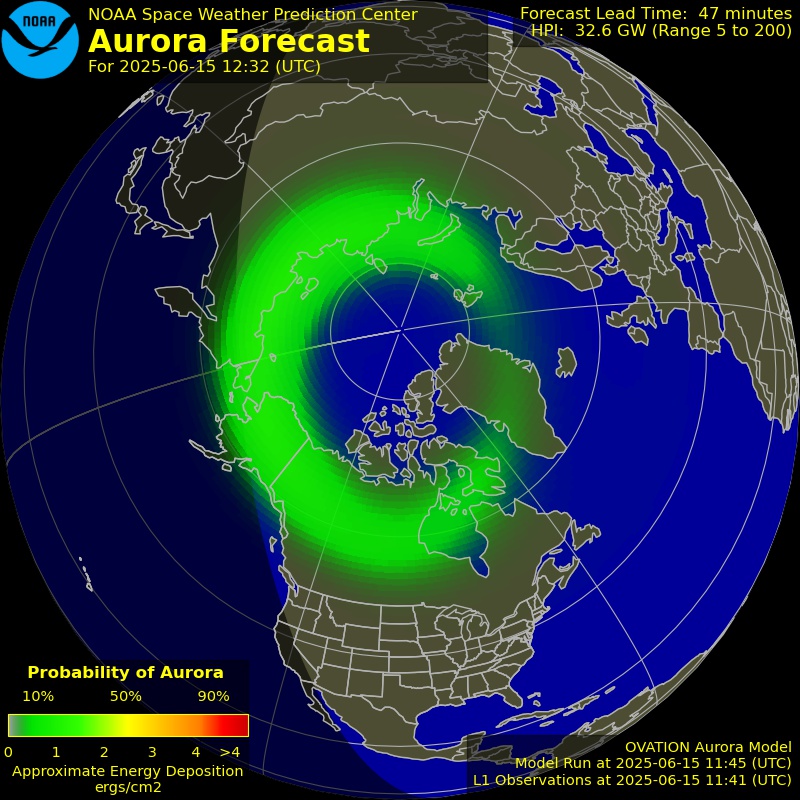
If the animation does not load, a static image will be shown.
Conditions assessment
The indicators consider your location, the local aurora chance and whether it is dark.
Kp (3h)
Kp (1 min)
Bz (GSM)
Bt (IMF)
Speed
Density
Temperature
Where to go in Illinois during a strong storm
Illinois has exactly one internationally certified dark-sky site: Middle Fork River Forest Preserve near Penfield in Champaign County, designated Illinois’ first and only International Dark Sky Park by DarkSky International in 2018 (source: darksky.org). It sits about 110 miles south of Chicago – a distance self-computed from coordinates, since no published source gives the Chicago-to-Penfield figure directly – which makes it a deliberate day trip, not a spur-of-the-moment drive.
For anyone who can’t make that drive on short notice, the honest advice is simpler: get as far from downtown Chicago’s light dome as you reasonably can, face north, and accept that suburban or exurban skies will show far less than a certified dark-sky site would. Illinois’ flat terrain means the horizon itself is rarely the problem – light pollution and cloud cover are.
Escaping clouds in Illinois
Chicago is a genuinely difficult city for this hobby on cloud grounds alone: about 59% of winter days bring heavy overcast, and 79% bring some meaningful cloud cover (source: currentresults.com) – among the cloudiest major cities in the country. That’s on top of the Kp8 threshold, not instead of it.
There’s no single “clear zone” to point to across a state this size, but the same rule applies everywhere: check a real-time cloud cover map alongside the Kp forecast, and be ready to drive south or west if Lake Michigan’s moisture is keeping the Chicago area socked in – central and southern Illinois, away from the lake effect, statistically see somewhat less cloud than the city itself.
What Kp index does Illinois need?
Realistically, Kp8 or higher. NOAA’s rule of thumb puts the aurora oval’s equatorward edge at about 66° magnetic latitude at Kp0, moving roughly 2° further south for each additional Kp step (source: spaceweather.gov). At Chicago’s geomagnetic latitude of ~50.8°N, that arithmetic points to Kp8-9 before the oval’s edge reaches far enough south to be visible on the horizon – the same G4-class bracket as Ohio, Iowa, and Nebraska.
This is a genuinely different category from the Canadian provinces on this site. Manitoba or New Brunswick can see aurora on many clear nights at Kp4-6; Illinois needs a storm large enough to generate G4-G5 space weather alerts and mainstream news coverage. Treat a Kp8+ forecast the way you’d treat a severe weather watch, not a routine check.
When are Illinois storms most likely?
There isn’t a strong seasonal signal worth building a calendar around at this Kp bracket. The Russell-McPherron effect – the well-documented tendency for geomagnetic storms to cluster near the spring and autumn equinoxes (verified via Wikipedia, earthsky.org and space.com) – is a real but secondary factor at Kp4-6. At Kp8-9, where solar-cycle position and individual coronal mass ejections dominate, the equinox effect is a minor tilt on the odds, not a plannable season.
The practical rule: watch NOAA’s 3-day forecast and G-scale storm watches (spaceweather.gov, swpc.noaa.gov) rather than the calendar. A Kp8+ storm can, in principle, happen in any month; it just needs the sun and the interplanetary magnetic field to cooperate.
What you’ll actually see from Illinois
Manage expectations before you drive out. From Chicago’s latitude, even a strong storm usually shows up as a low band of color on the northern horizon – often more visible to a camera (which gathers light the eye can’t) than to the naked eye. Reddish or magenta tones are common at this latitude, since the visible aurora here is often the higher-altitude red emission rather than the classic green curtains seen much further north.
Only the strongest storms (Kp9, G5-class – the same category as the May 2024 event) push the aurora high enough and bright enough to be unmistakable to the naked eye and show the more familiar green color. Bring a camera with manual settings and a tripod: a long exposure will often reveal color the eye is missing.
Can you see the northern lights from Illinois?
Only during strong geomagnetic storms, roughly Kp8 or higher (G4-G5 class). Chicago’s geomagnetic latitude (~50.8°N, a dipole-model estimate) puts it in the same practical bracket as Ohio, Iowa, and Nebraska, so Illinois only sees aurora during storms strong enough to make national news.
Where is the best place to see the northern lights in Illinois?
Middle Fork River Forest Preserve near Penfield in Champaign County – Illinois’ only International Dark Sky Park, designated by DarkSky International in 2018 (source: darksky.org). It’s about 110 miles south of Chicago (self-computed distance), so it’s a planned trip rather than a spur-of-the-moment drive. Anywhere well outside Chicago’s light dome, facing north, is a reasonable fallback during a strong storm.
What time of year is best for the northern lights in Illinois?
There isn’t a reliable best month. Kp8 storms are tied to the roughly 11-year solar cycle rather than the season, so the right approach is watching for a NOAA G4 storm watch rather than planning around a calendar window.
Is Illinois easier or harder for aurora viewing than Ohio, Indiana, Iowa, or Nebraska?
About the same Kp8 threshold as Ohio, Iowa, and Nebraska, and easier than Indiana (roughly Kp9). Illinois’ practical difficulty comes less from the storm threshold and more from Chicago’s frequent winter cloud cover (about 59% of winter days, per currentresults.com) and light pollution, plus the fact that the state’s only certified dark-sky site sits roughly 110 miles from the largest city.
Read also
Illinois is the fifth U.S. “event-gap” state covered on this site, alongside Ohio, Indiana, Iowa, and Nebraska – all in the same Kp8-9 bracket, all needing a genuine storm watch rather than a routine check.

GUIDE
Northern Lights in the USA: Live Radar and Forecast
Northern lights in the USA: live radar for Fairbanks, the official 21 August to 21 April season, how many nights to book, the Dalton Highway and what the Lower 48 needs.
For the full national picture, including where the northern lights are visible far more often, see the main USA hub above; for the Canadian provinces where a clear night alone is often enough, start with the Canada hub.