

Northern Lights in Iowa: Des Moines Forecast and Where to Go
In short: Iowa needs roughly the same Kp8+ storm as Ohio — one step easier than Indiana — and its wide-open farmland gives some of the darkest, most unobstructed rural skies in the Midwest when a strong storm hits.
| Element | Value |
|---|---|
| Geomagnetic latitude (dipole estimate, Des Moines) | ~50.2°N |
| Practical Kp threshold | Kp8 (NOAA oval-edge rule) — G4-class storm |
| Clearest / cloudiest months | August ~70% clear; January/February/December ~53% overcast (Weather Spark) |
| Notable dark-sky spot | Nine Eagles State Park, Decatur County — roughly 70 miles S of Des Moines (straight-line, from park coordinates) |
| Reputed darkest skies in Iowa | Whiterock Conservancy, Coon Rapids (west-central Iowa) |
Iowa’s flat, open farmland is actually a real advantage for aurora viewing when a storm is strong enough — there’s little in the way of a clear northern horizon almost anywhere outside town. The catch, as with its Midwest neighbors, is how strong that storm has to be. Here’s the honest picture for Des Moines and the rest of the state.
Can you see the northern lights from Iowa?
During strong storms, yes. Des Moines’s geomagnetic latitude (a simplified dipole-model estimate, not full AACGM-v2 precision) works out to roughly 50.2°N — close to Cleveland’s ~50.7°N and meaningfully better than Indianapolis’s ~48.8°N. Using NOAA’s published rule that the aurora oval’s equatorward edge sits near 66° magnetic latitude at Kp0 and moves roughly 2° further south per Kp step, Iowa needs approximately Kp8 — a G4-class storm, the same bracket as Ohio and one step easier than Indiana’s Kp9.
Iowa’s flat terrain and low population density outside its cities are a genuine practical advantage: unlike hillier or more forested states, a clear northern horizon is often just a short drive from any small town, without needing a specific mountain pass or coastline.
Northern Lights – live radar and parameters
Parameters refresh automatically. The local aurora chance is calculated for your location (GPS or city).
Aurora oval radar – Northern Hemisphere
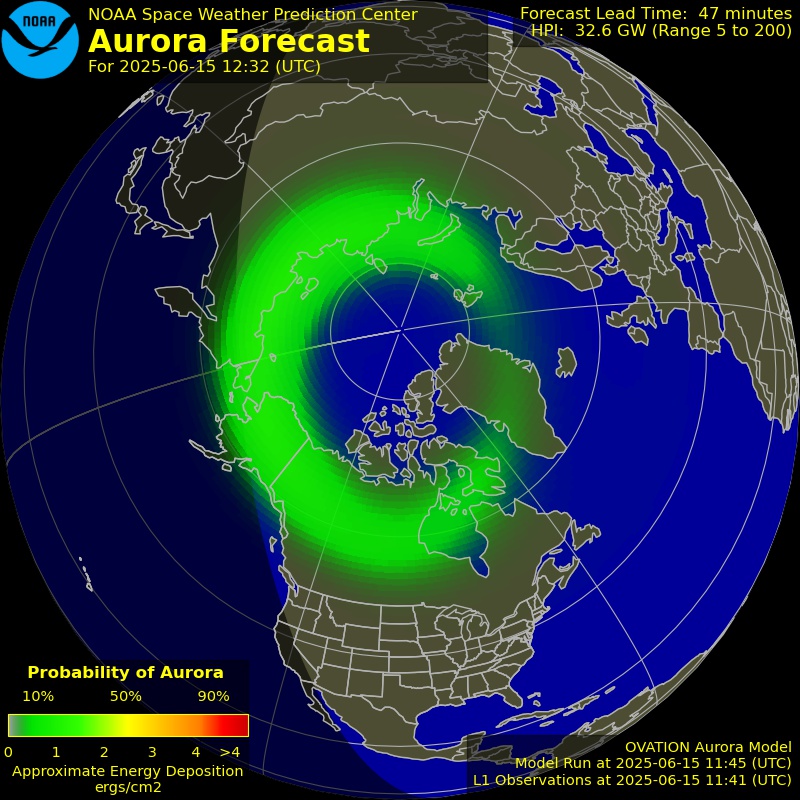
If the animation does not load, a static image will be shown.
Conditions assessment
The indicators consider your location, the local aurora chance and whether it is dark.
Kp (3h)
Kp (1 min)
Bz (GSM)
Bt (IMF)
Speed
Density
Temperature
Where to go in Iowa
Nine Eagles State Park in Decatur County, near the Missouri border, holds the state’s highest (darkest) Bortle Scale rating among its listed dark-sky parks — roughly 70 miles south of Des Moines in a straight line. Whiterock Conservancy in Coon Rapids, west-central Iowa, is locally reputed to have the darkest skies in the state and hosts astronomy events, though it isn’t a formally DarkSky-certified site. During a genuinely strong Kp8 storm, Iowa’s open farmland means even a short drive outside any town’s edge, facing north, can be enough — you don’t need to reach a specific park.
GUIDE
Northern Lights in the USA: Live Radar and Forecast
Northern lights in the USA: live radar for Fairbanks, the official 21 August to 21 April season, how many nights to book, the Dalton Highway and what the Lower 48 needs.
As with Ohio and Indiana, none of this lowers the Kp threshold — it only maximizes the view once a storm that strong actually arrives.
Weather: a milder concern than Ohio, still a factor
Weather Spark data for Des Moines shows August as the clearest month (~70% clear) and January/February/December tied as cloudiest (~53% overcast) — a somewhat milder cloud pattern than Cleveland’s. As with the other Midwest states on this site, though, a Kp8 storm can happen in any month, so there’s no reliable way to plan around the seasonal pattern; a clear sky is simply a second condition that has to align with the already-uncommon storm.
The same approach applies here as in Ohio and Indiana: check local cloud cover at the moment a strong storm watch is issued, not according to a seasonal calendar.
Tied to the solar cycle, not the season
Kp8-level storms are tied to the roughly 11-year solar cycle and become more frequent as the sun approaches and passes solar maximum. The equinox-driven Russell-McPherron effect that shapes timing for the more frequent, less extreme storms on this site’s Canada pages is a secondary factor at this storm strength — where the sun sits in its overall activity cycle matters more than the calendar month.
There is no reliable “best month” for Iowa in the way there is for locations needing only Kp4-6. The actionable signal is a NOAA Space Weather Prediction Center G4-level storm watch.
What to actually do
Don’t plan around a season. When NOAA’s Space Weather Prediction Center issues a G4 geomagnetic storm watch, check the live aurora widget above and a same-night local cloud forecast for any open rural spot north of your location, and go if both look favorable. Outside an active storm watch, there is no realistic chance of a sighting from Iowa.
What you’ll actually see
At Kp8, Iowa’s flat, open horizon is a genuine asset: reports from the 2024 storms that reached this latitude described visible color (often red or pink this far south) and a wide arc across the northern sky, sometimes visible to the naked eye away from town lights, not just in photos. Combined with the state’s low light pollution outside its handful of cities, a Kp8 night here can be one of the more rewarding sightings among the Midwest “event-gap” states on this site.
Can you see the northern lights from Iowa?
During strong geomagnetic storms, roughly Kp8 (G4-class) or higher. Des Moines’s geomagnetic latitude (~50.2°N, a dipole-model estimate) is close to Cleveland’s and notably better than Indianapolis’s, so Iowa needs a similar storm strength to Ohio.
Where is the best place in Iowa to see the aurora?
Nine Eagles State Park in Decatur County has the state’s darkest official Bortle rating among listed dark-sky parks, roughly 70 miles south of Des Moines. Whiterock Conservancy in Coon Rapids is locally reputed to have the darkest skies in the state. During a strong storm, any open farmland north-facing spot away from town lights can also work.
What time of year is best for the northern lights in Iowa?
There isn’t a reliable best month. Kp8 storms are tied to the roughly 11-year solar cycle rather than the season, so the right approach is watching for a NOAA G4 storm watch rather than planning around a calendar window.
Is Iowa easier or harder for aurora viewing than Ohio or Indiana?
About the same as Ohio (both need roughly Kp8) and easier than Indiana (which needs roughly Kp9). Iowa’s flatter terrain and lower light pollution outside its cities also make it easier to find a usable dark, open horizon once a strong storm is underway.
Read also
For the full picture across the USA — live radar and every state and region covered — start with the USA hub. Ohio and Indiana are covered in the same “event-gap” format:
GUIDE
Northern Lights in the USA: Live Radar and Forecast
Northern lights in the USA: live radar for Fairbanks, the official 21 August to 21 April season, how many nights to book, the Dalton Highway and what the Lower 48 needs.
NORTHERN LIGHTS
Aurora Forecast Tonight: Live Northern Lights Map
Check tonight's aurora forecast with live Kp, Bz, solar-wind, cloud-cover and NOAA/OVATION signals. Use the map for your location.