

How the Northern Lights Form: Causes, Science, and Origins of the Aurora Borealis
How northern lights form — the short answer
Northern lights form when energy from the solar wind is transferred into Earth’s magnetic environment. Electrons are accelerated along magnetic field lines toward the polar regions, where they collide with oxygen and nitrogen high in the atmosphere. As those gases release the energy, they emit the green, red, pink and purple light we call aurora.
Scientific sources: NASA Science and NOAA Space Weather Prediction Center.
How does the aurora form? In short
The northern lights form when particles from the Sun reach the Earth’s magnetosphere, are guided towards the magnetic poles and collide with oxygen and nitrogen atoms high in the atmosphere. These collisions turn energy into light: most often green, sometimes red, purple or bluish.
How the Northern Lights Form: Causes, Science, and Origins of the Aurora Borealis
Northern Lights: Complete Scientific Analysis of the Phenomenon, Mechanisms, Structures and Variability in Solar Cycles
The Northern Lights are caused by charged particles from the Sun interacting with Earth’s magnetic field and upper atmosphere. Solar wind carries mainly electrons and protons toward Earth, and the magnetic field guides them toward polar regions. When these particles collide with oxygen and nitrogen, they release light. This is how the aurora borealis forms, with color determined by the gas involved, particle energy, and altitude.
To connect this topic with a wider northern travel plan, see the North section.

NORTH
Explore northern destinations
A global OndaTravel section for northern trips: Iceland, Norway, fjords, Lofoten, northern lights, ready-made routes and planning tools.
Affiliate disclosure: Some links in this article may be affiliate links. If you use one of them, OndaTravel.pl may receive a small commission at no extra cost to you.


Historic aurora displays in Poland — separate guide
I Talk About the Northern Lights in One Episode of My Podcast Onda ? AIR
I Invite You
I INVITE YOU TO SUBSCRIBE AND WATCH THE MATERIALS

Energy Coming from the Sun: The Source of the Phenomenon
The Sun constantly emits solar wind — a stream of charged particles (mainly protons and electrons). Three basic phenomena cause an increase in its intensity:


Coronal Holes
Areas with open magnetic field lines,
Source of high-speed streams (CH HSS),
Cause stable, multi-day increase in geomagnetic activity.

Coronal Mass Ejections (CME — Coronal Mass Ejection)
- Impulsive ejections of plasma,
- Transport enormous amounts of energy,
- Can cause G1–G5 geomagnetic storms.


Critical Solar Wind Parameters
About density and the KP coefficient I wrote in this article Aurora Density BZ
NORTHERN LIGHTS
How the Northern Lights Form: Causes, Science, and Origins of the Aurora Borealis
How the northern lights form: solar wind, Earth's magnetic field, oxygen, nitrogen, colors and the atmospheric layers where auroras glow.
Speed (km/s) – higher = more kinetic energy,
Density (p/cm³) – specifies the number of particles reaching the magnetosphere,
Magnetic field IMF, especially Bz:
Bz < 0 → intense reconnection, possibility of strong aurora,
Bz > 0 → limited energy transfer.
Interaction with Earth’s Magnetosphere
Earth’s magnetic field protects the planet from the solar wind, but under specific conditions energy penetrates into its inner layers.

Magnetic Reconnection
This is the process of merging Earth’s magnetic field lines with IMF lines.
Effect:
- energy transfer to the magnetosphere,
- formation of auroral ovals over polar areas.


Energy Accumulation and Substorm
Particles accumulate in the magnetotail. When energy is released:
intensity increases within minutes.
the aurora expands,
dynamic structures appear,



Check out my YouTube channel and travel with me.
Follow the channel for videos, routes and practical travel inspiration.
Follow me here:
What’s up?
Enjoying my content?
Buy me a coffee at buycoffee.to/ondatravel and support the creation of more travel content.
Your support helps me create more practical guides, videos and travel inspiration.

Photon Emission Altitudes
More about “In which layer of the atmosphere do the Northern Lights form?” I wrote in the post
NORTHERN LIGHTS
How the Northern Lights Form: Causes, Science, and Origins of the Aurora Borealis
How the northern lights form: solar wind, Earth's magnetic field, oxygen, nitrogen, colors and the atmospheric layers where auroras glow.
- 100–150 km → green (oxygen O, emission 557.7 nm)
- 150–250 km → violet and pink (nitrogen N₂)
- > 250 km → red (highly ionized oxygen)

In which layer of the atmosphere does the aurora form?
Auroras form primarily in the ionosphere — the part of the atmosphere where air is strongly ionized by radiation coming from the Sun. It is there, at altitudes from about 100 up to even 500 kilometers, that charged particles from the solar wind collide with oxygen and nitrogen atoms, which then emit light visible from Earth’s surface. The ionosphere is part of the thermosphere, which is why many sources use both terms interchangeably.
The most intense parts of the aurora usually appear at altitudes of 100–150 km, where the characteristic green color dominates. Higher up, between 150–250 km, violet and pink hues become more common, while above 250 km rare red auroras can appear, associated with highly ionized oxygen. These ranges show how widely the phenomenon extends in space and how strongly it depends on the structure of the upper atmosphere.
It’s worth emphasizing that auroras do not form in the mesosphere, although this question comes up often. The mesosphere lies lower, and the phenomenon visible in the sky is the result of processes occurring far above it — in the region where the atmosphere transitions into outer space. It is there that the influences of the Sun, Earth’s magnetic field, and ionized gas combine to create a spectacle that has fascinated people around the world for centuries.

What determines the colors of the aurora?
The colors of the aurora depend on which atmospheric gas becomes excited and at what altitude the light emission occurs. We most commonly see green auroras because at around 100–150 km altitude oxygen dominates, and when it collides with charged particles from the solar wind, it emits light with a wavelength of 557.7 nm. This emission is responsible for the most characteristic, intense green color of the aurora. Higher up, in the thinner part of the ionosphere, oxygen can also generate a red color, but this requires different energy conditions, so red auroras appear less frequently and usually only during strong geomagnetic activity.
At even higher altitudes, reactions with nitrogen molecules dominate, producing shades of violet, pink, and purple. Lower in the ionosphere, yellowish or white-green blends sometimes appear, created by overlapping multiple light emissions at once. The combination of particle type, their energy, and altitude makes each aurora unique — some take on soft, pastel shades, while others explode with vivid colors across the entire sky.
In practice, the color of the aurora is the result of a complex interaction between the Sun and Earth’s atmosphere. The solar wind provides the energy, the ionosphere determines which emissions can occur, and local geomagnetic conditions influence which colors dominate at any given moment. Thanks to this, green, red, or violet auroras are not only beautiful displays but also visual records of physical processes happening hundreds of kilometers above our heads.
The most intense emissions appear at:
- 100–150 km – lower ionosphere (oxygen → green)
- 150–250 km – upper ionosphere (nitrogen → violet and pink)
- above 250 km – high ionosphere / thermosphere (oxygen → red)

Auroral Structures: Physical Classification
The aurora takes on specific forms, depending on the distribution of magnetic field lines and particle energy.
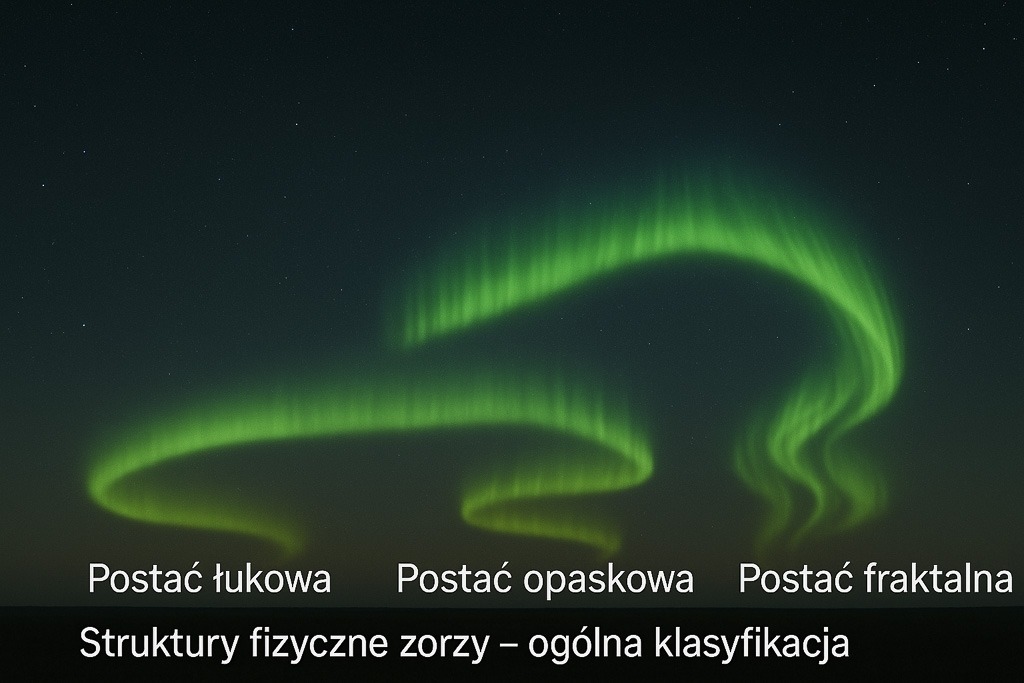
Arcs (Auroral Arcs)
- Single, stable structures,
- Occur with ordered electron flows.


Curtains (Auroral Curtains)
Complex vertical columns,
Form in areas of dense magnetic field.

Rays
Narrow vertical fibers,
Frequent during increased substorm activity.

Diffuse Aurora
- Weak, scattered structures,
- Difficult to observe with the naked eye.


I Invite You to My Films About Beautiful Places


Solar Cycle and Its Impact on the Northern Lights
Solar activity occurs in an approximately 11-year cycle, which affects the variability of the aurora. I write more about solar cycles here Solar cycle, and the Northern Lights
NORTHERN LIGHTS
How the Northern Lights Form: Causes, Science, and Origins of the Aurora Borealis
How the northern lights form: solar wind, Earth's magnetic field, oxygen, nitrogen, colors and the atmospheric layers where auroras glow.

Maximum Activity
- Increased number of CMEs,
- Strong geomagnetic storms,
- Aurora may be visible at lower geographic latitudes.

Northern Lights What They Are and How They Form
Meanwhile, if you want to learn about other phenomena occurring in the sky, I invite you to another article “Northern Lights and Other Phenomena in the Night Sky”
In this article, you will learn not only what the Northern Lights are and how they form, but also several fascinating phenomena that can appear alongside them. Besides the classic arcs and curtains of light, rare forms are described here, such as the so-called “Dune Aurora” – horizontal, wavy bands that are observed extremely rarely and only under specific conditions.
In the text, you will also find phenomena that are often confused with the aurora or appear in its vicinity, like STEVE – a bright, narrow ribbon running across the sky, or sprites, which are red flashes in the upper parts of the atmosphere. Thanks to this, the article allows you to discover how diverse and complex the light phenomena in the sky can be.
SKY PHENOMENA
Northern Lights and Other Phenomena in the Night Sky – Noctilucent Clouds, Haarp, Sprite Jellyfish
How to tell the Northern Lights from NLC, STEVE, sprites, airglow, city glow and HAARP myths. A practical guide to unusual lights in the night sky.
Minimum Activity
- CH HSS dominate,
- More stable auroras,
- Limited intensity of extreme phenomena.

Prediction Models
Forecasts are based on:
- CME statistics,
- wind speed and density measurements,
- long-term Bz observations.
Parameters Determining Aurora Visibility
The visibility of the Northern Lights depends primarily on solar activity, which causes geomagnetic disturbances. The stronger the solar wind stream and the higher the Kp index, the greater the chance that charged particles will reach the atmosphere over Iceland and cause intense flashes. The position relative to the so-called auroral oval is also important — the closer to its center, the stronger and more lasting the phenomenon.
Atmospheric conditions are equally important. Even with very high geomagnetic activity, the aurora will not be visible if the sky is covered by clouds, fog appears, or there is intense precipitation. The best visibility occurs on frosty, stable, cloudless nights, especially away from light sources.
The third group of factors are environmental elements. Places away from cities, with minimal light pollution, significantly increase the chance of observation. The altitude above sea level also matters greatly — the higher up, the cleaner the air tends to be and the wider the horizon. Thanks to the combination of these factors, Iceland often offers ideal conditions for admiring the Northern Lights.


Kp Index
A scale of 0–9 specifying global magnetic field disturbances. About density and the KP coefficient I wrote in this article “KP Coefficient and Density – Two Important Indicators in Observing the Northern Lights“
NORTHERN LIGHTS
How the Northern Lights Form: Causes, Science, and Origins of the Aurora Borealis
How the northern lights form: solar wind, Earth's magnetic field, oxygen, nitrogen, colors and the atmospheric layers where auroras glow.
- Kp 0–2 → aurora in polar regions
- Kp 3–4 → subpolar zones
- Kp 5+ → geomagnetic storm
- Kp 7+ → possibility of observation in Central Europe

Atmospheric Parameters
- cloud cover,
- amount of aerosols,
- humidity and air transparency,
- tropospheric conditions.

Light Pollution
Anthropogenic light reduces the contrast of the aurora, especially weak diffuse structures.

Northern Lights and Technology

Impact on Satellites
- increased atmospheric drag,
- communication disruptions,
- changes in orbit trajectories (especially LEO).

Radio Communication
Changes in the ionosphere can disrupt HF waves.

Power Infrastructure
Geomagnetic storms induce currents (GIC), which can overload transformers.

GPS
Strong geomagnetic activity caused by auroras can cause positional errors.

Auroras on Other Planets – Comparison
Jupiter
The strongest auroras in the Solar System; also powered by ions from Io.

Saturn
Auroras modulated by the planet’s rotation.

Mars
Phenomena occur locally — result of the lack of a global magnetic field.

Uranus and Neptune
Unusual aurora geometry due to the irregular magnetic fields of the planets.

The Northern Lights are the result of complex physical processes involving the interaction of solar plasma with Earth’s magnetic field and atmosphere at high altitudes. Their structures, colors, and dynamics result from solar wind parameters, magnetic reconnection, and ionospheric properties. Thanks to the analysis of solar cycles, geomagnetic models, and interplanetary observations, it is possible to understand the full scope of the phenomenon.
FAQ – Most Frequently Asked Questions About the Northern Lights
How to explain the northern lights to a child—and where they form
The simple version: the Sun sends charged particles, Earth’s magnetic field guides them toward the poles, and high in the atmosphere oxygen and nitrogen turn that energy into light.
- green and red auroras are produced mainly by oxygen
- purple and pink shades are linked mainly to nitrogen
- the glow forms in the upper atmosphere, especially the ionosphere and thermosphere
the history of aurora displays in the UK · the live aurora radar for the UK
At What Altitude Do the Northern Lights Form?
The aurora most often forms at an altitude of 100–250 km, and the rarest red auroras occur above 250–350 km.
What Determines the Colors of the Northern Lights?
Colors result from light emission by atmospheric gases:green → oxygen (557.7 nm),red → oxygen above 250 km,violet/pink → nitrogen N₂.
Are the Northern Lights Related to Geomagnetic Storms?
Yes. The aurora is a visible effect of geomagnetic disturbances caused by the solar wind or CME.
Can the Aurora Affect Technology?
Yes. It can cause:GPS disruptions,radio communication problems,increased satellite drag,GIC currents in power grids.
Do Auroras Occur Only on Earth?
No. They are also observed on Jupiter, Saturn, Uranus, Neptune and sporadically on Mars.
What Does the Intensity of the Aurora Depend On?
On:solar wind speed and density,Bz component of IMF,magnetic reconnection,atmospheric density at the emission altitude.
What is a Substorm?
A substorm is the sudden release of energy in the magnetotail, which causes a rapid increase in the intensity and dynamics of the aurora.
Why Are the Northern Lights Mainly Visible Near the Poles?
Because Earth’s magnetic field lines direct charged particles towards the polar areas.
Does the aurora form in the mesosphere? What is the name of the atmospheric layer where auroras occur?
No — although this question often comes up.The aurora does not form in the mesosphere, but above it, in the ionosphere and the thermosphere (at the boundary where the atmosphere begins to transition into the exosphere).
Continue with live forecasts, aurora tools and practical observation guides.





Sorry, the comment form is closed at this time.