

Northern Lights in the UK — Live Radar and Forecast
Northern Lights in the UK are never guaranteed on any single night — they depend on live geomagnetic activity, cloud cover and how far north you are. This page pulls the current Kp index and aurora status for the UK together with region-by-region visibility thresholds, so you can check tonight’s real chances in under a minute rather than guessing from a generic global forecast.
In short (30 seconds)
Whether you’ll see the aurora tonight depends on where in the UK you are and how active the geomagnetic field is right now. The live status below shows the current Kp index — compare it against the thresholds for your region in the table further down the page before you head outside.
| Question | Quick answer |
|---|---|
| What Kp do I need tonight? | From Kp 3 in Shetland and the far north Highlands, up to Kp 7+ for London and southern England — see the full regional table below |
| Where are my best chances? | Scotland, especially the far north and the Cairngorms — furthest from city light pollution and closest to the auroral oval |
| What time tonight? | Usually between 22:00 and 02:00, but the Kp index can shift within hours — always check the live status above before heading out |
Table of contents
- Will I see the Northern Lights in the UK tonight?
- Kp thresholds by UK region
- What is the Kp index?
- How to check tonight’s aurora alert
- Where in the UK to look
- Explore the Northern Lights across the UK
- Frequently asked questions
- Read also



Hi, I’m Krystian “dziadzia przewodnik” from OndaTravel.pl!
The North is my greatest passion, but the world is far too beautiful to stay in just one climate. On my blog, I combine the raw landscapes of Iceland and Norway with the exotic energy of Thailand or Vietnam, showing you how to travel authentically — with passion and a camera in hand.
What will you find on OndaTravel.pl?
Visual storytelling: As a photographer and filmmaker, I don’t just describe places — I take you there with professional photos and video.
North expert: Ready-to-use road trip plans for Iceland and Norway, smart tips for budget travel, and my original Northern Lights Radar (locations and forecast).
Travel through the lens of cinema: I track down filming locations — from icy scenes in Interstellar to tropical frames from world cinema.
New direction: Exotic destinations: I love contrast, so the blog is featuring more and more practical knowledge about Vietnam and Thailand. I’ll show you how to find your way around Southeast Asia and come back with your best memories.
P.S. follow me here


Northern Lights – live radar and parameters
Parameters refresh automatically. The local aurora chance is calculated for your location (GPS or city).
Aurora oval radar – Northern Hemisphere
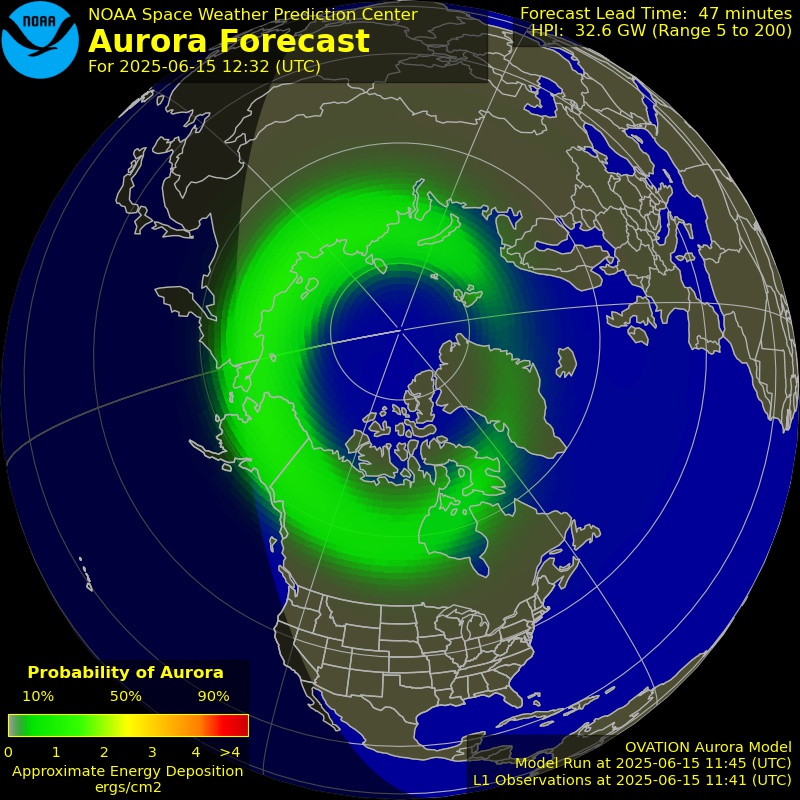
If the animation does not load, a static image will be shown.
Conditions assessment
The indicators consider your location, the local aurora chance and whether it is dark.
Kp (3h)
Kp (1 min)
Bz (GSM)
Bt (IMF)
Speed
Density
Temperature
Latest alerts: solar activity and geomagnetic storms
The monitor below updates automatically from NOAA data: it shows the outlook for the next seven nights and the current aurora alerts. Check it right before you head out — conditions can change within hours.
Sky phenomena
Planning your night-sky observations? These monthly guides highlight the most important astronomical events, meteor showers, Moon phases and the best observation windows. Below you’ll find the two most relevant monthly guides for the current period.

SKY PHENOMENA
Monthly guide
Sky events in October 2026: Draconids, Orionids and Saturn
The key sky events of the month, meteor activity, the Moon and practical observation windows.
Read the guide
SKY PHENOMENA
Monthly guide
Sky events in November 2026: Leonids, Taurids and a supermoon
The key sky events of the month, meteor activity, the Moon and practical observation windows.
Read the guideNorthern Lights
Looking for a longer-term Northern Lights outlook? These monthly guides complement the live radar with seasonal conditions, expected aurora activity and practical viewing tips. Below you’ll find the two most relevant monthly forecasts currently available.
NORTHERN LIGHTS
Monthly forecast
Northern Lights — October 2026
A monthly Northern Lights outlook with live-radar context and practical viewing guidance.
Read the guide
NORTHERN LIGHTS
Monthly forecast
Northern Lights — November 2026
A monthly Northern Lights outlook with live-radar context and practical viewing guidance.
Read the guide
Will I see the Northern Lights in the UK tonight?
There’s no single yes-or-no answer for “the UK” as a whole, because the country spans a wide range of geomagnetic latitudes — Shetland sits far closer to the auroral oval than Cornwall does. Use the live status at the top of this page as your starting point: it shows the current Kp index and general aurora activity level right now.
Then compare that number against your region in the table below. A Kp of 4 might mean nothing for London, but it’s a realistic chance in the Cairngorms. Three other conditions matter just as much as the Kp index: clear skies (check a cloud forecast, not just the aurora one), a genuinely dark, unobstructed north-facing horizon, and timing — most UK sightings cluster between around 22:00 and 02:00, though a strong geomagnetic storm can produce visible aurora at almost any time after dark.
Kp thresholds by UK region
These thresholds are estimates, not official regional forecasts. They’re derived from the standard relationship between the Kp index and the minimum geomagnetic latitude at which the aurora becomes visible (the NOAA/SWPC “viewline” model), adjusted for each region’s approximate distance from the auroral oval. Treat them as a planning guide, not a guarantee — and always cross-check the live status above before you go out.
| UK region | Kp for a chance overhead | Kp for a glow near the horizon | Kp for a strong, clearly visible display |
|---|---|---|---|
| Shetland / far north Highlands | 3 | 2 | 5 |
| Cairngorms / Aberdeenshire | 4 | 3 | 6 |
| Edinburgh / Glasgow / Newcastle / Northumberland | 5 | 4 | 7 |
| Manchester / Yorkshire / Midlands | 6 | 5 | 8 |
| Wales (north, Snowdonia) | 6 | 5 | 8 |
| London / southern England / south Wales | 7 | 6 | 9 (in practice, only the strongest storms) |
One counterintuitive point worth remembering: within any of these bands, elevation and darkness matter more than exact latitude. A hilltop viewpoint away from town lighting will often out-perform a lower-lying spot slightly further north that sits under a orange sky glow.
What is the Kp index?
The Kp index is a standardised scale, from 0 to 9, that measures how disturbed Earth’s geomagnetic field is over a three-hour window. It’s published by NOAA’s Space Weather Prediction Center and used worldwide as the common reference point for aurora forecasting. Kp 0–2 means quiet conditions — the aurora stays confined close to the poles. As the number rises, the auroral oval (the ring-shaped zone where the aurora is active) expands outward, pushing the visibility boundary further from the poles and closer to — or over — the UK.
In practice: Kp 5 is classed as a minor geomagnetic storm (G1), Kp 7 as a strong storm (G3), and Kp 9 as the most extreme category (G5) — genuinely rare events. Kp is useful as a quick reference, but it’s a three-hourly average, not a live reading — actual activity can spike or drop faster than the published number updates, which is why the live status above is a better real-time signal than the Kp figure alone.
How to check tonight’s aurora alert
Alongside the live status on this page, three UK institutional sources are worth bookmarking for the nights when activity is building:
- AuroraWatch UK — run by Lancaster University’s Space and Planetary Physics group. It issues a simple colour-coded alert (green, yellow, amber, red) based on real UK magnetometer data, plus optional email and app alerts when activity rises — the fastest way to get a heads-up without checking manually every hour.
- Met Office space weather forecast — the UK’s national meteorological service publishes a dedicated space weather outlook, including geomagnetic storm forecasts and aurora visibility guidance for the UK.
- British Geological Survey (BGS) — operates the UK’s own network of magnetometers and publishes the raw geomagnetic data that underpins AuroraWatch UK’s alerts, along with a geomagnetic coordinate calculator.
None of these sources can promise a sighting — geomagnetic activity, like weather, can change faster than any forecast updates. Treat an amber or red AuroraWatch UK alert, or a Kp forecast of 5 and above, as your cue to check the live status above and get to a dark, north-facing spot.
Where in the UK to look
Wherever you are, the same three rules apply: get away from artificial light, find a clear view of the northern horizon, and give your eyes at least 10–15 minutes to adjust to the dark. Scotland offers the best nationwide odds simply because it sits furthest north and has the most genuinely dark rural sky, but a decent storm (Kp 6–7 and above) can bring a visible glow to much further south, as the May 2024 storm demonstrated.
For a closer look at one of the UK’s most reliable inland viewing areas — with practical spots, dark-sky sites and its own live radar tuned to local coordinates — see our dedicated Cairngorms Northern Lights guide. The Cairngorms combine a relatively low Kp threshold with some of the darkest officially recognised skies in the UK, making them a strong first choice for anyone in Scotland or planning a trip north specifically to try to see the aurora.
GUIDE
Scotland Northern Lights Live – Cairngorms Radar and Forecast
Live aurora radar for the Cairngorms plus the Kp you actually need at Scottish latitude, official Dark Sky Park spots, and why your phone sees more than your eyes.
Explore the Northern Lights across the UK
This live radar is the hub for the UK Northern Lights cluster. From here you can check month-by-month odds, look back at the biggest storms on record, get a step-by-step guide to reading tonight’s alert, or go deeper into Scotland’s Cairngorms.
Northern Lights in the Cairngorms, Scotland — one of the UK’s best inland viewing areas: dark skies, practical spots and its own live radar.
Northern Lights in the UK in March 2027 — the spring equinox tends to lift geomagnetic activity; what that means for your chances this month.

AURORA ALERTS
Northern Lights in the UK in March 2027: When Are the Best Chances?
The spring equinox raises geomagnetic activity, but UK clocks change in March too. What Kp you need, which regions realistically qualify, and the live radar.
Northern Lights in the UK in April 2027 — still a realistic month in Scotland, but the shrinking window of darkness starts to matter.

AURORA ALERTS
Northern Lights in the UK in April 2027: When Are the Best Chances?
April still carries some equinox advantage, but Scotland's evening darkness window is shrinking fast. What Kp you need, where, and the live radar.
Northern Lights in the UK in July 2027 — why July is the toughest month of the year to see the aurora from the UK, and what to do instead.

AURORA ALERTS
Northern Lights in the UK in July 2027: Why Chances Are Very Low
Northern Lights in Poland in July 2026: live updates, when and what time to look at the sky, radar, map, Kp, Bz and CME.
Northern Lights in the UK in September 2026 — nights return and the autumn equinox lifts activity, one of the strongest months of the year.
AURORA ALERTS
Northern Lights in the UK in September 2026: When Are the Best Chances?
Nights return after summer's short darkness, and the autumn equinox lifts geomagnetic activity. What Kp you need, best UK regions, and the live radar.
Northern Lights in the UK in October 2026 — lengthening nights make October a solid transitional month for aurora watching.
AURORA ALERTS
Northern Lights in the UK in October 2026: When Are the Best Chances?
Nights lengthen fast and the clocks go back — October is a solid transitional month. What Kp you need, which regions qualify, and the live radar.
Northern Lights in the UK: the biggest storms in history — including the May 2024 G5 storm, visible across the whole UK, right down to London and Cornwall.

NORTHERN LIGHTS
Northern Lights in the UK: When Were the Biggest Aurora Storms in History?
The UK's only fully confirmed extreme aurora storm was the G5 event of 10-11 May 2024, seen from Cornwall to Shetland. What happened, and why.
Aurora Alert UK: how to check if tonight is a northern lights night — a step-by-step walkthrough of AuroraWatch UK’s alert levels and what each one means for you.

AURORA ALERTS
Aurora Alert UK: How to Check If Tonight Is a Northern Lights Night
How to read tonight's UK aurora alert: AuroraWatch UK's Green/Yellow/Amber/Red levels, NOAA's G-scale, and what each means for your part of the UK.
Geomagnetic storm, 10–12 October 2026: after several CMEs and M6.7 and M6.4 flares, a shock wave has hit Earth. Follow the geomagnetic storm live and your chances of seeing the northern lights in the UK, with NOAA bulletins added automatically.
GEOMAGNETIC STORM LIVE
CME hits Earth — will the aurora reach the UK?
Live NOAA bulletins, Kp, Bz, the 10–12 Oct forecast and where to look.
Frequently asked questions
Will I see the northern lights tonight in the UK?
It depends on where you are and how active geomagnetic conditions are right now. Check the live status at the top of this page for the current Kp index, then compare it against your region in the Kp threshold table. Far northern Scotland (Shetland, the north Highlands, the Cairngorms) has the lowest bar and the best odds; further south you need a genuinely strong storm (Kp 6 and above). You’ll also need clear skies and a dark, north-facing horizon — even a high Kp won’t help under cloud cover or heavy light pollution.
Where in the UK is the best place to see the northern lights?
Scotland offers the best nationwide odds, because it sits furthest north and has the darkest rural skies. Within Scotland, the far north (Shetland, Caithness, the north Highlands) needs the lowest Kp, while the Cairngorms combine a low threshold with easy access and officially recognised dark-sky sites — see our dedicated Cairngorms guide for specific viewpoints. Outside Scotland, Northumberland, the Yorkshire Dales and north Wales are the next-best options once a moderate-to-strong storm is underway.
What is the Kp index?
The Kp index is a 0-to-9 scale, published by NOAA’s Space Weather Prediction Center, that measures how disturbed Earth’s geomagnetic field is over a three-hour window. Higher values mean the auroral oval expands further from the poles, making the aurora visible from lower latitudes — including, on the strongest nights, from as far south as London. Kp is a useful quick reference, but it updates only every three hours, so treat the live status on this page as the more up-to-date signal.
Read also

GUIDE
OndaTravel guide
Northern Lights Radar: Live Aurora Forecast by Location
First check whether the auroral oval covers your latitude, then compare Kp, the direction of Bz and cloud cover. Even strong activity is not enough under full cloud…
Open
GUIDE
OndaTravel guide
Aurora Alerts
An aurora alert should be treated as a signal to check the conditions now: the radar for Poland, Kp, Bz, Bt, the solar wind, cloud cover and the northern horizon.…
OpenAURORA ALERTS
OndaTravel guide
Aurora Alert UK: How to Check If Tonight Is a Northern Lights Night
If you’ve heard there’s an aurora alert and want to know whether it applies to you tonight, the short version is: there’s no fixed „alert day” you can look up in…
Open
About the OndaTravel.pl author
Krystian – photographer, filmmaker and guide
Meet the OndaTravel.pl author: an independent Arctic guide, photographer and filmmaker. See how the guides are made, where the field photos come from, and how to reach out about a guided trip to Iceland, Lofoten or Norway.