


Aurora Alert UK: How to Check If Tonight Is a Northern Lights Night
If you’ve heard there’s an aurora alert and want to know whether it applies to you tonight, the short version is: there’s no fixed “alert day” you can look up in advance. Geomagnetic storms can’t be predicted more than a few days out — sometimes only hours — so any page announcing an alert for a specific date weeks ahead is guessing. What you can do, on any clear night of the year, is check the current alert level yourself in under a minute and know exactly what it means for where you are in the UK. This page shows you how.
In short (30 seconds)
An “aurora alert” in the UK almost always means AuroraWatch UK’s colour-coded status: Green, Yellow, Amber or Red. Green means don’t expect anything; Amber and Red mean go and check the sky. The live status below shows the current Kp index right now — cross-check it against the AuroraWatch UK level and your own region before you head outside.
| Question | Quick answer |
|---|---|
| Where do I check the alert right now? | The live radar below, plus AuroraWatch UK’s current status and NOAA SWPC’s 3-day forecast |
| Which alert level actually means “go outside”? | Amber or Red — Green and Yellow rarely mean anything visible outside Scotland |
| How far ahead can an alert be predicted? | Reliably, only 1-3 days; anything further out is a statistical trend, not a forecast |
Northern Lights – live radar and parameters
Parameters refresh automatically. The local aurora chance is calculated for your location (GPS or city).
Aurora oval radar – Northern Hemisphere
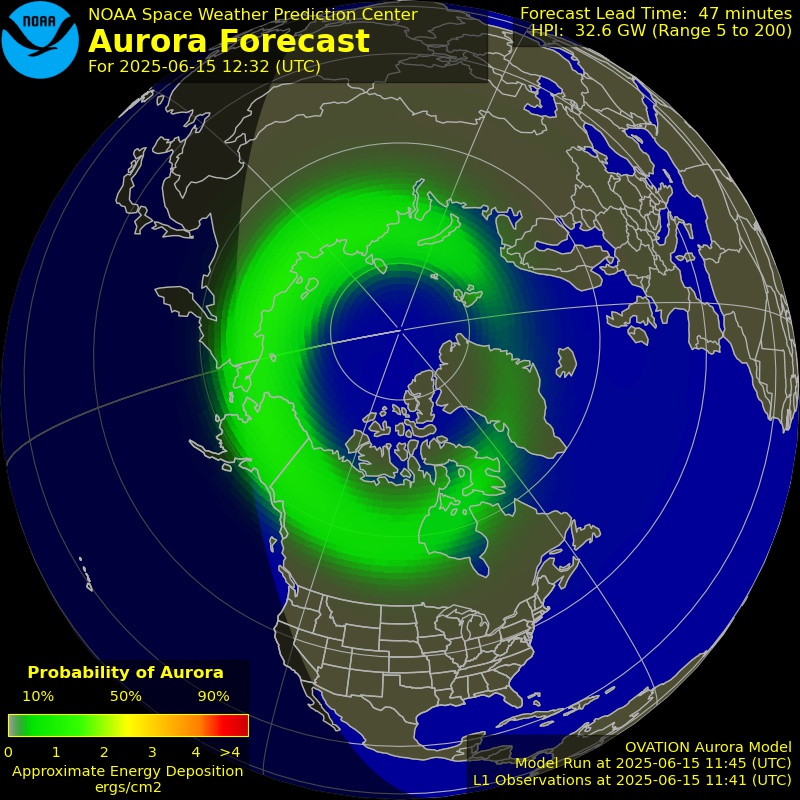
If the animation does not load, a static image will be shown.
Conditions assessment
The indicators consider your location, the local aurora chance and whether it is dark.
Kp (3h)
Kp (1 min)
Bz (GSM)
Bt (IMF)
Speed
Density
Temperature

Contents
- Why there’s no fixed “alert date” for the UK
- AuroraWatch UK’s alert levels: what Green, Yellow, Amber and Red mean
- NOAA’s G-scale, and how it relates to AuroraWatch UK
- What Kp you need once an alert is active
- How to check the alert in 3 steps
- What to do once you get an Amber or Red alert
- Common mistakes when following an aurora alert
- FAQ: the aurora alert in the UK
- Read also
Why there’s no fixed “alert date” for the UK
It’s common to see articles announcing an aurora alert for a specific night, weeks before it arrives. In practice, that kind of advance warning can’t be reliable: geomagnetic activity depends on solar wind and coronal mass ejections (CMEs) reaching Earth, and their real strength is only known 1 to 3 days ahead — sometimes with just hours of notice. A headline predicting an alert “for 14 February” published in January is, at best, a statistical possibility, not a real alert.
That’s why this page isn’t tied to a date. It teaches you to check, on any night of the year, whether there’s a real alert active and what it means from where you are in the UK. If you want the wider picture first — Kp thresholds for every UK region, all year round — start with the Northern Lights in the UK live radar and forecast hub.

GUIDE
Northern Lights in the UK — Live Radar and Forecast
Live UK aurora status and tonight's Kp index, plus Kp thresholds by region, official alert sources, and where to look.
AuroraWatch UK’s alert levels: what Green, Yellow, Amber and Red mean
When people in the UK say “there’s an aurora alert”, they usually mean AuroraWatch UK, run by Lancaster University’s Space and Planetary Physics group. It issues a simple, colour-coded status based on real UK magnetometer data — no need to interpret raw numbers yourself. Each colour has a specific, literal meaning about where the aurora might actually be seen:
| Level | What it means geographically |
|---|---|
| Green | No significant geomagnetic activity. Aurora is unlikely to be visible anywhere in the UK, even by camera. |
| Yellow | Minor activity. The aurora may be visible to the naked eye from Scotland, and may show up on camera from Scotland, northern England and Northern Ireland. |
| Amber | Possible sub-storm. The aurora is likely visible from Scotland, northern England and Northern Ireland, and possibly further south — worth checking wherever you are. |
| Red | Active substorm in progress. The aurora is likely visible by eye — and almost certainly by camera — from anywhere in the UK, weather permitting. |
Note: this wording follows AuroraWatch UK’s published alert descriptions at the time of writing — confirm it matches the current text on aurorawatch.lancs.ac.uk before publishing, as level descriptions are occasionally updated.
The practical rule: Green and Yellow are “keep half an eye on it” levels. Amber and Red are “go and look” levels — and Red, in particular, is rare enough that it’s worth dropping other plans for.
NOAA’s G-scale, and how it relates to AuroraWatch UK
Alongside AuroraWatch UK’s colours, you’ll also see geomagnetic storms described using NOAA’s international G-scale, from G1 (minor) to G5 (extreme). This is the same scale used by space weather agencies worldwide, including in NOAA SWPC’s own 3-day forecast and alerts and warnings pages. It maps loosely onto the Kp index and, in turn, onto AuroraWatch UK’s colours:
| NOAA level | Approx. Kp | Roughly maps to |
|---|---|---|
| G1 (minor) | 5 | AuroraWatch UK Yellow / low Amber |
| G2 (moderate) | 6 | AuroraWatch UK Amber |
| G3 (strong) | 7 | AuroraWatch UK Amber / Red |
| G4 (severe) | 8 | AuroraWatch UK Red |
| G5 (extreme) | 9 | AuroraWatch UK Red — the level reached on 10-11 May 2024, visible across the whole UK including London and Cornwall |
Note: the G-Kp equivalence is NOAA’s own public classification — verify the exact ranges against swpc.noaa.gov/noaa-scales-explanation before publishing. The “roughly maps to” column is an approximate cross-reference for this page, not an official AuroraWatch UK conversion table.
What Kp you need once an alert is active
An Amber or Red alert doesn’t mean the same thing everywhere in the UK — it means different odds depending on how far north you are. As a rough regional guide:
| UK region | Kp for a chance overhead | Kp for a glow near the horizon | Kp for a strong, clearly visible display |
|---|---|---|---|
| Shetland / far north Highlands | 3 | 2 | 5 |
| Cairngorms / Aberdeenshire | 4 | 3 | 6 |
| Edinburgh / Glasgow / Newcastle / Northumberland | 5 | 4 | 7 |
| Manchester / Yorkshire / Midlands | 6 | 5 | 8 |
| Wales (north, Snowdonia) | 6 | 5 | 8 |
| London / southern England / south Wales | 7 | 6 | 9 (in practice, only the strongest storms) |
Note: these thresholds are an orientative guide, not official regional forecasts — pending verification against the British Geological Survey’s geomagnetic coordinate calculator. Treat them as a planning guide, not a guarantee. The full table with more detail lives on the UK live radar hub.
How to check the alert in 3 steps
- Check NOAA SWPC’s 3-day forecast. It gives you an early sense of whether elevated activity is expected over the next few days — not a promise, but the most reliable outlook that exists this far ahead.
- On the night itself, check the live status on this page and AuroraWatch UK’s current colour. The Kp index recalculates every three hours; that live reading, not a forecast from days before, is what actually matters.
- Cross-check against clear skies for your region. A Red alert under total cloud cover won’t show you anything — always check the cloud forecast for your specific location, especially your northern horizon.
What to do once you get an Amber or Red alert
Once the alert level moves to Amber or Red, three things matter more than the alert itself: how dark your sky is, how clear your view north is, and how quickly you can act, since a substorm can peak and fade within an hour or two. Get away from artificial light, find an unobstructed view of the northern horizon, and give your eyes 10-15 minutes to properly adjust to the dark.
For the current national picture — live Kp index, plus the full regional threshold table — go to the Northern Lights in the UK live radar and forecast hub. If you’re in Scotland or planning to head north specifically to try to see the aurora, our dedicated Cairngorms Northern Lights guide covers one of the UK’s most reliable inland viewing areas, with a lower Kp threshold than most of the country, officially recognised dark-sky sites and its own live radar tuned to local coordinates.

GUIDE
Scotland Northern Lights Live – Cairngorms Radar and Forecast
Live aurora radar for the Cairngorms plus the Kp you actually need at Scottish latitude, official Dark Sky Park spots, and why your phone sees more than your eyes.
Common mistakes when following an aurora alert
- Trusting an alert “for two weeks from now”: no forecasting model is reliable that far ahead — any date announced with weeks of notice is a statistical guess, not a real alert.
- Treating Yellow the same as Amber: Yellow rarely means anything visible outside Scotland, often only by camera. Amber and Red are the levels actually worth acting on.
- Checking once and not returning: the Kp index updates every three hours, and AuroraWatch UK’s status can change within the same night — a storm can arrive and pass while you’re not looking.
- Ignoring cloud cover: even a Red alert is worthless under an overcast sky — always cross-check the Kp reading against a clear-sky forecast for your exact location.
- Assuming Amber/Red in Scotland means the same thing in London: check the Kp threshold table for your specific region before you plan a long drive.
FAQ: the aurora alert in the UK
What do the AuroraWatch UK alert colours mean?
Green means aurora is unlikely to be visible anywhere in the UK. Yellow means it may be visible by eye from Scotland and by camera from Scotland, northern England and Northern Ireland. Amber means it’s likely visible from Scotland, northern England and Northern Ireland, and possibly further south. Red means it’s likely visible by eye and camera from anywhere in the UK.
Does an Amber or Red alert guarantee I’ll see the aurora?
No. The alert reflects geomagnetic activity, not local conditions. You still need clear skies and a dark, unobstructed view of the northern horizon — a Red alert under thick cloud will show you nothing. Always check the sky forecast for your exact location alongside the alert level.
How far in advance can an aurora alert be predicted?
Reliably, only 1 to 3 days ahead, using NOAA SWPC’s 3-day forecast. Anything predicted further out — a specific date weeks away — is a statistical possibility at best, not a real alert.
How does NOAA’s G-scale relate to AuroraWatch UK’s colours?
NOAA’s G-scale (G1 minor to G5 extreme) is the international classification for geomagnetic storms. Roughly: G1-G2 corresponds to AuroraWatch UK’s Yellow/Amber range, G3-G4 to Amber/Red, and G5 — an extreme, rare event like 10-11 May 2024 — to Red, visible across the entire UK.
I got a Yellow alert — is it worth going outside?
Usually only if you’re in Scotland, and even then the aurora may only show up clearly on a camera rather than to the naked eye. Yellow is a ‘keep watching’ level, not a ‘go now’ level — Amber and Red are the ones worth acting on.
Does AuroraWatch UK send notifications when the alert level changes?
AuroraWatch UK offers optional email and app alerts so you don’t have to check manually — confirm current sign-up options on aurorawatch.lancs.ac.uk. Otherwise, simply return to the live status on this page whenever the sky is clear.
Read also
GUIDE
OndaTravel guide
Scotland Northern Lights Live – Cairngorms Radar and Forecast
The Cairngorms sit at around 59.5 degrees geomagnetic latitude, well south of the auroral oval, so this is a mid-latitude destination: you need Kp 3 for something on…
Open
GUIDE
OndaTravel guide
Northern Lights Radar: Live Aurora Forecast by Location
First check whether the auroral oval covers your latitude, then compare Kp, the direction of Bz and cloud cover. Even strong activity is not enough under full cloud…
Open
GUIDE
OndaTravel guide
Aurora Alerts
An aurora alert should be treated as a signal to check the conditions now: the radar for the UK, Kp, Bz, Bt, the solar wind, cloud cover and the northern horizon.…
Open



Sorry, the comment form is closed at this time.