Sky events in June 2026: Venus with Jupiter, NLC and Bootids
June 2026 will bring short, bright nights, but it will not be boring. The best observing potential comes from a very bright meeting of Venus and Jupiter after sunset, the season for noctilucent clouds, the young Moon near the planets and the unpredictable June Bootids.
This guide is a practical observing plan for Poland. It does not promise a huge meteor shower or a guaranteed aurora, because June requires realistic expectations. Instead, you get a list of the best evenings, photography tips and a clear distinction between what is easy to see with the naked eye and what needs a clean horizon, patience or an alert.
If you are just building your observing season, start with the previous article: sky events in May 2026. In June, the key internal tools are the noctilucent clouds guide, the NLC radar, the northern lights radar and aurora alerts.
June 2026 in the sky — in short
June 2026 is a month of short nights, a bright sky and a good season for noctilucent clouds. It is best to plan observations flexibly, because in this period the transparency of the air, the northern horizon and good weather are what matter.
Quick answer: what can you see in the sky in June 2026?
For a casual observer, the beginning and middle of the month will be the most impressive. On 8–9 June, look low in the west for Venus and Jupiter. On 15–17 June, Mercury and the young Moon join the scene. All month long, it is worth checking the northern horizon for NLC. Late June brings the Bootids and the full Moon, which in Poland effectively falls on the night of 29/30 June.

| Date | Event | Where to look? | Rating |
| 8–9 June 2026 | Venus close to Jupiter | west / northwest after sunset | the easiest and prettiest target of the month |
| 15 June 2026 | Mercury in good evening visibility | very low in the west | for patient observers, preferably with binoculars |
| 16–17 June 2026 | young Moon with planets | western horizon after sunset | great for photos with a phone or camera |
| all June | noctilucent clouds NLC | low northern horizon after dusk or before dawn | the most summery event of the month |
| 21 June 2026 | summer solstice | the longest day and the shortest night | a good time for NLC, not for dark skies |
| 27–28 June 2026 | June Bootids | wide view of the sky, darker place | a capricious shower, no guarantee of a show |
| night of 29/30 June 2026 | full Moon | east and southeastern horizon | easy observation, good for landscape frames |

SKY CALENDAR
Astronomical events calendar 2026
See the full 2026 calendar of sky events: planets, meteors, eclipses, full Moons and the best observing windows.

Check out my YouTube channel and travel with me.
Follow the channel for videos, routes and practical travel inspiration.
Follow me here:
What’s up?
Enjoying my content?
Buy me a coffee at buycoffee.to/ondatravel and support the creation of more travel content.
Your support helps me create more practical guides, videos and travel inspiration.

Best dates in June 2026 — what is really worth saving?
If I had to choose only three observing windows, they would be: 8–9 June for Venus and Jupiter, 16–17 June for the young Moon with planets, and any clear evening with a clean northern horizon for NLC. I would treat the Bootids as a bonus, not the main reason to drive out of town.

- Easiest with the naked eye: Venus and Jupiter after sunset.
- Best for photos: the young Moon, Venus and Jupiter low above the horizon.
- Najbardziej klimatyczne: Noctilucent clouds (NLC) above the northern horizon.
- Most uncertain: the June Bootids and the aurora.
- Best for beginners: a short walk to a place with an open western horizon, without a telescope or complicated equipment.
June has one drawback: nights are very short. It also has one advantage: the most interesting things happen low above the horizon at hours when most people can still go for a walk. It is a good month for people who want to start observing without a night trip to the mountains or to a very dark sky.
What will you find in this guide?
- Quick answer — the most important events in one place.
- Best June dates — what is really worth adding to your calendar.
- Venus and Jupiter on 8–9 June — the brightest duo of the month.
- Mercury, the Moon and planets on 15–17 June — an arrangement above the west.
- Noctilucent clouds NLC — when to look at the northern horizon.
- NLC or aurora? — how not to confuse the two.
- Bootids and Arietids — meteors without exaggerated promises.
- The Moon and the summer solstice — what the shortest night means.
- 3 gotowe scenariusze obserwacji — city, beach and darker skies.
- What not to promise in June? — uczciwe oczekiwania.
- OndaTravel tools — NLC, aurora and further planning.
- Co po czerwcu? — July, August and the rest of the season.
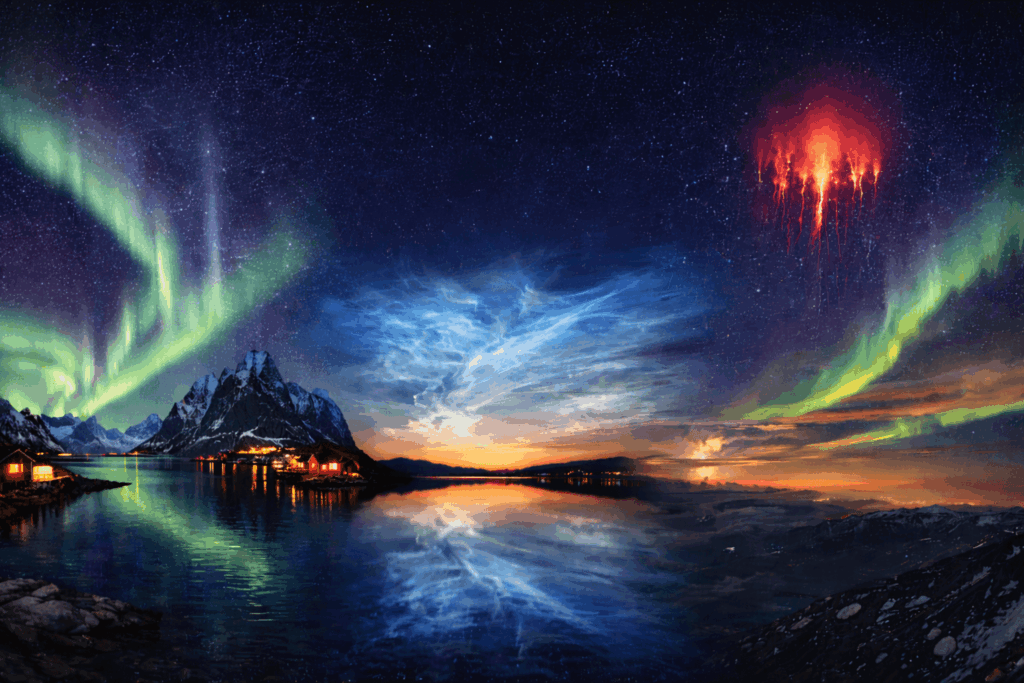
SKY PHENOMENA
Sky phenomena 2026
The main hub with calendars, radars, meteor showers, eclipses, auroras and seasonal observing guides.
Venus and Jupiter on 8–9 June 2026: the prettiest event of the month
The evenings of 8 and 9 June 2026 are the key point of the month. Venus and Jupiter, the two brightest planets visible from Earth, will appear close to each other in the western sky. To an observer, they will look like a pair of very bright points hanging low above the horizon after sunset.

You do not need a telescope. The naked eye is enough, and binoculars may simply make it easier to catch the arrangement against the bright twilight. The biggest issue is practical: the planets will be low, so you need an open western or northwestern horizon. It can also work in a city if buildings, trees or a hill do not block the view.
It is best to go out about 30–60 minutes after sunset. Venus should be the first bright point you notice. Jupiter will be fainter next to it, but still very clear. If the sky is transparent, this is one of those views you can show to a random person on a walk without any explanation.
For a photo, a phone or a camera with a short focal length is enough. The prettiest frame is the planets above a landscape: the sea, a lake, a forest line, a lighthouse, a tower or a city silhouette. Take several shots every few minutes, because the sky background darkens quickly and the planets sink lower.
Mercury, the young Moon and planets on 15–17 June
In mid-June, a wider planetary arrangement takes over. On 15 June, Mercury will be in one of its better evening configurations, but it will still be harder than Venus and Jupiter. It is a low object, sensitive to clouds near the horizon and urban glow.

On 16 June, a thin crescent Moon will appear low in the west near Mercury. On 17 June, the Moon will already be closer to Venus, with Jupiter still nearby. These two evenings are best for calm observing and photographing the “Moon plus planets” arrangement.
Do not wait for full darkness. With objects this low, the best window is short. Start observing about 35–45 minutes after sunset. First find Venus, then look for Jupiter, the Moon and the lower Mercury. Binoculars will help, but use them only after the Sun has fully set.
This is a good subject for a day-by-day mini photo series. On 8–9 June, photograph the Venus-Jupiter pair; on 16–17 June, return to the same spot to catch the young Moon moving between the planets.
Noctilucent clouds in June: the summer highlight of the northern horizon
June marks the start of the best period for noctilucent clouds, or NLC. These are not ordinary clouds. They form very high in the atmosphere and can glow with silvery-blue light when it is already twilight on the ground, but high ice crystals are still catching sunlight.

In Poland, it is best to look low above the northern horizon. A good time is about 1–2 hours after sunset and a similar window before dawn. NLC cannot be forecast for an exact day, so instead of relying on one date, it is worth building a habit of briefly checking the sky after clear evenings.
Noctilucent clouds look like delicate bands, waves, cobwebs or glowing streaks. They are usually silver, bluish or pearly. What distinguishes them from ordinary clouds is that they can stay bright against a darkening sky and remain low in the north.
You do not need any equipment to observe. For photos, a phone with night mode or a camera on a tripod is enough. What matters most is a clear northern horizon, no low clouds and a spot away from strong lights. It is worth comparing current observations with the NLC radar and the guide: noctilucent clouds NLC.

NOCTILUCENT CLOUDS
Noctilucent clouds NLC
A guide to summer noctilucent clouds: when to look for them, where to look and how to tell them apart from ordinary clouds.
NLC or aurora? How not to confuse summer phenomena
In June, confusion is easy because both NLC and a possible aurora can appear low above the northern horizon. The key difference is this: noctilucent clouds are a seasonal summer phenomenon visible during deep twilight, while the aurora depends on geomagnetic activity and does not appear simply because the night is clear.

NLC most often have a silvery, bluish or pearly color. They resemble waves, fibers, streaks or a thin cobweb. They are usually fairly stable and glow against the darkening sky. An aurora, if it occurs, may show clearer motion, arcs, vertical structures or greenish-reddish colors in long-exposure photos.
The safest approach is to check both sources at once: the NLC radar for noctilucent clouds and the northern lights radar i aurora alerts for geomagnetic activity. It is also worth reading the article: northern lights in the UK — history of the biggest observations, because it shows well that strong auroras over the UK are linked to major geomagnetic storms, not simply to the season.

AURORA RADAR
Northern lights radar
Check geomagnetic conditions and assess whether there is a real chance of seeing the aurora in Poland.
Bootids and Arietids: will there be meteors in June 2026?
June is not a meteor month in the style of the Perseids. There are, however, two topics worth explaining: the Arietids and the June Bootids. The Arietids are a very active daytime shower, so most meteors disappear in daylight. You can try just before dawn around the first half of June, but it is not an easy visual observation.
The June Bootids are more intuitive for a night observer, but very unpredictable. In some years they have surprised observers with higher activity, but most often they produce single meteors or a very weak display. Around 27 June is most often given as the maximum of this shower.
In 2026, late June will not be ideal because the full Moon is approaching. Bright sky will make fainter meteors harder to spot. Still, the Bootids are worth a short mention because their meteors are slow and easier to distinguish from random streaks if something does appear.
The most reasonable plan is simple: do not drive far only for the Bootids, but if you are in a darker place on the night of 27/28 June, spend 30–60 minutes calmly watching the sky. No phone, no telescope, just a wide view of the sky.

METEORS
Meteor shower calendar 2026
See when the most important meteor showers occur and which nights are worth saving in your observing calendar.
The Moon and the summer solstice in June 2026
The new Moon falls in mid-June. It is the best moment of the month for a darker sky, although June nights are still short and bright. For observing fainter objects, it is worth planning around the new Moon, especially if you want to leave the city.

Astronomical summer begins on 21 June. It is the longest day of the year and the period of the shortest nights. For an observer, this means less darkness, but also more motivation to hunt for NLC, because bright summer twilights help their visibility.
The full Moon falls on the night of 29/30 June in Polish time. It is not a good moment for faint meteors, but it is great for simple landscape photography: the Moon over the sea, a lake, a forest or a city. The prettiest effect comes from a low moonrise near the horizon, when the disk appears larger and warmer in color.
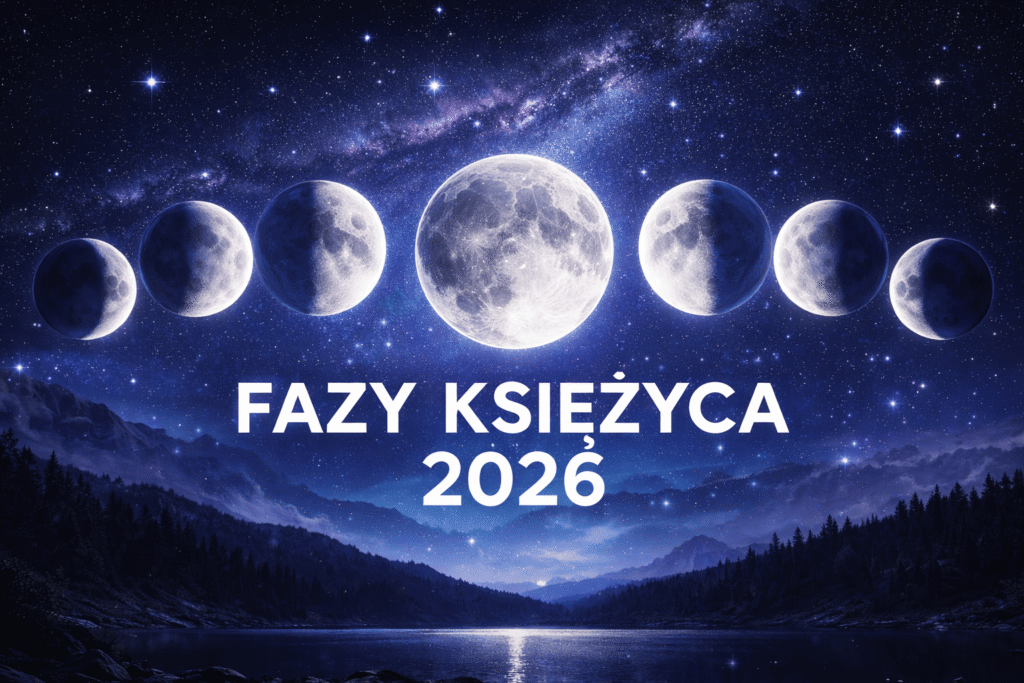
MOON
Moon phases 2026
Check the new Moon, full Moon and the best nights for darker skies, Moon photography and observing plans.
3 ready-made observing scenarios: city, beach and darker sky
Not everyone has to go under a perfectly dark sky. June 2026 has many events that can be observed during a walk, a trip to the water or a short outing outside the city. The most important thing is choosing the place for the specific target.

- City scenario: choose a spot with an open western horizon. Target: Venus, Jupiter, the young Moon and possibly Mercury. Equipment: naked eye, phone, possibly binoculars.
- Beach / lake scenario: choose a place with a wide northern horizon. Target: noctilucent clouds and photos after dusk. Equipment: a phone with night mode or a camera on a tripod.
- Out-of-town scenario: choose a darker place with a wide view of the sky. Target: Bootids, fainter stars and calm observation away from lights. Equipment: mat, deck chair, warm sweatshirt and patience.
The most universal place is one that has both a good western and northern horizon. Then, during one evening, you can start with the planets after sunset and later check whether noctilucent clouds appear in the north.
What not to promise in June? Honest expectations
June is a beautiful observing month, but not a month of big guarantees. The most common mistake is treating every calendar entry as a guaranteed show. In practice, the best things are simple: bright planets, the young Moon and NLC. The most uncertain topics are meteors and the aurora.
- Do not promise a meteor shower: the Bootids may produce single meteors or almost nothing.
- Do not promise an aurora: in June it can be seen only with suitable geomagnetic activity and good weather.
- Do not promise dark skies: around the solstice come the shortest nights of the year.
- Do not promise a supermoon: the June full Moon is interesting for photography, but it does not need to be described as a supermoon.
- Do not leave observing to the last minute: the planets and Moon will be low, so the horizon matters more than the equipment itself.
That is exactly why this article focuses on a practical plan. It is better to see a reliable, brief event from a good place than to wait all night for something that may not appear at all.
How to observe June sky events?
- For Venus and Jupiter, choose a place with an open western horizon and start observing shortly after sunset.
- For Mercury and the young Moon on 16–17 June, do not wait until night — the best window will be short.
- For NLC, look low in the north, especially after a clear day, about 1–2 hours after sunset.
- For the Bootids, choose a darker place, but expect single meteors rather than a big show.
- Before going out, check cloud cover, air transparency, the Moon phase and your local horizon.
- For photos of planets and the Moon, use a short focal length and a landscape; for NLC, a tripod or night mode will help.
The best June plan is three short outings instead of one long trip. First: 8–9 June for Venus and Jupiter. Second: 16–17 June for the young Moon with planets. Third: any clear evening with a clean northern horizon for noctilucent clouds.
Night-sky observing calendars and tools
Below you will find the most important tools and guides that really help plan June observations: NLC, the aurora radar, alerts and materials explaining when it is worth looking toward the northern horizon.

- Noctilucent clouds NLC — a guide to one of the most important summer phenomena.
- Radar NLC — the place to check whether it is worth watching the northern horizon tonight.
- Northern lights radar — live data whenever there is a chance of geomagnetic activity.
- Aurora alerts — a quick path to current updates.
- Northern lights in Poland — history of the biggest observations and context for strong events over Poland.
- Sky events in May 2026 — the previous monthly guide and reference point for the series.
What after June? NLC, Perseids, eclipse and the rest of the season
After June, a more classic summer observing season begins. Noctilucent clouds may still appear in July, and later meteors take a larger role. The best-known summer shower is the Perseids, whose maximum falls in August.
The year 2026 also brings a larger astronomical event in Europe: the August solar eclipse. This subject needs separate preparation: choosing a place, observing safely and checking real visibility from Poland.
The simplest continuation after June is: keep following NLC, save the August Perseids, check aurora alerts and prepare a separate plan for the eclipse. June is therefore not only a separate observing month, but also the gateway into the whole summer sky season.
Sky events in June 2026: monthly observing plan
Sky events in June 2026 are best planned around the western and northern horizons. The west will matter most for Venus, Jupiter, Mercury and the young Moon. The north will matter most for noctilucent clouds and a possible aurora during strong activity.
If you are searching for “what is visible in the sky in June 2026”, the shortest answer is: Venus and Jupiter on 8–9 June, Mercury and the young Moon on 15–17 June, NLC throughout the month, the summer solstice on 21 June, Bootids around 27–28 June and the full Moon on the night of 29/30 June.
The most striking photo of the month will probably come from the planets after sunset or from noctilucent clouds. Meteors are the most uncertain topic. The easiest event to see will be bright Venus, but its meeting with Jupiter will be the prettiest moment of June.
Data sources
The dates and interpretation of June events were compiled from current astronomical calendars and observing materials. When actually planning an outing, also check local weather, cloud cover, air transparency and obstacles on the horizon.
- NASA: key astronomical events in 2026
- EarthSky: Venus and Jupiter conjunction in June 2026
- EarthSky: Mercury after sunset
- Space.com: full Moon in June 2026
- Society for Popular Astronomy: June Bootids
- EarthSky: meteor shower guide
Frequently asked questions
What is best to observe in the sky in June 2026?
The most interesting targets will be Venus and Jupiter on 8–9 June, the young Moon with planets on 16–17 June, noctilucent clouds throughout the month and the June Bootids in late June.
When is the Venus and Jupiter conjunction in June 2026?
It is best to look on the evenings of 8 and 9 June 2026 after sunset, low above the western or northwestern horizon. Both planets will be visible to the naked eye.
When is the full Moon in June 2026?
The full Moon peaks late on 29 June in UTC, which in Poland effectively means the night of 29/30 June. It is a good moment for photos of the Moon low above the horizon.
When should you look for noctilucent clouds?
In June, it is worth looking low above the northern horizon about 1–2 hours after sunset or before dawn. The phenomenon is seasonal, but it cannot be predicted for a specific day.
Will the June Bootids 2026 be spectacular?
A spectacle should not be promised. This is a very variable shower that usually produces weak activity, but it is worth checking the sky around 27–28 June, especially from a darker place.
Can you see the northern lights in Poland in June 2026?
It is possible only during strong geomagnetic activity, but June’s bright nights make observation harder. It is better to follow the aurora through live alerts than to plan for a specific date in advance.
Read also / next
The materials below help you continue: from the May calendar, through NLC and observing radars, to the broader context of the northern lights in Poland. These are good places if you want to plan more observing nights.
- Sky events in May 2026
- Noctilucent clouds NLC
- NLC radar and noctilucent clouds monitor
- Northern lights radar
- Aurora alerts
- Northern lights in the UK — history of the biggest observations


Hi, I’m Krystian “dziadzia przewodnik” from OndaTravel.pl!
The North is my greatest passion, but the world is far too beautiful to stay in just one climate. On my blog, I combine the raw landscapes of Iceland and Norway with the exotic energy of Thailand or Vietnam, showing you how to travel authentically — with passion and a camera in hand.
What will you find on OndaTravel.pl?
Visual storytelling: As a photographer and filmmaker, I don’t just describe places — I take you there with professional photos and video.
North expert: Ready-to-use road trip plans for Iceland and Norway, smart tips for budget travel, and my original Northern Lights Radar (locations and forecast).
Travel through the lens of cinema: I track down filming locations — from icy scenes in Interstellar to tropical frames from world cinema.
New direction: Exotic destinations: I love contrast, so the blog is featuring more and more practical knowledge about Vietnam and Thailand. I’ll show you how to find your way around Southeast Asia and come back with your best memories.
P.S. follow me here


Author
Krystian „dziadzia przewodnik”The North is my greatest passion, but the world is too beautiful to stay in one climate. On my blog I combine the raw nature of Iceland and Norway with the exotic energy of Thailand and Vietnam, showing you how to travel authentically, with passion and a camera in hand.