

Northern Lights in Quebec: Montreal Forecast and Where to Go
In short: Montreal is a harder case than it looks on a map. At roughly 55 degrees geomagnetic latitude (simple dipole estimate), it sits further from the auroral oval than Winnipeg or Saskatoon despite a comparable geographic latitude — eastern Canada is simply further from the magnetic pole’s influence at this longitude. Using NOAA’s rule that the oval’s edge sits near 66 degrees magnetic latitude at Kp 0 and moves about 2 degrees closer to the equator per Kp step, the oval only reaches Montreal’s latitude around Kp 5-6, a genuinely strong storm, not a routine one.
Geomagnetic latitude is a simplified dipole estimate, not an AACGM-v2 calculation.
| Element | What to know |
|---|---|
| Location | 45.5°N geographic, roughly 55° magnetic (dipole estimate) |
| Kp threshold | Around Kp 5-6 for a visible display; below that, Montreal is normally too far south |
| Season | Late August to mid-April, but the storms strong enough to matter here are less frequent than further west |
| Sky clarity | January is the cloudiest month (about 64% overcast or mostly cloudy); November and March are usually clearer |
| Direction | North, over the Laurentians, away from the city’s own glow |
| Nearest real dark sky, in the right direction | Mont-Tremblant National Park, about 131 km north |
This is the honest version of a page that usually oversells. Montreal is a real Canadian city with genuine northern lights sightings on record, but it is not a Prairie town: the storm you need here is stronger, and rarer, than most guides admit. This page gives you the actual threshold, the one nearby spot that faces the right direction, and why a routine Kp 3-4 forecast will not do much for you here.
Can you see the northern lights from Montreal?
Only during a genuinely strong storm, and even then, rarely from inside the city. Montreal’s geomagnetic latitude is lower than it looks on an ordinary map, which is why a Kp 3 or 4 forecast that would light up Manitoba or Saskatchewan usually does nothing here. It takes a Kp 5 or higher storm, ideally 6 or above, for color to become visible low on the northern horizon from a genuinely dark spot outside the city. Storms that strong happen only a handful of times in a typical year, which is also why they tend to make the news when they do.
Northern Lights – live radar and parameters
Parameters refresh automatically. The local aurora chance is calculated for your location (GPS or city).
Aurora oval radar – Northern Hemisphere
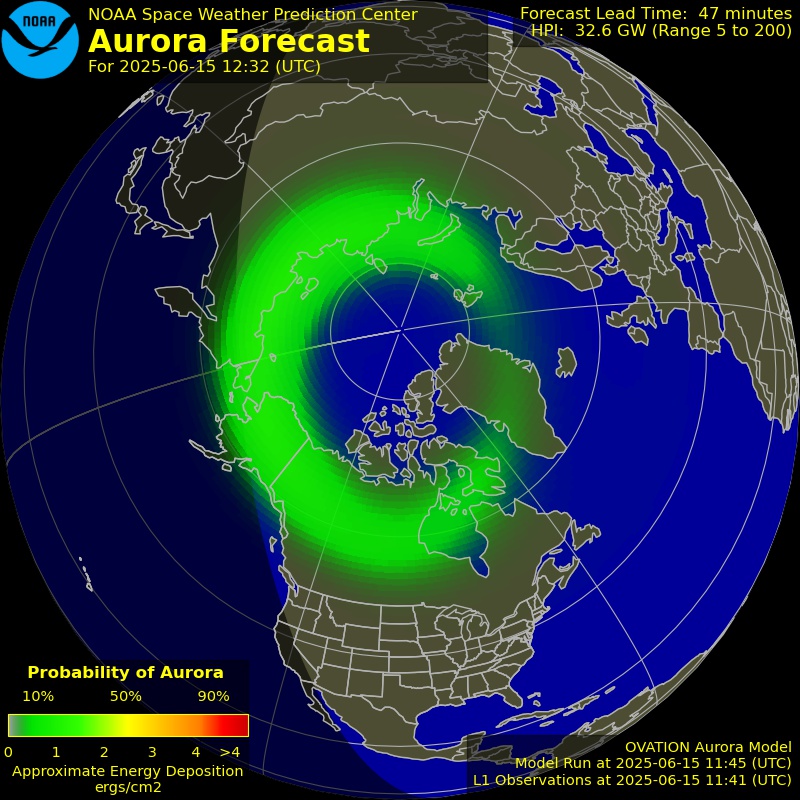
If the animation does not load, a static image will be shown.
Conditions assessment
The indicators consider your location, the local aurora chance and whether it is dark.
Kp (3h)
Kp (1 min)
Bz (GSM)
Bt (IMF)
Speed
Density
Temperature
Where to go near Montreal
One option actually faces the right way:
- Mont-Tremblant National Park — about 131 km north of the city in the Laurentians. This is the direction that matters: north, with real elevation and distance from Montreal’s own light dome. Worth the drive specifically when a Kp 5+ storm is forecast, not as a routine outing.
- Parc Frédéric-Back, inside the city — wide open fields and few streetlamps make it usable for a quick check during an exceptional Kp 7+ storm, but it will not save a borderline night.
Other popular Quebec dark-sky spots, like the Mont-Mégantic International Dark Sky Reserve, sit east or southeast of Montreal rather than north, which puts the city’s own glow between you and the aurora rather than behind you. They are excellent for stargazing generally, just not the first choice specifically for a low aurora.
Escaping the clouds
Montreal follows the same pattern as the rest of southern Canada: January is the cloudiest month of the aurora season (around 64% overcast or mostly cloudy), while November and March run noticeably clearer. Since a storm strong enough to reach Montreal is already uncommon, stacking the odds by favoring the clearer shoulder months matters more here than almost anywhere else in this guide — there is no point driving to Mont-Tremblant under a solid cloud deck for a storm this rare.
What Kp index do you need here
Using NOAA’s rule that the auroral oval’s edge sits near 66 degrees magnetic latitude at Kp 0 and moves about 2 degrees closer to the equator per Kp step, Montreal’s roughly 55 degree magnetic latitude (simple dipole estimate) puts the oval’s edge over the city only around Kp 5-6. That is a strong to severe geomagnetic storm (NOAA category G1-G2 or higher), not the moderate activity that satisfies more northerly parts of Canada. Below Kp 4, plan on seeing nothing from this latitude.
When: season, hours and moon
The season runs from late August through mid-April by darkness alone, but realistically your odds track the solar cycle and the equinoxes (September and March) more than the calendar month, since you are waiting for a rare, strong event rather than routine activity. Within any night that a storm is forecast, the best hours are the same as everywhere: within an hour or two of local midnight. Given how infrequent a strong-enough storm already is, do not let a bright moon talk you out of checking — but a new-moon week is still the better bet if the forecast is only borderline.
What you’ll actually see from Montreal
Because Montreal needs a Kp5-6 storm just to put the oval within reach, what you get here is rarely the vivid green curtains people picture. On a Kp5 night from a genuinely dark spot like Mont-Tremblant, expect a low, sometimes grey-green or pinkish glow near the northern horizon, occasionally brightening into faint pillars. Cameras (even phone night mode) will show color your eyes struggle to register — that gap between what a long-exposure photo captures and what you see live is normal at this latitude, not a sign you’re missing something.
On the rare Kp7+ nights, the display can climb higher and show real color and movement even from in-city dark corners like Parc Frédéric-Back. Those nights are infrequent enough that patience, not a fixed schedule, is the right expectation to set.
What Kp index do I need to see the northern lights from Montreal?
Montreal sits at roughly 55°N geomagnetic latitude (a dipole-model estimate, not precision AACGM-v2), so you generally need Kp5 or higher for any realistic chance, and Kp6-7 for a display worth the drive. This is meaningfully higher than Winnipeg or Saskatoon, which can see aurora at Kp4.
Where should I go to see the aurora near Montreal?
Mont-Tremblant National Park, about 131 km north of the city and in the correct direction (away from Montreal’s light dome), is the most realistic option. In-city dark corners like Parc Frédéric-Back can work only during strong Kp7+ storms.
Is Mont-Mégantic a good spot for aurora hunting?
Mont-Mégantic International Dark Sky Reserve is excellent for stargazing but is east-southeast of Montreal. For an aurora low on the northern horizon, that direction puts Montreal’s own light pollution between you and the sky you’re trying to see — Mont-Tremblant to the north is the better choice specifically for aurora.
Can I see the northern lights from inside Montreal?
Only during the strongest storms (Kp7 and above), and even then light pollution will wash out anything but a bright, high display. For any routine Kp5-6 event, you need to leave the city and its light dome behind.
Other Canadian provinces worth checking
Montreal’s Kp5-6 threshold is on the harder end for Canada. If you’re willing to travel or are simply curious how much easier other regions have it, the Canadian Prairies see aurora far more often:
Read also
For the full national picture — live radar, the Kp scale explained, and every province and territory covered — start with the Canada hub. If you want to check tonight’s forecast anywhere before you commit to a drive, the live aurora forecast tool covers the whole hemisphere.

GUIDE
Northern Lights in Canada: Live Radar and Forecast
Northern lights in Canada: live radar, Kp thresholds for Yellowknife, Churchill and the Yukon, the season as the provinces define it, and how it compares with Scandinavia.
NORTHERN LIGHTS
Aurora Forecast Tonight: Live Northern Lights Map
Check tonight's aurora forecast with live Kp, Bz, solar-wind, cloud-cover and NOAA/OVATION signals. Use the map for your location.