

Winnipeg is not on anyone’s short list of aurora capitals, and that is a fair starting point. The city sits far enough south that the northern lights need real geomagnetic activity to show up, not just a quiet, steady glow. This page gives the honest version: what storm strength you actually need, where around Winnipeg to go, and why the calendar matters more than most guides admit.
In short: Winnipeg sits at roughly 58 degrees geomagnetic latitude (simple dipole estimate), so it needs a moderate storm, not a rare one. Using NOAA’s rule that the auroral oval’s edge sits near 66 degrees magnetic latitude at Kp 0 and moves about 2 degrees closer to the equator per Kp step, the oval reaches Winnipeg’s latitude around Kp 4, with a clearer, higher display more typical at Kp 5 and above.
Geomagnetic latitude is a simplified dipole estimate, not an AACGM-v2 calculation.
| Element | What to know |
|---|---|
| Location | 49.9°N geographic, roughly 58° magnetic (dipole estimate) — well south of the auroral oval’s usual position |
| Kp threshold | Around Kp 4 for a low display near the horizon, Kp 5 or higher for a clearer show higher in the sky |
| Season | Late August to mid-April, when nights are dark enough; deep summer (May-July) stays too bright |
| Sky clarity | Counterintuitive: Winnipeg’s cloudiest months are December-February (up to 66% cloudy in February); shoulder months like November and March are usually clearer |
| Direction | North, away from the city’s own glow to the south |
| Nearest dark sky | Birds Hill Provincial Park, 24 km north; Oak Hammock Marsh, 34 km north; Spruce Woods Provincial Park (designated Dark-Sky Preserve), about 210 km southwest by road |
Can you see the northern lights from Winnipeg?
Rarely from inside the city, and only during a fairly strong storm. Winnipeg’s own lights wash out anything faint low on the northern horizon. From just outside the city, in a genuinely dark spot facing north, a Kp 4 storm can produce a low green or reddish glow near the horizon, and a Kp 5 or higher storm can put color noticeably higher in the sky. Kp 4-5 geomagnetic storms happen a number of times in a typical year, mostly clustered around the spring and autumn equinoxes — the limiting factor is usually the sky, not the sun.
Northern Lights – live radar and parameters
Parameters refresh automatically. The local aurora chance is calculated for your location (GPS or city).
Aurora oval radar – Northern Hemisphere
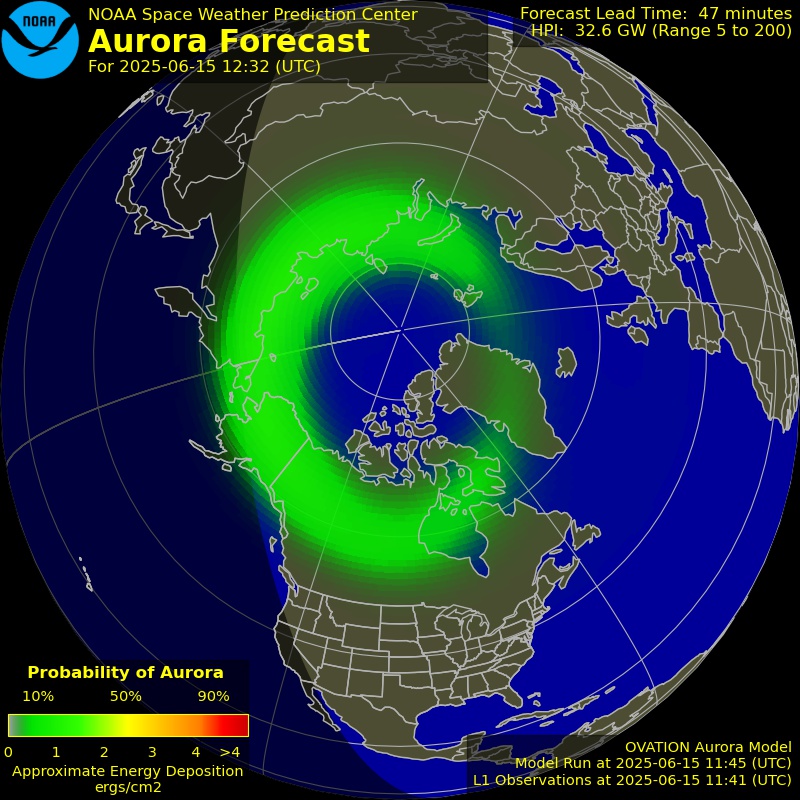
If the animation does not load, a static image will be shown.
Conditions assessment
The indicators consider your location, the local aurora chance and whether it is dark.
Kp (3h)
Kp (1 min)
Bz (GSM)
Bt (IMF)
Speed
Density
Temperature
Where to go near Winnipeg
Three real options, all reachable without an overnight trip:
- Birds Hill Provincial Park — about 24 km north of Winnipeg on Highway 59. The closest genuinely dark option, with open fields facing the right direction.
- Oak Hammock Marsh — about 34 km north of the city. A conservation area with wide, flat sightlines and little tree cover to block a low horizon glow.
- Spruce Woods Provincial Park — roughly 210 km southwest by road (about 160 km in a straight line), near Glenboro. This is Manitoba’s designated Dark-Sky Preserve, worth the drive only when a stronger storm (Kp 5+) is forecast, since it is too far for a quick check on a whim.
Escaping the clouds
Manitoba’s winter reputation for clear prairie skies does not hold up in the data. Winnipeg is actually cloudier in December, January and February (roughly 60-66% of the time overcast or mostly cloudy) than it is in the shoulder months of November and March (closer to 55-60%). Since the aurora season already runs from late August to mid-April, the practical move is to weight your attempts toward the shoulder months rather than the deep-winter weeks people assume are best, and to keep the drive to Spruce Woods in reserve for a night when the forecast actually shows clear skies that far southwest, since a cloud bank over Winnipeg does not always extend that far.
What Kp index do you need here
NOAA’s working rule is that the auroral oval’s equatorward edge sits near 66 degrees magnetic latitude at Kp 0, and moves about 2 degrees closer to the equator for each step up in Kp. Winnipeg sits at roughly 58 degrees magnetic latitude by a simple dipole estimate, which puts the oval’s edge over the city at around Kp 4. In practice that means a Kp 4 storm can produce a faint glow low on the northern horizon, while Kp 5 and above bring the display noticeably higher and more colorful. Below Kp 3, Manitoba is normally too far south to see anything.
When: season, hours and moon
The season runs from late August, once nights are dark again, through mid-April; by May the far-northern latitude of summer twilight makes even a strong storm hard to see. Within that window, the best hours are the same everywhere: within an hour or two of local midnight. A bright moon will not stop a strong storm from being visible, but it will wash out a faint one, so a new-moon week is worth favoring when the forecast is only borderline.
What you’ll actually see from Manitoba
At a Kp 4-5 storm from a genuinely dark spot north of Winnipeg, expect a low arc or glow along the northern horizon — usually a pale green to the naked eye, sometimes with a faint reddish tinge above it, and it will look far more vivid in a phone or camera photo than to your eyes directly. Pillars or overhead movement are only likely at Kp 6 and above, which is a less frequent, more newsworthy storm. Setting that expectation before you drive out is what keeps a quiet night from feeling like a wasted one — a subtle horizon glow is still a real sighting, not a failure.
If Manitoba is not lining up for you tonight, the same live radar and forecast tool covers every location in this guide, and the northern United States has its own version of this same question with a different Kp threshold.
Neighbouring Saskatchewan, a touch further along the same magnetic latitude gradient, needs a slightly weaker storm than Manitoba does.

GUIDE
Northern Lights in the USA: Live Radar and Forecast
Northern lights in the USA: live radar for Fairbanks, the official 21 August to 21 April season, how many nights to book, the Dalton Highway and what the Lower 48 needs.
What Kp index do you need to see the northern lights from Winnipeg?
Around Kp 4 for a faint glow low on the northern horizon, and Kp 5 or higher for a clearer, higher display. Below Kp 3, Manitoba is normally too far south of the auroral oval to see anything.
Where can you actually see the aurora near Winnipeg?
Birds Hill Provincial Park (about 24 km north) and Oak Hammock Marsh (about 34 km north) are the closest genuinely dark, open sites. Spruce Woods Provincial Park, Manitoba’s designated Dark-Sky Preserve, is about 210 km southwest and worth the drive mainly for Kp 5+ storms.
Is winter really the best season in Manitoba?
Not by sky clarity. Winnipeg is actually cloudier in December-February than in the shoulder months of November and March, so those shoulder months inside the late-August-to-mid-April aurora season are often a better bet for a clear sky, not just a dark one.
Can you see the northern lights from inside Winnipeg?
Rarely, and only during a strong storm. City lighting washes out anything faint low on the horizon, so heading a short distance north is almost always necessary.
Read also

GUIDE
Northern Lights in Canada: Live Radar and Forecast
Northern lights in Canada: live radar, Kp thresholds for Yellowknife, Churchill and the Yukon, the season as the provinces define it, and how it compares with Scandinavia.

NORTHERN LIGHTS
Aurora Forecast Tonight: Live Northern Lights Map
Check tonight's aurora forecast with live Kp, Bz, solar-wind, cloud-cover and NOAA/OVATION signals. Use the map for your location.