

In short: Halifax sits at a lower geomagnetic latitude than its geographic position suggests, so it needs a stronger storm than Vancouver despite being farther north — but its skies clear more often, especially around the September equinox.
| Element | Value |
|---|---|
| Geomagnetic latitude (dipole estimate) | ~53.8°N |
| Practical Kp threshold | Kp6+ (NOAA oval-edge rule) |
| Cloudiest month | May (~61% overcast, Weather Spark) |
| Clearest month | September (~58% clear, Weather Spark) |
| Nearest Dark-Sky Preserve | Kejimkujik National Park (RASC-designated), ~2 hours SW of Halifax |
Halifax looks, on a map, like it should have decent odds — it’s farther north than Vancouver and further from the equator than Montreal. The magnetic geography tells a different story. Here’s the honest version of what it actually takes to see the northern lights from Nova Scotia’s capital, and where to go when conditions line up.
Can you see the northern lights from Halifax?
Only during strong storms — and somewhat stronger ones than you might expect from the map. Halifax’s geomagnetic latitude (a simplified dipole-model estimate, not full AACGM-v2 precision) works out to roughly 53.8°N, lower than Vancouver’s ~54.7°N despite Halifax sitting nearly five degrees farther north geographically. That’s because Earth’s magnetic north pole is offset toward northern Canada, which pulls the effective “aurora latitude” down for Atlantic Canada relative to the Pacific coast.
Using NOAA’s published rule that the aurora oval’s equatorward edge sits near 66° magnetic latitude at Kp0 and moves roughly 2° further south per additional Kp step, Halifax needs approximately Kp6 or higher before the oval reaches far enough south — a step above the Kp5-6 needed in Montreal or Vancouver, and well above the Kp4 that suffices in Winnipeg or Saskatoon.
Northern Lights – live radar and parameters
Parameters refresh automatically. The local aurora chance is calculated for your location (GPS or city).
Aurora oval radar – Northern Hemisphere
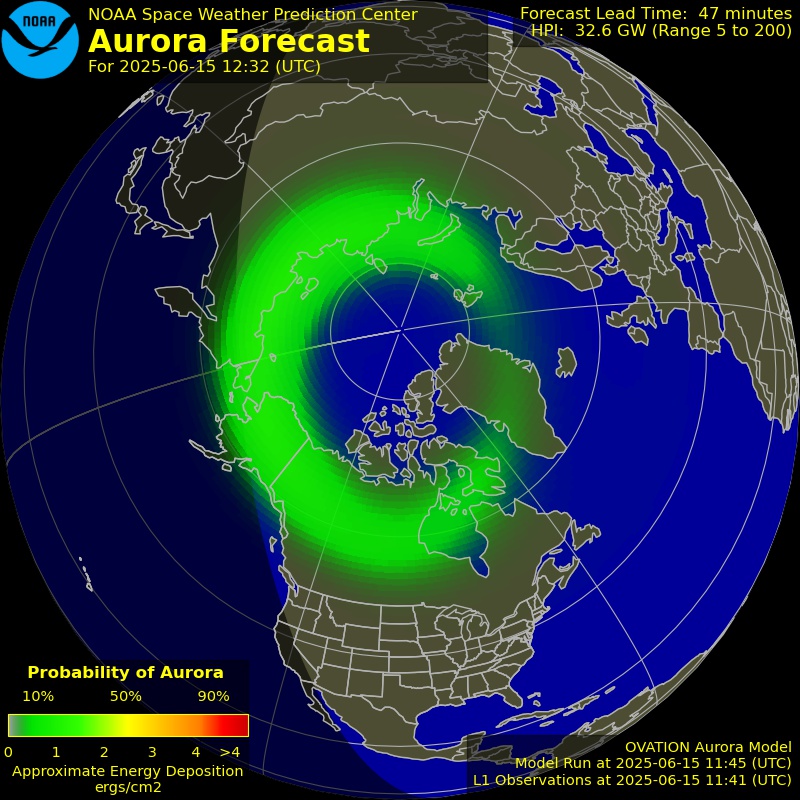
If the animation does not load, a static image will be shown.
Conditions assessment
The indicators consider your location, the local aurora chance and whether it is dark.
Kp (3h)
Kp (1 min)
Bz (GSM)
Bt (IMF)
Speed
Density
Temperature
Where to go near Halifax
Inside the Halifax Regional Municipality, spots that put some distance between you and downtown’s glow include Fisherman’s Cove on the Dartmouth side, Peggy’s Cove, Lawrencetown Beach, and York Redoubt National Historic Site off Purcell’s Cove Road — all can work during a strong, high display. For a genuinely dark sky, Kejimkujik National Park, a Royal Astronomical Society of Canada-designated Dark-Sky Preserve roughly two hours southwest of the city, is the most reliable option; Tobeatic Wilderness Reserve and Kejimkujik’s Seaside section offer similar darkness slightly closer or farther depending on route.

GUIDE
Northern Lights in Canada: Live Radar and Forecast
Northern lights in Canada: live radar, Kp thresholds for Yellowknife, Churchill and the Yukon, the season as the provinces define it, and how it compares with Scandinavia.
None of these spots change the Kp math above — they remove light pollution, not the storm strength you still need.
Weather is the one thing working in Halifax’s favor
Compared to Vancouver’s coastal cloud, Halifax’s sky is genuinely more cooperative. Weather Spark data puts the cloudiest month, May, at only about 61% overcast — nowhere near Vancouver’s 71-73% winter peak — and the clearest month, September, at about 58% clear. There isn’t a single brutal cloud season here the way there is on the Pacific coast; the main obstacle really is the Kp threshold, not the weather.
That makes September the strongest month to plan around for two independent reasons: it’s Halifax’s clearest month by Weather Spark’s data, and, as covered below, early autumn also brings a genuine increase in storm frequency.
The equinox effect, and why it matters more here
Geomagnetic storms are measurably more frequent around the spring and autumn equinoxes, a well-documented pattern called the Russell-McPherron effect: Earth’s magnetic field lines up more favorably with the solar wind’s field near the equinoxes, increasing the odds of the kind of storm that reaches Kp6+.
Because Halifax needs that higher Kp threshold in the first place, timing matters more here than in the Prairie provinces, where Kp4 storms are common enough that season is a secondary factor. Late September through early October — when equinox-driven activity is rising and local skies are already clearing for the year — is the single best window to plan a trip around.
When to actually try
Aim for clear nights in September with a Kp6+ forecast; treat the equinox in late March as a secondary window if a strong storm is forecast. May, despite being on the milder side weather-wise, is the cloudiest month and not worth prioritizing. Check the live aurora widget above whenever a strong storm is forecast, and pair it with a normal weather check before heading out to Kejimkujik or the coast.
What you’ll actually see
At the Kp6 threshold this location typically needs, expect a clear glow or arc near the northern horizon from a dark spot like Kejimkujik, with color more visible in photos than to the naked eye. Stronger Kp7+ storms can bring visible color and movement even from closer, less-dark spots like Peggy’s Cove. As with every location on the harder end of this series, treat a Halifax sighting as a genuine event worth planning a night around, not a routine occurrence.
Can you see the northern lights from Halifax?
Yes, but only during strong geomagnetic storms of roughly Kp6 or higher. Halifax’s geomagnetic latitude (~53.8°N, a dipole-model estimate) is actually lower than Vancouver’s despite being farther north geographically, because Earth’s magnetic pole is offset toward northern Canada.
Where is the best place near Halifax to see the aurora?
Kejimkujik National Park, a Royal Astronomical Society of Canada-designated Dark-Sky Preserve about two hours southwest of Halifax, offers the darkest skies in the region. Closer options like Peggy’s Cove, Fisherman’s Cove, and Lawrencetown Beach can work during stronger displays.
What is the best time of year to see the aurora in Halifax?
September, for two independent reasons: it’s Halifax’s clearest month for cloud cover (about 58% clear per Weather Spark), and the September equinox brings a documented increase in geomagnetic storm frequency (the Russell-McPherron effect).
Why does Vancouver need a similar Kp to Halifax despite being farther south on the map?
Geomagnetic latitude, not geographic latitude, determines aurora visibility. Earth’s magnetic north pole sits offset toward northern Canada, which lowers the effective aurora latitude for Atlantic Canada. As a result Halifax (~53.8°N geomagnetic) needs roughly Kp6+, slightly more than Vancouver’s Kp5-6 despite Halifax’s higher geographic latitude.
Other Canadian provinces worth checking
Halifax needs one of the higher Kp thresholds in this series. If you’re willing to look elsewhere, the Prairie provinces need far less:
Quebec and British Columbia sit in between:
Read also
For the full national picture — live radar, the Kp scale explained, and every province and territory covered — start with the Canada hub. To check tonight’s forecast anywhere before committing to the drive to Kejimkujik, the live aurora forecast tool covers the whole hemisphere.
GUIDE
Northern Lights in Canada: Live Radar and Forecast
Northern lights in Canada: live radar, Kp thresholds for Yellowknife, Churchill and the Yukon, the season as the provinces define it, and how it compares with Scandinavia.

NORTHERN LIGHTS
Aurora Forecast Tonight: Live Northern Lights Map
Check tonight's aurora forecast with live Kp, Bz, solar-wind, cloud-cover and NOAA/OVATION signals. Use the map for your location.