

In short: St. John’s has one of Atlantic Canada’s more favorable geomagnetic latitudes — needing only about Kp5 — but is officially Canada’s foggiest major city, which is the real obstacle here.
| Element | Value |
|---|---|
| Geomagnetic latitude (dipole estimate) | ~56.2°N |
| Practical Kp threshold | Kp5 (NOAA oval-edge rule) |
| Fog days per year | 124 (Environment Canada, via Wikipedia) — the most of any major Canadian city |
| Clearest / cloudiest months | September ~50% clear; May ~69% overcast (Weather Spark) |
| In-city viewing spot | Signal Hill National Historic Site — elevated, open, no drive required |
St. John’s is a genuinely interesting case: its geomagnetic latitude is one of the more favorable in Atlantic Canada, better than Halifax’s or Fredericton’s. The obstacle here isn’t magnetic geography — it’s that St. John’s is, by Environment Canada’s own numbers, the foggiest major city in the country. Here’s the honest picture and the one spot in the city that works without a drive.
Can you see the northern lights from St. John’s?
During moderate storms, more easily than you might expect from an island out in the Atlantic. St. John’s geomagnetic latitude (a simplified dipole-model estimate, not full AACGM-v2 precision) works out to roughly 56.2°N — better than Fredericton’s ~55.1°N, Montreal’s ~55°N, and considerably better than Halifax’s ~53.8°N. Using NOAA’s published rule that the aurora oval’s equatorward edge sits near 66° magnetic latitude at Kp0 and moves roughly 2° further south per Kp step, St. John’s needs only about Kp5 — the easiest threshold of any Atlantic Canada page on this site, and close to the Prairie provinces’ Kp4.
The real limiting factor is weather, not magnetism: St. John’s averages 124 fog days a year, the most of any major Canadian city, according to Environment Canada data. Fog at ground level blocks a Kp5 aurora just as effectively as a Kp2 one.
Northern Lights – live radar and parameters
Parameters refresh automatically. The local aurora chance is calculated for your location (GPS or city).
Aurora oval radar – Northern Hemisphere
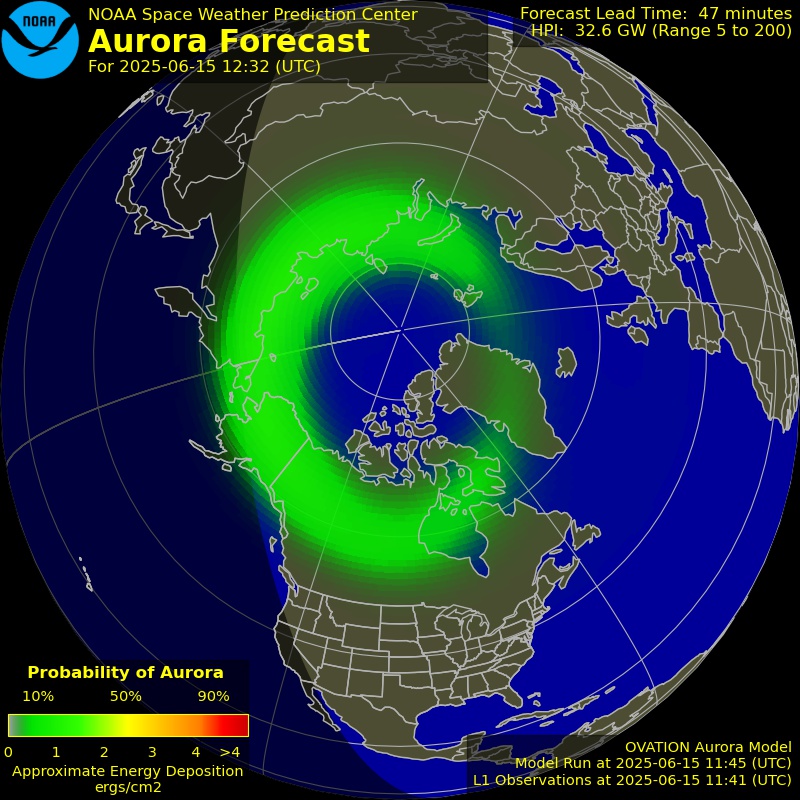
If the animation does not load, a static image will be shown.
Conditions assessment
The indicators consider your location, the local aurora chance and whether it is dark.
Kp (3h)
Kp (1 min)
Bz (GSM)
Bt (IMF)
Speed
Density
Temperature
Where to go: you may not need to leave the city
Signal Hill National Historic Site, right in St. John’s, is the standout local option: its elevation and open, unobstructed exposure over the harbour and the Atlantic give it a clear view of the northern sky without the drive most other Canadian cities on this site require. For a fully rural setting, Gros Morne National Park (on the island’s west coast, several hours from St. John’s) and the Bonavista Peninsula are commonly recommended, along with Twillingate further north.

GUIDE
Northern Lights in Canada: Live Radar and Forecast
Northern lights in Canada: live radar, Kp thresholds for Yellowknife, Churchill and the Yukon, the season as the provinces define it, and how it compares with Scandinavia.
None of these solve the fog problem below — Signal Hill’s elevation helps on nights with low-lying coastal fog, but a full overcast system will block the view from anywhere on the island.
Fog, not cloud, is St. John’s specific problem
Weather Spark data shows St. John’s cloudiest month is May (~69% overcast) and its clearest is September (~50% clear) — a weaker clear season than every other Canadian province covered on this site, none of which drop below roughly 56% at their best month. Layered on top of ordinary cloud cover is the fog: 124 days a year on average, driven by the cold Labrador Current meeting warmer air offshore, a coastal effect that persists even on nights that would otherwise register as “clear” in regional cloud data.
There’s no equivalent of driving 40 km inland to escape it the way there sometimes is elsewhere — fog banks along this coast can be very local and unpredictable, which is exactly why checking a same-night local forecast matters more here than the general seasonal pattern.
The equinox effect still applies
As on our other Canada pages, the Russell-McPherron effect means geomagnetic storms are measurably more frequent near the spring and autumn equinoxes, when Earth’s magnetic field lines up more favorably with the solar wind’s field.
For St. John’s, that makes September the best overall window: it’s the clearest month by Weather Spark’s data (even if only 50% clear) and it coincides with rising equinox-driven storm activity. Because the Kp threshold here is already comparatively low (~Kp5), a clear September night gives St. John’s genuinely good odds by this site’s standards.
When to actually try
Aim for clear, fog-free nights in September with a Kp5+ forecast. May is the worst month on both counts (cloudiest, and deep into the fog season) and not worth prioritizing. Because fog here is so local and short-notice, check a same-day marine/coastal forecast in addition to the live aurora widget above before heading to Signal Hill.
What you’ll actually see
At the Kp5 threshold this location typically needs, expect a visible glow or arc on the northern horizon from Signal Hill on a genuinely clear night, with color more pronounced in photos than to the eye — similar to what a Kp5 night looks like in Winnipeg or Saskatoon. Kp7+ storms can bring real color and movement visible even against St. John’s modest light pollution. The comparatively low Kp bar here means St. John’s can, on the right clear night, outperform several other provinces covered on this site despite its Atlantic location.
Can you see the northern lights from St. John’s, Newfoundland?
Yes, during moderate storms — St. John’s geomagnetic latitude (~56.2°N, a dipole-model estimate) needs only about Kp5, one of the more favorable thresholds in Atlantic Canada. The main obstacle is weather: St. John’s averages 124 fog days a year, the most of any major Canadian city.
Where is the best place in St. John’s to see the aurora?
Signal Hill National Historic Site, right in the city, offers an elevated, unobstructed view over the harbour and Atlantic without needing to drive out of town. For a fully rural setting, Gros Morne National Park and the Bonavista Peninsula are commonly recommended, several hours from the city.
Why is fog such a problem in St. John’s specifically?
St. John’s sits where the cold Labrador Current meets warmer offshore air, producing frequent, often very local fog banks that can block a clear-sky forecast on short notice. This is a distinct problem from ordinary cloud cover and is why checking a same-night local forecast matters more here than elsewhere.
Is Newfoundland easier or harder for aurora viewing than the rest of Atlantic Canada?
Easier in terms of the Kp threshold needed (~Kp5 versus Nova Scotia’s Kp6+ and New Brunswick’s Kp5-6), because St. John’s has a more favorable geomagnetic latitude. It’s harder in terms of weather, since fog and cloud cover here are more persistent and less predictable than in Halifax or Fredericton.
Other Canadian provinces worth checking
St. John’s has one of the easier Kp thresholds in this series, similar to the Prairie provinces:
New Brunswick, Quebec, British Columbia, and Nova Scotia each need a somewhat to considerably stronger storm:
Read also
For the full national picture — live radar, the Kp scale explained, and every province and territory covered — start with the Canada hub. To check tonight’s forecast anywhere before heading to Signal Hill, the live aurora forecast tool covers the whole hemisphere.
GUIDE
Northern Lights in Canada: Live Radar and Forecast
Northern lights in Canada: live radar, Kp thresholds for Yellowknife, Churchill and the Yukon, the season as the provinces define it, and how it compares with Scandinavia.

NORTHERN LIGHTS
Aurora Forecast Tonight: Live Northern Lights Map
Check tonight's aurora forecast with live Kp, Bz, solar-wind, cloud-cover and NOAA/OVATION signals. Use the map for your location.