

Northern Lights in British Columbia: Vancouver Forecast and Where to Go
In short: Vancouver combines a geomagnetic latitude similar to Montreal’s with the heaviest coastal cloud cover of any city covered on this site — the toughest realistic combination in Canada for casual aurora viewing.
| Element | Value |
|---|---|
| Geomagnetic latitude (dipole estimate) | ~54.7°N |
| Practical Kp threshold | Kp5-6 (NOAA oval-edge rule) |
| Cloudiest months | December-January (~72-73% overcast, Weather Spark) |
| Clearest months | July-August (~66% clear) — but short, bright nights |
| Nearest realistic dark-ish spot | Porteau Cove Provincial Park, 38 km N on Hwy 99 (BC Parks) |
If you’ve searched for the northern lights in Vancouver, you’ve probably found a mix of dramatic photos and vague promises. Here’s the honest version: Vancouver is one of the hardest major Canadian cities to see aurora from, not because of one factor but two stacked together — a geomagnetic latitude in the same range as Montreal’s, and the heaviest, most persistent cloud cover of any city we’ve mapped in this series. This page explains exactly what that means and where a realistic attempt actually makes sense.
Can you see the northern lights from Vancouver?
Rarely, and only during strong storms. Vancouver sits at roughly 54.7°N geomagnetic latitude (a simplified dipole-model estimate, not full AACGM-v2 precision) — close to Montreal’s and well south of the Prairie provinces. Using NOAA’s published rule that the aurora oval’s equatorward edge sits near 66° magnetic latitude at Kp0 and moves about 2° further south per Kp step, Vancouver needs roughly Kp5-6 activity before the oval reaches far enough south to matter, and clear skies at the same time.
That second condition is the harder one here. Winnipeg and Saskatoon only need Kp4 and have comparatively dry prairie air; Vancouver needs a stronger storm AND a break in a cloud pattern that covers the sky 70%+ of the time for four straight months of the year.
Northern Lights – live radar and parameters
Parameters refresh automatically. The local aurora chance is calculated for your location (GPS or city).
Aurora oval radar – Northern Hemisphere
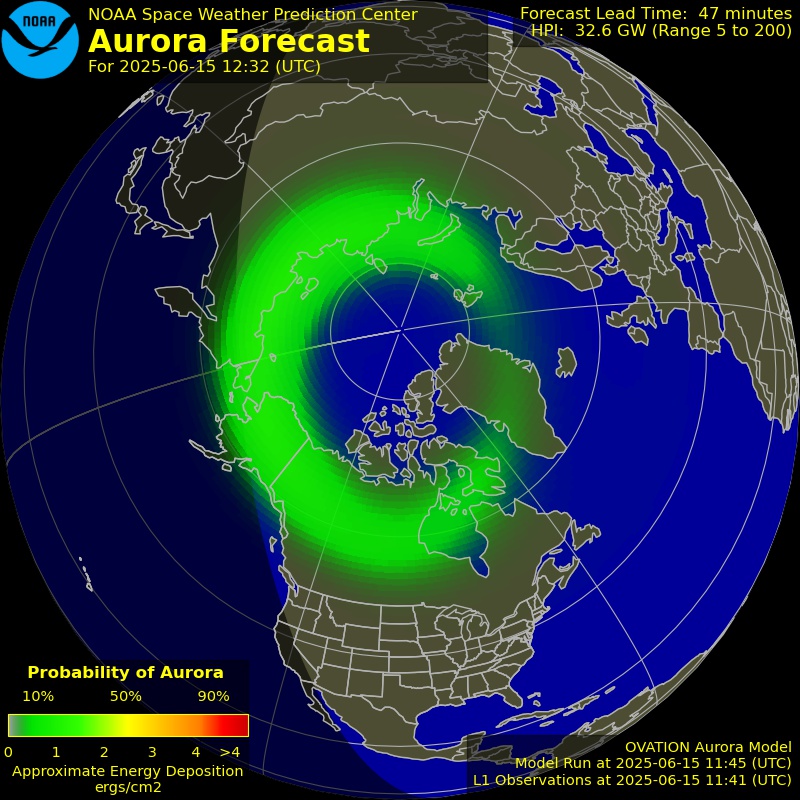
If the animation does not load, a static image will be shown.
Conditions assessment
The indicators consider your location, the local aurora chance and whether it is dark.
Kp (3h)
Kp (1 min)
Bz (GSM)
Bt (IMF)
Speed
Density
Temperature
Where to go near Vancouver
The single biggest obstacle inside city limits isn’t direction, it’s light pollution reflecting off low cloud. Local guides point to a handful of spots that combine a clear view north with some distance from downtown’s glow: Porteau Cove Provincial Park, 38 km north of Vancouver on Highway 99 toward Squamish, is the most commonly recommended option — it faces open water and the correct direction, and sits along the Sea-to-Sky corridor. Closer options like Spanish Banks, Burnaby Mountain, and Iona Beach Regional Park can work during a strong, high display, but expect meaningfully more light pollution washing out anything faint.
GUIDE
Northern Lights in Canada: Live Radar and Forecast
Northern lights in Canada: live radar, Kp thresholds for Yellowknife, Churchill and the Yukon, the season as the provinces define it, and how it compares with Scandinavia.
None of these solve the cloud problem — that’s regional, not a light-pollution issue, and driving 40 km doesn’t usually get you above or around a coastal weather system. What it buys you is a genuinely dark, unobstructed view for the nights when the sky does clear.
Escaping the clouds: Vancouver’s real bottleneck
According to Weather Spark data, Vancouver is overcast or mostly cloudy roughly 71-73% of the time from November through January — exactly the months with the longest, darkest nights. The genuinely clearer stretch runs June through September (up to 66% clear in July-August), but June and July have very little astronomical darkness at this latitude, so a clear summer sky mostly isn’t useful for aurora hunting. September is the practical sweet spot: skies are already trending clearer (56% clear per Weather Spark) while nights are dark enough again, and — as covered below — early autumn also happens to be a genuinely better time for storms, not just clearer skies.
There isn’t a simple 40 km drive that reliably fixes this the way it sometimes does inland: Vancouver’s cloud is a coastal weather-system problem, not a local light-pollution problem, so a clear night at Porteau Cove usually means a clear night across the wider region too — and vice versa.
Why the equinoxes matter more here than the calendar month
Independent of weather, the sun itself produces more of the right kind of storms around the spring and autumn equinoxes. This is a documented pattern called the Russell-McPherron effect: Earth’s magnetic field lines up more favorably with the solar wind’s magnetic field near the equinoxes, making geomagnetic storms measurably more frequent in March and September than in the summer or winter months.
For Vancouver specifically, that makes late September into early October the single best window to plan around: equinox-driven storm frequency is rising, cloud cover is already dropping from its summer high, and nights are dark enough to matter. March carries the same solar advantage but Vancouver’s cloud cover is still near its winter peak (~69% overcast per Weather Spark), which is why September edges it out as the more realistic target.
When to actually try
Putting the pieces together: aim for clear forecast nights in September, keep a secondary watch on late March if a strong storm is forecast despite the odds, and treat December-February as a near write-off regardless of Kp — the cloud, not the geomagnetic activity, is what will stop you. Check the live aurora widget above on any clear night with a Kp5+ forecast, and confirm local sky conditions with a standard weather forecast before driving out to Porteau Cove.
What you’ll actually see
On the nights it comes together — Kp5-6, clear sky, dark enough hours — expect a low glow or faint arc near the northern horizon over the water, more visible in a camera’s long exposure than to the naked eye. Genuinely bright, colorful, naked-eye displays need Kp7+ and are uncommon this far south. Treat any Vancouver sighting as a bonus rather than a plan, and keep expectations closer to “a pale glow worth the drive” than to the vivid photos that circulate after major storms.
Can you see the northern lights from Vancouver?
Occasionally, during strong geomagnetic storms (Kp5-6 or higher) and only when the sky is clear at the same time. Vancouver’s geomagnetic latitude (~54.7°N, a dipole-model estimate) puts it in the same difficulty range as Montreal, and its persistent coastal cloud cover makes the combination rarer than almost anywhere else covered on this site.
Where is the best place near Vancouver to see the aurora?
Porteau Cove Provincial Park, about 38 km north of Vancouver on Highway 99 toward Squamish, is the most commonly recommended spot — it offers a clear northern view over water with less light pollution than in-city options like Spanish Banks or Burnaby Mountain.
What is the best time of year to try in Vancouver?
Late September into early October: cloud cover is dropping from its summer low toward the clearer autumn pattern, nights are dark enough, and the autumn equinox increases geomagnetic storm frequency (the Russell-McPherron effect). December-February combines the highest storm-relevant darkness with the worst cloud cover (roughly 70-73% overcast), making it the least reliable window despite the long nights.
Why is Vancouver harder for aurora viewing than Winnipeg or Saskatoon?
Two compounding reasons: Vancouver’s geomagnetic latitude is several degrees lower, requiring roughly Kp5-6 instead of the Prairie provinces’ Kp4, and its oceanic climate produces far more cloud cover, especially in the winter months when nights are darkest.
Other Canadian provinces worth checking
Vancouver’s combination of latitude and cloud makes it one of the toughest spots in this series. If you’re willing to look elsewhere, the Prairie provinces need a much lower Kp and have drier skies:
Quebec (Montreal) shares Vancouver’s Kp5-6 threshold but without the same relentless cloud cover:
Read also
For the full national picture — live radar, the Kp scale explained, and every province and territory covered — start with the Canada hub. To check tonight’s forecast anywhere before committing to the drive to Porteau Cove, the live aurora forecast tool covers the whole hemisphere.
GUIDE
Northern Lights in Canada: Live Radar and Forecast
Northern lights in Canada: live radar, Kp thresholds for Yellowknife, Churchill and the Yukon, the season as the provinces define it, and how it compares with Scandinavia.
NORTHERN LIGHTS
Aurora Forecast Tonight: Live Northern Lights Map
Check tonight's aurora forecast with live Kp, Bz, solar-wind, cloud-cover and NOAA/OVATION signals. Use the map for your location.