

Northern Lights in Saskatchewan: Saskatoon Forecast and Where to Go
Saskatchewan markets itself harder on the northern lights than most Canadian provinces do, and the geomagnetic latitude backs it up: Saskatoon needs a somewhat weaker storm than Winnipeg to get a real display. This page gives the honest version for people near Saskatoon — the actual Kp threshold, named places to go, and why the calendar matters as much as the storm forecast.
In short: Saskatoon sits at roughly 59-60 degrees geomagnetic latitude (simple dipole estimate) — a touch further north, magnetically, than Winnipeg. Using NOAA’s rule that the auroral oval’s edge sits near 66 degrees magnetic latitude at Kp 0 and moves about 2 degrees closer to the equator per Kp step, the oval reaches Saskatoon’s latitude around Kp 3, with Kp 4-5 bringing a clearer, higher display.
Geomagnetic latitude is a simplified dipole estimate, not an AACGM-v2 calculation.
| Element | What to know |
|---|---|
| Location | 52.1°N geographic, roughly 59-60° magnetic (dipole estimate) — slightly closer to the oval than Winnipeg |
| Kp threshold | Around Kp 3 for a low display near the horizon, Kp 4-5 for a clearer show higher in the sky |
| Season | Mid-August to mid-April; Saskatchewan tourism boards themselves market October-March as the core window |
| Sky clarity | Same pattern as Manitoba: February is the cloudiest month (about 68% overcast or mostly cloudy), March and November are somewhat clearer |
| Direction | North, away from Saskatoon’s own glow |
| Nearest dark sky | Wanuskewin Heritage Park, 17 km north; Prince Albert National Park, about 229 km north, for a stronger commitment when a bigger storm is forecast |
Can you see the northern lights from Saskatoon?
Occasionally from the city’s edge, more reliably from just outside it. Saskatoon’s own lighting still washes out a faint glow low on the horizon, but the geomagnetic latitude here is close enough to the auroral oval that a Kp 3 storm can produce a low glow to the north, and Kp 4-5 puts real color higher in the sky. Storms at this strength happen a good number of times across a typical year, clustered around the spring and autumn equinoxes — the sky, not the sun, is usually what gets in the way.
Northern Lights – live radar and parameters
Parameters refresh automatically. The local aurora chance is calculated for your location (GPS or city).
Aurora oval radar – Northern Hemisphere
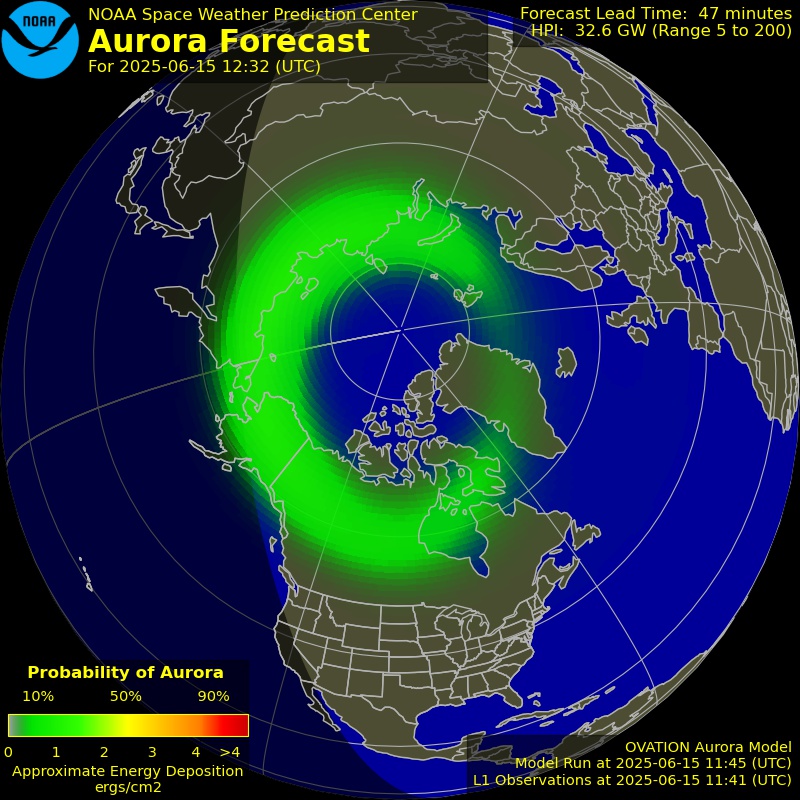
If the animation does not load, a static image will be shown.
Conditions assessment
The indicators consider your location, the local aurora chance and whether it is dark.
Kp (3h)
Kp (1 min)
Bz (GSM)
Bt (IMF)
Speed
Density
Temperature
Where to go near Saskatoon
Three real options, in order of effort:
- Wanuskewin Heritage Park — about 17 km north of the city along the South Saskatchewan River valley. The closest genuinely dark option, and it sits in the right direction: north, away from the city glow.
- Beaver Creek Conservation Area — about 13 km south of the city. Closer than Wanuskewin, but on the wrong side of Saskatoon for aurora specifically, since the city’s own glow sits between you and the northern horizon. Better for general stargazing than for a low aurora.
- Prince Albert National Park — about 229 km north. Waskesiu Lake’s beaches (Paignton Beach, South Bay, Trippes Beach) add a flat, open horizon and a lake reflection, and are worth the longer drive when a Kp 4+ storm is actually forecast, not on a whim.
Escaping the clouds
The same counterintuitive pattern shows up here as in Manitoba: Saskatoon is cloudier in the depths of winter (February runs close to 68% overcast or mostly cloudy) than in the shoulder months of November and March. Since the aurora season already stretches from mid-August to mid-April, it is worth weighting attempts toward those shoulder weeks rather than assuming January is automatically the best month just because it is the darkest one. If Saskatoon itself is socked in, a bank of cloud does not always reach as far as Prince Albert National Park, which is one more reason that drive is reserved for nights when a real storm is forecast.
What Kp index do you need here
Using NOAA’s rule that the auroral oval’s edge sits near 66 degrees magnetic latitude at Kp 0 and moves about 2 degrees closer to the equator per Kp step, Saskatoon’s roughly 59-60 degree magnetic latitude (simple dipole estimate) puts the oval’s edge over the city at around Kp 3 — a notch easier than Winnipeg. Kp 4 and 5 storms bring the display higher and more colorful. Below Kp 2, Saskatchewan is normally too far south to see anything worth the drive.
When: season, hours and moon
Saskatchewan tourism material itself markets October through March as the core season, though the real window (dark enough nights) runs from mid-August to mid-April. Inside that window, the best hours are consistent everywhere: within an hour or two of local midnight. A bright moon will not stop a strong storm from being visible but will wash out a faint one, so it is worth checking the moon phase alongside the Kp forecast when the storm is only borderline.
What you’ll actually see from Saskatchewan
At a Kp 3-4 storm from a dark spot north of Saskatoon, expect a pale green arc or glow low on the northern horizon, visible to the naked eye but noticeably more vivid in a phone camera. At Kp 5, color can extend higher and pillars become possible; overhead movement is mainly a Kp 6+ event. Setting this expectation before the drive is what keeps a modest horizon glow from feeling like a failed trip — it is a real sighting either way.
If Saskatchewan is not cooperating tonight, the same live radar and forecast tool covers every location in this guide, including neighbouring Manitoba, which needs a slightly stronger storm.
What Kp index do you need to see the northern lights from Saskatoon?
Around Kp 3 for a faint glow low on the northern horizon, and Kp 4-5 for a clearer, higher display. Below Kp 2, Saskatchewan is normally too far south of the auroral oval.
Where can you actually see the aurora near Saskatoon?
Wanuskewin Heritage Park, about 17 km north, is the closest genuinely dark spot in the right direction. Prince Albert National Park, about 229 km north, is worth the longer drive when a Kp 4+ storm is forecast.
Is winter really the best season in Saskatchewan?
Not by sky clarity. Saskatoon is cloudier in December-February (February runs close to 68% overcast) than in the shoulder months of November and March, which fall inside the same mid-August-to-mid-April aurora season.
Can you see the northern lights from inside Saskatoon?
Occasionally during a strong storm, but city lighting washes out anything faint low on the horizon, so a short drive north is usually needed.
Read also

GUIDE
Northern Lights in Canada: Live Radar and Forecast
Northern lights in Canada: live radar, Kp thresholds for Yellowknife, Churchill and the Yukon, the season as the provinces define it, and how it compares with Scandinavia.
NORTHERN LIGHTS
Aurora Forecast Tonight: Live Northern Lights Map
Check tonight's aurora forecast with live Kp, Bz, solar-wind, cloud-cover and NOAA/OVATION signals. Use the map for your location.