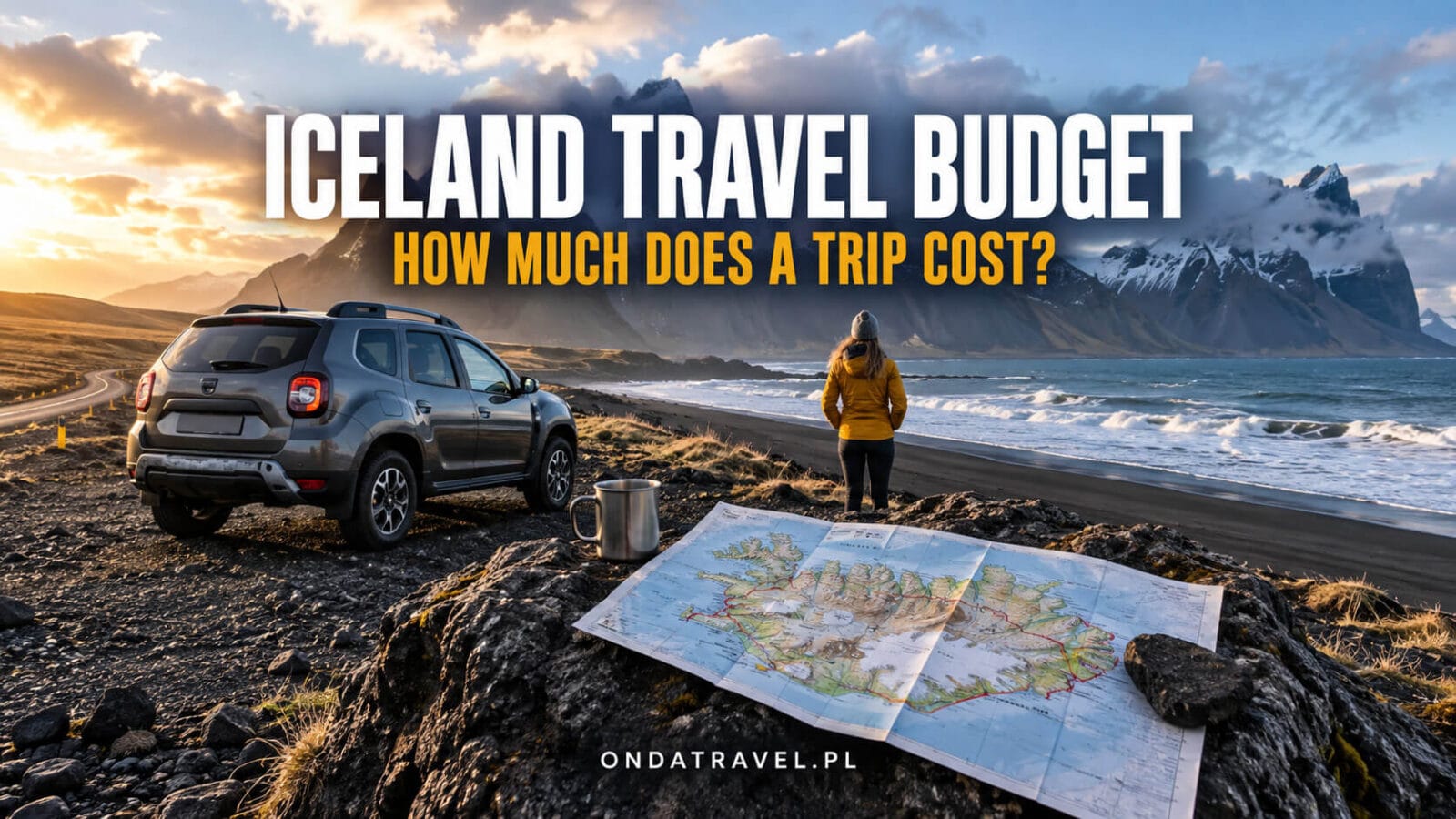
Iceland Travel Budget: How Much Does a Trip Cost and How to Save
Iceland Budget at a Glance
Iceland doesn’t have to cost a fortune, but it does require careful planning. The biggest expenses are accommodation, car rental and fuel — food and attractions can realistically be trimmed without losing trip quality.

Check out my YouTube channel and travel with me.
Follow the channel for videos, routes and practical travel inspiration.
Follow me here:
What’s up?
Enjoying my content?
Buy me a coffee at buycoffee.to/ondatravel and support the creation of more travel content.
Your support helps me create more practical guides, videos and travel inspiration.

How much does a week in Iceland really cost
Iceland is often called one of the most expensive countries in Europe to visit — and that’s true, but the scale of your spending depends mainly on your travel style, not simply on being in the country. The ranges below are costs per person, per week, excluding flights (flight prices vary seasonally and are worth checking separately).
- Budget (approx. 56,000 ISK/week): camping or a hostel with a shared kitchen, self-catering, an economy car split between several people, free attractions (waterfalls, hiking trails).
- Mid-range (approx. 126,000 ISK/week): a guesthouse or private room, some meals out (especially lunch — cheaper than dinner), 1–2 paid attractions on the itinerary.
- Comfort (approx. 245,000 ISK/week): 3–4* hotels, restaurant dinners, guided tours (e.g. into a volcano, on a glacier), a higher-class rental car.
These amounts don’t include the flight ticket or the airport transfer — more on that in the accommodation and transport section. Approximate rate: about 100 ISK ≈ 3 PLN, but always check the current rate just before you travel, since the Icelandic króna can fluctuate.
Fuel and the new per-kilometre charge (2026)
Since 1 January 2026, Iceland has had a new road-charge system — kílómetragjald, a per-kilometre charge (6.95 ISK/km for passenger cars) that has replaced most of the previous fuel excise duty. It’s a major change that’s still rarely mentioned in English-language guides, and it directly affects the cost of renting and returning a car — rental companies usually bill it automatically based on kilometres driven, so it’s worth checking the contract before you sign.
Fuel prices at the pump remain high — according to the gsmbensin.is comparison site (checked 29 August 2026), petrol cost about 201 ISK/l and diesel about 234 ISK/l at Orkan stations. It’s worth comparing prices between stations before filling up — differences can reach several ISK per litre, and on a longer route that adds up to a real difference in your budget.
Food, groceries and alcohol
Food is one area where the difference between a budget approach and eating out for every meal is huge. Cooking for yourself in a campsite or guesthouse kitchen can cut food costs by as much as half. The main budget supermarkets are Bónus and Krónan — it’s worth doing your main shopping there rather than at the smaller shops by petrol stations, where prices are noticeably higher.
In Iceland, alcohol is sold only in state-run Vínbúðin shops (aside from low-alcohol beer, available in regular supermarkets) — prices are high and opening hours are limited, so plan your shopping in advance, not for the evening. Bringing alcohol in from abroad is subject to customs limits (a 6-unit system) — check the current limits before you travel, as they vary by type of drink.
Tap water in Iceland is safe to drink and high quality — there’s no need to buy bottled water, which by itself is a real saving over a week.
Card payments and the DCC trap
Iceland is an almost entirely cashless country — you pay by card practically everywhere, including public toilets and parking meters. Cash can even be a hassle, since some places simply don’t accept it. Even so, it’s worth knowing your card’s PIN — some terminals, especially at petrol stations, require it instead of contactless authorisation.
What to watch out for: the payment terminal will often ask whether you want to pay in ISK or in your home currency (PLN/EUR) — this is so-called DCC (Dynamic Currency Conversion). Choosing your home currency almost always means a worse exchange rate set by the terminal, not by your bank. Always choose to pay in ISK — your bank will handle the conversion anyway, usually at a better rate.
Tipping isn’t expected in Iceland — the price on the receipt is the final price. If you’re shopping tax-free, the VAT refund threshold is 12,000 ISK per receipt (Skatturinn, the official threshold).
Entry tickets and parking fees
Most of Iceland’s best-known natural attractions (waterfalls, beaches, viewpoints) are free to visit — you mainly pay for parking, not entry. Parking fees at popular spots usually range from 200 to 1,200 ISK, depending on the location and how long you stay. Payment is usually made through an app or a card machine — keep your phone charged and a tested app (e.g. Parka) installed before you reach an area with poor signal.
Not paying for parking at a signposted spot can end with a fine sent by post to the rental company, and then charged to your card — so it’s better to pay right away, even if the stop seems short.
Accommodation and the accommodation tax
Since 1 January 2025, Iceland has charged an accommodation tax (gistináttaskattur) of 800 ISK per night per room/sleeping unit — usually added automatically to the bill, but worth checking at booking time to avoid surprises on arrival. Accommodation is usually the single largest line item in the budget — camping and hostels with a shared kitchen can cost several times less than hotels in Reykjavík or along popular routes.

READ ALSO
Want the full picture? See the complete guide: Reykjavík: the capital of Iceland, what to see and how much time you need.
How to actually save money without losing quality
- Do your main shopping at Bónus or Krónan, not at petrol stations.
- Cook at least some of your meals yourself — even one less day of “eating out” makes a difference over a week.
- Always pay by card in ISK, and never accept currency conversion (DCC) at the terminal.
- Drink tap water instead of buying bottled.
- Book popular attractions (e.g. Sky Lagoon, Blue Lagoon) online in advance — prices are sometimes lower than on-site, and you’re guaranteed entry.
- Split the car and fuel among more people if you’re travelling as a group — the cost per person drops proportionally.
- Instead of the expensive lagoons (Blue Lagoon, Sky Lagoon), try a regular sundlaug — a public geothermal pool used by locals, which costs a fraction of the price and gives a very similar hot-water relaxation experience.
- Get an e-SIM instead of roaming — a few-GB package for a week is usually inexpensive and is plenty for navigation and basic connectivity.
What’s not worth skimping on: car insurance (Icelandic roads and weather can catch you out) and proper rain and thermal gear — buying poor-quality gear locally doesn’t end up cheaper, and it ruins the comfort of the whole trip.
Frequently asked questions
How much does a week in Iceland really cost?
From about 56,000 ISK per person on a budget trip (camping, self-catering) to about 245,000 ISK on a comfort trip (hotels, restaurants, guided tours) — excluding the flight.
What is Iceland’s new per-kilometre charge?
Since 1 January 2026, Iceland has charged kílómetragjald — a fee of 6.95 ISK per kilometre for passenger cars, replacing most of the previous fuel excise duty. Rental companies usually bill it automatically based on kilometres driven.
How do I avoid an unfavourable currency conversion when paying by card?
At the terminal, always choose to pay in ISK, not in your home currency. Choosing your own currency (DCC) almost always means a worse rate set by the terminal.
Do you have to pay to enter natural attractions?
Most waterfalls, beaches and viewpoints are free — you mainly pay for parking, usually 200 to 1,200 ISK, via an app or a card machine.
Is there an accommodation tax in Iceland?
Yes, since 1 January 2025 there’s a gistináttaskattur — an accommodation tax of 800 ISK per night, usually added automatically to the bill.
Is a campervan cheaper than renting a car and staying in a hotel?
Not necessarily — traveller reports suggest a campervan (especially a 4×4 with insurance) can be pricier than a car plus a guesthouse room booked in advance. Choosing a campervan mainly makes sense for flexibility and the van-life experience, not always for pure savings — it’s worth comparing both options for your specific dates.
Plan the rest of your trip: check the Iceland hub with the full topic map, the ready-made 7-day Iceland itinerary, and the guide to hot springs and geothermal pools, so you can match your budget to a specific route.

ICELAND HUB
Iceland — main guide to routes and regions
The complete Iceland guide: routes, regions, practical guides and the key decisions to make before you go.
See also the detailed guide to card payments, cash and VAT refunds in Iceland (Polish-language page — an English version is not yet published) — you’ll find out how much an ATM withdrawal costs and how to avoid the DCC trap.


Hi, I’m Krystian “dziadzia przewodnik” from OndaTravel.pl!
The North is my greatest passion, but the world is far too beautiful to stay in just one climate. On my blog, I combine the raw landscapes of Iceland and Norway with the exotic energy of Thailand or Vietnam, showing you how to travel authentically — with passion and a camera in hand.
What will you find on OndaTravel.pl?
Visual storytelling: As a photographer and filmmaker, I don’t just describe places — I take you there with professional photos and video.
North expert: Ready-to-use road trip plans for Iceland and Norway, smart tips for budget travel, and my original Northern Lights Radar (locations and forecast).
Travel through the lens of cinema: I track down filming locations — from icy scenes in Interstellar to tropical frames from world cinema.
New direction: Exotic destinations: I love contrast, so the blog is featuring more and more practical knowledge about Vietnam and Thailand. I’ll show you how to find your way around Southeast Asia and come back with your best memories.
P.S. follow me here


Author
Krystian „dziadzia przewodnik”The North is my greatest passion, but the world is too beautiful to stay in one climate. On my blog I combine the raw nature of Iceland and Norway with the exotic energy of Thailand and Vietnam, showing you how to travel authentically, with passion and a camera in hand.