


Thrihnukagigur – The Only Volcano in the World You Can Descend into by Elevator! – Iceland
Thrihnukagigur – in brief
Thrihnukagigur is one of the most unusual attractions in Iceland: a descent into the inside of a dormant volcano. The experience requires a booking, the right season and a readiness for a higher cost, but for many people it is one of the most memorable things to do near Reykjavik.
Iceland volcano guide – Reykjanes, Reykjavík and Inside the Volcano
Thrihnukagigur (Þríhnúkagígur) is the only volcano in the world where visitors can descend by lift into a solidified magma chamber. Near Reykjavík, the experience combines a hike across lava fields with a 120 m descent into the crater, making it one of Iceland’s most unusual volcanic attractions.
To connect this topic with a wider northern travel plan, see the North section.

NORTH
North: Iceland, Norway, northern lights and Lofoten
A dedicated OndaTravel section for northern trips: Iceland, Norway, fjords, Lofoten, northern lights, ready-made routes and planning tools.

Thrihnukagigur, often called the “Icelandic Underground Cathedral”, is a place wrapped in legend and scientific fascination. The story of its discovery and how it was opened to visitors is a mix of chance, courage and long-term vision.
Quick start: Þríhnúkagígur – the volcano elevator near Reykjavík
This is the only place in the world where you descend by lift into an empty magma chamber. It works best as an easy add-on from Reykjavík or as part of a wider day in southwest Iceland.
- Requirements: moderate fitness and proper hiking shoes for uneven lava terrain.
- Related topics: Reykjanes – volcanoes and geothermal landscapes and Fagradalsfjall / Grindavík eruption updates.
- After the tour: if you want a geothermal finish, see hot springs near Reykjavík.
- Trip planning: if this is your first Iceland trip, connect this stop with Iceland in 4 days or Iceland in 7 days.
Iceland section: Travel → Iceland · Main guide: Iceland travel guide · Regional section: Reykjanes · Base: Reykjavík

ROUTE PLANNING
Iceland travel guide — connect Reykjanes with your route
Thrihnukagigur is easiest to plan as part of a wider Iceland route. Open the main guide to connect Reykjanes, Reykjavík, hot springs, volcanoes and day-by-day itinerary ideas.
Related posts: Grindavík / Fagradalsfjall eruptions · Arnarker lava cave · hot springs near Reykjavík
Practical information: season, duration, hike, age and what to bring
- Season: the operator usually runs tours from May 5 to October 30, but always confirm the current dates before booking.
- Duration: the full experience usually takes 5–6 hours with pickup and drop-off, or around 4 hours if you drive to the meeting point yourself.
- Hike: about 3 km / 2 miles each way across lava terrain; it usually takes 45–50 minutes, with a short steeper section near the end.
- Descent and chamber time: the lift goes down about 120 m; the ride itself takes around 7 minutes, and you usually spend about 30 minutes inside.
- Who it suits: moderate fitness is required; the operator describes the difficulty as roughly 2/5. The current child rate usually applies to ages 8–12.
- What to bring: good hiking shoes, warm layers, something windproof and waterproof, and your camera.


Hi, I’m Krystian “dziadzia przewodnik” from OndaTravel.pl!
The North is my greatest passion, but the world is far too beautiful to stay in just one climate. On my blog, I combine the raw landscapes of Iceland and Norway with the exotic energy of Thailand or Vietnam, showing you how to travel authentically — with passion and a camera in hand.
What will you find on OndaTravel.pl?
Visual storytelling: As a photographer and filmmaker, I don’t just describe places — I take you there with professional photos and video.
North expert: Ready-to-use road trip plans for Iceland and Norway, smart tips for budget travel, and my original Northern Lights Radar (locations and forecast).
Travel through the lens of cinema: I track down filming locations — from icy scenes in Interstellar to tropical frames from world cinema.
New direction: Exotic destinations: I love contrast, so the blog is featuring more and more practical knowledge about Vietnam and Thailand. I’ll show you how to find your way around Southeast Asia and come back with your best memories.
P.S. follow me here
How to combine Þríhnúkagígur with Reykjanes and Reykjavík in one trip plan
If you stay in Reykjavík, treat Þríhnúkagígur as the strongest geological highlight on the edge of the capital area and Reykjanes. It is not an isolated curiosity — it fits naturally into a wider southwest Iceland route.
- Option 1: a half-day trip from Reykjavík — the volcano descent itself, then city sightseeing in the evening.
- Option 2: a “volcano day” on Reykjanes — Þríhnúkagígur first, then other regional stops or a relaxing finish in hot springs near Reykjavík.
- Option 3: your first Iceland trip — place this attraction inside a ready-made route like Iceland in 4 days or Iceland in 7 days.
- For lava and geology fans: combine this post with Arnarker and the report from Fagradalsfjall / Grindavík to see a broader volcanic picture of Reykjanes.
Most logical internal-link path: Travel → Iceland → Iceland section → Reykjanes → Þríhnúkagígur.


The Þríhnúkar volcanic cone erupted three times.
The youngest crater formed in that cluster is Þríhnúkagígur.
Þríhnúkagígur, commonly simplified in English as Thrihnukagigur, literally means the “crater of the three peaks”. It is a dormant volcano that last erupted around 4,000 years ago.
Þríhnúkagígur is a unique, enormous lava crater hidden beneath Þríhnúkarnir, on the edge of the Bláfjöll area near the ski slopes, about 20 km from Reykjavík.
The name Þríhnúkagígur is usually translated as the “Crater of the Three Peaks”. It comes from the Icelandic words Þrír (three), hnúkar (peaks / knolls) and gígur (crater). The name refers to the three distinct peaks surrounding the volcano.
The volcano belongs to the Brennisteinsfjöll volcanic system near Reykjavík, the capital of Iceland. From a trip-planning perspective, this post works best when read together with my guides to Reykjanes, Reykjavík and a ready-made route like Iceland in 7 days.
The most fascinating aspect of Þríhnúkagígur is that its magma chamber was effectively drained after the eruption — the lava flowed away, leaving behind a vast empty space.
History of Discovery: From Risky Expedition to Tourist Sensation
Thrihnukagigur owes its fame to Árni B. Stefánsson, the Icelandic explorer who in the 1970s was the first to descend into the chamber on ropes. His dream was to “make hell accessible to tourists” — and after 38 years of preparation (in 2012) he made it happen. Today the volcano is visited by thousands of people every year, and Stefánsson is a local legend.


Key milestones in the story:
First explorations (1970s):
A local guide and explorer, Árni B. Stefánsson, was one of the first to investigate the mysterious crater near the Bláfjöll ski area close to Reykjavík. Although the volcano last erupted 4,000 years ago, its magma chamber did not collapse — which is rare — leaving a unique empty space deep underground.
Scientific breakthrough (1974):
Árni B. Stefánsson, together with a team of climbers and geologists, descended 120 meters on ropes into the Þríhnúkagígur crater and discovered the spectacular multi-coloured walls of the chamber. That was the moment when the idea of opening this place to the world was born.
Long years of preparation:
For decades, engineers and geologists worked on chamber stability and safety systems.
In 2010, a documentary about the volcano was filmed by National Geographic.
Only in 2012 — 38 years after the discovery — was Thrihnukagigur opened to visitors, with the special lift that now takes people into the heart of the volcano.
Project idea:
In 2004, Árni B. Stefánsson, Björn Ólafsson and Einar K. Stefánsson founded “Þríhnúka ehf.”, a company created to explore how this extraordinary place could be opened to the public while preserving its natural value and integrity.
Why was this discovery so groundbreaking?
Unique geology: Most volcanoes seal or collapse their magma chambers after eruption. Thrihnukagigur is the only known place where you can see such a large open chamber from the inside.
A risky mission: The first explorers descended on ropes into the unknown — today the lift and viewing platforms make the experience far safer and more comfortable.
Stefánsson’s vision: The Icelandic explorer dreamed of making this hidden underworld accessible to visitors, and that idea now draws thousands of people every year.
Quick facts for curious travellers:
Chamber depth: 120 m — roughly the height of a 40-storey building.
Rock colours: red (iron), black (basalt) and gold (sulphur), created by chemical reactions between magma and air.
Name: “Þríhnúkagígur” means “the crater of the three peaks” in Icelandic, referring to the shape of the volcano.

Why is it Worth Visiting Thrihnukagigur?
- The only attraction of its kind in the world
No other volcano lets you descend by lift into a magma chamber. It really does feel like a journey into the Earth. - Extraordinary colours and rock formations
The chamber walls glow with shades of red (iron oxides), black (solidified lava) and gold (sulphur). It looks like a science-fiction set. - Safety and accessibility
You do not need climbing gear — the lift and viewing platforms make the experience organized and controlled. The current child rate usually applies to ages 8–12, but always check the latest operator rules. - A live geology lesson
The guides — often with a strong geology background — explain how Iceland’s volcanoes work and how this landscape was formed.
PHOTO COPYRIGHTS: Inside the Volcano
Base Camp

The Base Camp at Thrihnukagígur, 206 Hafnarfjörður, Iceland, is the key starting point for the entire journey into the volcano. Here is what matters most:
Meeting and preparation point:
This is where participants gather. On arrival, there is a short briefing during which the guides explain safety procedures, the key rules and the plan for the whole excursion.
Start of the hike:
From the base camp, visitors set off on an approximately 3 km walk (one way) across lava fields. This part of the route introduces you to Iceland’s raw volcanic landscape before you reach the lift that descends into the volcano.
Educational and logistical role:
The base camp also works as an information point where you can learn more about the geology, the region and the volcano itself. On-site boards or short briefings help prepare visitors for one of the rarest magma-chamber descents in the world.
Seasonality:
Tours usually run from May 5 to October 30, but always check the current operating dates with the operator before booking.
Descent into the volcano:
The open lift descends about 120 metres into the magma chamber.
Prices:
Adults: ISK 51,000 (indicative price, subject to change)
Children (8–12): ISK 25,000 (indicative price, subject to change)
Tour operator: 3H-Travel
In short, the base camp is where the experience begins: visitors are prepared, informed and then led into a striking volcanic landscape on the way to the chamber descent.
The official Inside the Volcano website, where you can book the tour, is here.

Fun Facts about Þríhnúkagígur / Thrihnukagigur
In August 2015, members of the Icelandic band Kaleo and fourteen members of the support team descended into the magma chamber and recorded a live version of “Way Down We Go”.
In 2016, the organisers of the Secret Solstice festival announced that alternative-rock musician Chino Moreno of Deftones would perform the first public concert inside a volcano’s magma chamber.
Active volcanoes of Iceland – eruptions on the Reykjanes Peninsula
Iceland is a land of volcanoes. Even though Þríhnúkagígur itself is visited as a dormant magma chamber, the whole southwest remains geologically active. The eruption series on Reykjanes has continued since 2021, the most recent ended episode in the Sundhnúkur area took place in the summer of 2025, and the Icelandic Meteorological Office says that magma is still accumulating beneath Svartsengi, making a new intrusion or eruption the most likely scenario. Read this article together with my guide to Reykjanes, the post about Fagradalsfjall / Grindavík eruptions, and the practical guide to Reykjavík as a base. Before your trip, always check the latest notices from IMO and Visit Reykjanes.

March 2024 eruption: On 16 March, a fissure about 3 km long opened between Stóra-Skógfell and Sýlingarfell, threatening the town of Grindavík. The eruption lasted until 9 May 2024.
May 2024 eruption: On 29 May, another eruption began and the fissure expanded to about 3.4 km. It lasted 24 days and ended on 22 June.
November 2024 eruption: On 20 November, an eruption began at Sundhnúkagígar, opening a fissure about 2.5 km long. The event led to the evacuation of around 60 Grindavík residents.
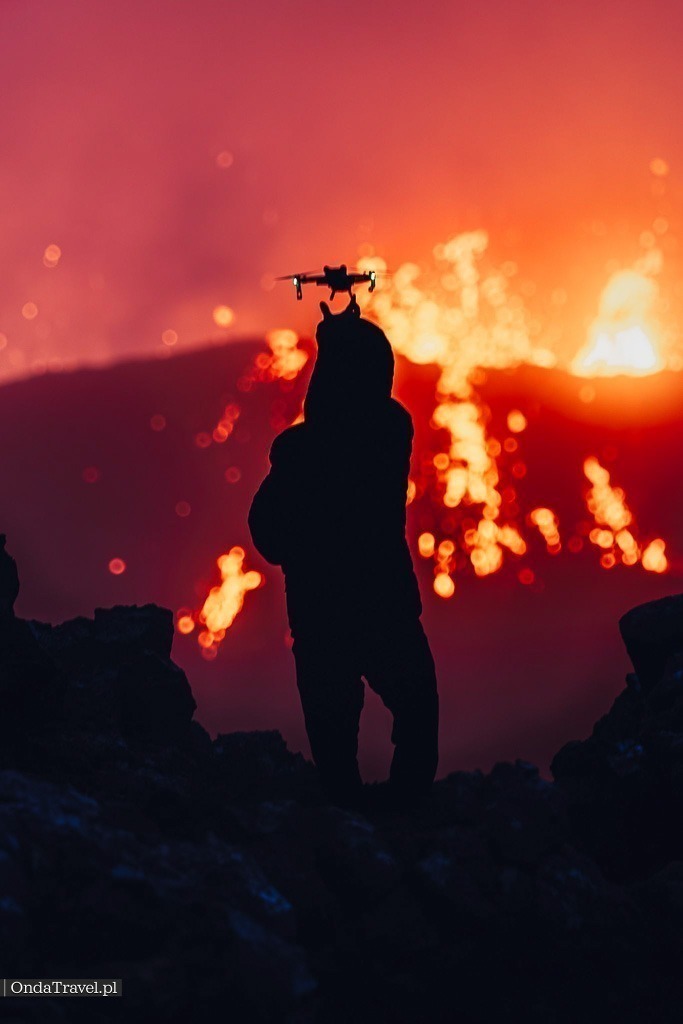
Whenever an eruption starts in Iceland, I usually launch a livestream on the OndaTravel YouTube channel.
At the beginning of 2025, scientists also noted increased seismic activity around Bárðarbunga beneath the Vatnajökull glacier. Observations like this are a reminder that Iceland remains one of the most geologically active places in Europe, so it is always worth checking the latest IMO notices before your trip.
These events are a reminder of Iceland’s constant geothermal activity and the kind of natural drama that draws travellers from around the world. If you want more route ideas, broader destination planning and more Iceland highlights, continue through my main Iceland content here.
Volcanoes and earthquakes are part of everyday Icelandic geography.
I also recommend Ferlir.is and the article Þríhnúkagígur – fyrirhugað aðgengi if you want more background on the discovery of the volcano.
Icelandic Volcanoes – Complete Guide to the Island’s Active Volcanoes

Active Volcanoes of Iceland and the Regions Where They Occur
- Eyjafjallajökul
- Location: Southern Iceland (63.63°N, 19.62°W), beneath the glacier of the same name.
- Last Activity: 2010 (explosive eruption that disrupted air traffic in Europe).
- Details: Known for phreatomagmatic eruptions caused by the interaction of water and magma.
- Katla
- Location: South, under the Mýrdalsjökull glacier (63.63°N, 19.05°W).
- Last Activity: 1918 (major eruption), suspected smaller activity in 1955 and 1999 (unconfirmed).
- Details: Its eruptions can trigger jökulhlaup glacial floods. It is considered one of Iceland’s most dangerous volcanoes.
- Hekla
- Location: Southern Iceland (63.98°N, 19.70°W).
- Last Activity: 2000 (a 12-day eruption).
- Details: Often nicknamed the “Gateway to Hell”. It produces mixed eruptions — both explosive and effusive.
- Grímsvötn
- Location: Under the Vatnajökull glacier (64.42°N, 17.33°W).
- Last Activity: May 2021 (short but intense eruption).
- Details: The most active volcano in Iceland. Its eruptions are often linked with glacier melt.
- Bárðarbunga
- Location: Central Iceland, under Vatnajökull (64.64°N, 17.56°W).
- Last Activity: 2014–2015 (a six-month eruption with extensive lava flows).
- Details: The second-highest volcano in Iceland. Its eruption produced the country’s largest lava field since the 18th century.
- Fagradalsfjall
- Location: Reykjanes Peninsula (63.89°N, 22.27°W).
- Last Activity: 2021 (a six-month eruption), 2022 (a three-week eruption), 2023 (a short eruption in July).
- Details: Part of the Krýsuvík volcanic system. Known for effusive eruptions with spectacular lava fountains.
- Askja
- Location: Central Highlands (65.03°N, 16.75°W).
Last Activity: 1961 (a minor eruption).Details: A caldera filled by Lake Öskjuvatn. The major 1875 eruption influenced emigration from Iceland.
- Location: Central Highlands (65.03°N, 16.75°W).
- Öræfajökull
- Location: Southeast, under the Vatnajökull glacier (64.00°N, 16.65°W).
Last Activity: 1727–1728 (a destructive eruption).Details: The highest peak in Iceland (2,110 m). It is currently monitored because of increased seismic activity.
- Krafla
Location: Northeastern Iceland (65.73°N, 16.78°W).Last Activity: 1984 (the last event in an eruption series that ran from 1975 to 1984).Details: Known for its geothermal field and power plant.
- Reykjanes
- Location: Reykjanes Peninsula (63.88°N, 22.50°W).
Last Activity: 2021–2025 (an eruption series on the peninsula, with the latest ended episode in the Sundhnúksgígar area occurring in July–August 2025).Details: Volcanic system associated with the Mid-Atlantic Rift. Frequent earthquakes.
- Location: Reykjanes Peninsula (63.88°N, 22.50°W).
- Hengill
- Location: Southwest (64.18°N, 21.33°W).
Last Activity: around AD 150–200.Details: An active geothermal system used for power production.
- Location: Southwest (64.18°N, 21.33°W).
Quick facts:
Iceland has around 30 active volcanic systems.
Subglacial eruptions (for example Grímsvötn) often generate ash and glacial floods.
Volcanoes on the Reykjanes Peninsula (for example Fagradalsfjall) are currently among the most active areas.- Þríhnúkagígur volcano Iceland
- Iceland volcano tourist attraction
- volcano elevator descent Iceland
- Þríhnúkagígur travel guide
- Iceland Þríhnúkagígur volcano
FAQ: Þríhnúkagígur / Inside the Volcano
How long does the Þríhnúkagígur tour take?
Usually 5–6 hours with pickup and return. If you drive to the meeting point yourself, the whole experience usually takes around 4 hours.
What is the minimum age for the volcano descent?
The child rate usually applies to ages 8–12, but always check the latest operator rules before booking.
Do I need climbing experience?
No. This is an organised tour: you get a helmet and harness, and the descent is by lift. The biggest requirement is a moderate walk across uneven lava terrain.
What should I wear and bring?
Bring hiking shoes, warm layers, and windproof / waterproof outerwear. The weather near Bláfjöll can change quickly.
Does the tour run in winter?
Usually not. The standard operator season most often runs from May 5 to October 30, so in winter you need to look at other geological attractions or lava caves instead.
Read also / next
If you are planning Reykjanes, Reykjavík and your first route around Iceland, continue through this internal-link path:
- Travel → Iceland – the content map for the whole destination and the clearest starting point.
- Iceland section – the key regions, routes and first-trip planning basics.
- Reykjanes – the regional section this post should feed into naturally.
- Reykjavík – the easiest base for a trip to Þríhnúkagígur.
- Iceland in 4 days – the shorter option for a first trip.
- Iceland in 7 days – a broader road-trip option with more major stops and more time to connect regions.
- Hot springs near Reykjavík – a natural way to finish the day after the volcano descent.
- Arnarker – another Reykjanes geology stop that fits this theme perfectly.
- Fagradalsfjall / Grindavík – the post that shows the active, modern volcanic face of Reykjanes.
The simplest path for users and SEO: Iceland → Reykjanes → Reykjavík → Þríhnúkagígur → hot springs / active volcanoes / ready-made itineraries.
Hi, I’m Krystian “dziadzia przewodnik” from OndaTravel.pl!
The North is my greatest passion, but the world is far too beautiful to stay in just one climate. On my blog, I combine the raw landscapes of Iceland and Norway with the exotic energy of Thailand or Vietnam, showing you how to travel authentically — with passion and a camera in hand.
What will you find on OndaTravel.pl?
Visual storytelling: As a photographer and filmmaker, I don’t just describe places — I take you there with professional photos and video.
North expert: Ready-to-use road trip plans for Iceland and Norway, smart tips for budget travel, and my original Northern Lights Radar (locations and forecast).
Travel through the lens of cinema: I track down filming locations — from icy scenes in Interstellar to tropical frames from world cinema.
New direction: Exotic destinations: I love contrast, so the blog is featuring more and more practical knowledge about Vietnam and Thailand. I’ll show you how to find your way around Southeast Asia and come back with your best memories.
P.S. follow me here



Sorry, the comment form is closed at this time.