


Northern Lights in Poland in July 2026: When Are the Best Chances to See the Aurora?
AURORA ALERT (Poland) • Last updated: 5 July 2026, 22:14 CEST • Sources: NOAA SWPC, SIDC/STCE, Met Office
ACTIVE MONITORING — night of 5–6 July 2026: NOAA recorded K=4 at 19:59 CEST. This is an active level, still below the G1 storm threshold. For 5–6 July, NOAA still considers G1 likely, with a chance of an isolated G2 interval.
Do not head out based only on the forecast Kp. For Poland, the decisive signal is a real strengthening of the solar wind and magnetic field together with sustained southward Bz. A new Type II radio emission with an estimated speed of 959 km/s and a later M5-class flare require further analysis, but they do not yet confirm a new Earth-directed CME.
Northern Lights in Poland in July 2026 — how to use this live report
| Post mode | Live report updated when the situation changes materially |
| Decision to go out | Only after changes are confirmed in live data |
| Biggest limitation | Short and very bright July night |
| Best direction | A dark site with an open view to the north |
Latest aurora alerts: updates and quick decisions for tonight
Below is an automatic list of the latest posts from the Aurora alertscategory. Each alert links to the radar and explains whether it is realistically worth chasing the aurora in Poland.
If you want to combine aurora forecasts with a real travel plan, also see the Northsection, where I have collected Iceland, Norway, the Lofoten Islands, fjords and the most important northern destinations for aurora viewing.


Current guide for this month:
Latest guides
What to watch in the sky in July and August 2026?
Check two current observing calendars: summer noctilucent clouds, the Moon, the Milky Way, meteor showers, the Perseids and the August eclipses.
Updates (added as the situation develops)
Rule: new updates are added at the top of the list. Each entry has its own timestamp and forms part of this live report.
— another M1.4 follows the strong M5-class flare
5 July brought a whole series of additional M-class flares. The most important events included M2.7 at 07:39 CEST, M1.4 at 18:45 CEST, a strong M5-class flare peaking at 19:57 CEST and another M1.4 at 21:07 CEST. The main source of activity remains AR4479, now very close to the Sun’s western limb.
— NOAA records K=4 and active monitoring resumes
K=4 means active conditions, but not yet a G1 geomagnetic storm. NOAA’s K=4 warning remains in force until 05:00 CEST on 6 July. Poland still needs a further increase in activity and a favourable, southward Bz during the short nighttime observing window.
— strong M5-class flare from region AR4479
NOAA’s alert product classified the event as M5.5, while the edited event report lists M5.3. For that reason, this live report describes it as an M5-class flare. The event reached R2 level, but a flare by itself does not automatically mean a CME or aurora on Earth.
— new Type II radio emission with an estimated speed of 959 km/s
NOAA recorded a Type II radio emission associated with a shock wave in the solar corona. The event report also noted an earlier eruption from region AR4479. This is an important sign of a possible CME, but at this stage there is no official confirmation of a new Earth-directed ejection. This event should not automatically be linked to the later M5-class flare.
— new region AR4482 produces an X1.3 flare
NOAA confirmed a strong R3 radio blackout, a Type II emission with an estimated speed of 2714 km/s and a 10 cm radio burst peaking at 890 sfu. Later coronagraph analysis showed, however, that the associated CME was travelling on a trajectory beyond Earth’s orbit and an impact on our planet is not expected.
— Earth reaches G3 level and Kp rises to 7
The storm was driven by prolonged southward Bz, which fell to around −19 nT. Bt increased to about 24.5 nT, while solar-wind speed reached around 637 km/s. The favourable magnetic-field orientation was the main factor strengthening the magnetosphere’s response.
Full guide
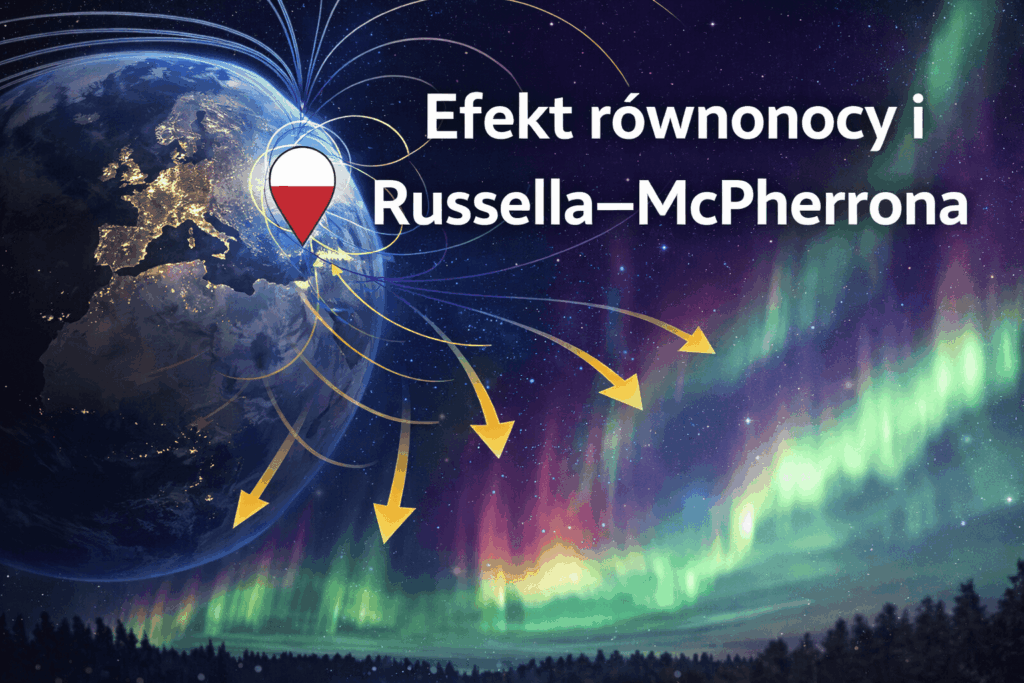
The equinox effect and the Russell–McPherron effect
The equinox effect and the Russell–McPherron effect are two key mechanisms that explain why Earth’s geomagnetic activity increases near the equinoxes and weakens closer to the solstices. They help explain the seasonality of magnetic storms, increased technological risk at certain times of year and why the periods around March and September are so important in space weather.
Is the night dark enough for the Northern Lights in July?
- Northern Poland: in early July the sky remains bright throughout the night, so a weak aurora can disappear in the twilight glow.
- Darkest part of the night: this is when observations are most worthwhile, but its duration depends on latitude and the exact location.
- Northern horizon: should be as clear as possible, without city glow, fog or low cloud.
- Camera or phone: a longer exposure can record subtle colours before the human eye can see them.
Project support
Check out my YouTube channel and follow OndaTravel.pl for more travel guides, routes and Northern Lights updates. If you enjoy my content, you can also buy me a coffee and support the creation of new materials.
What is happening on the Sun right now?
- AR4479: the region near the Sun’s western limb remains very active. On 5 July it produced another series of M-class flares, including M2.7, several M1 events and a strong M5-class flare peaking at 19:57 CEST.
- New eruption and Type II: NOAA recorded a Type II radio emission with an estimated speed of 959 km/s and an earlier eruption from AR4479. This is an important sign of a possible CME, but its direction toward Earth has not yet been confirmed.
- AR4482 and the X1.3 flare: NOAA analysed the CME associated with the 4 July event. Its trajectory passes beyond Earth’s orbit and an impact from this particular ejection is not expected.
- Most important question: now concerns not the class of subsequent flares themselves, but the coronagraph-analysis results for the new eruption and whether any new CME has an Earth-directed component.
For aurora observers, the entire chain of events matters: the eruption on the Sun, the CME’s actual trajectory, the time it reaches the L1 point, and only then the magnetic-field parameters and the response of Earth’s magnetosphere.
Will the Northern Lights be visible in Poland tonight? Forecast for 5–6 July 2026
On the evening of 5 July, conditions remain active, but there is still no basis for declaring a certain aurora in Poland. NOAA recorded K=4 at 19:59 CEST. In the current forecast, G1 is likely on 5–6 July and an isolated G2 interval remains possible. The Met Office still allows for the later arrival of another CME, but stresses low confidence in both its timing and whether it will arrive at all.
- Actual conditions: K=4 was reached at 19:59 CEST. This is an active level, still below the G1 geomagnetic-storm threshold.
- Key NOAA forecast window: for 23:00 CEST on 5 July to 02:00 CEST on 6 July, Kp 4.67 is forecast, which is the G1 threshold. Treat this as a period for heightened monitoring, not as a guarantee of aurora.
- CME uncertainty: The Met Office still allows for another arrival later on 5 July UTC. If an impact actually occurs, G1–G2 intervals are possible, with a small chance of an isolated G3 period.
- For Poland: live data will be crucial — an increase in Bt, sufficiently strong and sustained southward Bz, the response of magnetometers and the actual extent of the auroral oval during the short window of darkness.
The status therefore remains unchanged: active monitoring, not an aurora alarm. K=4 alone, forecast G1 conditions or new flares are not yet sufficient reason to head out to dark skies.
When and what time should you look for the Northern Lights in July 2026?
If you are asking when the Northern Lights may be visible in Poland and what time to look at the sky, this schedule shows when to move from passive forecast watching to active data checks. It does not predict the exact time the aurora will appear.
- Evening of 5 July: K=4 has already been reached. Check whether speed, density and Bt increase further and whether Bz begins to remain clearly southward.
- Around 23:00–02:00 CEST: this is currently NOAA’s highest forecast interval, with Kp 4.67 at the G1 threshold. Treat it as a period for intensified data checks, not as a predicted time for the aurora to appear.
- Night of 5–6 July: move to observing the northern horizon only when favourable solar-wind parameters persist and are confirmed by the response of Earth’s magnetosphere.
- 6 July: G1 remains likely and an isolated G2 interval is possible. Without a new strong impulse, activity should then gradually weaken.
Do not wait only for the final Kp value. This index describes activity over time intervals, so in a rapidly changing situation the solar-wind parameters and magnetometers may react earlier.
If you want to combine skywatching with travel, also see the Northsection, where I have collected Iceland, Norway, the Lofoten Islands, fjords and guides useful for planning a Northern Lights trip.

NORTH
North: Iceland, Norway, Northern Lights and the Lofoten Islands
A dedicated OndaTravel section for northern destinations: Iceland, Norway, fjords, the Lofoten Islands, Northern Lights, ready-made itineraries and travel-planning tools.
Checklist: 5 things that determine success in Poland
- Sky: as dark as possible, away from cities, ideally with a clear view to the north.
- Clouds: even moderate cloud cover can wipe out a subtle aurora. Clear spells and a low northern horizon are the priority.
- Live trend: conditions strengthening for 30–90 minutes are more important in practice than a single headline about a flare.
- Exposure time: allow at least 20–40 minutes for observing or photography, because the aurora can be wave-like and irregular.
- Camera or phone: with a subtle event, a camera will very often show more than the naked eye, especially in central and southern Poland.
Where in Poland should you try? (quick tips)
In July, latitude and the quality of the northern horizon are especially important because the natural brightness of the sky makes weaker aurora harder to see.
- Baltic coast: an open view to the north, preferably away from the light glow of the Tricity area and other large towns.
- Warmia, Masuria and the Suwałki Region: dark locations with a wide horizon and little light pollution.
- Central and southern Poland: observing becomes worthwhile only when the auroral oval expands strongly and atmospheric transparency is very good.
Watch out for noctilucent clouds: in July they can appear above the northern horizon and are sometimes mistaken for aurora. NLCs have a silvery, distinctly rippled structure, while the aurora is linked to geomagnetic activity and usually behaves differently over time.
It is also worth adding the calmer guide when the Northern Lights are visible in Polandto this live report. It helps distinguish a temporary alert from a real observing window in which activity, sky darkness and weather have a chance to come together.
Northern Lights in Poland tonight: live radar, map and forecast
Northern Lights radar for Poland – live
Northern Lights forecast and Kp, Bz and Bt parameters – live
Northern Lights map – all radars and locations
How do the Northern Lights form?
The equinox effect and the Russell–McPherron effect
Northern Lights in Poland in March 2026 – archive of the previous live report
FAQ (short and specific)
Can the Northern Lights be visible in July without a fully astronomical night?
Yes, but sufficiently strong activity and good atmospheric transparency are required. A bright sky background makes a weak aurora low over the northern horizon especially difficult to see.
Does forecast Kp6 guarantee the Northern Lights in Poland?
No. Forecast Kp is only one factor. Bz, Bt, solar-wind speed, the actual extent of the auroral oval, cloud cover and local sky darkness also matter.
What is the first sign that a CME has actually arrived?
Most often, L1 data show a sudden change in parameters: a jump in speed or density and a strengthening of the magnetic field. Only then can we assess whether Bz favours a stronger magnetospheric response.
Does an X1.3 flare automatically mean aurora?
No. A flare and a geomagnetic storm are different stages. A strong aurora requires a suitable ejection of material, a favourable trajectory and the right magnetic-field orientation after it reaches Earth.
Why can a phone see the aurora before the eye?
A camera sensor can collect light for longer and enhance subtle colours. That is why a weak aurora can appear in a photo as a greenish or purplish glow before it becomes clearly visible to the naked eye.
Sources and how this live report is updated
This live report is updated using official NOAA SWPC communications, SIDC/STCE bulletins, Met Office forecasts and current data used to assess auroral activity.
A new update is added only when the actual situation changes: a CME arrives, the official forecast changes, a significant eruption occurs, or live parameters open or close a real observing window.
- NOAA SWPC: Alerts, Watches and Warnings
- NOAA SWPC: 3-Day Forecast
- NOAA SWPC (text): 3-Day Forecast (TXT)
- NOAA SWPC (text): Forecast Discussion (TXT)
- SIDC/STCE: Geoalert / coronal mass ejections
- SpaceWeatherLive: Solar flares
- SpaceWeatherLive: Solar activity
- SpaceWeatherLive: 3-day forecast
- Met Office: Space Weather Forecast
Read also / next
Aurora alerts – all current posts
Northern Lights radar in Poland – live
Northern Lights live – forecast and parameters
Northern Lights in Poland in March 2026 – archive of the previous live report
The equinox effect and the Russell–McPherron effect
History of Northern Lights observations in Poland


Support OndaTravel
Hi, I’m Krystian “dziadzia” from OndaTravel.pl!
The North is still my greatest travel love, but the world is too beautiful to stay in one climate. On OndaTravel.pl I combine the raw landscapes of Iceland and Norway with the energy of Thailand, Vietnam and other places that are worth seeing with curiosity and a camera in hand.
What you’ll find on OndaTravel.pl:
- Northern Europe expertise: ready-made Iceland and Norway road trip plans, budget travel tips and my own Northern Lights radar.
- Film-location travel: routes through places known from films and series, from cold northern landscapes to tropical frames.
- Practical trip planning: guides, maps, city break ideas, photo spots and real travel tips instead of random advice from the internet.
If my guides help you plan a trip, you can support OndaTravel by visiting my YouTube channel, following the project on social media or buying me a coffee. Thank you for helping me create more travel materials.
Next month in the season: Northern Lights in Poland September 2026.

April 2026
Northern Lights in Poland in April 2026 – alerts and observing windows
April closes the active part of the aurora season – strong geomagnetic storms are still possible after the equinox. Check the Kp thresholds and the alert history for this month.





Sorry, the comment form is closed at this time.