
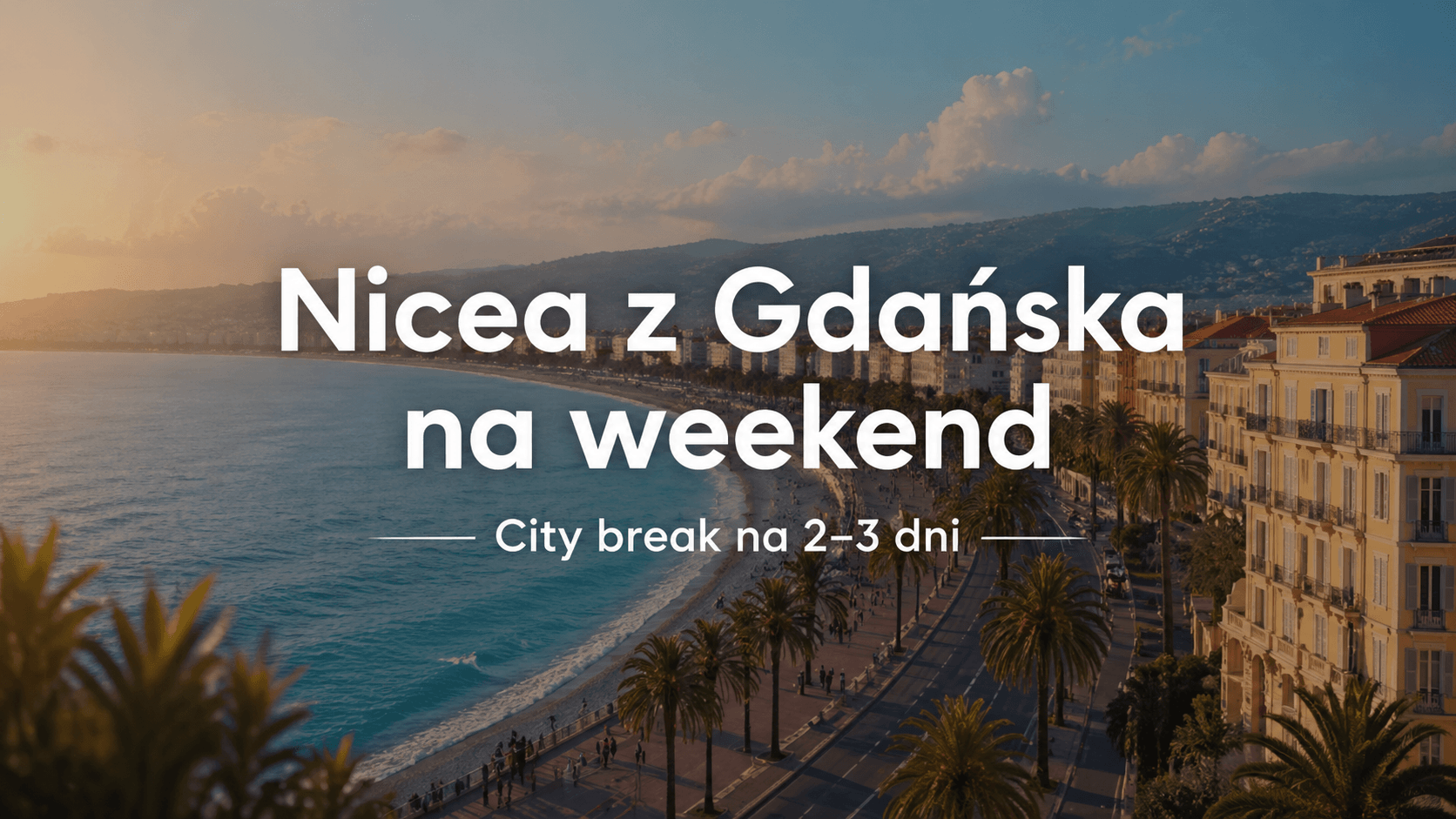
In short: Nice from Gdańsk is one of the strongest city break ideas for 2026: a direct flight, a fast tram from the airport to the center, the sea, old town, viewpoints and easy trips around the French Riviera. This guide shows how to plan Nice for a weekend, Nice in 2 days or Nice in 3 days without renting a car.
Nice from Gdańsk — at a glance
Nice is a good destination for a 2–3-day city break if you want to combine the sea, old town, promenade, viewpoints and the atmosphere of the French Riviera without extensive planning. It works best at a relaxed pace: one day for Nice, a second for views and the coast, and a third for a short trip nearby.
In short: Nice from Gdańsk is one of the strongest city break ideas for 2026: a direct flight, a quick tram from the airport to the centre, the sea, the old town, viewpoints and easy trips along the French Riviera. This guide shows how to plan Nice for a weekend, Nice in 2 days or Nice in 3 days without renting a car. Europe on OndaTravel.pl.
This guide shows when to fly, how to get from Nice airport to the centre, how to build a 2-day plan, how to extend it with a third day and how not to waste a short trip on an overly ambitious itinerary.


Short trip from Gdańsk
City breaks from Gdańsk: destinations for 2–3 days
A guide to weekend flights from Gdańsk: new routes, car-free cities, sunny destinations and northern ideas.
Best plan in 30 seconds
The simplest plan for Nice from Gdańsk: for 2 days, stay in Nice and combine the promenade, old town, Cours Saleya, Colline du Château, the port and a calm evening by the sea. For 3 days, add only one trip outside the city instead of trying to see the whole French Riviera at once. for 2 days, stay in Nice and combine the promenade, old town, Cours Saleya, Colline du Château, the port and a relaxed evening by the sea. For 3 days, add just one trip outside the city instead of trying to see the whole French Riviera at once.
- 2 days: Place Masséna, Vieux Nice, Cours Saleya, Colline du Château, Port Lympia and Promenade des Anglais. Place Masséna, Vieux Nice, Cours Saleya, Colline du Château, Port Lympia and Promenade des Anglais.
- 3 days: Nice + one trip: Èze, Monaco, Villefranche-sur-Mer or Antibes. Nice + one day trip: Èze, Monaco, Villefranche-sur-Mer or Antibes.
- Without a car: yes, for a first city break a car usually gets in the way more than it helps. yes, on a first city break a car usually gets in the way more than it helps.
- Best base: the centre, the area around Jean Médecin, Place Masséna, Vieux Nice, the port or tram line 2. the center, the Jean Médecin area, Place Masséna, Vieux Nice, the port or tram line 2.
- Best time: May–June or September–October, when it is easier to combine weather, prices and comfortable sightseeing. May–June or September–October, when it is easier to balance weather, prices and sightseeing comfort.
Nice from Gdańsk — quick answer
Nice from Gdańsk makes sense for a city break if you want to combine the city, the sea, a walkable promenade, viewpoints and the atmosphere of the French Riviera without renting a car. For 2 days, focus on Nice itself: Promenade des Anglais, Vieux Nice, Colline du Château, the port, Cours Saleya market and a calm evening by the sea. For 3 days, you can add Monaco, Èze, Villefranche-sur-Mer or Antibes. For 2 days, focus on Nice: Promenade des Anglais, Vieux Nice, Colline du Château, the port, Cours Saleya market and a relaxed evening by the sea. For 3 days, you can add Monaco, Èze, Villefranche-sur-Mer or Antibes.
Nice for a weekend works best when you do not try to see the whole coast at once. In practice, a Nice city break is best based on accommodation close to the centre, walks through the old town and possibly one short trip. In the 2026 season, check “Gdańsk Nice flights” and “Gdańsk Nice 2026 connection” directly with the carrier, because the schedule may change seasonally.
This is not a destination for rushing through the whole coast. The best first-trip plan is Nice as a base, one strong viewpoint, the old town, the sea and at most one short trip outside the city.

What will you find in this guide?
- Best plan in 30 seconds
- Quick answer
- Who is Nice from Gdańsk for?
- Gdańsk — Nice flights: what should you know?
- How to get from Nice airport to the centre?
- Nice sightseeing plan for 2 days
- Nice city break plan for 3 days
- Where to stay in Nice?
- How much does a city break in Nice cost?
- Does Nice work without a car?
- When to fly to Nice?
- What to see in Nice?
- The simplest walking route
- Pre-trip checklist
- What to eat in Nice?
- Best photo spots
- Plan B: rain, heat and crowds
- Most common mistakes during a city break in Nice
- Is it worth returning to Nice?
- FAQ: Nice from Gdańsk for a weekend

Who is Nice from Gdańsk for?
Nice is great for people who want to combine the sea, the old town, food, viewpoints and easy transport without a car. But it is worth saying honestly: this is not a classic destination with a soft sandy beach in the centre. The beaches along Promenade des Anglais are pebbly — galets, the characteristic rounded stones. For a quick city break they add charm and make the sea colour look beautiful, but for longer lounging it is worth having water shoes, a thicker mat or considering a paid beach club.
For families with children, Nice makes sense if the plan is calm: promenade and Cours Saleya in the morning, a break later, and viewpoints plus Vieux Nice without rushing. For people sensitive to noise, accommodation outside the very heart of Vieux Nice will be better. The old town has the most atmosphere, but in the evening and at night it can be loud, especially near restaurants, bars and narrow streets.
Nice will be a good choice if you are looking for a short trip with a “wow” effect already on the first day. The city gives easy access to the sea, old town, viewpoints, cafés, markets, museums and regional railways that let you quickly continue along the coast.
- For people flying to the French Riviera for the first time — Nice is the simplest base. — Nice is the easiest base.
- For couples — the promenade, sunsets, old town and dinners near the port work well for a short trip. — the promenade, sunsets, the old town and dinners by the port work well for a short trip.
- For people without a car — trams, trains and buses are enough for most plans. — trams, trains and buses are enough for most plans.
- For photographers — the light on Castle Hill, the port, old town and coastline give many shots in a short time. — the light on Castle Hill, the port, old town and coastline offer plenty of photo opportunities in a short time.

Gdańsk — Nice flights: what should you know?
The direct Gdańsk — Nice connection should be treated as seasonal: before buying a ticket, check the exact weekday, arrival time and terminal. In practice, the biggest difference is not the flight length itself but the landing time. With a morning arrival, you can immediately start with the promenade or Vieux Nice; with a late arrival, it is better to book accommodation close to tram T2, Jean Médecin, Masséna or Port Lympia.
For a weekend, do not build the plan around “three full days” if the flights realistically give you only two afternoons and one morning. In that case, Nice itself is a better choice than forcing Monaco, Èze and Menton into the same trip. With good flight times, the third day can be a calm bonus: Villefranche-sur-Mer, Cimiez, Mont Boron or one short train trip.
Nice appeared among the new destinations from Gdańsk for the 2026 season. According to information published by Gdańsk Airport and the city of Gdańsk, the route is to be operated by Wizz Air, with summer 2026 flights to Nice planned from 2 May on Tuesdays, Thursdays, Saturdays and Sundays. Before buying a ticket, always check the current schedule directly with the carrier, because times and frequency may change seasonally.
The best layout for a city break is a Saturday departure and Tuesday return, or a Thursday departure and Sunday return. This makes it easier to create a real 2–3-day stay without taking a long holiday.

How to get from Nice airport to the centre?
The simplest arrival pattern is this: from Terminal 1 or Terminal 2, go to tram T2 and ride towards the centre. The line passes important city points, including Jean Médecin, Alsace-Lorraine and Port Lympia, so for a short trip it is best to choose accommodation close to the tram or within easy walking distance. The section between the terminals and Grand Arénas is a separate free airport section, which is why fares can look confusing at first glance.
The biggest catch is tickets. Official materials mention a special airport round-trip ticket for around 10 euros, while regular single tickets also operate in the city network. There may also be an extra charge for the card medium. That is why, both in the text and in practice, it is not worth memorising one “magic” price — it is better to check the current option in the ticket machine, the Lignes d’Azur app or during trip planning. If you choose bus 12+, remember that you do not buy the ticket from the driver, so you need to have it before boarding.
A taxi makes sense with a late arrival, large luggage, travel in a group of 3–4 people or accommodation outside the convenient tram axis. Use the official taxi rank at the terminal, not random offers outside the doors. Official airport fares include a flat rate to central Nice of around 32 euros, but before the ride it is still worth confirming the price, asking for card payment and requesting a receipt.
The simplest option is tram line 2 towards Port Lympia. Nice Airport’s official website states that the tram connects Terminal 1 and Terminal 2 with the centre, stops at Jean Médecin among other places and reaches Port Lympia in under 30 minutes. This is one of the reasons why Nice works very well as a car-free city break.
For a short trip, the best accommodation areas are Jean Médecin, Vieux Nice, Masséna, the port or somewhere within reach of tram line 2. This way, after arrival, you do not waste time on a complicated transfer.


The most important thing on a first trip: tram line 2 is not an attraction, but a real advantage of Nice over many other cities. From the terminals, you can travel towards Jean Médecin and Port Lympia, so accommodation close to this axis lets you start sightseeing without a taxi and without a rental car. In practice, it is worth deciding in advance whether you buy an airport ticket or use the walk/ride to Grand Arénas and the regular city fare. It is a small detail, but for two people on a short weekend it makes a real difference in the budget.
Nice in 2 days: a simple sightseeing plan
Day 1 should build your first image of Nice, so it is best to start along this axis: Promenade des Anglais, Rauba Capeù, Colline du Château, Vieux Nice, Cours Saleya and Place Masséna or Place Garibaldi. This order is not random. First you see the sea and the bay, then you go up to the best viewpoint, and only later descend into the old town streets, where it is easy to stop for socca, ice cream or coffee.
Day 2 should feel different, so you do not only repeat the old town. The best rhythm is Port Lympia in the morning, then a short UNESCO or Belle Époque block around Quai des États-Unis, Villa Masséna or Centre Nice Patrimoine Mondial, and later one chosen path: art and Cimiez, Chagall/Matisse, or a slower option with the promenade, beach and sunset. This keeps the plan urban, seaside and practical rather than a checklist of points to tick off.

Day 1: old town, promenade and sunset
- Arrival and tram to the centre.
- Walk through Place Masséna and Promenade du Paillon.
- Vieux Nice: narrow streets, cafés, ice cream and local shops.
- Cours Saleya and the market area.
- Promenade des Anglais before sunset.
- Evening around the old town or the port.
Day 2: viewpoint, port and calm Nice
- Morning climb to Colline du Château.
- View of the bay, port and old town.
- Walk to Port Lympia.
- Lunch or coffee in the less crowded port area.
- Return through the old town or walk by the sea.
- Tram transfer to the airport.
The 2-day version should not be overloaded. Nice works best when you leave time for the sea, light and calm transitions between places. This is not a city that needs to be visited with a list of twenty stops.

Nice in 3 days: what to add to the plan?
For the third day in Nice, choose one path, not everything at once. The biggest mistake is a plan like: Èze in the morning, then Monaco, then Menton, and in the evening still “something” in Nice. It looks good on a map, but in practice turns a city break into a logistical sprint. With 3 days, it is best to decide whether you want a slow day, a postcard day or an art/weather-plan day.
- Slow option: Villefranche-sur-Mer as one close and very photogenic trip outside Nice. This is the best choice if you want a turquoise bay, a calmer pace and a return to Nice for the evening. Choose Villefranche-sur-Mer as one nearby, highly photogenic trip from Nice. It is the best option if you want a turquoise bay, a slower pace and to return to Nice for the evening.
- Postcard option: Èze + Monaco, but only if you accept more people, more connections and a more touristy rhythm of the day. Èze usually means combining a train with bus 83, while Monaco is quick by TER train. Èze + Monaco, but only if you are comfortable with more people, more transfers and a more touristy pace. Getting to Èze usually involves combining the train with bus 83, while Monaco is quick to reach by TER train.
- Plan B option: stay in Nice and choose Cimiez, Chagall, Matisse, Parc Phoenix, Mont Boron, Fort du Mont-Alban or a Niçoise cooking workshop. This is best in rain, heat or tiredness after the first two days. stay in Nice and choose Cimiez, the Chagall and Matisse museums, Parc Phoenix, Mont Boron, Fort du Mont-Alban or a Niçoise cooking workshop. This works best in rain, extreme heat or when you are tired after the first two days.
The third day makes the biggest difference. You can stay in Nice and explore more slowly, or choose one short trip outside the city. Most importantly: do not try to do Monaco, Èze, Cannes and Antibes in one day. It is better to choose one direction and actually enjoy it.
| Idea for the third day | For whom? | Why is it worth it? |
|---|---|---|
| Monaco | for people who want to see the most famous nearby destination | an easy symbol of the French Riviera, good views and a quick trip from Nice |
| Èze | for people who like views and stone villages | the atmosphere of a medieval village and a panorama of the coast |
| Villefranche-sur-Mer | for a calmer pace | a colourful bay, proximity to Nice and a less intense plan |
| Antibes | for people who want to combine a walk, the sea and the old town | a good choice for a gentler southern day |

Check out my YouTube channel and travel with me.
Follow the channel for videos, routes and practical travel inspiration.
Follow me here:
What’s up?
Enjoying my content?
Buy me a coffee at buycoffee.to/ondatravel and support the creation of more travel content.
Your support helps me create more practical guides, videos and travel inspiration.

Where to stay in Nice for a short trip?
For 2–3 days, the location of your accommodation is more important than a “pretty address” on the map. Vieux Nice has atmosphere, but does not always give the best sleep. Jean Médecin is convenient logistically, but can be busy. Port Lympia is a great compromise for people who want nice surroundings, tram access and a slightly calmer evening.
| Area | For whom | Practical note |
| Vieux Nice | For a first visit, atmosphere, restaurants and evening walks | It can be loud at night; check reviews for noise and window insulation |
| Jean Médecin / tram area | For logistics, short stays and easy airport transfer | Convenient, but more urban and busy |
| Port Lympia | For photos, a calmer atmosphere and good T2 connection | A very good compromise between the centre and breathing space |
| Promenade / Carré d’Or | For the view, the sea and a classic city break | Often more expensive; check whether the room really has a view |
| Libération / Carabacel | For better value and less touristy food | Good if you do not need to sleep “inside the postcard” |
On a city break, the location of your accommodation matters more than a large room or extra amenities. The most convenient areas are the centre around Jean Médecin, the area near Place Masséna, the old town, the port and places with easy access to tram line 2. For a very short stay, avoid accommodation that looks cheaper but requires a long commute.
- Jean Médecin / centre — a good compromise between transport, shops and walking distance to the old town. — a good compromise between transport, shops and walking access to the old town.
- Vieux Nice — atmosphere and evening life, but it can be noisier.
- Port Lympia — a good choice if you prefer quieter evenings and views of the port.
- Promenade des Anglais — great for views, but prices can be higher.
How much does a city break in Nice cost?
Nice is not the cheapest city break destination, but costs can be controlled if you choose the timing and accommodation well. The season makes the biggest difference: in summer, accommodation prices are usually higher, and the city and beaches are more crowded. Spring and autumn often give the best balance between weather, price and comfortable sightseeing.
- Biggest cost: accommodation in a good location. accommodation in a good location.
- Easiest saving: public transport instead of taxis. public transport instead of taxis.
- Best compromise: breakfast or coffee in town and one calm meal a day. breakfast or coffee in town and one relaxed meal a day.
- Biggest mistake: accommodation too far away, which takes time and energy. accommodation that is too far away and costs you time and energy.
The biggest cost differences come from three things: timing, accommodation location and eating style. The most expensive will be the areas around the most obvious views, the full summer season, private beaches and spontaneous restaurants along the promenade. A cheaper but still convenient option is accommodation near the tram or within walking distance of the centre, breakfasts from bakeries, socca or pan bagnat during the day and one calmer dinner instead of three random meals by the sea. In the budget, also include the airport transfer, short tram rides and a possible train trip to Villefranche, Monaco, Menton or Antibes.
When calculating costs, it is worth separating mandatory expenses from those that easily get out of control. Mandatory costs are flights, accommodation, transfer and basic transport; variable costs are restaurants, private beaches, train trips and attractions outside Nice. If the budget should stay reasonable, keep accommodation close to the tram and leave more expensive scenic dinners as one conscious point in the plan.
Nice without a car — does it make sense?
A car in Nice for a classic weekend is more of a problem than an advantage. You do the core of the city on foot, the airport is served by the tram, and the coast works well by TER trains. You can reach Monaco and Menton by direct train, Villefranche-sur-Mer is very close, and Èze only requires better planning of the train + bus 83 connection.
A car only starts to make sense if you plan Bellet, mountain villages, harder-to-reach points deeper in the region or a route beyond a typical city break. For 2–3 days from Gdańsk, it is better to invest time in a good accommodation location and one logical train trip than in parking, traffic and looking for a space near the promenade.
Yes. Nice is one of those destinations where a car on a short trip may get in the way more than it helps. The centre is walkable, the airport has a quick tram connection, and many places on the French Riviera can be visited by train or bus.
A car makes sense only when you plan a longer trip outside the city, several smaller villages deeper in the region or a route through Provence. For a first city break from Gdańsk to Nice, it is better to skip it.

Yes, Nice without a car makes a lot of sense, especially for a 2–3-day city break. A car in the centre means parking, traffic, stress and cost, not more freedom. The tram, regional trains and walkable centre are enough for a plan covering Promenade des Anglais, Vieux Nice, Cours Saleya, Colline du Château, the port and one reasonable trip. A car only starts to make sense for a longer route through the hills, small villages or several places in one day, but that is a different type of travel than a short city break from Gdańsk.
When to fly to Nice for a weekend?
The most comfortable months for a city break are usually May, June, September and October: there is enough light, the city is lively, and walking along the promenade and through Vieux Nice is not yet a fight with heat. July and August are the most demanding — more crowded, more expensive and hotter, so the plan needs more breaks, fewer stairs at noon and more morning or evening viewpoints.
Winter does not have to be a bad choice if you treat Nice as a city, not a beach holiday. Nice Carnival can be a strong reason to travel, and May gives a local atmosphere between the off-season and full summer. With a winter or spring flight, the biggest advantage is light, food, museums and walks, not swimming in the sea.
The most universal periods are spring, early summer and autumn. Then it is easier to combine pleasant weather with sightseeing. July and August are good if you want a typical holiday atmosphere, but for a short city break they may mean higher prices and bigger crowds.
| Period | Is it worth it? | For whom? |
|---|---|---|
| May–June | very good choice | city break, walks, sea, photos |
| July–August | good, but more expensive and more crowded | holiday atmosphere, beach, evenings by the sea |
| September–October | very good choice | fewer crowds, still a southern atmosphere |
| winter | more of a calm city break than beach time | walks, food, museums and a break from winter |
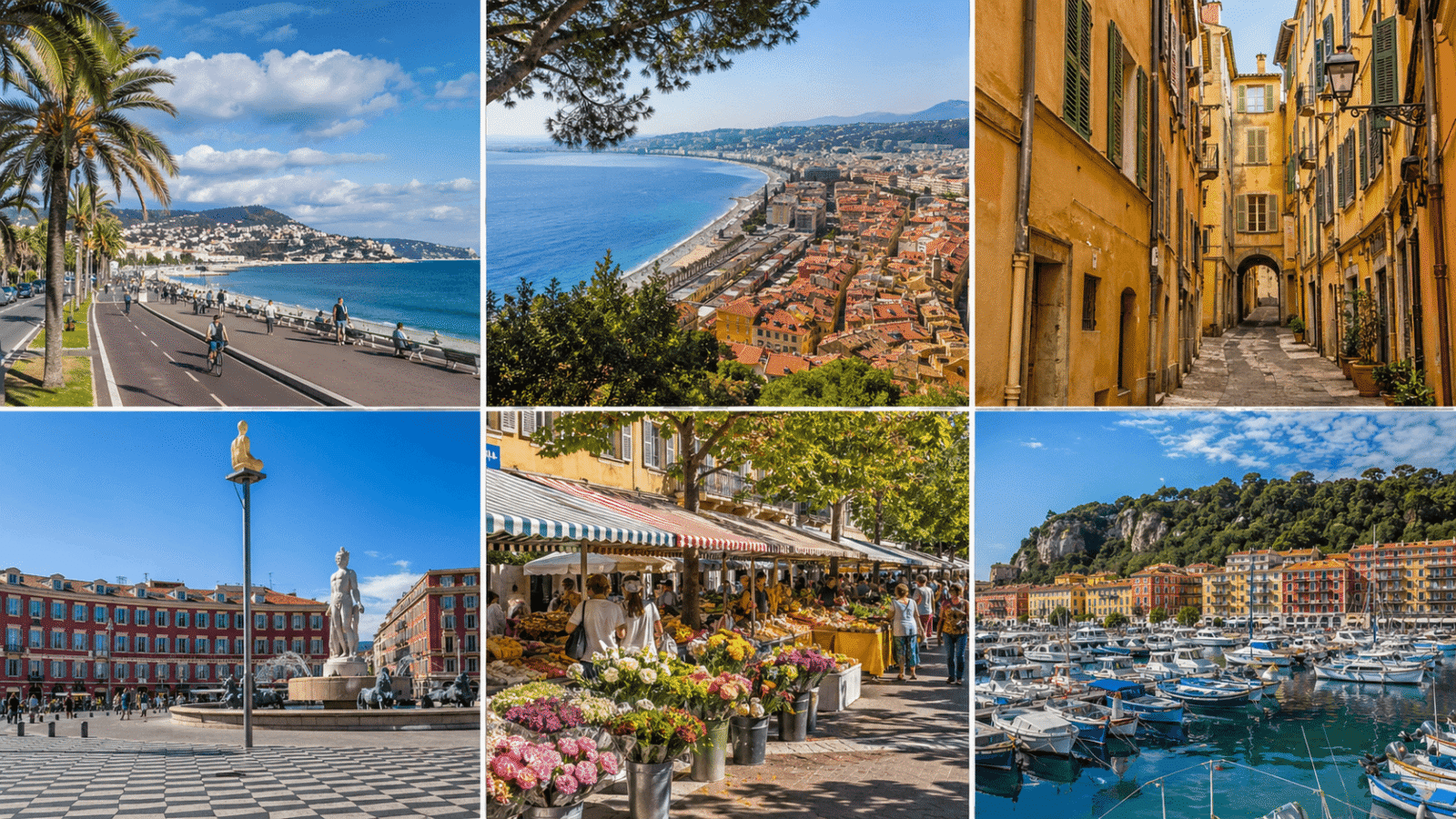


The best time for Nice depends on whether you want to sightsee more or rest by the sea. Spring and autumn are the most comfortable for walks, photos, the market and viewpoints, because you are not fighting the heat all day. Summer gives the strongest holiday atmosphere, but also means higher prices, crowds and a pebbly beach that will not suit everyone. In winter, Nice still works as a city trip with the sea and light, but you need to treat it more as a calm French Riviera stay than a beach weekend. On a short trip, flight times matter more than the perfect month: a good arrival and later return can turn 2 days into almost a full weekend.
What to see in Nice? Priorities for a short trip
It is worth adding a few places to the priority list that make Nice a fuller guide, not just a set of obvious attractions. Centre Nice Patrimoine Mondial helps you understand why the promenade, the city’s winter history and UNESCO heritage are so important here. Port Lympia is worth treating as a separate walking block, not just a passage between the Old Town and the tram. Lou Passagin, the free electric crossing across the port, is a small detail but gives a very local accent.
If you have more time or want to escape the crowd, add Mont Boron and Fort du Mont-Alban to the plan. They are not “must-see” points during your first few hours in Nice, but with 3 days they give some of the best views and much more space than the middle of Vieux Nice. They work especially well in late afternoon, when the light is softer.
Important practical update: MAMAC should not currently be planned as a normal weekend attraction. The museum is closed for renovation, and the reopening date should be checked before travel. For plan B, it is better to rely on Chagall, Matisse, Villa Masséna, Palais Lascaris, Centre Nice Patrimoine Mondial or Parc Phoenix.
If you type “what to see in Nice” into a search engine, the most important answer is: do not try to see everything. On a city break from Gdańsk, first choose places that give the most atmosphere in a short time: Promenade des Anglais, Vieux Nice, Cours Saleya, Colline du Château, Port Lympia and Place Masséna.
| Place | Why is it worth it? | Best time |
|---|---|---|
| Promenade des Anglais | the most recognisable walk along Baie des Anges | morning or before sunset |
| Vieux Nice | old town, cafés, alleys, colours and local atmosphere | afternoon and evening |
| Cours Saleya | market, food, flowers and quick contact with everyday Nice | morning |
| Colline du Château | the best viewpoint over the bay, old town and port | morning or golden hour |
| Port Lympia | a pleasant walk, colourful façades and a calmer evening | late afternoon |
| Place Masséna | a good orientation point between the centre, promenade and old town | on the way between attractions |

Promenade des Anglais in Nice
Promenade des Anglais is best planned in the morning or before sunset. This place gives a quick “I am on the French Riviera” effect: the sea, palms, a wide promenade and the classic view of Nice.

Vieux Nice in Nice
Vieux Nice is the heart of old Nice and one of the places that best captures the city’s atmosphere. Narrow streets, colourful façades, cafés and small shops are best planned for the afternoon or evening.

Cours Saleya in Nice
Cours Saleya is worth seeing in the morning, when the market is at its liveliest. It is a good place for a short walk, local flavours, flowers and contact with the everyday rhythm of old Nice.

Castle Hill in Nice — Colline du Château
Colline du Château is a priority on a short trip, because from one place you can see the bay, Promenade des Anglais, the old town and the port. It is best to go up in the morning or during golden hour.

Place Masséna in Nice
Place Masséna works well as an orientation point while sightseeing in Nice. It connects the centre, Promenade du Paillon, the old town and the route towards the sea.
For 2 days, this set is more than enough. For 3 days, you can add one trip outside Nice: Monaco, Èze, Villefranche-sur-Mer or Antibes. Choose one, not all at once.


The simplest walking route in Nice
The best route for a first city break in Nice should be simple and walkable. This way, you do not waste time on complicated transfers, and the most important places form a natural loop between the centre, old town, viewpoint and sea.
Suggested route: Place Masséna → Vieux Nice → Cours Saleya → Colline du Château → Port Lympia → Promenade des Anglais. Place Masséna → Vieux Nice → Cours Saleya → Colline du Château → Port Lympia → Promenade des Anglais.
It is best to spread this route out without rushing. Cours Saleya market and the climb to Colline du Château work well in the morning, while late afternoon is best left for the port or Promenade des Anglais, when the light over Baie des Anges is at its prettiest.
The simplest route should start where Nice is most compact: Place Masséna, Promenade du Paillon, Vieux Nice and Cours Saleya. Then head towards Colline du Château, because from above you can best see how the city sits between the sea, old town, port and hills. After descending, you can continue to Port Lympia or return along the promenade towards sunset. This is a route you can do without rushing, with a break for socca, coffee or ice cream, not just as a march from point to point. If you have less energy, shorten the port part and leave it for the second day.
Checklist: Nice from Gdańsk for a weekend step by step
Treat this section as a practical checklist before booking. For a city break in Nice, the most important things are flight times, accommodation location and the decision whether you stay only in Nice or add one French Riviera trip.
- Check the Gdańsk — Nice flight layout. The most convenient dates give you a full day on site or an evening return. The most convenient schedules give you a full day at the destination or an evening return.
- Choose accommodation close to tram line 2, the centre, old town or port. On a short trip, location saves more than an apparently cheaper room far from the centre. On a short trip, a good location saves you more than a seemingly cheaper stay far from the center.
- Do not rent a car for your first city break. Nice, the airport and part of the French Riviera are convenient by public transport. Nice, the airport and part of the French Riviera are easy to explore by public transport.
- For 2 days, stay in Nice. The promenade, old town, Cours Saleya, Castle Hill and port will give you a complete trip. The promenade, old town, Cours Saleya, Castle Hill and the port are enough for a full trip.
- For 3 days, add only one trip. Monaco is the most famous, Èze the most scenic, Villefranche calmer, and Antibes good for a walk and the sea. Monaco is the best known, Èze has the best views, Villefranche is quieter, and Antibes is good for a walk and the sea.
- Leave time without a plan. Nice works better as a city to walk through than as a list of attractions to tick off. Nice works better as a city for walking than as a checklist of attractions.
Before the trip, check the arrival time, last tram connections, accommodation location in relation to line 2 and the plan for the first evening. Pack comfortable shoes, sunglasses, a thin layer for wind from the sea and something for the pebbly beach if you plan to swim or sit by the water longer. Save offline the route from the airport, the stop nearest your hotel and an alternative rainy-day plan. For a 3-day plan, choose only one trip outside Nice instead of making a list of Monaco, Èze, Menton, Cannes and Antibes at once.
What to eat in Nice? A short list of local flavours
The best food strategy in Nice is not chasing one viral queue, but recognising local flavours and districts. Look for the Cuisine Nissarde label, because it helps distinguish places that keep to traditional recipes from venues living only off tourist traffic. On a short trip, it is enough to aim for a few things: socca, pan bagnat, pissaladière, salade niçoise, tourte de blettes, petits farcis and, seasonally, beignets de fleurs de courgette. Cuisine Nissarde, because this label helps distinguish places that follow traditional recipes from venues living purely off tourist traffic. On a short trip, it is enough to aim for a few things: socca, pan bagnat, pissaladière, salade niçoise, tourte de blettes, petits farcis and, in season, beignets de fleurs de courgette.
Cours Saleya and Vieux Nice are good for first contact with the city’s cuisine, but the longest queue does not always mean the best choice. If you want more local value, also look towards Libération, Carabacel, the port and the area around Garibaldi. For a weekend, check opening days, because some addresses may close on Sunday or Monday — on a short trip, one closed restaurant can change the whole evening.
Nice has its own cuisine and it is worth planning at least one local meal instead of a random restaurant near the most touristy passage. On a short trip, simple things work best: socca, pan bagnat, pissaladière, salade niçoise, petits farcis or ice cream after a walk through the old town.
| What to eat? | What is it? | When does it fit? |
|---|---|---|
| Socca | a thin chickpea flour pancake | a quick snack in the old town |
| Pan bagnat | a sandwich in the style of salade niçoise, good for takeaway | lunch before a walk by the sea |
| Pissaladière | onion, olives, anchovies and the flavour of southern France | a light meal or snack |
| Salade niçoise | the best-known salad linked with Nice | lunch on a warm day |
| Petits farcis | local-style stuffed vegetables | when you want to try something more home-style |
The simplest rule: on the first day, eat something local around the old town or Cours Saleya, and on the second day leave yourself a calmer meal near the port or after coming down from the viewpoint.

Nice is one of those places where food should be part of the plan, not a random stop. Start with socca, the thin chickpea flour pancake that tastes best simple and without pretending to be elegant. Add pan bagnat, pissaladière, petits farcis, salade niçoise and olives from the market, and you get a much better image of the city than from a random pizza on the promenade. Cours Saleya is good for a morning atmosphere, but that does not mean every restaurant in the busiest place will be the best choice. Look for side streets in Vieux Nice, simple places and spots where you can see the local rhythm, not only tourist flow.
Best photo spots in Nice
In Nice, the photo location matters, but the time of day matters even more. Castle Hill works best at sunrise or during golden hour, because at noon the light can be harsh and the climb in the heat less pleasant. Port Lympia looks best in the morning and blue hour, Cours Saleya makes the most sense in the morning, and Place Masséna closes the day well after dark.
| Place | Best time | Why is it worth it |
| Colline du Château | Sunrise or golden hour | The strongest panorama of the bay, port and rooftops of old Nice |
| Rauba Capeù | Morning or late afternoon | Classic shot with the bay and promenade |
| Port Lympia | Morning or blue hour | Pastel façades, boats and a calmer atmosphere |
| Cours Saleya | Morning | Market, colours, light and local movement |
| Mont Boron / Fort Mont-Alban | Late afternoon | Wide view and a less obvious perspective on the coast |
| Villefranche-sur-Mer | Before noon | Turquoise bay and colourful façades without the same rush as in the centre |
Nice is a very rewarding city for photography, because in a short time it gives you several completely different frames: the sea, pastel streets, port, city square, market and a panorama from above. You will take the best photos when you do not try to photograph everything in the middle of the day.
- Colline du Château: panorama of the bay, red rooftops of the old town and view of the port. panorama of the bay, the red roofs of the old town and a view of the port.
- Promenade des Anglais: the classic frame with palms, blue chairs and the sea. a classic shot with palm trees, blue chairs and the sea.
- Vieux Nice: narrow streets, façade details, cafés and a southern atmosphere. narrow streets, façade details, cafés and a southern atmosphere.
- Cours Saleya: market colours, flowers, fruit and local city life. market colors, flowers, fruit and local city life.
- Place Masséna: geometric paving, red façades and the central point of Nice. geometric paving, red façades and a central landmark in Nice.
- Port Lympia: boats, colourful townhouses and a calmer late-afternoon atmosphere. boats, colorful townhouses and a calmer late-afternoon atmosphere.

The best photos in Nice come when you combine classic views with details. Colline du Château gives a wide panorama of the bay and rooftops of the old town, but equally good shots are lower down: blue chairs on Promenade des Anglais, light on the façades of Vieux Nice, Cours Saleya market, boats in Port Lympia and the bend at Quai Rauba Capeu. Photograph the old town and market in the morning, the promenade and viewpoint in late afternoon. At noon the light can be harsh, so it is better to look for shade, colourful streets and details instead of a classic panorama.
Plan B: rain, heat and crowds in Nice
Rain, heat and crowds require three different backup plans. In rain, the best set is Chagall or Matisse, Centre Nice Patrimoine Mondial, Palais Lascaris, Villa Masséna, Parc Phoenix or a Niçoise cooking workshop. In heat, move Castle Hill, Rauba Capeù and longer walks to the morning or evening, and give the middle of the day to a museum, lunch, shade or a beach lounger. In crowds, escape to the port, Cimiez, Mont Boron, Fort Mont-Alban or Villefranche.
The worst Plan B is clinging rigidly to the original route. Nice handles changes well: instead of giving up the day, you can swap one block for a calmer one. Vieux Nice in the rain still has atmosphere, but wet stone streets and crowds under awnings are not for everyone. The promenade in full August sun may look beautiful in a photo, but can be tiring as a long walk at noon.
A good city break should have a backup plan. Nice is a walking destination, but weather, heat or crowds can quickly change the sightseeing pace. It is better to have a simple Plan B than to force an overloaded itinerary.
- When it rains: shorten walks, plan a café, museum, covered market or a calmer meal around the old town. shorten your walks and plan a café, museum, covered market or a relaxed meal near the old town.
- When it is hot: sightsee in the morning and late afternoon, and leave the middle of the day for rest, food or shorter shaded walks. Sightsee in the morning and late afternoon, and leave the middle of the day for rest, food or shorter walks in the shade.
- When it is crowded: skip the most obvious promenade hours and choose the port, side streets of Vieux Nice or a less intense walking route. skip the busiest hours on the promenade and choose the port, the side streets of Vieux Nice or a less intensive walking route.
- When you have little time: stay with the set of Place Masséna, Vieux Nice, Cours Saleya, Colline du Château and the promenade. stick to Place Masséna, Vieux Nice, Cours Saleya, Colline du Château and the promenade.
Plan B in Nice should depend on the problem. In rain, shorten viewpoints and move the day’s focus to Vieux Nice, cafés, museums, market arcades and calmer food. In heat, do Colline du Château in the morning or evening, and leave the middle of the day for rest, ice cream, a museum or shade. In crowds, do not try to take the shortest route through the busiest parts of the old town — turn into side streets or move the walk to the port. If public transport or regional trains are overloaded, skip the trip outside the city and make a stronger, calmer Nice plan instead of fighting logistics.
Most common mistakes during a city break in Nice
The biggest mistake is treating the third day like a race across the whole Riviera. Monaco, Èze, Menton, Villefranche, Saint-Jean-Cap-Ferrat and Antibes are tempting, but on a short trip you cannot combine them without losing quality. Choose one strong direction and do it well.
- Do not expect a sandy beach in the centre. Nice has pebbly beaches, so comfort requires water shoes, a mat or a lounger. Nice has pebble beaches, so for comfort bring water shoes, a beach mat or use a lounger.
- Do not sleep in Vieux Nice without checking the noise. The atmosphere is great, but at night it can be loud. The atmosphere is great, but it can be noisy at night.
- Do not list MAMAC as a guaranteed sightseeing point. The museum status must be checked before the trip. Check the museum’s current status before your trip.
- Do not base your food only on queues in the centre. Cuisine Nissarde, the port, Libération and the area around Garibaldi can give a better rhythm than the most touristy places. Cuisine Nissarde, the port, Libération and the Garibaldi area can offer a better rhythm than the most touristy restaurants.
- Do not underestimate airport fares. The tram is simple, but ticket types and card-medium fees can surprise you. The tram is simple to use, but ticket types and the extra charge for the travel card can be surprising.
- Too many places in 2 days. Monaco, Èze, Cannes and Antibes in one short trip sound good only on a map. Monaco, Èze, Cannes and Antibes in one short trip sound good only on the map.
- Accommodation too far from the centre. Saving on the room often disappears when you lose time on commuting. Savings on the room often disappear when you lose time commuting.
- No airport transfer plan. Tram line 2 is simple, but it is worth knowing in advance where you get off. Tram line 2 is simple, but it helps to know in advance where you need to get off.
- Confusing a city break with a touring holiday. For a weekend, it is better to choose Nice and one addition than to try to see the whole French Riviera. For a weekend, it is better to choose Nice plus one extra stop than try to see the entire French Riviera.
- Booking in peak summer without checking accommodation prices. July and August can be great for weather, but more expensive and more crowded. July and August can have great weather, but they are more expensive and more crowded.
The best city break in Nice is simple: a good arrival, convenient accommodation, tram from the airport, two strong walks, one viewpoint and one planned local meal.

The most common mistake is treating Nice only as a base and trying to see the whole French Riviera in 48 hours. Monaco, Èze, Menton, Antibes, Cannes and Villefranche are tempting, but on a first trip it is better to choose one excursion and leave time for the city itself. The second mistake is accommodation far from the tram or centre, so every day starts with logistics. The third is assuming that the beach in Nice will be soft and sandy — it is pebbly, so it is worth preparing differently than for a classic beach destination.
Is it worth returning to Nice?
Yes — Nice is one of those cities worth returning to, but not to tick off the same list of attractions again. The second time, it is best to treat it as a calm base for the French Riviera: for Èze, Villefranche-sur-Mer, Monaco, Antibes or less obvious walks around Nice itself.
On the first trip, the most important thing is not to overload the plan. On the next one, you can allow yourself a slower pace, more local food, photos at better times of day and one well-chosen route outside the city.
It is worth returning to Nice because the first city break usually shows only the basic layout: promenade, old town, market, viewpoint and port. A second trip can be much calmer: Cimiez, the Matisse and Chagall museums, Villefranche-sur-Mer, Saint-Jean-Cap-Ferrat, Antibes, Menton or one well-planned route to Èze and Monaco. That is why it is not worth overloading the first weekend. It is better to return for the French Riviera at a slower pace than turn the first trip into a rushed train tour.
Returning also makes sense because Nice is a great base, but you do not have to do everything the first time. On another trip, you can go more calmly into museums, Cimiez, traces of Matisse and Chagall, pebbly beaches, longer seaside walks or one well-chosen route outside the city. This is a destination that works better in a rhythm of returns than in rushing through the entire French Riviera.
FAQ: Nice from Gdańsk for a weekend
Are there direct flights from Gdańsk to Nice?
Yes, Nice has been announced as a new destination from Gdańsk for the 2026 season. Before buying a ticket, check the current schedule with the carrier, because flight times and frequency may change seasonally.
Is Nice suitable for a 2-day city break?
Yes, but it is best to limit the plan to Nice itself: the old town, Promenade des Anglais, Colline du Château, the port and a calm evening by the sea. With two days, it is not worth adding too many places outside the city.
What to see in Nice in 3 days?
In 3 days, you can see Nice more calmly and add one trip: Monaco, Èze, Villefranche-sur-Mer or Antibes. It is best to choose only one direction outside the city.
Do you need a car in Nice?
Not for a city break. The airport is well connected with the centre by tram, you can walk a lot around Nice, and many places on the coast can be reached by public transport.
Where is the best place to stay in Nice for a short trip?
The most convenient areas are the centre, Jean Médecin, near Place Masséna, the old town, the port or tram line 2. On a short trip, location matters more than a high room standard.

Trip planning
Travel: guides, routes and trip ideas
The main Travel section page: guides, routes, inspiration and the most important travel sections on OndaTravel.pl.
Film note: Nice and Studios de la Victorine
Nice has a film history, but it is best described honestly: not as one simple route through scenes in the centre, but as part of a larger cinema tradition on the French Riviera. The most important point is Studios de la Victorine, a historic film studio operating in Nice.
- Studios de la Victorine is an interesting stop for film lovers, but it will not always be a priority on a first weekend.
- Promenade des Anglais, Vieux Nice and the light of the French Riviera explain why the area feels so cinematic, even though specific scenes often relate to the Riviera as a whole rather than just central Nice.
- Treat Villefranche-sur-Mer, Monaco, Èze and Cannes as the wider cinematic context of the region, not a must-see list to squeeze into 2 days.
- If you are interested in film, it is better to pair Nice with a slower third day than rush through all the resorts at once.

FILM TOURISM
Film tourism: travelling in the footsteps of films and series
See guides to filming locations, places known from series and routes where pop culture meets travel.
Read also / next
 16 June 2026
Athens from Gdańsk for a weekend: 2–3 day city break
Athens from Gdańsk for a weekend: a ready 2–3 day city break plan, airport transfer, Acropolis, Plaka, Monastiraki, places to stay, costs…
16 June 2026
Athens from Gdańsk for a weekend: 2–3 day city break
Athens from Gdańsk for a weekend: a ready 2–3 day city break plan, airport transfer, Acropolis, Plaka, Monastiraki, places to stay, costs…
 1 May 2026
Bergen from Gdańsk for a weekend: a 2–3-day city break
Bergen from Gdańsk for a weekend: a practical 2–3-day city break guide with airport transfer, Bryggen, Fløyen, viewpoints and fjord ideas.
10 August 2026
Brussels from Gdańsk for a weekend: a 2–3-day city break
Brussels from Gdańsk for a weekend: a 2–3-day city break plan, flights, airport transfer, accommodation, attractions, a walking route and car-free sightseeing.
10 August 2026
Budapest from Gdańsk for a weekend: 2–3 day city break
Budapest in 2–3 days: a ready-made Buda and Pest sightseeing plan, Parliament, Fisherman’s Bastion, thermal baths, airport transfer and weekend costs.
8 May 2026
Copenhagen from Gdańsk for a weekend: a 2–3-day city break
Copenhagen from Gdańsk for a weekend: a practical 2–3-day city break guide with airport metro, Nyhavn, Tivoli, harbour walks and neighbourhoods.
1 May 2026
Bergen from Gdańsk for a weekend: a 2–3-day city break
Bergen from Gdańsk for a weekend: a practical 2–3-day city break guide with airport transfer, Bryggen, Fløyen, viewpoints and fjord ideas.
10 August 2026
Brussels from Gdańsk for a weekend: a 2–3-day city break
Brussels from Gdańsk for a weekend: a 2–3-day city break plan, flights, airport transfer, accommodation, attractions, a walking route and car-free sightseeing.
10 August 2026
Budapest from Gdańsk for a weekend: 2–3 day city break
Budapest in 2–3 days: a ready-made Buda and Pest sightseeing plan, Parliament, Fisherman’s Bastion, thermal baths, airport transfer and weekend costs.
8 May 2026
Copenhagen from Gdańsk for a weekend: a 2–3-day city break
Copenhagen from Gdańsk for a weekend: a practical 2–3-day city break guide with airport metro, Nyhavn, Tivoli, harbour walks and neighbourhoods.
 29 April 2026
Dubrovnik from Gdańsk for a weekend: a 2–3-day city break
Dubrovnik from Gdańsk for a weekend: a practical 2–3-day city break guide with airport transfer, old town, city walls, viewpoints and island…
11 August 2026
Iceland from Gdańsk for a weekend: 2–3 day city break
Iceland from Gdańsk for a weekend: flight to Keflavík, Reykjavík, Reykjanes, a 2–3 day plan, transfers, accommodation, costs and the most common…
29 April 2026
Dubrovnik from Gdańsk for a weekend: a 2–3-day city break
Dubrovnik from Gdańsk for a weekend: a practical 2–3-day city break guide with airport transfer, old town, city walls, viewpoints and island…
11 August 2026
Iceland from Gdańsk for a weekend: 2–3 day city break
Iceland from Gdańsk for a weekend: flight to Keflavík, Reykjavík, Reykjanes, a 2–3 day plan, transfers, accommodation, costs and the most common…
 3 May 2026
Istanbul from Gdańsk for a weekend: a 2–3-day city break
Istanbul from Gdańsk for a weekend: a practical 2–3-day city break guide with airport transfer, Sultanahmet, Galata, Bosphorus and bazaars.
3 May 2026
Istanbul from Gdańsk for a weekend: a 2–3-day city break
Istanbul from Gdańsk for a weekend: a practical 2–3-day city break guide with airport transfer, Sultanahmet, Galata, Bosphorus and bazaars.
 9 August 2026
London from Gdańsk for a weekend: a 2–3-day city break
London from Gdańsk for a weekend: a 2–3-day city break plan, flights, airport transfer, accommodation, attractions, a walking route and car-free sightseeing.
9 August 2026
London from Gdańsk for a weekend: a 2–3-day city break
London from Gdańsk for a weekend: a 2–3-day city break plan, flights, airport transfer, accommodation, attractions, a walking route and car-free sightseeing.
 8 May 2026
Oslo from Gdańsk for a weekend: a 2–3-day city break
Oslo from Gdańsk for a weekend: a practical 2–3-day city break guide with airport train, Opera House, Bjørvika, museums, saunas and fjord…
17 June 2026
Palermo from Gdańsk for a weekend: 2–3 day city break
Palermo from Gdańsk for a weekend: flights, airport transfer, 2–3 day itinerary, where to stay, what to see, what to eat and…
15 June 2026
Palma de Mallorca from Gdańsk for a weekend: 2–3 day city break
Palma de Mallorca from Gdańsk for a weekend: 2–3 day city break plan, airport transfer, accommodation, costs, attractions, beaches and sightseeing without…
8 May 2026
Oslo from Gdańsk for a weekend: a 2–3-day city break
Oslo from Gdańsk for a weekend: a practical 2–3-day city break guide with airport train, Opera House, Bjørvika, museums, saunas and fjord…
17 June 2026
Palermo from Gdańsk for a weekend: 2–3 day city break
Palermo from Gdańsk for a weekend: flights, airport transfer, 2–3 day itinerary, where to stay, what to see, what to eat and…
15 June 2026
Palma de Mallorca from Gdańsk for a weekend: 2–3 day city break
Palma de Mallorca from Gdańsk for a weekend: 2–3 day city break plan, airport transfer, accommodation, costs, attractions, beaches and sightseeing without…
 12 August 2026
Paris from Gdańsk for a weekend: a 2–3 day city break
Paris from Gdańsk for a weekend: flights to Paris-Beauvais, transfer to the city centre, a 2- and 3-day itinerary, attractions, accommodation, budget…
17 June 2026
Rijeka from Gdańsk for a weekend: 2–3 day city break
Rijeka from Gdańsk for a weekend: a 2–3 day city break with airport transfer, Korzo, Trsat Castle, Opatija, places to stay, costs…
9 August 2026
Stockholm from Gdańsk for a weekend: a 2–3-day city break
Stockholm from Gdańsk for a weekend: a 2–3-day city break plan, transfer from Arlanda, Gamla Stan, metro, viewpoints, accommodation, costs and a…
12 August 2026
Paris from Gdańsk for a weekend: a 2–3 day city break
Paris from Gdańsk for a weekend: flights to Paris-Beauvais, transfer to the city centre, a 2- and 3-day itinerary, attractions, accommodation, budget…
17 June 2026
Rijeka from Gdańsk for a weekend: 2–3 day city break
Rijeka from Gdańsk for a weekend: a 2–3 day city break with airport transfer, Korzo, Trsat Castle, Opatija, places to stay, costs…
9 August 2026
Stockholm from Gdańsk for a weekend: a 2–3-day city break
Stockholm from Gdańsk for a weekend: a 2–3-day city break plan, transfer from Arlanda, Gamla Stan, metro, viewpoints, accommodation, costs and a…
 27 April 2026
Tallinn from Gdańsk for a weekend: a 2–3-day city break
Tallinn from Gdańsk for a weekend: a practical 2–3-day city break guide with airport transfer, where to stay, what to see and…
27 April 2026
Tallinn from Gdańsk for a weekend: a 2–3-day city break
Tallinn from Gdańsk for a weekend: a practical 2–3-day city break guide with airport transfer, where to stay, what to see and…


Hi, I’m Krystian “dziadzia przewodnik” from OndaTravel.pl!
The North is my greatest passion, but the world is far too beautiful to stay in just one climate. On my blog, I combine the raw landscapes of Iceland and Norway with the exotic energy of Thailand or Vietnam, showing you how to travel authentically — with passion and a camera in hand.
What will you find on OndaTravel.pl?
Visual storytelling: As a photographer and filmmaker, I don’t just describe places — I take you there with professional photos and video.
North expert: Ready-to-use road trip plans for Iceland and Norway, smart tips for budget travel, and my original Northern Lights Radar (locations and forecast).
Travel through the lens of cinema: I track down filming locations — from icy scenes in Interstellar to tropical frames from world cinema.
New direction: Exotic destinations: I love contrast, so the blog is featuring more and more practical knowledge about Vietnam and Thailand. I’ll show you how to find your way around Southeast Asia and come back with your best memories.
P.S. follow me here


If you are comparing northern destinations from Gdańsk, also check Oslo from Gdańsk for a weekend — a simple city break with the Opera House, Bjørvika, Aker Brygge, Holmenkollen and a car-free plan.

GUIDE
Oslo from Gdańsk for a weekend: a 2–3-day city break
Oslo from Gdańsk for a weekend: a practical 2–3-day city break guide with airport train, Opera House, Bjørvika, museums, saunas and fjord views.
If you are looking for a short, simple city break from Gdańsk, also see Vilnius from Gdańsk for a weekend — a compact plan with the Old Town, Gate of Dawn, Užupis and car-free sightseeing.
If you are looking for another simple car-free city break, also see Brussels from Gdańsk for a weekend — a ready-made plan for Grand Place, the galleries, Sablon, the Atomium and the European Quarter.
If you are comparing several destinations for a short trip, also see Budapest from Gdańsk for a weekend — a good city break idea with the Danube, thermal baths and a compact car-free plan.
If you want to combine ancient sights, views and a southern atmosphere on a short trip from Gdańsk, also see the guide: Athens from Gdańsk for a weekend: a 2–3-day city break.
If you are looking for a Croatian destination for a long weekend from Gdańsk, also see the guide: Rijeka from Gdańsk for a weekend: a 2–3-day city break.

City breaks from Gdańsk
Rijeka from Gdańsk for a weekend
A ready-made 2–3-day plan: Korzo, Trsat, the market, port, city beaches, Opatija or Krk island, plus car-free sightseeing.