


Snæfellsnes: Iceland’s first UNESCO Biosphere Reserve
Snæfellsnes UNESCO — in short
The news that Snæfellsnes is Iceland’s first UNESCO biosphere area strengthens the peninsula’s importance not only as a tourist attraction, but also as a place of natural and cultural value. For a traveller this means a greater emphasis on calm, responsible sightseeing.
Snæfellsnes / Snaefellsnes — Iceland’s first UNESCO Biosphere Reserve
Iceland Snæfellsnes / Snaefellsnes peninsula
Iceland has a new reason to be proud: the Snæfellsnes peninsula and Snæfellsjökull National Park have been officially recognized by UNESCO as a Biosphere Reserve. This is the first such distinction for an area of this type in Iceland. (AP News)
Affiliate disclosure: Some links in this article may be affiliate links. If you use one of them, OndaTravel.pl may receive a small commission at no extra cost to you.
Practical planning links: if you want to turn the UNESCO story into a real route, continue with the full Snæfellsnes travel guide, the Snæfellsnes in 1 day from Reykjavík route plan, the Iceland section and the Iceland 7-day itinerary.

REGION PLANNING
Iceland travel guide — connect Snæfellsnes with the full itinerary
Use the main Iceland guide to place Snæfellsnes beside Reykjavík, West Iceland, Ring Road priorities, driving distances and weather backup choices.
What does this mean?
The Biosphere Reserve status is more than just nature conservation — it’s about combining actions for:
- environmental conservation,
- sustainable development of local communities,
- research and education. (grocentre.is)
The area covered by this protection is approximately 1,460 km² and includes very diverse landscapes: the Snæfellsjökull volcano with its glacier, lava fields, wetlands, meadows, steep sea cliffs, as well as communities based on fishing, sheep farming, and tourism. (AP News)


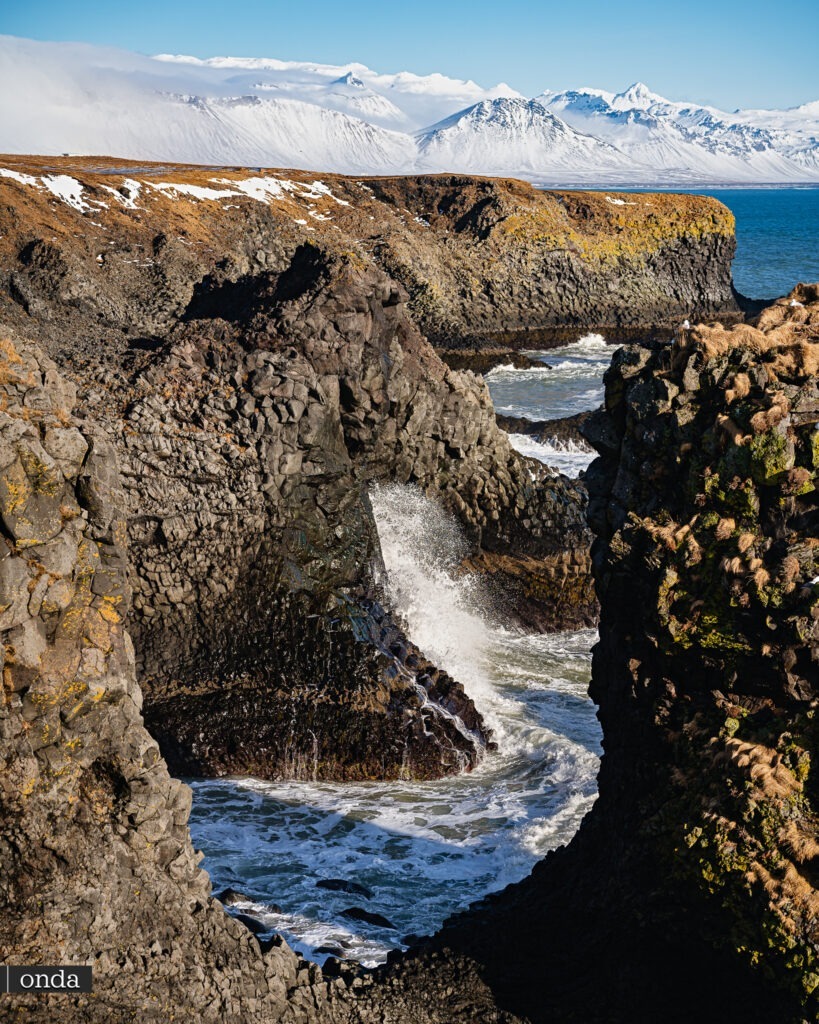
Table of Contents: Arnarstapi Snæfellsnes


What is UNESCO and what does the Biosphere Reserve status mean
UNESCO stands for United Nations Educational, Scientific and Cultural Organization. It is a UN agency established in 1945, whose goal is to support international cooperation in the fields of education, science, culture and communication, as well as the protection of world natural and cultural heritage.
Biosphere Reserve Status
This is a special distinction awarded by UNESCO as part of the “Man and the Biosphere Programme – MAB”.
? What does it mean?
- An area with special natural and/or cultural values, where actions are taken for environmental protection and sustainable development.
- It combines nature conservation with human activity, e.g., tourism, education, traditional crafts, or agriculture.
- It has the character of a model area where good practices in nature conservation and harmonious coexistence of humans with nature are tested.
? Biosphere reserves are divided into three zones:
- Core zone – most strictly protected (e.g., national parks).
- Buffer zone – surrounds the core, allows for e.g., scientific research, education, ecological tourism.
- Transition zone – an area where people live and the economy is developed in accordance with the principles of sustainable development.


Iceland Snaefellsnes what to see
I invite you to the entire article about the Snæfellsnes Peninsula
The Snæfellsnes Peninsula in Iceland is a picturesque land with a rich history and breathtaking nature. This peninsula is often called “Iceland in miniature” due to the diversity of landscapes that can be found here.
The history of the Snæfellsnes peninsula dates back to ancient times, when it was inhabited by Vikings and played an important role in their culture. The peninsula is also known for Icelandic sagas, which tell of legends and myths associated with this region.

What do Icelandic media / authorities say about the UNESCO distinction?
- The Minister of Environment, Energy and Climate emphasized that the Snæfellsnes community has been engaged in actions for sustainable development for years — including through EarthCheck certification, ecological education, and protection of natural resources. (stjornarradid.is)
- The Snæfellsjökull Park Directorate (“Þjóðgarðsverðir”) and local government authorities signed a declaration of intent to establish a UNESCO Man and Biosphere area for Snæfellsnes in 2022. (Snæfellsjökulsþjóðgarður)
- From UNESCO and AP News, it was reported that this area provides “a refuge for seabirds, seals and over 70% of Iceland’s vegetation” — including hundreds of species of flowers and ferns. (AP News)



Check out my YouTube channel and travel with me.
Follow the channel for videos, routes and practical travel inspiration.
Follow me here:
What’s up?
Enjoying my content?
Buy me a coffee at buycoffee.to/ondatravel and support the creation of more travel content.
Your support helps me create more practical guides, videos and travel inspiration.

Why is this important?
- Protection of unique ecosystems — Snæfellsjökull and its surroundings are a place of high natural, geological and cultural value.
- Responsible tourism — the biosphere reserve status can support the development of tourism that does not harm nature but uses it in a sustainable way.
- Myth, culture and literature — Snæfellsjökull was a literary backdrop, e.g., for Jules Verne’s “Journey to the Center of the Earth”, and a place of legends and sagas. The UNESCO status will increase its recognition.
- Sustainable local development — the region’s inhabitants will have greater motivation and support for educational, protective and research activities.


Challenges and prospects of the Snaefellsnes region
- Climate change — the Snæfellsjökull glacier is vulnerable to melting; its ice cover is decreasing. This requires monitoring and adaptive actions. (UNESCO)
- Balance between tourist traffic and protection — the greater the number of tourists, the greater the potential risk to delicate ecosystems. It is urgent to design tourist infrastructure in accordance with sustainable development principles.
- Involvement of local communities — it is crucial that residents see benefits in this, not just limitations. Education and cooperation are essential.
Official nomination and inscription to UNESCO
- UNESCO announced on September 27, 2025, that among 26 new biosphere reserves (in 21 countries), one of them is Snæfellsnes in Iceland. (AP News)
- In the UNESCO article – “26 new Biosphere Reserves” – we read that “…six countries are seeing the designation of their first biosphere reserve: … Iceland …” — which indicates that Snæfellsnes is the first area of this type in Iceland. (UNESCO)
- In the entry “Storkriket and Snæfellsnes: Two new Nordic UNESCO Biosphere Reserves” it was confirmed that Snæfellsnes was designated as the first biosphere reserve in Iceland: “The two Nordic Biosphere Reserves, Storkriket in Sweden and Snæfellsnes in Iceland, are among 26 new biosphere reserves … the first in Iceland.” (unric.org)


What area of Snaefellsnes was covered by the UNESCO distinction
- The reserve area has a surface area of ~ 1,460 km² (564 mi²) and includes diverse landscapes: volcanic peaks, lava fields, wetlands, meadows, grassy fields, as well as the Snæfellsjökull glacier. (AP News)
- The reserve is an important refuge for seabirds, seals and vegetation: it contains over 70% of Iceland’s flora, including 330 species of wild flowers and ferns. (AP News)
- In the context of the local population: the area is inhabited by over 4,000 people, and the region’s economy is based on, among others, fishing, sheep farming and tourism. (AP News)
UNESCO nomination process, local cooperation
- The submission to UNESCO was formally accepted (or accepted for consideration) as a step forward — although the final decision belongs to the International Coordinating Council of the Man and the Biosphere programme. (Iceland Review)
- The nomination was prepared in cooperation with the peninsula’s municipalities, non-governmental organizations and local stakeholders. In the Iceland Review article we read: “The nomination highlights decades of pioneering work on sustainability and resource management in Snæfellsnes,” — said Björg Ágústsdóttir, chair of the Snæfellsnes Regional Park.
- The nomination proposal was submitted in September 2024, after years of cooperation between local authorities, businesses and NGOs.
- In the nomination plan: Snæfellsjökull National Park would constitute the core area of the reserve, while the surrounding area (the Snæfellsnes regional park) would serve buffer and transition zone functions, supporting sustainable tourism, research and regional development.
Global context and challenges of the Snaefellsnes region in Iceland
- In the UNESCO communiqué, it was emphasized that the concept of biosphere reserves assumes coordination between scientists, residents and authorities, to balance nature conservation with social and economic needs.
- UNESCO indicates that about 60% of existing biosphere reserves face challenges related to climate change, extreme weather events and rising sea levels.
- In environmental media summaries, there is also a note that the applications for new biosphere reserves (including Snæfellsnes) were approved during the 5th UNESCO Biosphere Reserves Congress in Hangzhou, which represents the largest expansion of the network in 20 years. (UNESCO)


FAQ: Snæfellsnes UNESCO Biosphere Reserve – frequently asked questions
Is Snæfellsnes a UNESCO area?
Yes, the Snæfellsnes peninsula has been designated as Iceland’s first UNESCO biosphere area. This strengthens its importance when planning a trip around Iceland.
Why is Snæfellsnes important in an Iceland itinerary?
Snæfellsnes shows many Icelandic landscapes in a compact route: coastline, lava fields, volcanic scenery, small towns and viewpoints.
Can Snæfellsnes be seen in one day from Reykjavík?
Yes, but it will be an intense route. At a calmer pace it is better to plan an overnight stay on the peninsula or combine Snæfellsnes with a longer tour of Iceland.
How do I combine Snæfellsnes with other Iceland guides?
It is best to start with the main Iceland section and then pick a plan: Snæfellsnes in one day, Iceland in 7 days, the Golden Circle or the Ring Road along the South Coast.
Read also / next
Continue with Snaefellsnes, Iceland routes and nearby regions to build a stronger travel plan.
Snaefellsnes travel guide
The main guide to the peninsula, key stops, landscapes and route planning.
Open guideIceland travel
All English Iceland routes, regions and practical guides in one place.
Open IcelandIceland in 7 days
A practical route for combining the peninsula with the rest of Iceland.
See itineraryReykjavik travel guide
Use Reykjavik as a base or starting point before heading west.
Open ReykjavikGolden Circle
A classic Iceland route to compare with the Snaefellsnes peninsula.
Open routeContact
If you want to ask about a route, a travel plan, Northern Lights conditions, photography or cooperation with OndaTravel.pl, send a short message with the destination and the most important question in the subject line.



Sorry, the comment form is closed at this time.