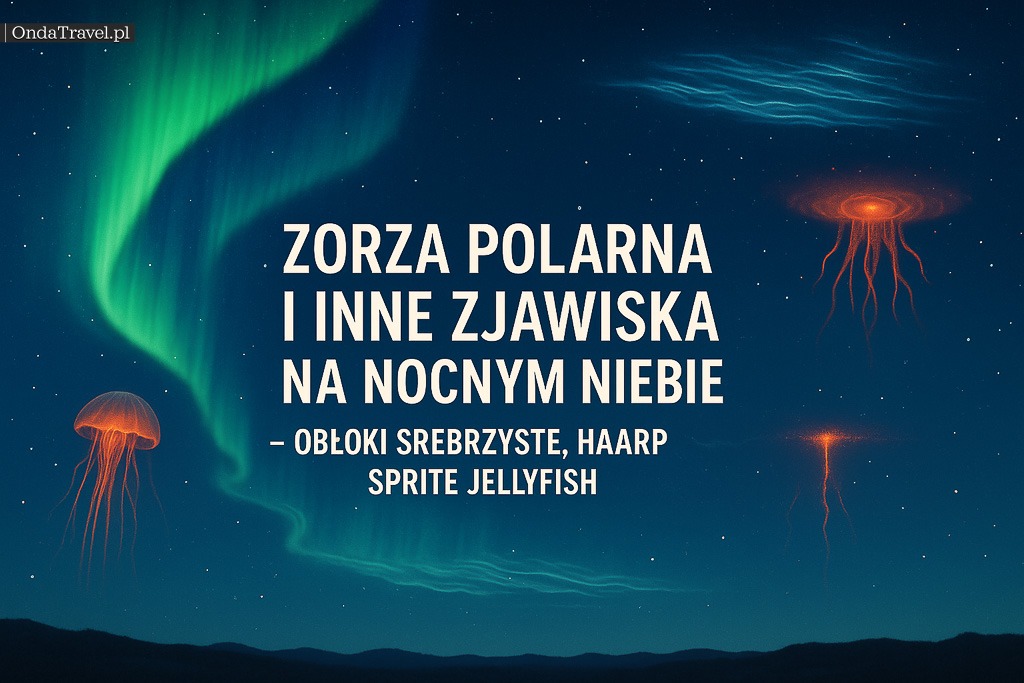
Northern Lights and Other Phenomena in the Night Sky – Noctilucent Clouds, Haarp, Sprite Jellyfish
Northern Lights and Other Phenomena in the Night Sky – Noctilucent Clouds, Haarp, Sprite Jellyfish
… what are the northern lights and how are the northern lights formed?


Can you see the northern lights over Poland? This is one of the questions I most often hear from travelers and night sky enthusiasts. The answer is: yes, although this phenomenon is rare in our country and requires the right conditions. That’s why more and more people are following the aurora radar and special forecasts that suggest when it’s worth looking up at the sky.
In this guide, I will show you how the northern lights are formed, where they occur in the world, and also explain when the northern lights have a chance to appear in the sky in Poland. I will also suggest whether this amazing phenomenon is in any way dangerous and answer directly: are the northern lights dangerous for humans.
If you dream of one day seeing the green and purple ribbons of light, follow the northern lights forecast for Poland with me. Together we will check if a cosmic spectacle awaits us tonight.
Northern Lights – Table of Contents


Northern lights over Poland – is it possible?

Northern lights over Poland – when and how to see them?
Northern lights in Poland – is it possible?
Yes, the northern lights can also be observed over Poland, although it is a rather rare phenomenon. They most often occur at higher latitudes, but under favorable conditions they can also be visible in Poland, especially in the north of the country.
Why do we have a better chance of seeing the aurora now?
We are currently going through a period of increased solar activity, the peak of which is expected in 2025. During the solar maximum, the number of solar flares and geomagnetic storms increases, which can cause the aurora to appear at lower latitudes. This means that we can more often expect magnetic storms and, as a result – northern lights visible even in Poland!
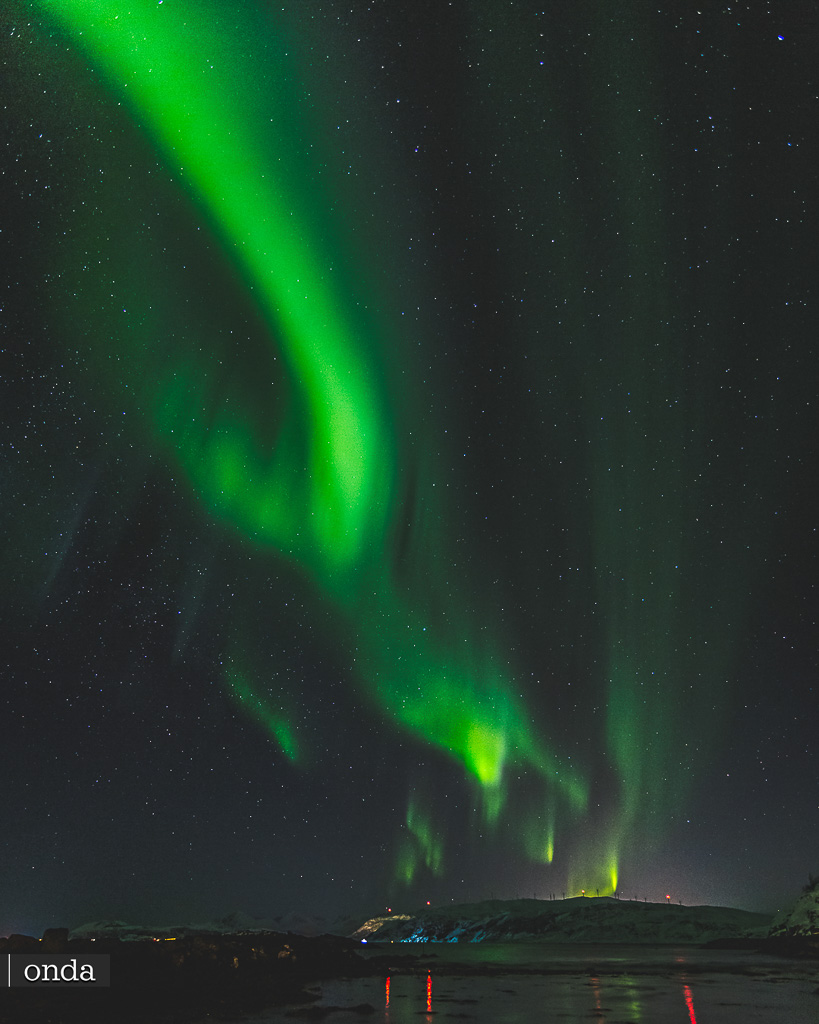
In the photo, the northern lights captured in Sopot on 10/11/2024


NASA and NOAA confirm
The 25th Solar Cycle has begun. Experts from NASA and NOAA announced that the solar minimum occurred in December 2019, marking the beginning of a new cycle. Scientists track the Sun’s activity by observing sunspots, which can be the source of powerful explosions such as solar flares or coronal mass ejections. NASA and NOAA are collaborating on space weather forecasts, which are crucial for protecting technology on Earth and astronauts in space. These forecasts will also support the Artemis program missions, preparing us for greater solar activity, the maximum of which is expected in July 2025.

Northern Lights – Northern Lights : cosmic spectacle on Earth
what are the northern lights?
Do you often wonder what the northern lights are, how the northern lights are formed, when to observe the northern lights, northern lights in Poland, aurora in Poland, but you don’t really know? I will answer these questions and many more in this article. If you want to see the most beautiful northern lights, I invite you on a trip, for example around Norway
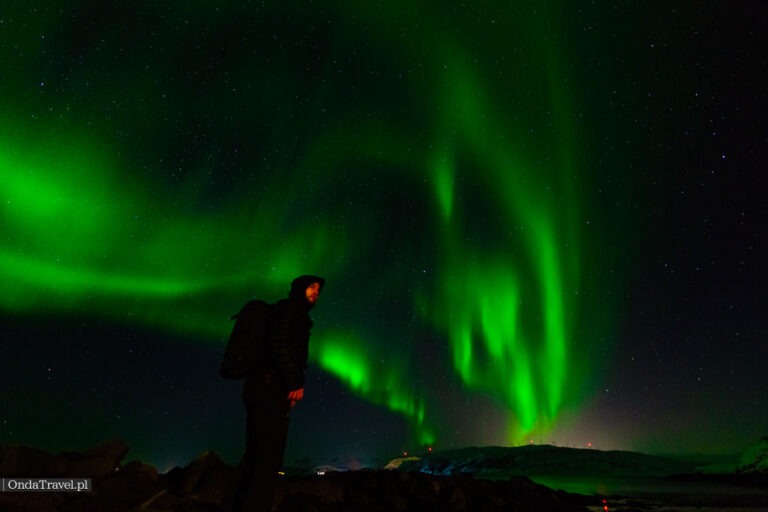
The northern lights, also called aurora borealis (Aurora Borealis) (in the northern hemisphere) and aurora australis (Aurora Australis) (in the southern hemisphere) , is a light phenomenon that amazes observers all over the world. This cosmic light show dances in the sky, painting it with colorful arcs, curtains and rays.
There are many different names for the northern lights. In Norwegian it is called “nordlys”, and in Finnish “revontulet”.
Aurora (disambiguation), Aurora Borealis (disambiguation), Aurora Australis (disambiguation), Northern Lights (disambiguation), and Southern Lights (disambiguation).
… what are the northern lights, what are the northern lights and how are the northern lights formed?
Northern Lights: how they are formed and where this phenomenon comes from
Northern Lights: full scientific analysis of the phenomenon, mechanisms, structures and variability in solar cycles
The northern lights (aurora polaris) is a phenomenon resulting from the interaction of solar plasma with the Earth’s magnetosphere and ionosphere. It is formed as a result of a series of physical processes involving the dynamics of the solar wind, magnetic reconnection, particle transport and photon emission at specific atmospheric altitudes.
The following description presents the aurora exclusively in scientific terms — with an emphasis on energy mechanisms, physical parameters, the structure of the phenomenon and variability related to solar cycles.
Northern Lights – key real-time parameters
from NOAA / Ovation – Kp Index and Aurora Radar
Aurora radar – northern lights today – northern lights

Aurora Radar OVATION
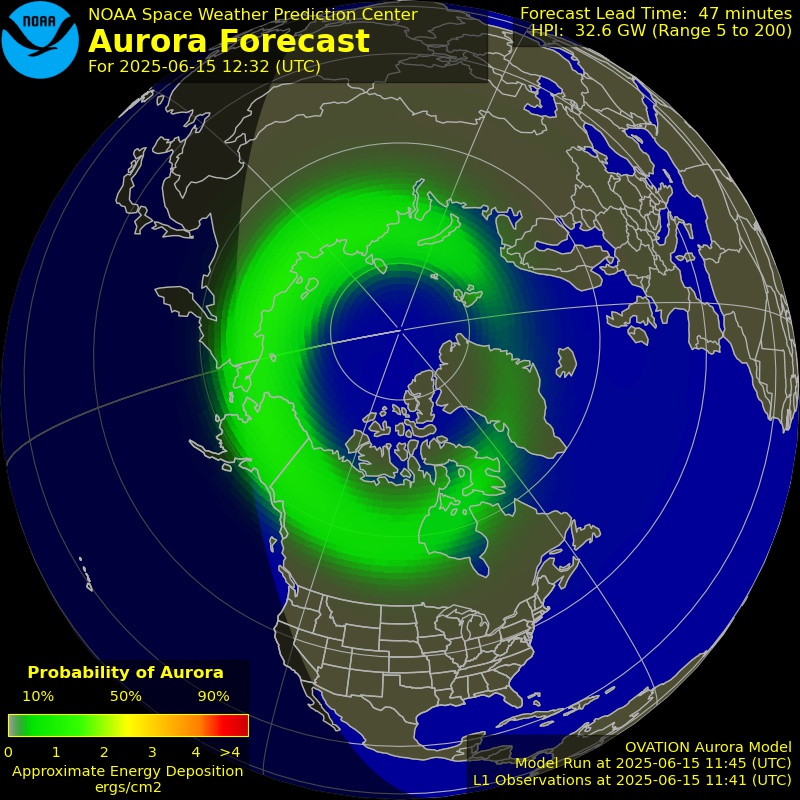
Aurora radar – NOAA Geomagnetic Activity Observation and Forecast
| Kp < 5 | Kp = 5 (G1) | Kp = 6 (G2) | Kp = 7 (G3) | Kp = 8, 9- (G4) | Kp = 9o (G5) |
|---|
I talk about the Northern Lights in one of the episodes of my podcast Onda 🛑 AIR
I invite you


Northern Lights – what types do we distinguish
Boreal aurora (Aurora Borealis):
- This is the most common type of northern lights, visible in the northern hemisphere.
- It occurs around the Arctic Circle, in countries such as Norway, Sweden, Finland, Iceland, Canada, Alaska and Russia.
- The most commonly observed colors are green, red, blue and purple.
- The color of the northern lights depends on the type of atoms or molecules that are excited by the charged particles from the solar wind.
- The boreal aurora can take various forms, such as arcs, bands, curtains and patches.
Australian aurora (Aurora Australis):
- This is a less known type of northern lights, visible in the southern hemisphere.
- It occurs around the Antarctic Circle, in countries such as Antarctica, New Zealand, Australia and Chile.
- The Australian aurora is very similar to the boreal aurora in terms of colors and forms.
- However, due to its location, it is more difficult to observe.
in which layer do the northern lights form, in which layer of the atmosphere do the northern lights occur, in which sphere do the northern lights occur, what is the name of the layer of the Earth’s atmosphere in which the northern lights form
Dune Aurora, also known as
wavy northern lights or sand auroras
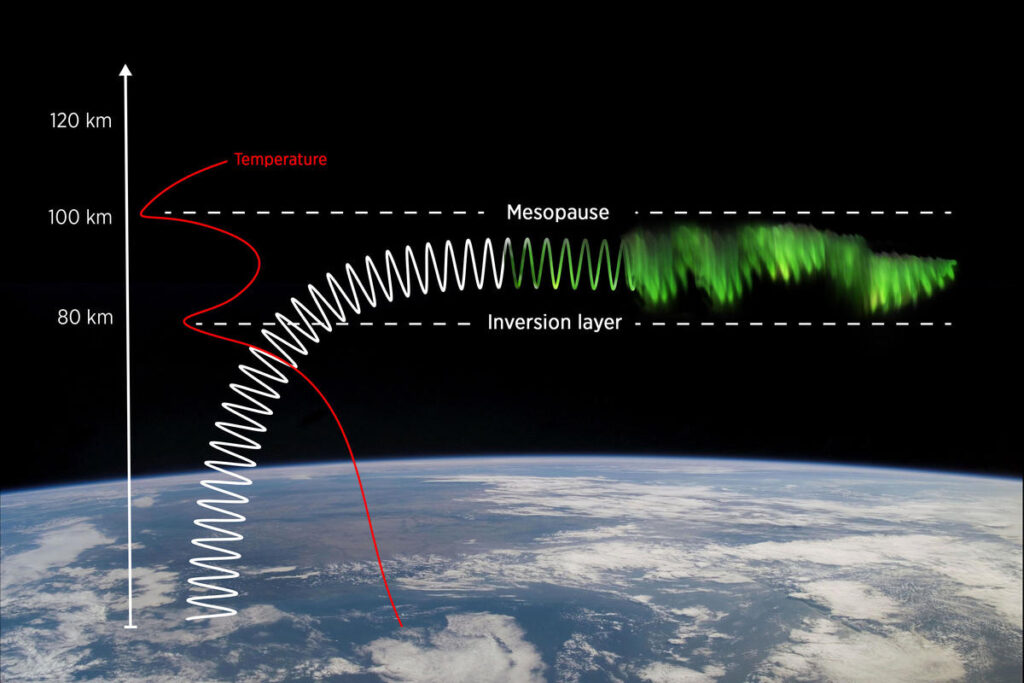
Dune Aurora, also known as wavy northern lights or sand auroras, is a rare type of northern lights characterized by a wavy or dune-like structure. This phenomenon is created as a result of the interaction between gravity waves and ionized particles in the Earth’s atmosphere. Dune Aurora were first observed in 2016 by a Finnish group of researchers.
Dune Aurora can be observed in polar regions such as Norway, Iceland and Canada. However, this phenomenon is relatively rare and difficult to predict. The best chances of observing it are on dark, cloudless nights when northern lights activity is high.
In addition to these two main types, there are also other, rarer types of northern lights, such as the polar aurora and subauroral aurora.


RELATED ATMOSPHERIC PHENOMENA
STEVE (Strong Thermal Emission Velocity Enhancement)
STEVE (Strong Thermal Emission Velocity Enhancement) is an optical phenomenon observed in the upper atmosphere. It appears as a purple-green ribbon of light and is sometimes visible next to the northern lights.
- It is a relatively new discovery, named by aurora observers from Alberta, Canada in late 2016.
- The name STEVE is a so-called backronym, an acronym created backwards to fit the full name of the phenomenon.
- The exact cause of STEVE is not yet fully understood, but it is known to be different from the northern lights. The aurora is created by the collision of particles (such as electrons and protons) with the Earth’s atmosphere, while STEVE is associated with a ribbon of hot gases.
- STEVE can sometimes be observed together with the northern lights, but they are two distinct phenomena.


Sprite Jellyfish
(red jellyfish)
Red jellyfish, also known as sprite, is a fascinating atmospheric phenomenon resembling a jellyfish in appearance. It is a flash that occurs high in the ionosphere, i.e., the layer of the Earth’s atmosphere located at an altitude of 50 to 1000 km above the surface.

How is a Sprite (red jellyfish) formed?
The formation of a red jellyfish is associated with electrical discharges in storms. During a strong storm, clouds accumulate huge amounts of electrical charges. These charges can be large enough to trigger discharges reaching the ionosphere. These discharges are called sprites.
Why is the red jellyfish that color?
The red jellyfish owes its color to light emission by nitrogen. Nitrogen molecules in the ionosphere are excited by the energy of the electrical discharge and then emit light of a characteristic red color.
- They can have a diameter of up to 30 kilometers.
- They can be visible from a distance of up to 500 kilometers.
- They were first photographed in 1989.
- Scientists still do not fully understand how red jellyfish sprites are formed.
Since 1886, sprites have been described in scientific literature, and sometimes even recorded as UFO activity. In 1925, C.T.R. Wilson[5] predicted their existence, and in 1956 even personally observed them, but this information was ignored. On the night of July 5-6, 1989, Professor John Randolph Winckler, a physicist from the University of Minnesota, along with his students – Robert Franz and Robert Nemzek – while testing an LLLTV camera (“low-light-level TV camera”) recorded two frames containing bright columns of light above the tops of thunderclouds in northern Minnesota[6]. This was the first documented evidence of this phenomenon, which the authors described as “light-to-stratosphere”; initially, this phenomenon was also referred to as cloud-to-space lightning (Eng. cloud-to-space lightning), but was quickly renamed to red sprite (Eng. red sprite)
WIKIPEDIA


? Lubisz moje treści❓ Ja lubię kawę ☕️
Wesprzyj mnie ? dorzucając się do jednej ?
Do you like my content? ❓ I like coffee ☕️
Support me by chipping in for one ☕️

Hej! 👋 Tu Krystian – fotograf, filmowiec, podróżnik i przewodnik.
Uwielbiam dzielić się z Wami tym, co odkrywam podczas moich podróży 🌍📸 uchwycić chwile, które inspirują. ☺️
Jeśli podoba Ci się to, co robię i chciałbyś, żebym mógł pokazać Wam jeszcze więcej – możesz mnie wesprzeć poprzez wpłatę na BuyCoffee ☕💛
Każda wpłata to dla mnie możliwość tworzenia jeszcze ciekawszych materiałów, wyjazdów i inspirujących historii.
Dzięki Twojemu wsparciu mogę kontynuować tę przygodę i zabierać Cię w miejsca, które warto zobaczyć! ✈️
buycoffee.to/ondatravel
Hey! 👋 It’s Krystian — a photographer, filmmaker, traveler, and guide.
I love sharing with you what I discover on my journeys 🌍📸 and capturing moments that inspire. ☺️
If you like what I do and you’d like to help me show you even more, you can support me with a donation on BuyCoffee ☕💛
Every contribution helps me create even more interesting content, trips, and inspiring stories.
Thanks to your support, I can keep this adventure going and take you to places worth seeing! ✈️



Zobacz więcej na Youtube
Zapraszam do subskrypcji mojego kanału, gdzie pojawiają sie filmy z ciekawych miejsc oraz Livestreamy podczas których możesz zadać
pytanie i poznać społeczność!
KODY RABATOWE NA TWOJE ZAKUPY

How the northern lights are formed
Northern Lights – Northern Lights :
cosmic spectacle on Earth
To understand the magic of the aurora borealis, we need to delve into some physics and the cosmos!

1. Source of the phenomenon – The Sun and solar wind


The source of the phenomenon are solar storms / magnetic storms. During these violent explosions on the Sun’s surface, huge amounts of charged particles are released, creating the so-called solar wind. These particles race through space at speeds of millions of kilometers per hour, carrying immense energy with them.


In the new post about the aurora borealis, you will find additional information: Coronal Holes , Coronal Mass Ejections (CME)
These maps show the local northern boundary of the aurora from the equator side at different levels of geomagnetic activity on October 28, 2011 – these maps change with the shifting position of the geomagnetic poles. A K-index of Kp= 3 corresponds to a relatively low level of geomagnetic activity, while Kp= 9 indicates a high level.
2. Earth’s Magnetic Field – The Protective Shield
Fortunately, we are protected from them by Earth’s magnetic field. It acts like a shield, deflecting most of the solar wind around the planet. However, some of the charged particles, mainly protons and electrons, become trapped in the magnetic field and are directed towards Earth’s magnetic poles.


3. Magnetic Traps – Gateways to the Aurora
Earth’s magnetic traps, also known as the Van Allen radiation belts, are two ring-shaped regions around Earth where charged particles from the Sun are trapped. These regions are shaped by Earth’s magnetic field and play a key role in protecting our planet from harmful cosmic radiation.
Types of magnetic traps:
- Inner magnetic trap: Located closer to Earth, at altitudes from 1,000 to 10,000 km. It mainly traps high-energy protons.
- Outer magnetic trap: Extends from 10,000 to 60,000 km from Earth and contains mainly high-energy electrons.
However, Earth’s magnetic field is not perfectly symmetrical. It has weaker points, like the two magnetic poles, around which so-called magnetic traps form. They act like funnels, capturing solar wind particles and directing them towards the poles.
OBJAZDOWE WYCIECZKI PO ISLANDII

Polowanie na zorze polarne
Islandia
Wybierz się z nami w niezapomnianą podróż na Islandię zimą i podziwiaj spektakularną zorzę polarną!
Wycieczka objazdowa po Islandii w zimie, szczególnie połączona z polowaniem na zorzę polarną, to prawdziwa gratka dla miłośników natury i przygód!
Surowe piękno wyspy rekompensują wszystko. Dlatego Islandia to idealne miejsce na zimową wycieczkę czy ferie ze zgraną kameralna grupa.
Zobacz jakie zdjęcia Zrobisz podczas tej wycieczki po krainie ognia i lodu. Sprawdź mój profil na Facebooku i Instagramie lub Youtube

Aurora Borealis – Norway trip
4. Particle Collision – The Birth of the Aurora Borealis
It is precisely above the poles that the spectacular encounter occurs. When the charged solar wind particles reach the magnetic traps, they collide with atoms and molecules of gases in the upper layers of Earth’s atmosphere (mainly oxygen and nitrogen). These collisions excite these molecules, which then emit energy in the form of light – this is how the aurora borealis is born!

The aurora borealis is not a uniform phenomenon. It often takes the form of arcs, light curtains, or scattered patches, and its intensity and colors can change dynamically. This phenomenon is influenced by many factors, including the strength of the solar storm, the density of gases in the ionosphere, and the angle at which particles hit the atmosphere.

5. What Determines the Color of the Aurora Borealis


The color of the aurora borealis depends on the type of excited atom or molecule. The most common colors are:

Green: Emitted by excited oxygen atoms at an altitude of about 100 km above the Earth’s surface.
Red: Created by the excitation of oxygen atoms at higher altitudes, about 200-300 km.
Blue: Emitted by nitrogen molecules at an altitude of about 90 km.
Purple: Less common, created by the combination of red and blue.
In which atmospheric layer does the aurora borealis form
What is the name of the Earth’s atmospheric layer where auroras form
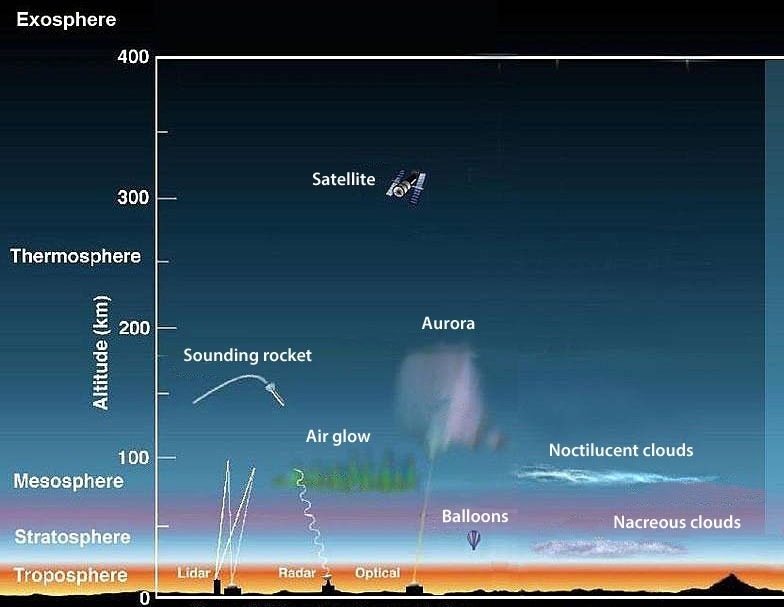
Auroras form high in the Earth’s atmosphere, in a layer called the thermosphere, which extends above the mesosphere. It is there, at altitudes from about 80 to even 500 kilometers above the Earth’s surface, that atmospheric molecules collide with charged solar wind particles, leading to the creation of the spectacular glow. This phenomenon occurs within the ionosphere, the ionized part of the thermosphere, which is particularly susceptible to the influence of Earth’s magnetic field. Although the mesosphere is located below and is not the main site of aurora formation, it is the transition between the mesosphere and thermosphere that marks the lower boundary of the area where this amazing phenomenon can be observed.
Answering the questions … in which atmospheric layer does the aurora occur … in which sphere does the aurora occur … in which atmospheric layer does the aurora form
The aurora occurs in the thermosphere, a layer of Earth’s atmosphere located at an altitude from about 80 to 600 kilometers above the Earth’s surface.


Aurora Borealis and Its Structures
I wrote about the structures of the aurora borealis themselves in the new post, and in it you will learn about Arcs (Auroral Arcs), Curtains (Auroral Curtains), Rays, Diffuse Aurora
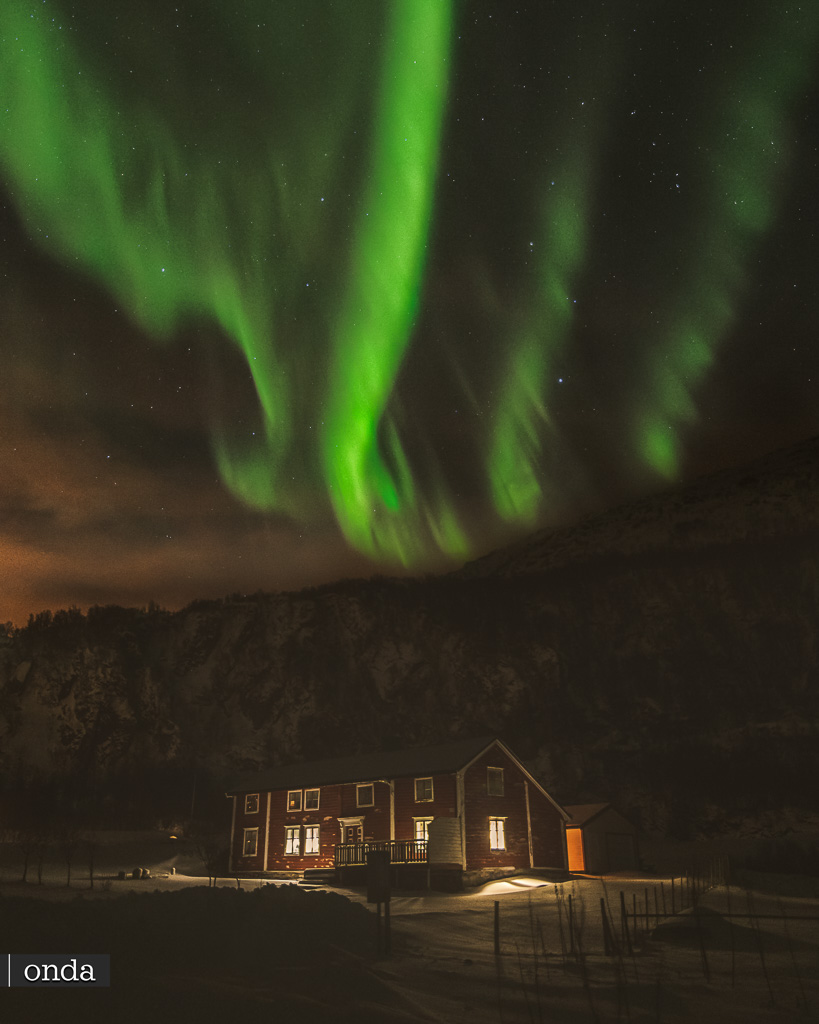
6. Aurora Location – Where to Watch the Cosmic Spectacle?
The aurora borealis is easiest to observe around Earth’s magnetic poles, i.e., in the north (aurora borealis) and south (aurora australis). This happens because the magnetic field lines converge in these regions, directing more solar wind particles there.
The best conditions for observing the aurora occur in the polar regions, such as Greenland, Alaska, northern Canada. In Europe, the aurora can be admired in Norway, Finland, Sweden, Iceland, and even in the northern part of Poland. This happens because Earth’s magnetic field lines converge in these regions, leading to a greater concentration of charged particles. Areas with low light pollution and clear skies are particularly favorable for aurora observation.
The aurora borealis is not only a beautiful spectacle but also a fascinating scientific phenomenon. Studying the aurora helps us better understand processes occurring on the Sun and in Earth’s atmosphere, and also to learn about the nature of our planet’s magnetic field.
It is worth mentioning that auroras can also be observed in Poland, although this phenomenon is rarer and less intense here. The best chances of admiring the aurora in our country occur in winter, during clear weather and near the borders with Scandinavia.
OBJAZDOWE WYCIECZKI PO NORWEGII
Polowanie na zorze polarne
Tromso i wyspa Senja Norwegia
Wycieczki Norwegia – Weekendowe polowanie na zorze polarną w Norwegii październik i kwiecień.
Zapraszamy na niezapomniane polowanie na zorzę polarną aurora borealis w Tromsø i Senja, w magicznej Norwegii! Już niedługo podziwiać będziemy taneczną grę świateł na nocnym niebie. Przygotujcie aparaty i ciepłe ubrania, ponieważ czeka nas niesamowita przygoda. Szczegóły już wkrótce!
Zobacz jakie zdjęcia Zrobisz podczas tej wycieczki po krainie ognia i lodu. Sprawdź mój profil na Facebooku i Instagramie lub Youtube
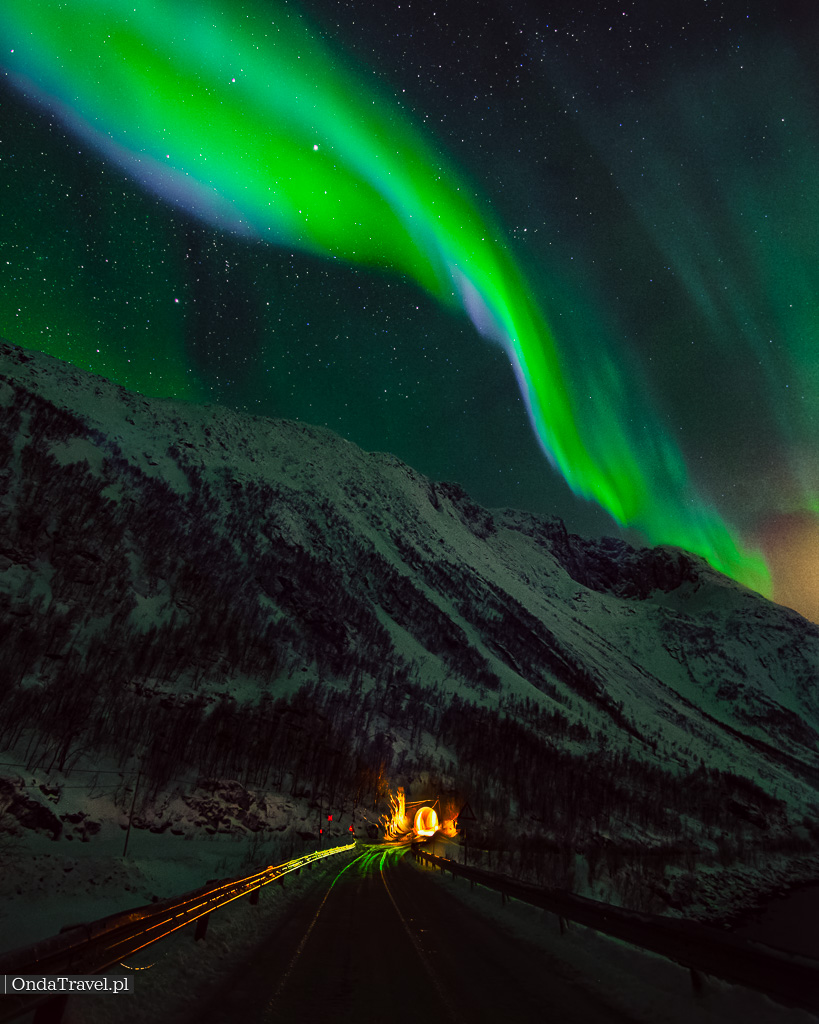
Aurora Borealis – Norway trip


7. KP Coefficient and Density – Two Important Indicators in Aurora Observation
To effectively plan an aurora hunt, in addition to knowing weather forecasts and location, it’s also worth paying attention to two important indicators: the KP coefficient and density.
Auroral activity charts updated in real time
Below you will find the latest information regarding the solar wind and interplanetary magnetic field from the last 24 hours, measured by the Deep Space Climate Observatory (DSCOVR) located at the Sun-Earth L1 point. These parameters are the first ones used to predict auroral activity. The redder they are, the better the auroral activity! At the current speed, it will take the solar wind 45 minutes to propagate from DSCOVR to Earth.
1. KP Coefficient (Planetary K-index)
The KP coefficient is a global indicator of Earth’s geomagnetic activity, indicating the level of disturbances caused by the solar wind. The KP scale ranges from 0 to 9, where 0 means minimal activity and 9 means extremely high activity. The higher the KP coefficient, the greater the chance of strong and widespread auroras, visible even in areas located at lower latitudes than the polar circle.
Information about the current and forecasted KP coefficient can be found on numerous websites dedicated to space weather forecasts, including:
- AuroraWatch Europe: https://www.aurora-service.eu/
- SpaceWeatherLive: https://www.spaceweatherlive.com/
- The Weather Channel: https://weather.com/
- NOAA SWPC Planetary K-index
This is the planetary K-index from NOAA SWPC. It is a preliminary Kp index that is updated every minute by NOAA SWPC, estimating the measured Kp over the last 3 hours based on eight ground-based magnetometers worldwide. This estimated 3-hour planetary Kp-Index consists of 10 values ranging from 0 to 9. It is important to understand that this Kp-index is not a forecast or indicator of current conditions; it always shows the Kp value for a certain observed period. - GFZ Potsdam Quicklook Kp-index
This is the Quick Look Kp-index from the GFZ German Research Centre for Geosciences. It is a preliminary Kp index that estimates the Kp-index in 3-hour periods. It is expressed on a scale of thirds and has 28 values. - GFZ Potsdam Quicklook Geomagnetic ap-index
The ap index is a 3-hour “equivalent amplitude” indicator that expresses the range of disturbances in the horizontal components of the magnetic field and is directly related to the Kp index. The daily Ap index is calculated as the average of eight ap values from a given day. The A index was created because there was a need to develop some kind of daily average of geomagnetic activity. Due to the nonlinear relationship of the K scale with magnetometer fluctuations, it makes no sense to average a set of K indices.
2. Aurora Density BZ
Aurora density specifies the intensity and brightness of the phenomenon. Aurora density is usually given in degrees of magnitude or sabins. The higher the value, the brighter and more spectacular the aurora.
Unfortunately, aurora density is more difficult to estimate accurately in advance. Information about the current aurora density in a given location can be obtained from local astronomical observatories or aurora observation groups.
3. Interpretation of KP and Density Indicators:
- KP 0-2: Aurora borealis probably will not be visible, even in polar areas.
- KP 3-4: Aurora borealis may be visible in polar and subpolar areas under favorable weather conditions.
- KP 5-6: Aurora borealis may be visible in subpolar areas, and even at lower latitudes under favorable weather conditions.
- KP 7-9: Aurora borealis may be visible worldwide under favorable weather conditions.
I invite you to follow my social media portals, where I try to share my discoveries in the form of photos and videos not only from Iceland
8. Best Places in Norway to Observe the Aurora Borealis
Norway is famous for having some of the best places in the world to observe the aurora borealis. This is due to the country’s location in the auroral zone, where Earth’s magnetic field lines converge, directing more solar wind particles towards them.
Here are some of the best places to observe the aurora borealis in Norway:
- Tromsø: Known as the “Capital of the Northern Lights,” Tromsø is one of the most popular places to observe the aurora. The city lies above the Arctic Circle and offers long, dark nights in winter, creating ideal conditions for watching this phenomenon.
- Alta: Located about 300 km east of Tromsø, Alta is another great place for aurora observation. The city is known for its clear skies and low level of light pollution, ensuring excellent visibility.
- Svalbard: The Svalbard archipelago lies much further north than mainland Norway, making it one of the best places in the world to observe the aurora. The aurora can be admired here even during the day, and the nights are extremely dark and long.
- Lofoten: The Lofoten archipelago is famous for its beautiful landscapes and stunning views of the aurora borealis. The islands lie above the Arctic Circle and offer long, dark nights in winter, making them an ideal place to observe this phenomenon.
- Senja: Senja Island is the second largest island in Norway and is becoming an increasingly popular place for aurora observation. The island is known for its clear skies and low level of light pollution, ensuring excellent visibility.
Astronomical Observatory – right in the center of Tromso:
Tromsø Geofysiske Observatorium (Nordlysobservatoriet): This is a real astronomical observatory conducting research on the aurora borealis and other cosmic phenomena. Unfortunately, it is not open to visitors. It is located at Prestvannvegen 40, 9011 Tromsø
Northern Norwegian Science Center: This science center has a planetarium where you can watch aurora borealis shows. It’s a great option for people who want to learn more about this phenomenon in an accessible way. The center is located at Hansine Hansens veg 17, 9019 Tromsø
Planetariet playground: This is a children’s playground with a space theme. It is located at Hansine Hansens veg 19, 9019 Tromsø

SENJA ISLAND BEYOND THE ARCTIC CIRCLE – TROMSO NORWAY – WHAT IS WORTH SEEING

I invite you to the article/post about Tromso and Senja Island


9. How to Check When and Where the Strongest Aurora Borealis Will Appear?
To plan a successful aurora hunt, it’s worth using several useful tools and websites:
1. Websites forecasting the aurora:
- AuroraWatch Europe: https://www.aurora-service.eu/aurora-forecast/ – European site with aurora forecasts for various regions of Europe. Offers real-time aurora activity maps and forecasts for several days ahead.
- The Weather Channel: https://weather.com/ – The well-known weather site also has a section dedicated to the aurora borealis. You’ll find aurora activity maps, 3-day forecasts, and information about current weather conditions.
- SpaceWeatherLive: https://www.spaceweatherlive.com/ – Site focusing on space weather forecasts, including auroral activity. Offers detailed aurora activity maps and animations, KP-index forecasts, and information about current solar flares.
2. Mobile applications:
- My Aurora Forecast & Alerts: https://play.google.com/store/apps/details?id=com.jrustonapps.myauroraforecast – Mobile app with aurora forecasts for a given location and information about current geomagnetic activity.
- Aurora Now – Northern Lights: https://play.google.com/store/apps/details?id=com.vnilapps.auroranow – Another popular mobile app with aurora forecasts, notifications about upcoming light shows, and observation tips.
3. Local astronomical observatories and observation groups:
In many regions where the aurora frequently appears, there are local astronomical observatories and groups of aurora enthusiasts. They often provide current information about aurora visibility in a given area and also organize tours and observation meetings. It’s worth checking the websites or social media of such groups in your planned observation location.
4. General tips:
- Winter period: The aurora borealis is best observed in the winter period, from September to April, when the nights are long and dark.
- Outside the city: Avoid observations near cities, where light pollution hinders aurora observation.
- Clear weather: Clear skies are essential for good aurora visibility.
- Patience: Aurora observation requires patience. Sometimes you have to wait a while for the light show to appear.
Remember that aurora forecasts are not 100% certain, but they provide valuable guidance that can significantly increase your chances of successful observations.
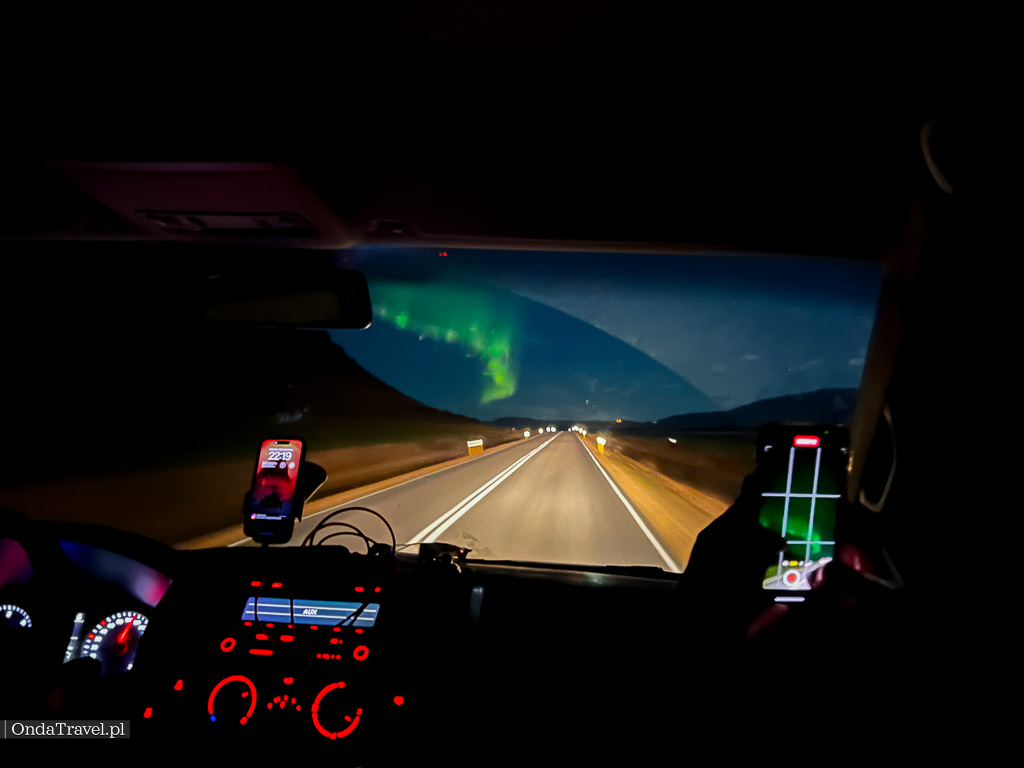
AURORAS IN ICELAND
Iceland at night – hunting for the aurora borealis and arctic adventures!
During our trips to Iceland in the autumn-winter period, we also hunt for auroras. After a whole day of visiting the most beautiful places in Iceland, the culmination is looking for Northern Lights in a group.
Do you dream of an unforgettable adventure under the stars, where nature delights at every turn? Come with us to Iceland in autumn or winter to discover the magic of the arctic night!

Wonderful landscapes and unforgettable experiences:
- Visit the most beautiful corners of Iceland – geysers, waterfalls, glaciers, black beaches and fjords.
- Feel the power of nature during trekking trails.
- Visit picturesque towns and villages to get to know Icelandic culture and local customs.
- Bathing in hot springs is the perfect way to relax after a day full of impressions.
- In the evening set off on an aurora hunt – the lights dancing in the sky are a spectacle that takes your breath away!
Iceland is the perfect place for:
- Nature lovers and active recreation
- Photographers wanting to capture breathtaking landscapes
- Aurora hunters
- People wanting to break away from everyday life and experience something special
Check our latest dates and book your dream trip today!

WYCIECZKI OBJAZDOWE PO ISLANDII
WYCIECZKA OBJAZDOWA PO ISLANDII

PLAN NA CZTERODNIOWĄ
WYCIECZKĘ PO ISLANDII
WYCIECZKA OBJAZDOWA PO ISLANDII
PLAN NA SIEDMIODNIOWĄ
WYCIECZKĘ PO ISLANDII
ISLANDIA POLOWANIE NA ZORZĘ POLARNĄ ZIMĄ
PLAN NA PIĘCIODNIOWĄ
WYCIECZKĘ PO ISLANDII
What is the aurora borealis and how is it formed
Aurora Borealis – Northern Lights : A Cosmic Spectacle on Earth
10. Solar Cycle and the Aurora Borealis
There is a strong connection between the solar cycle and the aurora borealis. The solar cycle is an 11-year period during which the Sun’s activity changes from minimum to maximum. During solar maximum, the Sun is more active, ejecting more plasma and coronal mass ejections (CMEs). These ejections carry charged particles that interact with Earth’s magnetic field, causing the aurora borealis to form.

During solar maximum, auroras are visible more often and more intensely. They can be visible even at lower latitudes, where this phenomenon is usually rarely observed. In 2023, during the last solar maximum, auroras were visible in many places in Europe, and even in Poland.
On the other hand, during solar minimum, auroras are rarer and weaker. They may only be visible at high latitudes, such as the Arctic and Antarctic. In 2019, during the last solar minimum, aurora observations were much rarer.
In 2019, a team of scientists collaborated with the NOAA Space Weather Prediction Center (SWPC) to develop a preliminary forecast for Solar Cycle 25, which began in December 2019.
This forecast predicted that the cycle’s maximum would occur between December 2024 and April 2025, and the average annual sunspot number (Wolf number) would be about 110.
However, later observations and analyses led to a revision of this forecast. It is currently estimated that the maximum of Solar Cycle 25 will occur between January and October 2024, and the average annual sunspot number will be about 155.
This change results from a better understanding of the processes occurring on the Sun and the influence of various factors on its activity.
It is also worth mentioning that forecasting the solar cycle is a complex task and involves many uncertainties. Even the best scientific models cannot predict with complete accuracy how the next cycle will proceed.
Here are some sources where you can find more information about solar cycle forecasts:
- NOAA SWPC: https://www.swpc.noaa.gov/forecasts
- NASA Solar Dynamics Observatory: https://sdo.gsfc.nasa.gov/
- SpaceWeatherLive.com: https://www.spaceweatherlive.com/
Remember that information about the solar cycle is constantly updated as new data comes in.

11. Artificial Aurora Borealis:
latest research and facts
That’s right, recent research on the aurora borealis focuses on the development of technology for artificially inducing it. This innovative field evokes many emotions and opens doors to fascinating possibilities, but at the same time raises ethical and legal questions.
Potential applications of artificial aurora:
- Scientific research: Artificial aurora could become a valuable tool for scientists, enabling them to study the ionosphere, the influence of the solar wind on Earth, and other cosmic phenomena.
- Tourism: The artificial phenomenon could expand the tourist offer, attracting crowds of observers to places where the natural aurora is rarely visible.
- Military: Unfortunately, artificial aurora could potentially be used for military purposes, to disrupt enemy navigation and communication systems.
12. Artificial Aurora and HAARP:
Facts and Myths
Although the HAARP program (High-Frequency Active Auroral Research Program) does indeed use powerful radio transmitters to study the ionosphere, there is no evidence that it is used to induce artificial aurora.
There are many conspiracy theories surrounding HAARP, linking it to various phenomena, including earthquakes, weather anomalies, and even mind control. However, these theories have no basis in facts and have been repeatedly debunked by scientists.

Facts about HAARP:
- It was launched in 2002 in Alaska by the US Navy and the University of Alaska Fairbanks.
- The main goal of the program is to study the ionosphere, the layer of Earth’s atmosphere located at an altitude from 50 to 1000 km.
- Powerful radio transmitters are used for research, which send beams of radio waves into the ionosphere.
- This research helps us better understand how the ionosphere affects radio communication, navigation systems, and satellites.
SKYGLOWPROJECT.COM: HAARP BOREALIS from Harun Mehmedinovic on Vimeo.
Myths about HAARP:
- HAARP can cause earthquakes and other natural disasters. There is no evidence to support this claim. HAARP emits radio waves at frequencies that cannot penetrate the Earth and cause earthquakes.
- HAARP can control people’s minds. This is nonsense. The radio waves emitted by HAARP do not have enough power to penetrate the skull and affect the brain.
- HAARP is a secret military program with evil intentions. HAARP is a research project that is openly reported on the program’s website (https://haarp.gi.alaska.edu/).
In summary:
- HAARP is not used to induce artificial aurora.
- Conspiracy theories about HAARP have no basis in facts.
- HAARP is a research program that helps us better understand the ionosphere.
The HAARP facility in Alaska will create an artificial #aurora for 4 nights, using radio pulses to excite electrons in the ionosphere & mimic the natural phenomenon of the northern lights. The beautiful nighttime light show will be widely visible for those in Alaska. pic.twitter.com/3M11Y4SRfo
— Byte (@ByteEcosystem) November 7, 2023
13. Curiosities about the Aurora Borealis:
The aurora borealis is not a sound: Contrary to popular belief, the aurora borealis does not emit any sound.
In the past, the aurora was called dancing spirits: People from different cultures had different beliefs about the aurora borealis. For example, the Sami believed they were the dancing spirits of the dead, while the Vikings thought it was a bridge leading to Asgard.
The aurora can be seen from space: The aurora is so bright that it can be seen even from space. Astronauts often report observing the aurora during space missions.
The aurora also occurs on other planets: The aurora has been observed on Jupiter, Saturn, Uranus, and Neptune.
The aurora is a great photographic phenomenon: The aurora is a beautiful and photogenic phenomenon.
The aurora can affect navigation systems: Strong geomagnetic storms can disrupt the operation of navigation systems such as GPS.
The aurora can cause power grid failures: Strong geomagnetic storms can also cause power grid failures. In 1989, a geomagnetic storm caused a blackout in Canada that affected over 6 million people.
The aurora can be visible even during the day, but it is more difficult to spot due to sunlight.
There is a special type of aurora, called subauroral aurora. It is visible at lower latitudes and appears as a faintly visible haze.
Scientists are developing technology that will enable the artificial induction of the aurora.
The aurora can affect human health: Some studies suggest that the aurora may have a negative impact on human health, causing headaches, fatigue, and sleep problems.
Happy aurora hunting!

Aurora Borealis – Nature’s Spectacular Show
Wondering what the aurora borealis is and how it forms? It is an amazing light phenomenon that we can observe in the night sky, especially around Earth’s magnetic poles. It is formed as a result of collisions between charged solar wind particles and the upper layers of our planet’s atmosphere. These collisions cause the emission of light, which creates characteristic, colorful streaks and arcs. But when is the aurora borealis visible? It depends on many factors, such as solar activity, time of year, and geographic location.
Aurora Borealis in Poland is a relatively rare phenomenon, but possible to observe, especially during intense solar storms. The best chances of seeing the aurora in our country are in the northern regions, away from city lights. When is the aurora borealis in Poland? Most often in autumn and winter, during periods of increased solar activity.
Aurora Borealis in Norway is a much more common sight. Scandinavian countries are among the best places in the world to observe this phenomenon. Aurora borealis in Norway when? The best months are September-April, when the nights are longest. Popular places to admire the aurora are Lofoten, Tromsø, or northern Norway.
I invite you to AURORA HUNTING – SENJA – TROMSO NORWAY
Aurora Borealis in Iceland is another incredible experience. Iceland, due to its geographical location, offers excellent conditions for observing the aurora borealis. Where does the aurora occur in Iceland? Practically all over the country, especially away from large cities.
I invite you to Iceland round trip – aurora hunting or to Aurora Camp with NocneNiebo.pl
In summary, where can we see the aurora borealis? Most often in countries located near Earth’s magnetic poles, such as Norway, Iceland, Canada, or Alaska. Where is the aurora visible in Poland? Best in the northern regions, during intense solar storms. It is a phenomenon that delights with its beauty and mystery. If you dream of seeing the aurora borealis, it’s worth planning a trip to one of the places where it is a frequent guest in the night sky.
The aurora borealis is an extraordinary, colorful light phenomenon in the night sky that has fascinated people for centuries. It is formed as a result of the interaction of charged solar wind particles with the upper layers of the Earth’s atmosphere, mainly around the magnetic poles. If you want to admire this spectacular dance of lights, it is worth going on a trip to Norway or Iceland, where observing the aurora borealis is particularly popular. Do you dream of seeing the aurora borealis today? Check the current forecasts and set off to conquer the polar landscapes, e.g., I invite you to the “Aurora Borealis Iceland” trip. Photos of the aurora are an unforgettable souvenir from such a trip. Where does the aurora occur most often? In Scandinavian countries, Alaska, or Canada. And did you know that Aurora is the Latin name for the aurora borealis? It is she who creates these incredible patterns and colors in the sky.
I hope I have developed answers to the most frequently asked questions: how is the aurora formed, what is the aurora, aurora when, what does the aurora look like, what is the aurora, when is the aurora in Poland, where does the aurora occur, aurora where, where is the aurora, aurora Norway, aurora in Poland, aurora where visible, aurora Norway when, aurora Iceland when
13. Noctilucent Clouds – Noctilucent Clouds NLC
Have you ever looked at the night sky and seen delicate, glowing clouds that seem almost magical? Those are noctilucent clouds, known in English as noctilucent clouds. These rare and beautiful atmospheric phenomena attract the attention of both sky enthusiasts and scientists. In this article, you will learn what noctilucent clouds are, how they form, when and where you can see them, and how to photograph them. We will also look at the science behind this phenomenon and its historical significance.
The name Noctilucent Clouds comes from Latin and literally means “night-shining clouds”:
The name Noctilucent Clouds comes from Latin and literally means “night-shining clouds”:
nocti – – from noctis, meaning “night”
– lucent – from lucere, meaning “to shine”, “to glow”
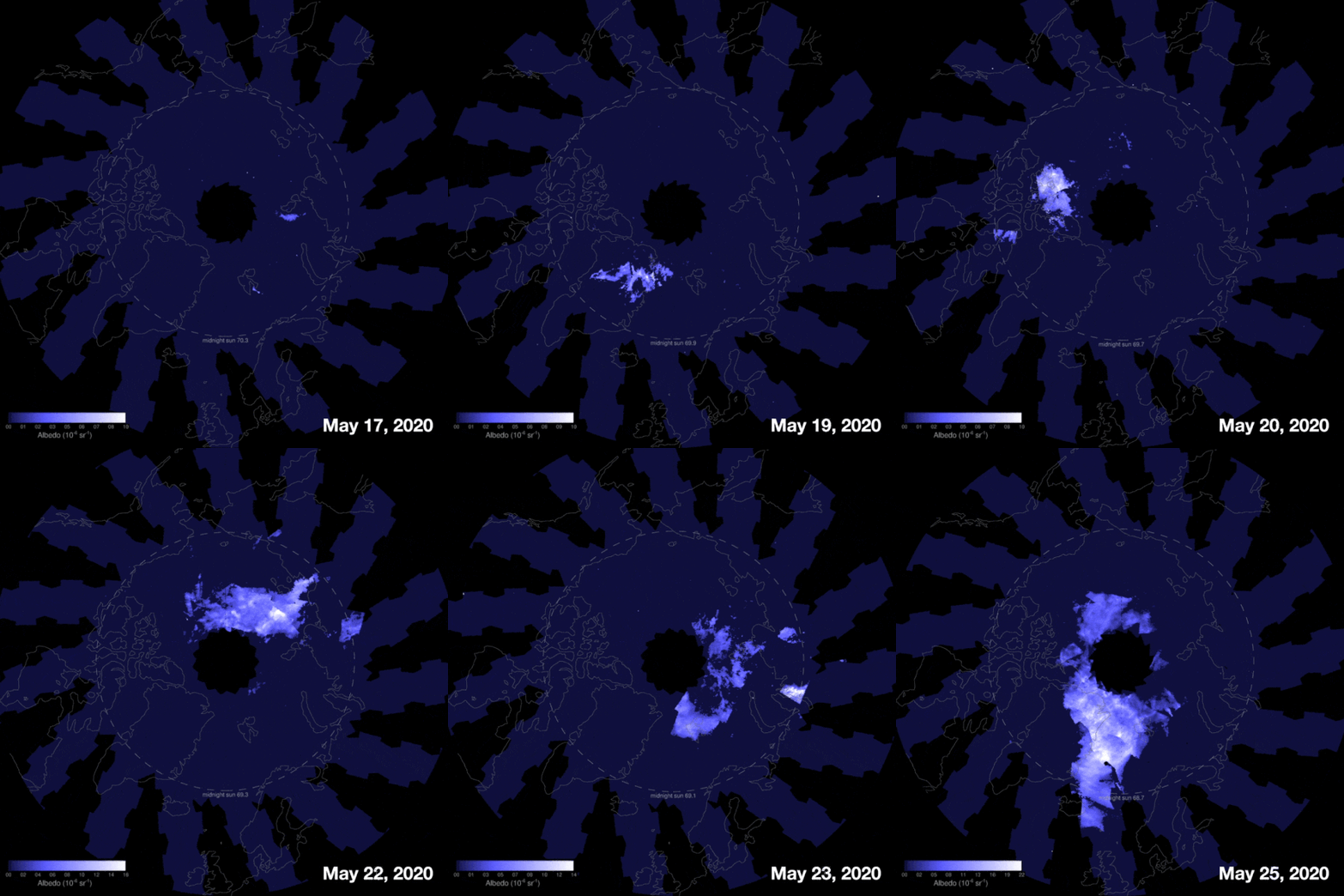
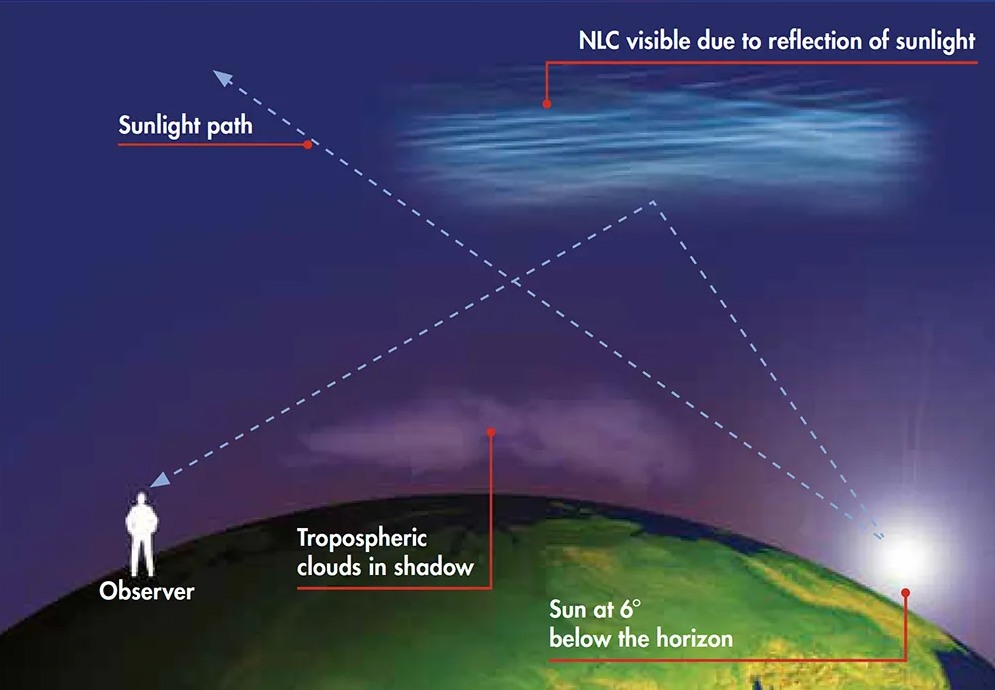
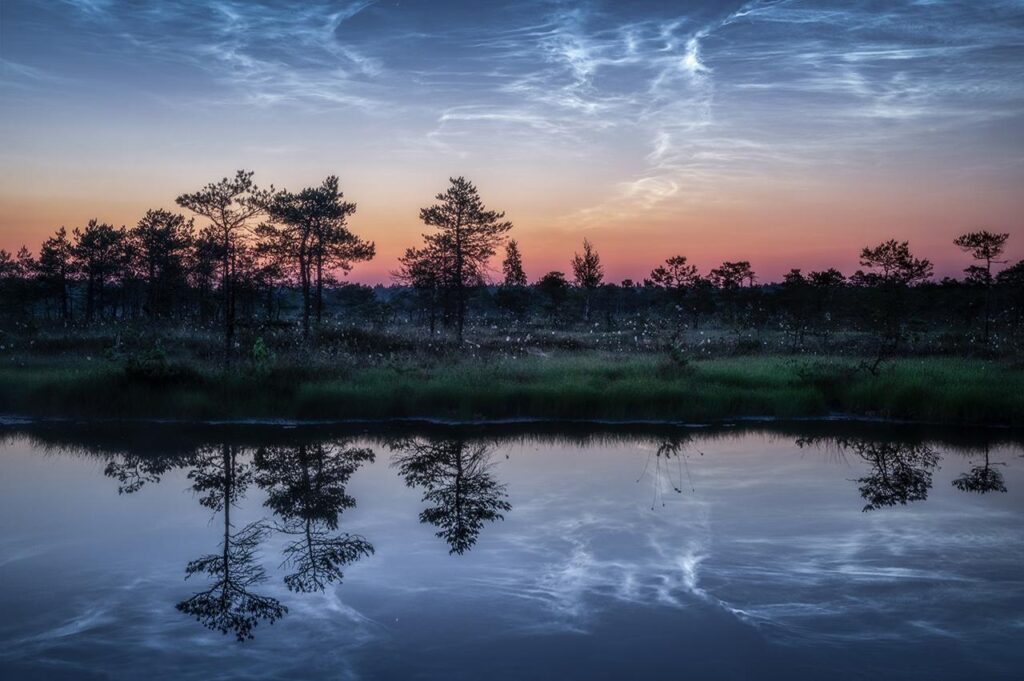
Noctilucent Clouds, i.e., noctilucent clouds, are very high mesospheric clouds that appear in the upper layers of the atmosphere – at an altitude of about 75–85 km – and are visible only at dusk or dawn, when the Sun is just below the horizon and illuminates them from below. Their name therefore directly refers to their remarkable characteristic: glowing at night, even though other clouds are no longer visible.
This phenomenon occurs mainly in summer, at high latitudes – e.g., in Scandinavia, Iceland, or northern Poland.
What are noctilucent clouds?
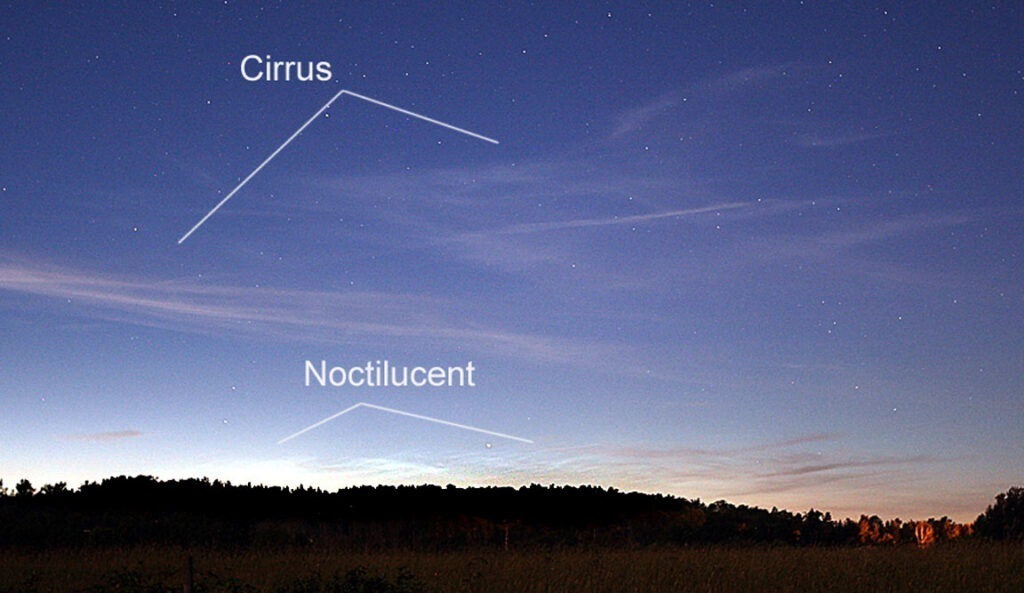
Noctilucent clouds are the highest clouds in the Earth’s atmosphere, forming in the mesosphere at altitudes from 76 to 85 kilometers above the Earth’s surface. Unlike ordinary tropospheric clouds, which consist of water droplets or ice crystals, noctilucent clouds are composed of tiny ice crystals that reflect sunlight, giving them their characteristic silvery or bluish glow.
They form at extremely low temperatures (around -120°C) in the presence of water vapor and dust particles, originating for example from meteors or volcanic eruptions. They are visible at twilight, especially in summer at latitudes from 50° to 70°, when the sun is from 6° to 16° below the horizon, illuminating them against the dark sky.
When and where can we see noctilucent clouds?
The best time to observe noctilucent clouds falls in the summer months – in the northern hemisphere from late May to August, and in the southern hemisphere from November to February. They most often appear around the summer solstice.
Geographically, noctilucent clouds can be seen at latitudes from 50° to 70°. In the northern hemisphere, this includes places like Scandinavia, Canada, Alaska, or Russia, and in the southern hemisphere – New Zealand and the southern regions of South America.
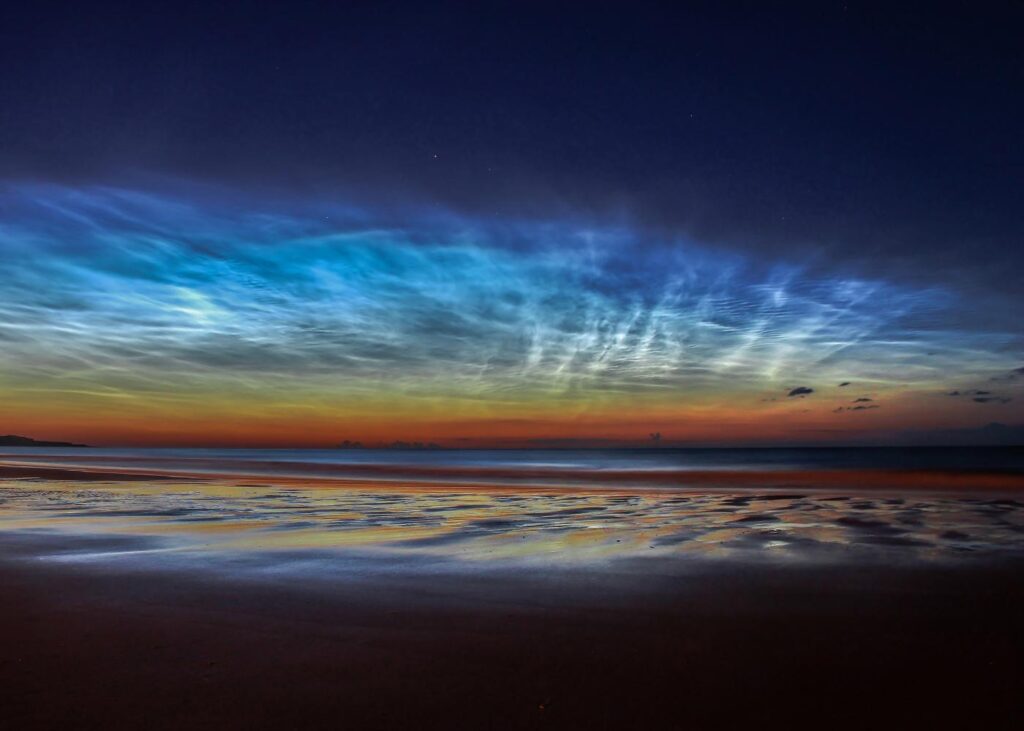
To spot them, look towards the horizon (northern or southern, depending on the hemisphere) about 30 minutes to an hour after sunset or before sunrise. They look like thin, wavy bands of silvery or electric blue color.
Noctilucent clouds vs. aurora borealis – differences
Noctilucent clouds are sometimes confused with other phenomena, such as the aurora borealis (aurora borealis). Here are the key differences:
- Noctilucent clouds: High-altitude clouds illuminated by the sun, looking like thin, silvery-blue bands.
- Aurora borealis: Colorful lights caused by solar particles, visible as green, red, or purple curtains.
Another similar phenomenon is iridescent clouds, which are located lower and have rainbow colors.
The science behind noctilucent clouds
Noctilucent clouds are not just beauty, but also an object of scientific research. Their frequency and brightness may increase in connection with climate change – a warmer troposphere cools the mesosphere, favoring their formation. They are also influenced by space weather, e.g., solar activity, which affects the upper layers of the atmosphere.
The science behind noctilucent clouds
Noctilucent clouds are not just beauty, but also an object of scientific research. Their frequency and brightness may increase in connection with climate change – a warmer troposphere cools the mesosphere, favoring their formation. They are also influenced by space weather, e.g., solar activity, which affects the upper layers of the atmosphere.
Historical observations of noctilucent clouds
Origin of the term “noctilucent clouds”
The term “noctilucent clouds” appeared in meteorological literature at the end of the 19th century, when researchers began systematically cataloging night sky phenomena. In the first reports, they were described as “noctilucent clouds,” which literally means “clouds shining at night.”
First historical reports
Observations in the 19th century
In the 19th century, meteorology underwent a rapid transformation: the introduction of the telegraph enabled rapid transmission of reports from different parts of the globe. Thanks to this, phenomena such as noctilucent clouds began to be recorded not only locally but also on an international scale.
Breakthrough reports from 1885
In 1885, observers in Scandinavia, and then in Central Europe, began reporting long, thin bands of bright light that persisted for up to an hour after sunset. These first, documented mentions initiated systematic research of the phenomenon.
Reports from the early 20th century
In the following decades, European and American meteorologists collected more and more data: cloud atlases from the 1920s and 1930s already contained diagrams and sketches that helped in identifying noctilucent clouds.
Major observations from 1956
The year 1956 is considered a breakthrough in the history of research – it was then, thanks to Soviet and American research stations, that the most spectacular formations were recorded, visible even at latitudes of 40°N.
Satellite reconnaissance and space research
Since the 1960s, the first meteorological satellites equipped with cameras and spectrometers capable of recording clouds in ultraviolet began to enter orbit. Projects such as NASA’s AIM (Aeronomy of Ice in the Mesosphere) provided precise data on the distribution of noctilucent clouds across the entire Earth.
Noctilucent clouds and climate change
Research has shown that the frequency and intensity of noctilucent clouds increase with climate change. This phenomenon is linked to an increase in water vapor in the upper layers of the atmosphere and changes in circulation in the mesosphere.
Latest discoveries and research projects {#najnowsze}
In recent years, the EUVE mission and further instruments on the ISS have allowed for even more precise tracking of the dynamics of noctilucent clouds, combining data from climate models and ground-based observations.
Significance for aviation and cosmonautics {#lotnictwo}
Noctilucent clouds, although high above air routes, provide information about the electrodynamic conditions of the upper layers, which is important for planning space missions and radio communication safety.
Aurora Borealis – Questions and Answers
When will the aurora be visible in Poland?
The aurora is usually visible in Poland when there is a strong geomagnetic storm combined with a solar flare of class M or X. The most probable periods are night hours from autumn to spring, especially when the sky is clear and bright.
Where in Poland is the best place to see the aurora?
The best places are areas with very little light pollution – e.g., northern voivodeships (Pomeranian, Warmia-Masuria), national parks, mountains. Avoid cities and street lights. The further north, the greater the chance.
How often does the aurora occur over Poland?
This phenomenon is rather rare in our latitudes; it happens during exceptional solar activity and geomagnetic storms. There may be several such nights per year, but a strong aurora is an event that happens once every few years.
How to check the aurora forecast?
Check geomagnetic forecasts (e.g., Kp index, NOAA reports), follow announcements from the Heliogeophysical Forecast Center CBK PAN or IMGW. Apps or websites like “aurora forecast” are also useful.
Can you see the aurora with the naked eye?
Yes, if conditions are good: dark sky, minimal artificial light, high intensity geomagnetic storm. The aurora can be spotted without binoculars or a telescope, but the colors will be less intense than in long-exposure photos.
How to photograph the aurora in Poland?
Use a tripod, wide-angle lens, set high ISO (e.g., 1600-3200), long exposure (10-30 s). It’s worth having a remote shutter release or delay to avoid vibrations. Shoot in RAW format to better process the photo later.
Why does the aurora rarely appear in southern Poland?
Because the auroral zone (i.e., the belt where auroras are more frequent) usually does not reach that far south. Only during very strong geomagnetic storms and favorable configuration of the Earth’s magnetic field can the aurora be visible further south.
What colors can the aurora have and what does it depend on?
Aurora colors depend on the type of gases in the atmosphere (e.g., oxygen – green, red; nitrogen – purple, blue) and on the altitude, composition of solar particles, and intensity of the flare. Shades of green often dominate.
What is the Kp index and how does it affect aurora visibility?
The Kp index is a measure of geomagnetic activity (scale from 0 to 9). The higher the Kp, the greater the probability that the aurora will be visible further from the magnetic poles, including in Poland. With Kp 5-7 and higher — greater chance.
Does the aurora harm people or devices?
Usually not – the aurora itself is not dangerous for people observing it from Earth. But very strong geomagnetic storms can affect satellites, communication systems, or power grids if protective systems are insufficient.
Where to see the aurora?
Most reliably in regions beyond the Arctic Circle: Norway (Tromsø, Lofoten), Iceland, Sweden (Abisko), Finland (Lapland), Alaska, or Canada.
When is the best time for the aurora?
From September to April, when nights are long and dark. Most observations occur around the equinoxes – March and September.
Aurora in Iceland – when to go?
From September to March. It’s best to go outside Reykjavik, to the northern and eastern regions, where the sky is darker.
Iceland round trip – aurora hunting
Aurora in Norway – best places
Tromsø, Alta, Lofoten islands, and Svalbard. In winter from 18:00 to 2:00 chances are highest.
Norway round trip Tromso / Senja – aurora hunting
What exactly is the aurora borealis?
It is a natural light phenomenon that occurs when solar wind particles collide with the Earth’s atmosphere, causing the sky to glow in shades of green, pink, purple, and red.
At what time does the aurora most often appear?
Usually between 21:00 and 3:00 at night, although it can also occur outside these hours.
Does the aurora appear every night?
No. It depends on solar activity and weather. Even in the “aurora season” there is no 100% guarantee of observation.
What colors can the aurora have?
Most often green, but also red, purple, pink, and blue, depending on the altitude and type of gases in the atmosphere.
Is the aurora visible to the naked eye?
Yes, although a camera can capture more colors than the human eye. The most intense auroras are clearly visible without equipment.
What is the aurora borealis?
It is a natural light phenomenon that occurs when solar wind particles collide with the Earth’s atmosphere and excite oxygen and nitrogen atoms to glow.
In which atmospheric layer does the aurora form?
The aurora forms mainly in the ionosphere, i.e., the upper part of the thermosphere, at altitudes from about 80 to even 500 km above the Earth’s surface.
What is the name of the atmospheric layer in which auroras form?
It is the thermosphere, more precisely its part called the ionosphere.
Does the aurora form in the mesosphere?
No. The mesosphere is located lower (50–85 km). Auroras begin only in the upper atmosphere – in the thermosphere (from about 80 km upwards).
Does the aurora appear today / aurora tonight?
It depends on solar activity. Current forecasts can be checked on services with Kp index measurements (e.g., 3–5 means good chances for visibility within the polar circle).
- aurora Iceland guide
- when to see the aurora
- aurora tips for tourists
- how to photograph the aurora
- best places for the aurora
MORE ARTICLES ABOUT ICELAND AND NORWAY





REZERWACJE
W tytule proszę podać wybraną wycieczkę
Islandia wycieczka , Polowanie na zorze polarna

Excerpt:
“`